

The short version
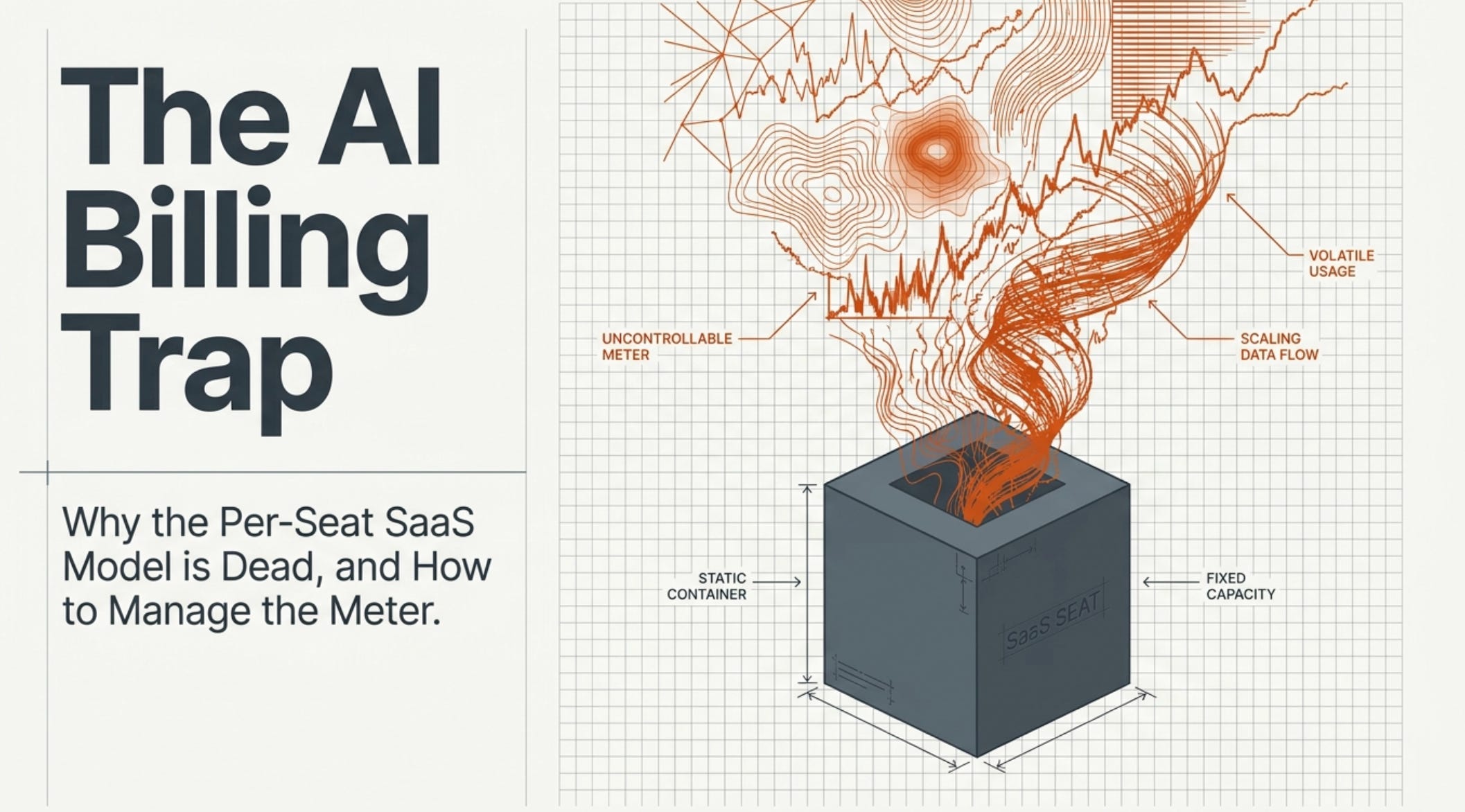
Anthropic, OpenAI, and Microsoft all charge for the seat and then meter the usage on top of it; at two of the three, the meter now reaches chat.
Agent work broke the seat’s assumption: a seat was priced for a person, and a person has ceilings an agent does not.
Two things break per-head budgets: adoption outruns the plan, and a few heavy users run up most of the bill. The average user runs 3 times as many conversations as the person in the middle.
Assign costs to departments and negotiate the billing terms, using the vendors’ own usage reports; billing a department means matching their users and groups to your org chart.
The part I like least: organizations rating themselves mature at cloud cost discipline overran AI budgets more often than beginners.
The seat is just the entry fee now
Anthropic’s billing page for the Claude Enterprise plan has a sentence that surprises everyone I show it to. The seat fee gives each person the Claude apps, plus Claude Code — and then: it “doesn’t include any usage.”
Every token your team consumes is billed separately, at the same rates developers pay on the API. (A token is the unit AI is metered in: a fragment of a word, roughly three-quarters of one. It is the kilowatt-hour of this bill.)
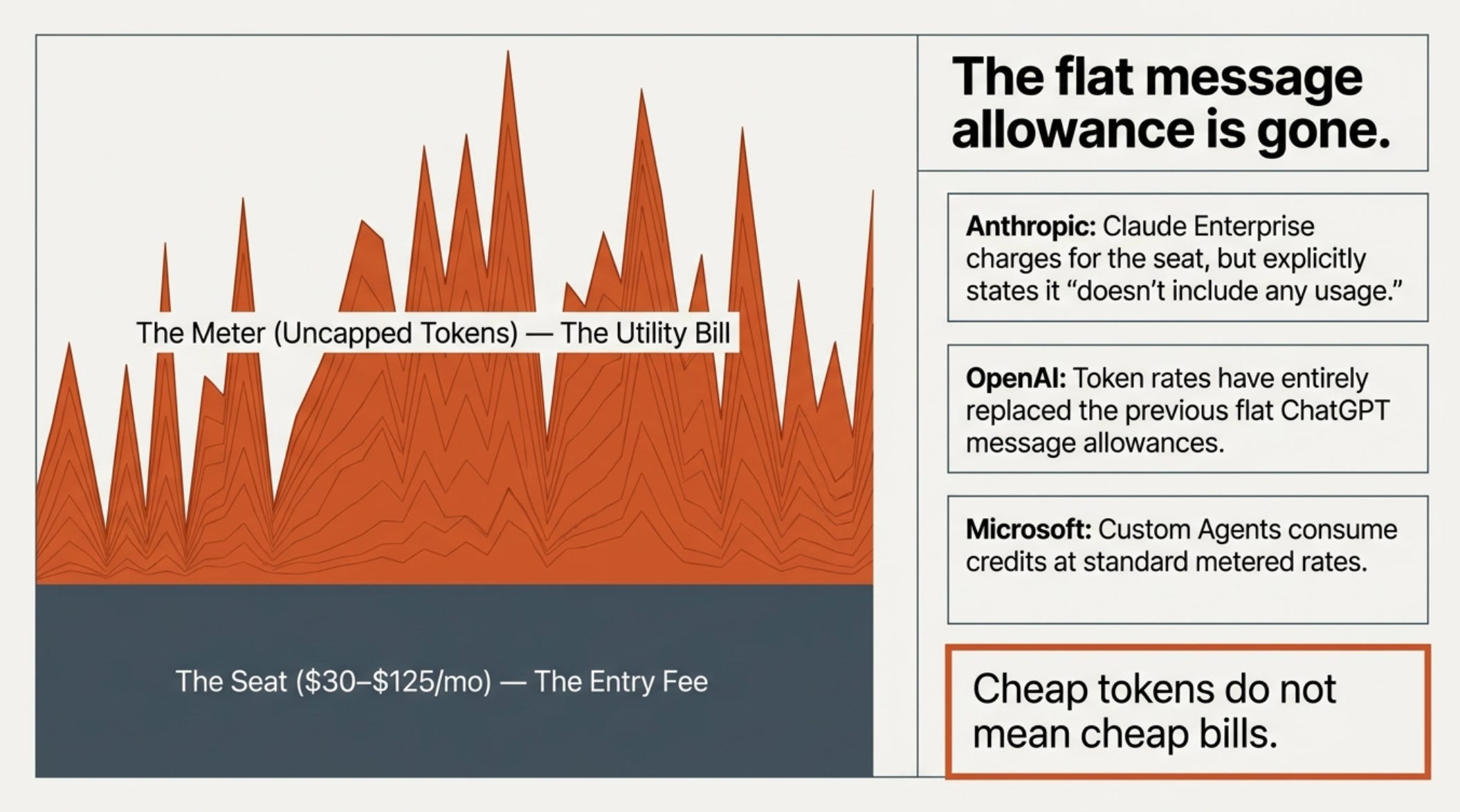
OpenAI’s Enterprise rate card says its token rates “replace ChatGPT message rates which were previously based on model and message count.” The flat message allowance is gone; chat now bills by model and token.
Microsoft, which reported 20 million paid Copilot seats in April, still covers ordinary Copilot answers under its $30-a-user seat. But Computer-Using Agents, the ones that operate software the way a person would, are excluded outright. An agent flow rides free only when an agent calls it for a signed-in licensed user; any other trigger consumes Copilot Credits at the standard rate.
Anthropic had an increase for Sonnet scheduled for September 1 and cancelled it; the introductory $2-in, $10-out price per million tokens is now, Anthropic says, simply the price.
Cheap tokens have never meant cheap bills, because you end up using so many more of them. In The Token Paradox I put numbers on it: per-token prices fell 280x while enterprise AI bills rose 480%, because a fraud case stopped being one prompt and became an agent making 10 to 20 calls to close it, each retrieval stuffing 3 to 5 times more text into the prompt than the question itself. Anthropic’s rate held this time. What changed at all 3 is how much of your work gets charged for.
The easy explanation is that the meter switches on when agents show up, and you can keep paying a flat fee for the ordinary stuff. That’s not what happened.
At Anthropic and OpenAI, plain chat gets billed by the token now too. Agents didn’t just add a new line to the bill — they broke the idea the seat was priced on in the first place.
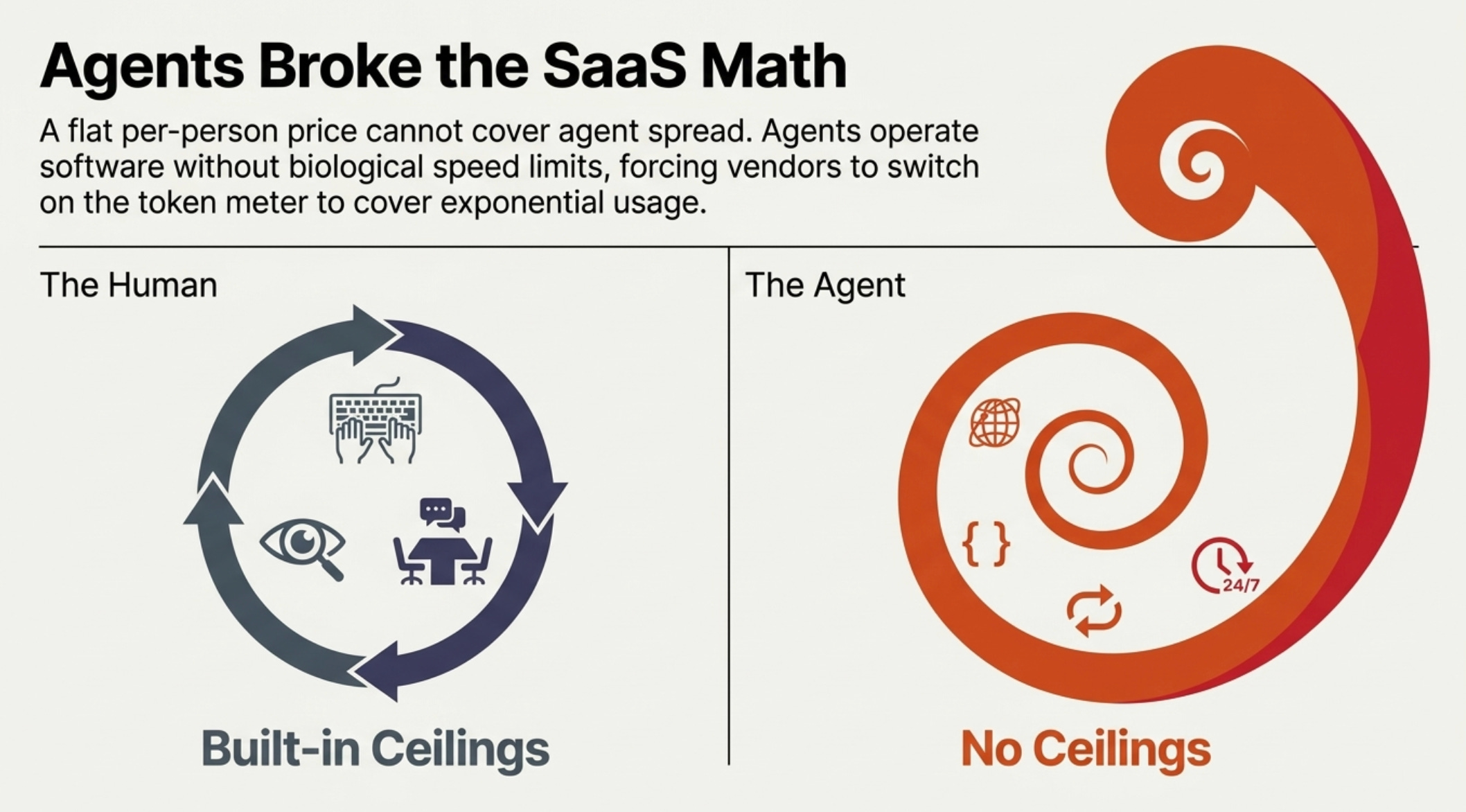
A seat was priced for a person typing into a chat box, and a person comes with built-in ceilings: they type slowly, they read what comes back, they go to meetings.
An agent has none of those. It browses, runs code, retries what fails, and keeps working after everyone has left. A flat per-person price cannot cover that spread, so the usage went onto the meter, chat included.
In March I argued per-seat pricing was dying. It didn’t die; it turned into an entry fee. The seat is now the fixed, predictable, almost boring bottom of the bill, and everything that is variable is above it.
This year the entry fee split into two. ChatGPT Business & Claude Team each added a premium seat and priced it, independently, at the identical number: $100 a month billed annually, $125 month-to-month, 5 times each plan’s standard allowance.
When 2 rivals pick the same price to the dollar, I think they are both aiming at the same person: the heavy user the flat seat never fit. That split into tiers, $100 one included, is what I sketched in May.
What a ChatGPT Enterprise seat costs is anyone’s guess. OpenAI has never put its own number on a public page, and I won’t repeat the figures going around.
One limit on what follows: this article is about the seats your employees sit in and the meter above them. What your developers build straight onto the models is a different bill, and I’ll take that up another time.
Three kinds of user, one price
Everything I’ve written about AI cost has modeled workloads: document processing, coding, fraud review. I had never modeled a person, and the meter above the seat is a per-person problem.
The best data I’ve found on what people actually do is Akamai’s 2026 enterprise AI report, built on browser traffic from LayerX, a security company Akamai bought: real employees using ChatGPT, Copilot, Gemini, and Claude inside real enterprises.
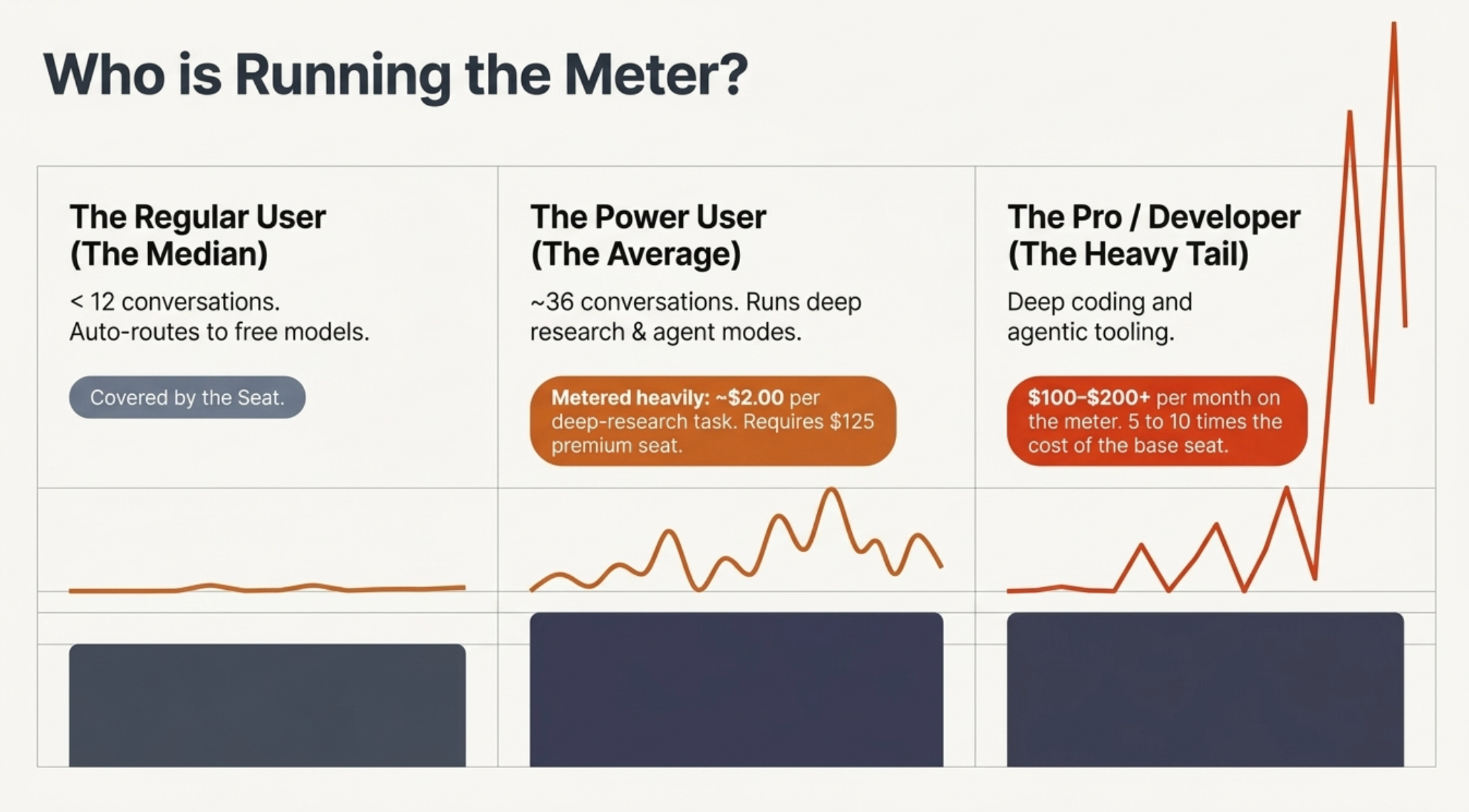
The regular user
12 conversations or fewer — the bottom half of everyone in the data
18% of employees touch AI tools even weekly
What the meter adds: close to nothing
Akamai’s chart labels the median user at 2 conversations; its own text says the bottom half run 12 or fewer. I’ll use 12, the number that works against me. Only 18% of employees touch AI tools even weekly.
For this person the meter barely turns: quick questions auto-route to small models OpenAI doesn’t charge for at all, the expensive features never get opened, and everyday chat sits under the seat on most plans (not on Claude Enterprise or ChatGPT Enterprise, where a dozen conversations bill by the token).
Most of your headcount is this person, which can make a pilot look inexpensive.
The power user
36 conversations of 5 prompts each — 3 times what the person in the middle ran
The heaviest 5% ran 144-plus conversations; the deepest 5% of conversations ran past 18 prompts
What the meter adds: about $2 a deep-research task, $1.20 an agent-mode message (my arithmetic)
The average user in the same data ran 36 conversations of 5 prompts each, 3 times what the person in the middle ran. The heaviest 5% of users ran 144-plus conversations, and the deepest 5% of conversations ran past 18 prompts.
Two things drive it. Adoption outruns the plan, because headcount climbs all year and the budget assumed the starting count. And most of the bill comes from a few heavy users, so an estimate built on the typical user comes in low.
What the power user does that the regular user doesn’t is run the metered features.
On OpenAI’s rate card a deep-research task is 50 credits and a message in agent mode is 30; my own cross-check of its 2 published cards puts a credit at 4 cents, which makes those about $2.00 a task and $1.20 a message (my arithmetic, not OpenAI’s).
The effort dial I wrote about in May still applies too: the same model on the same prompt can cost 10 times more depending on how hard it’s asked to think. 2 people with the same title on the same seat can differ by 10x in what they cost, with neither doing anything wrong.
The $125 premium seat exists for exactly this person.
The pro and the developer
$100 to $200 per developer per month, on OpenAI’s own rate card
Uber’s reported internal figures: $150 to $250 for the average engineer, $500 to $2,000 for the heaviest
What the meter adds: 5 to 10 times what the seat costs
The third person barely touches the chat box; their consumption runs through coding agents, and here the vendor will tell you the number. OpenAI’s own rate card: “On average, Codex costs approximately $100–$200 per developer per month.” Uber’s reported internal figures line up: $150 to $250 for the average engineer, $500 to $2,000 for the heaviest, per The Information; Uber hasn’t published its own numbers. Against a $20-to-$25 seat, the meter above a developer runs 5 to 10 times what the seat costs.
Around 5,000 of Uber’s engineers took up Claude Code, and by April the company had burned its full-year 2026 budget for AI coding tools (the reporting points at the coding-tools line, though not consistently). By June it had capped every employee at $1,500 a month per agentic coding tool. I’ll come back to what happened next — it’s the part that applies to everyone else.
Person What the seat covers What meters above it Regular (the median) Nearly everything they do Almost nothing Power (the average, ~3x the median) Everyday chat, within limits Deep research ~$2 a task, agent mode ~$1.20 a message (my arithmetic), long-input and fast-mode multipliers Pro / developer (the heavy tail) Access, little else $100–200 per developer per month, on OpenAI’s own card
No vendor gives you the report you want
The instinct at this point is to ask for the report: cost by department, by person, by use case. What the 3 vendors ship is narrower: consumption by user, group, service, or agent, depending on product.
Anthropic keys cost to an email address.
Microsoft’s Copilot cost console covers its agent platforms but not the $30 seat, and its per-user report counts prompts without attaching a single dollar.
OpenAI’s export even carries a self-reported department field.
What none of them attaches to a department is a dollar, so the mapping is yours.
Agents make the gap worse. Microsoft lets just one case go free: an agent doing the work for a signed-in, licensed person. Everything else costs you. Microsoft’s own sample agent handles orders at 20 credits each time it runs, with no one watching it. Send that bill to whoever asked for the agent.
For applications calling model APIs, the FinOps Foundation, the trade body for cloud cost management, recommends native attribution first, a gateway where needed to “inject tagging and allocation metadata that providers do not supply natively.” A gateway sits on API traffic, the bill this article set aside, not in front of the seats.
In its 2026 survey of nearly 1,200 practitioners, 98% now manage AI spend, up from 31% 2 years ago; the top challenges named are visibility, allocation to business units, and return; and the most-requested tool is fine-grained monitoring of AI spend.
4 things you can do about it
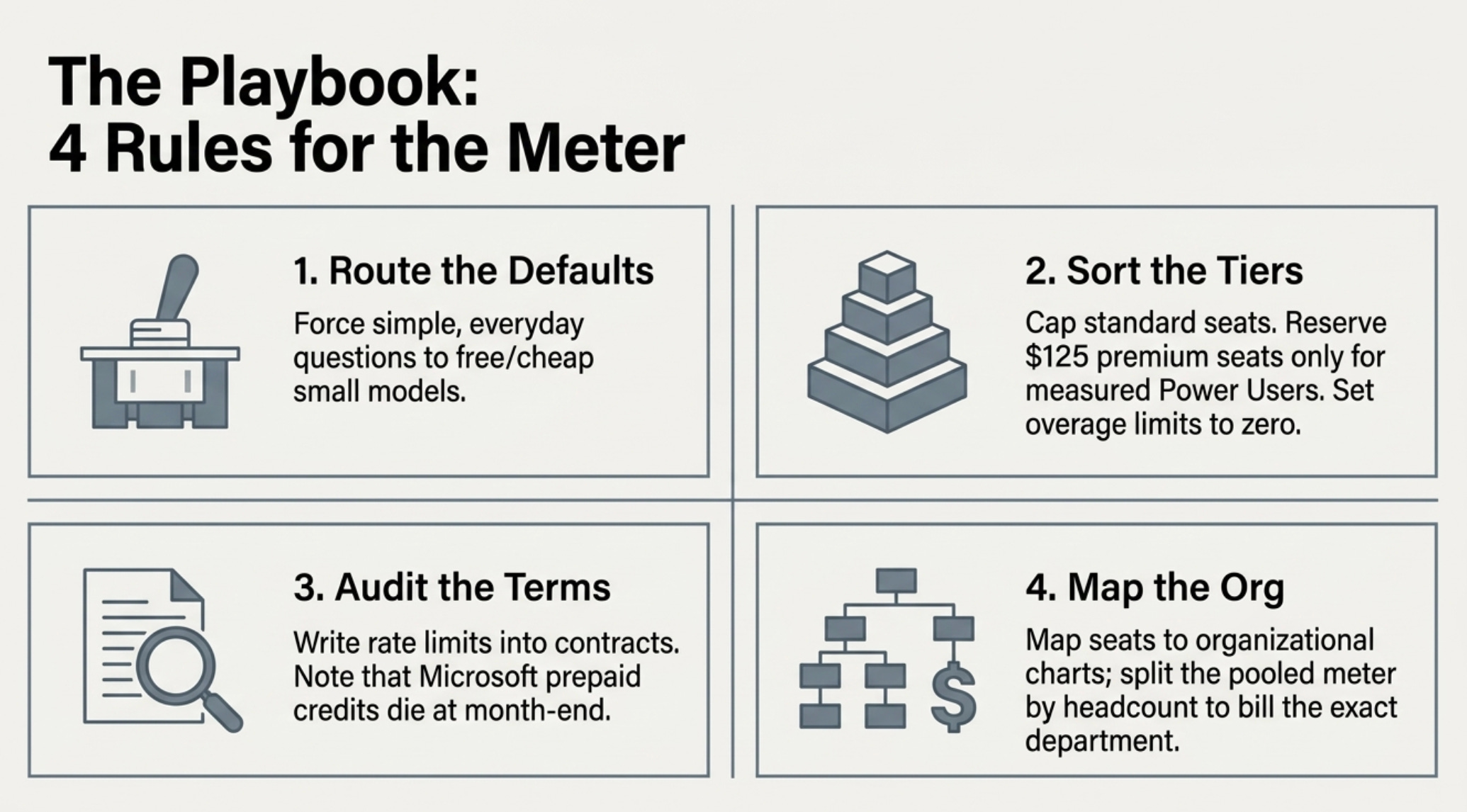
1. Decide which use cases get the best models
This is where I’d spend the management attention, because defaults do most of the governing: questions auto-routed to small models cost nothing. Who controls the model tier, and what an accepted outcome should cost, I’ve covered in the Michelin article. (Whether to run a model yourself instead is a separate question, and I’ve answered it.)
2. Use seat tiers to sort people
That 5x premium seat sorts them for you: give it to the people whose measured usage justifies it and leave the median on the standard seat. Anthropic returns each user’s estimated Claude Code cost, per day and per model, in cents, through a free admin interface; OpenAI shows Work and Codex credit usage in estimated dollars for eligible Enterprise workspaces.
On OpenAI, watch the defaults. You can cap credits by seat type and by user, but both start switched off, and if you leave the top-up limit blank it will keep buying more credits for you, forever. Turn them on, and on Enterprise set the overage limit to zero if you want it to stop dead. Microsoft cuts custom agents off at 125% of what you prepaid and can put a monthly ceiling on each one. Claude Team stops at 150 seats and ChatGPT Business at 200, but those just limit how many people you can add, not how much they can spend — for that you need an Enterprise plan.
3. Read the billing terms
They diverge more than the prices do. OpenAI bills every committed seat whether anyone occupies it and calls the unused ones generally non-refundable. Microsoft’s prepaid credits die at month-end with no rollover. Posted rates can change at any time, in either direction, which argues for writing them into the agreement rather than trusting the pricing page. Anthropic discloses, under its price table, that its newer models produce roughly 30% more tokens for the same text; at an unchanged rate that is a third more for the same work, though where the rate fell, as Sonnet 5’s did, it is not.
4. Bill the department that asked
I’d assign seats and premium tiers to named departments so the fixed layer follows the org chart, then split the pooled meter by an agreed key: headcount, seat count, measured share where a vendor gives you one.
It is imprecise and it works, with one catch: 47% of enterprise AI conversations in the Akamai data run on personal logins, not corporate accounts. Whatever you allocate, you are governing roughly the visible half.
Being good at cloud costs didn’t help
If the method were as available as I’ve made it sound, the organizations best at cost discipline would show the best results, and the data says the opposite. In a survey of 500 finance leaders (fielded in February, published in June), 79% said their organizations overran AI budgets in the past year. Among those rating themselves mature or leading-edge at FinOps, 89% overran, against 69% of the self-described beginners — and by more: a 30.9% average overspend against 16.1%.
Maybe it’s selection: mature organizations adopt harder and measure better, so more of their overruns exist and get seen. That is probably some of it, and the survey cannot separate it from the harder reading, which is that cloud cost discipline simply has not transferred to this layer yet.
I’d want to know what they actually had switched on.
Four months at Uber
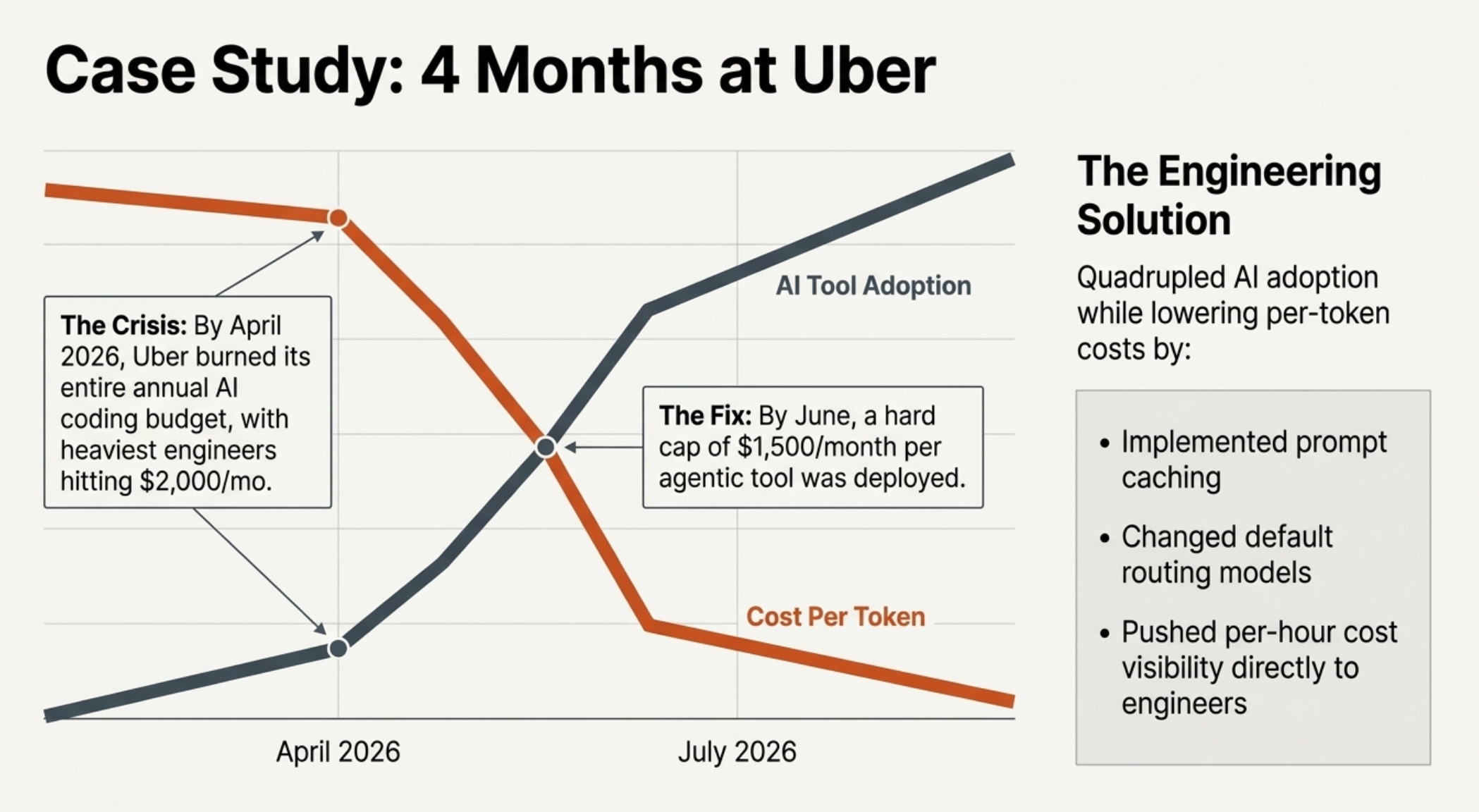
On August 7 Uber’s CTO posted, on his own X account, that Uber had quadrupled the number of employees on frontier AI tools while the cost per token came down: “not because we’ve restricted access, but because we’ve treated efficiency as an engineering problem rather than a budget problem.”
The levers he named sit on the list above:
prompt caching,
changed default models,
efficiency evaluations before new models roll out, and
per-hour cost visibility pushed down to the engineers using the tools.
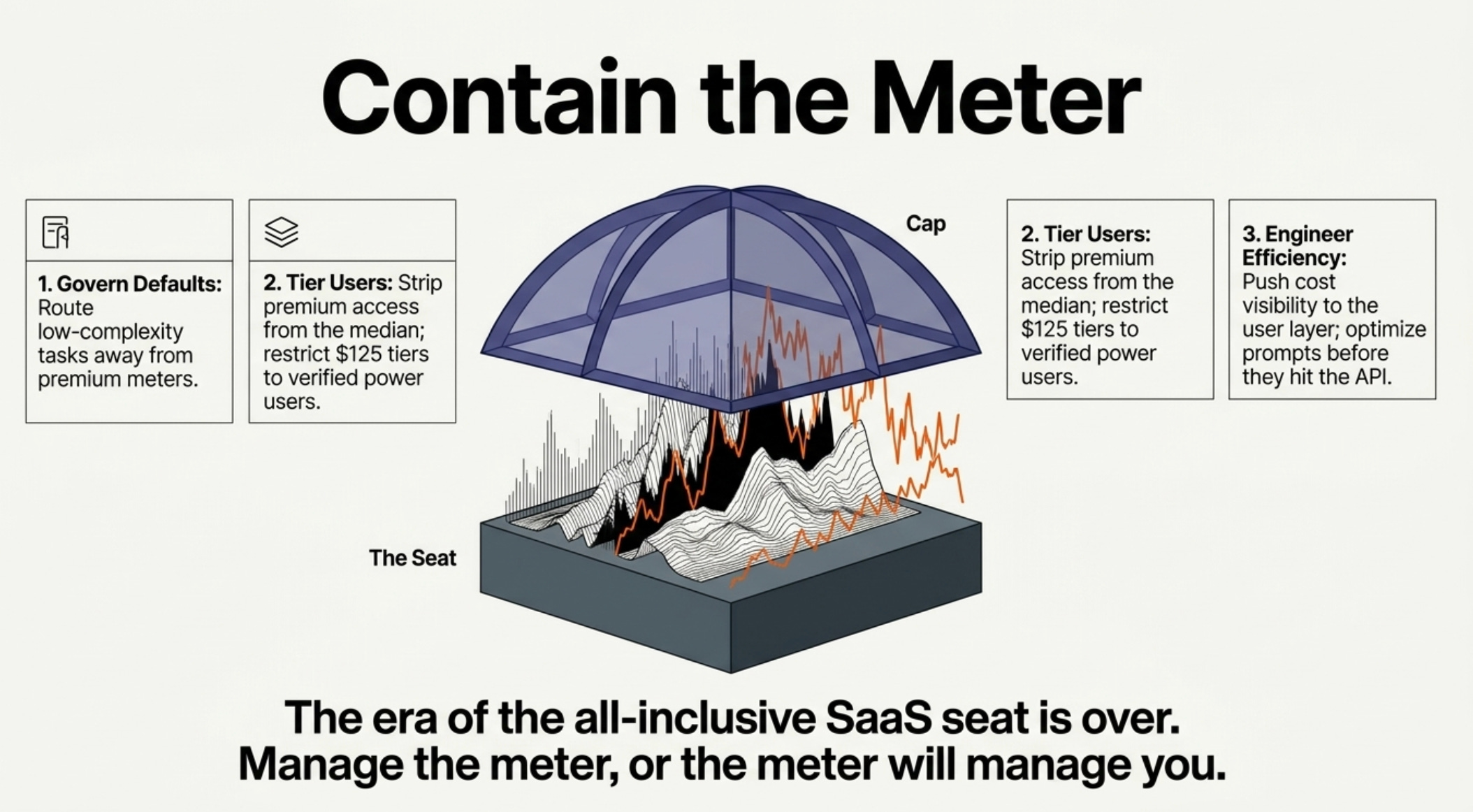
The June cap is a restriction on access; I read him as crediting the levers, not the ceiling. And Fortune notes he declined to say whether Uber was using more or less computing. What he says changed is how they worked: they cached prompts and changed which model answered by default.
Even the best public example of a company digging itself out never says the total bill went down.
What Uber’s 4 months show is somebody deciding: which work gets the best models, where the limits sit, what the contract says.
Sources
Anthropic — Enterprise plan billing: support.claude.com/en/articles/11526368
Anthropic — model pricing and the cancelled September 1 increase: platform.claude.com/docs/en/about-claude/pricing
Anthropic — Claude Code Analytics API: platform.claude.com/docs/en/manage-claude/claude-code-analytics-api
Anthropic — Team plan billing: support.claude.com/en/articles/9267289
Anthropic — plans and premium seat: claude.com/pricing
OpenAI — Enterprise token rate card: help.openai.com/en/articles/20001415
OpenAI — Business/Enterprise/Edu rate card (credits): help.openai.com/en/articles/11481834
OpenAI — credits and spend controls: help.openai.com/en/articles/20001155
OpenAI — overage limits: help.openai.com/en/articles/11487671
OpenAI — billing and seats: help.openai.com/en/articles/8792536
OpenAI — workspace analytics and user export (department field): help.openai.com/en/articles/10875114
OpenAI — business pricing and premium seat: openai.com/business/pricing
Microsoft — Copilot Studio message and credit management: learn.microsoft.com/en-us/microsoft-copilot-studio/requirements-messages-management
Microsoft — usage-based billing for Copilot Credits: learn.microsoft.com/en-us/microsoft-365/copilot/usage-based-billing-overview-copilot-credits
Microsoft — M365 Copilot usage report: learn.microsoft.com/en-us/microsoft-365/admin/activity-reports/microsoft-365-copilot-usage
Microsoft — M365 Copilot enterprise pricing: microsoft.com/en-us/microsoft-365-copilot/pricing/enterprise
Microsoft — FY26 Q3 earnings call, April 29, 2026 (20M paid Copilot seats): microsoft.com/en-us/investor
Akamai — State of the Internet V12 Issue 04, Enterprise AI Usage Risk Report 2026 (LayerX telemetry): akamai.com/site/en/documents/state-of-the-internet/2026/enterprise-ai-risk-report.pdf
DoiT / Sapio Research — AI spending survey, 500 finance leaders, published June 9, 2026: doit.com/blog/ai-spending-survey
FinOps Foundation — Tokenomics working group (updated June 3, 2026): finops.org/wg/token-economics-saas
FinOps Foundation — State of FinOps 2026: data.finops.org
Fortune — Uber CTO first-party X post, August 7, 2026: fortune.com/2026/08/07/uber-ai-spending-tokenmaxxing-is-over-cto/
TechCrunch (citing Bloomberg) — Uber’s $1,500 monthly cap, June 2, 2026
The Information — Uber CTO interview, April 2026, attribution confirmed via downstream outlets
How this article was made: the thesis and structure are mine. A research pipeline I run pulled the pricing pages, reports, and datelines above, and every claim that carries weight traces to one of them; figures labelled “my arithmetic” are derived, not vendor-published. I edit the final text by hand.