

The short version
Token prices keep falling, and companies keep using more tokens anyway. Agents working in swarms are part of why.
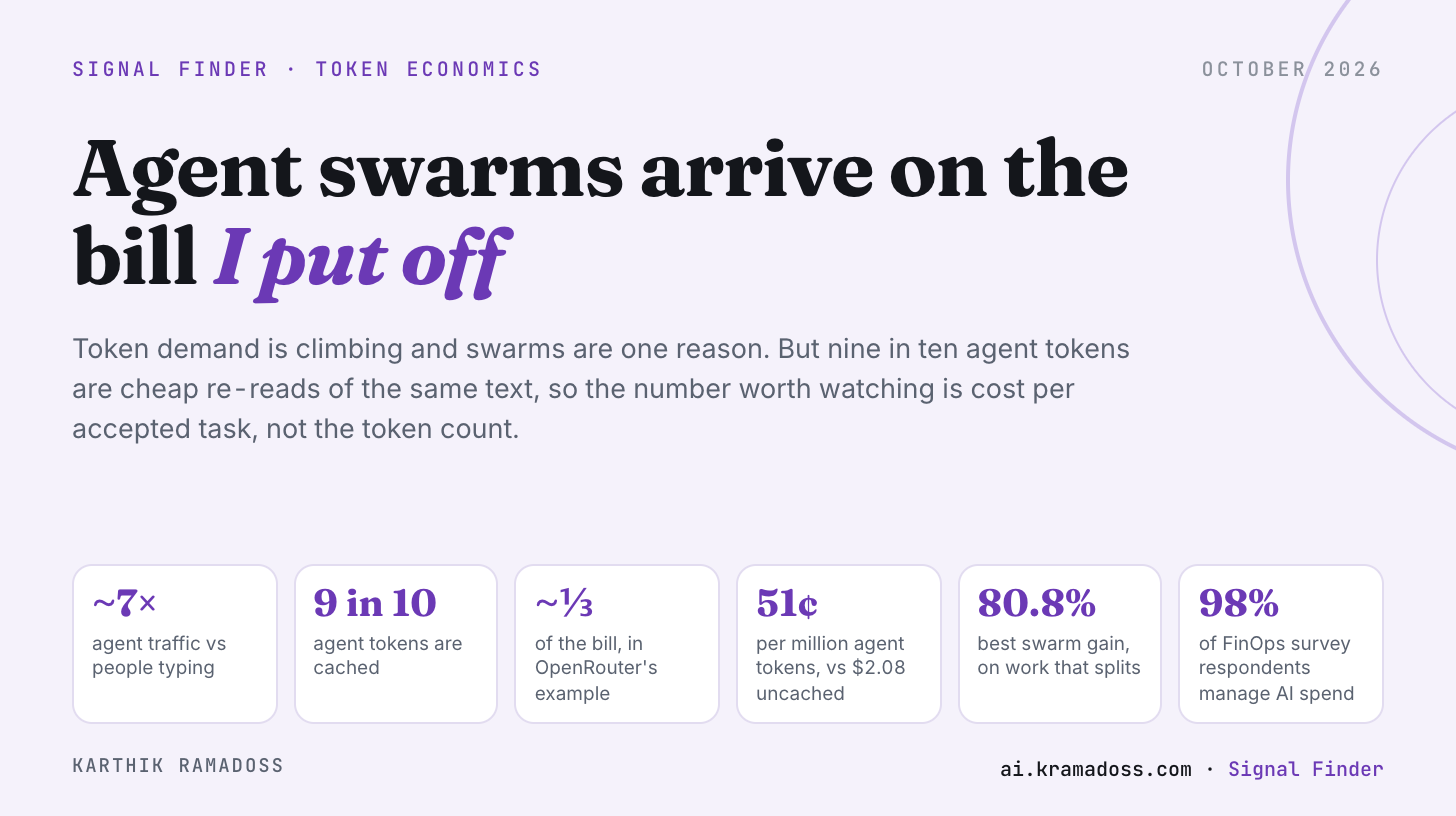
What surprised me: nearly nine in ten agent tokens are cached re-reads, about a third of the bill in OpenRouter’s example.
At matched budgets, swarms help on work that splits into pieces and hurt on work that runs in sequence. Mostly you’re buying coverage.
Monday: pull cost per accepted task and the cache-hit rate for each agent workload. Well under OpenRouter’s 85 percent median? Ask why.
The sentence I wrote in September
Back in September, in the article on enterprise seats, I tucked one line into italics and moved on: what developers build straight onto the models is a different bill, and I’d take it up another time.
This is me taking it up.
What pulled me back was a newsletter from OpenRouter, the marketplace that routes requests to dozens of models and publishes what flows through it.
The October 8 edition says agents passed humans in token volume on February 6. By the last week of September, traffic from agents was running about 7 times the traffic from people typing prompts.
(Quick definition, if you haven’t had to budget for one yet: a token is the unit the model bills by, roughly three quarters of a word going in and the same coming out.)
The same newsletter has a 2nd number, and that one is why I’m writing this instead of making a slide. Nearly 9 in 10 of those agent tokens were cached prompt tokens, and in its worked example they made up only about a third of the bill.
Where I started
Here is what I believed going in, and still mostly do.
I do think agent swarms are transformative. But even though the token price is going down, the token demand is going up, and agent swarms are one of the reasons.
By swarm I mean many agents working one problem at the same time and talking to each other.
The demand side is easy to see.
Google said at I/O that the tokens it processes across its products each month went from 9.7 trillion in May 2024 to more than 3.2 quadrillion in May 2026, a rise of more than 300 times. Its model APIs, the doors developers use, ran at about 22 billion tokens a minute in the second quarter, up from 16 billion a quarter earlier.
OpenRouter’s weekly volume went from half a trillion tokens in January 2025 to 128 trillion by mid-September 2026, roughly 250 times in 20 months.
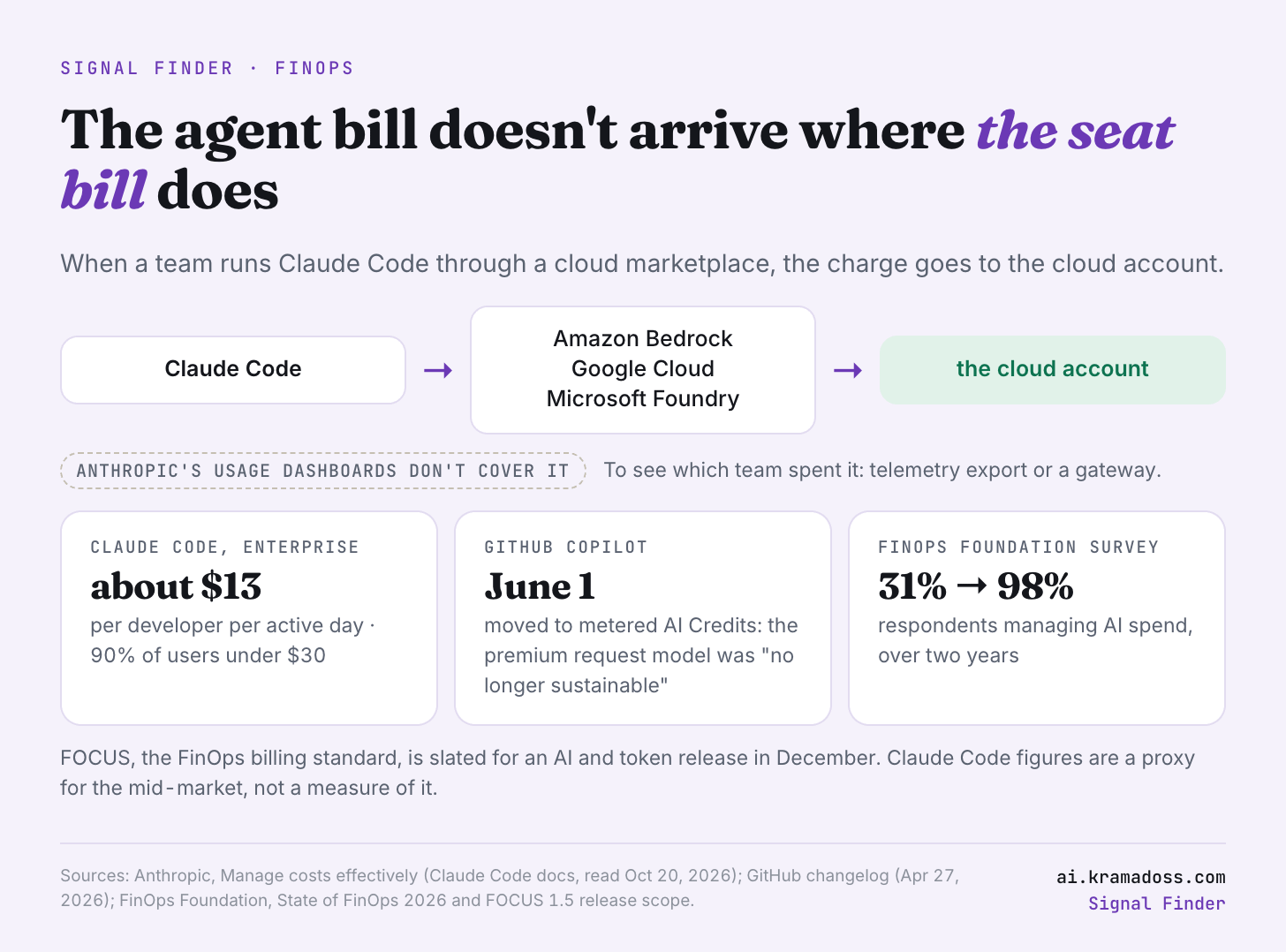
One caveat before you forward any of this: it’s platform and cloud data, mostly American. I don’t have equivalent numbers for China, India or the Gulf, so please don’t read it as a global curve.
Meanwhile the price fell just as steeply.
Epoch AI’s newest estimate is that the cost of a fixed level of model performance has fallen about 47 percent a quarter since 2023, which works out to something like 13 times a year.
The version you’ll read everywhere else
You’ll see Gartner’s version of this story a lot.
Gartner calls it the Inference Paradox: the price of a token falls, and AI inference costs rise more than fivefold through 2028 because each generation of capability needs more tokens, and often dearer ones. I made the same argument in April, and I still think the direction is right. To be fair to Gartner, it forecasts costs, not token counts, so caching may already be in its number.
What I didn’t see in April is that the token count has stopped being a good stand-in for the bill. The reason is caching. When an agent works a long task, it re-sends the same instructions, the same documents and the same tool descriptions at every step. The model providers now keep that repeated text on hand and charge a fraction to read it back. That read-back is a cache hit.
OpenRouter’s worked example, at Sonnet 5 list prices, splits a million agent tokens 87 percent cached, 12 percent fresh input and 1 percent output: about 51 cents before cache-write premiums, against $2.08 with no caching. The median provider’s cache rate on agent prompts went from 44 percent in January to 85 percent in September. On Anthropic’s own price list a cache hit on Opus 5.5 or Sonnet 5.5 costs one twentieth of a fresh token, and on Fable 5.1 one fortieth.
Put another way, an agent bill is a thin slice of expensive fresh input, a sliver of pricier output, and a big slab of cheap re-reads.
Multiply tokens by the list price and you overstate it. So when someone shows me a chart of agent tokens climbing, my first question is what the dollars did, and the chart can’t tell me the full story without looking at the cache hit %.
One more wrinkle: prices are moving in both directions, depending on the model. Haiku 5.5 lists at $0.10 a million tokens in for prompts up to 100,000 tokens, a tenth of Haiku 4.5, while Fable 5.1 lists at two and a half times Opus 5.5.
If your budget assumes “tokens get cheaper,” that holds for the models most of the work will drift towards, not for the ones your hardest tasks will want.
You’ll hear the Jevons paradox story too: cheaper tokens make people burn so many more that spend goes up. In the short run it’s weaker than it sounds. Demirer and colleagues (researchers at MIT, Boston University and Microsoft Research — cited for measuring how token demand responds to price cuts) measured how much demand moves when the price does and found the response just above one.
In plain terms, a 10 percent price cut pulls in only a little more than 10 percent more demand. They read that as going against Jevons in the short run, without ruling out a longer-run effect. My read is that new kinds of work drive more of the rise than old work made cheaper, though the price studies can’t say how much.
Agents, and swarms of them, are that new work.
What does a swarm buy you?
In June I wrote that the choice between one agent and many depends on whether the task splits into pieces. Since then the research has put numbers on that rule, and found its limit.
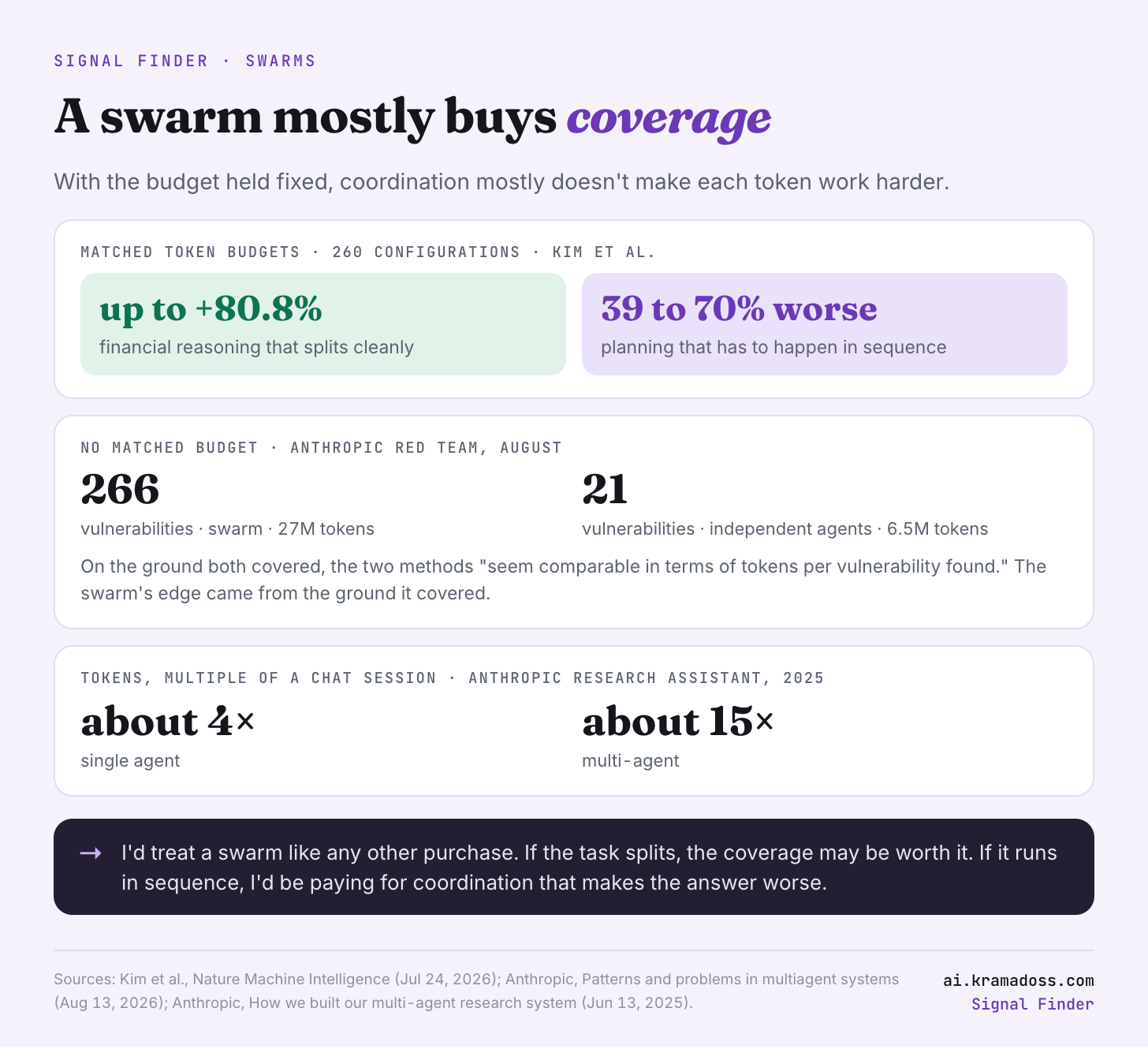
Kim and colleagues (researchers at Google Research, Google DeepMind and MIT — cited for the matched-budget test of single versus multi-agent setups) ran 260 configurations at matched token budgets, meaning every setup got the same token allowance, and published in Nature Machine Intelligence in July. On financial reasoning that splits cleanly, a team of agents beat a single one by up to 80.8 percent. On planning that has to happen in sequence, teams did 39 to 70 percent worse. The gain shrank as the single agent got stronger, and the cost of coordinating grew faster than the number of agents.
Anthropic’s red team tried the other kind of test in August, with no matched budget. A coordinated swarm hunting for vulnerabilities in code found 266 of them using 27 million tokens, where independent agents found 21 using 6.5 million. On the ground both covered, the two methods “seem comparable in terms of tokens per vulnerability found.” Overall the swarm used fewer tokens per bug, and the difference came from the ground it covered. And for the same lab’s research assistant in 2025, multi-agent runs used about 15 times the tokens of a chat session, against about four for a single agent.
That’s the piece I was missing in June. With the budget held fixed, coordination mostly doesn’t make each token work harder. Once you let the budget grow, the question becomes whether the extra coverage, speed or quality is worth paying for.
The biggest public swarm I found this month points the same way.
Prime Intellect, which sells compute, reports that its rewrite of a codebase in Rust ran 2,209 agents over a little more than two weeks, consumed about 228.7 billion tokens, and passed 16,758 messages between agents. The post doesn’t say what it cost, and I’m not going to guess. In Aaron Levie’s case, posted on October 18, is that work today is limited by how well people can plan, run, review and coordinate it, and that swarms lift the limit, so in theory compute becomes the only input that matters.
That in theory is the part I’d hold on to.
Here’s a gap I couldn’t close. I couldn’t find anyone, not a lab, not a cloud, not OpenRouter, who publishes what share of agent tokens comes from swarms as opposed to single agents running long.
“Swarms are one of the reasons demand is up” is an argument I believe. It isn’t a number I can show you.
The bill the usage dashboards miss
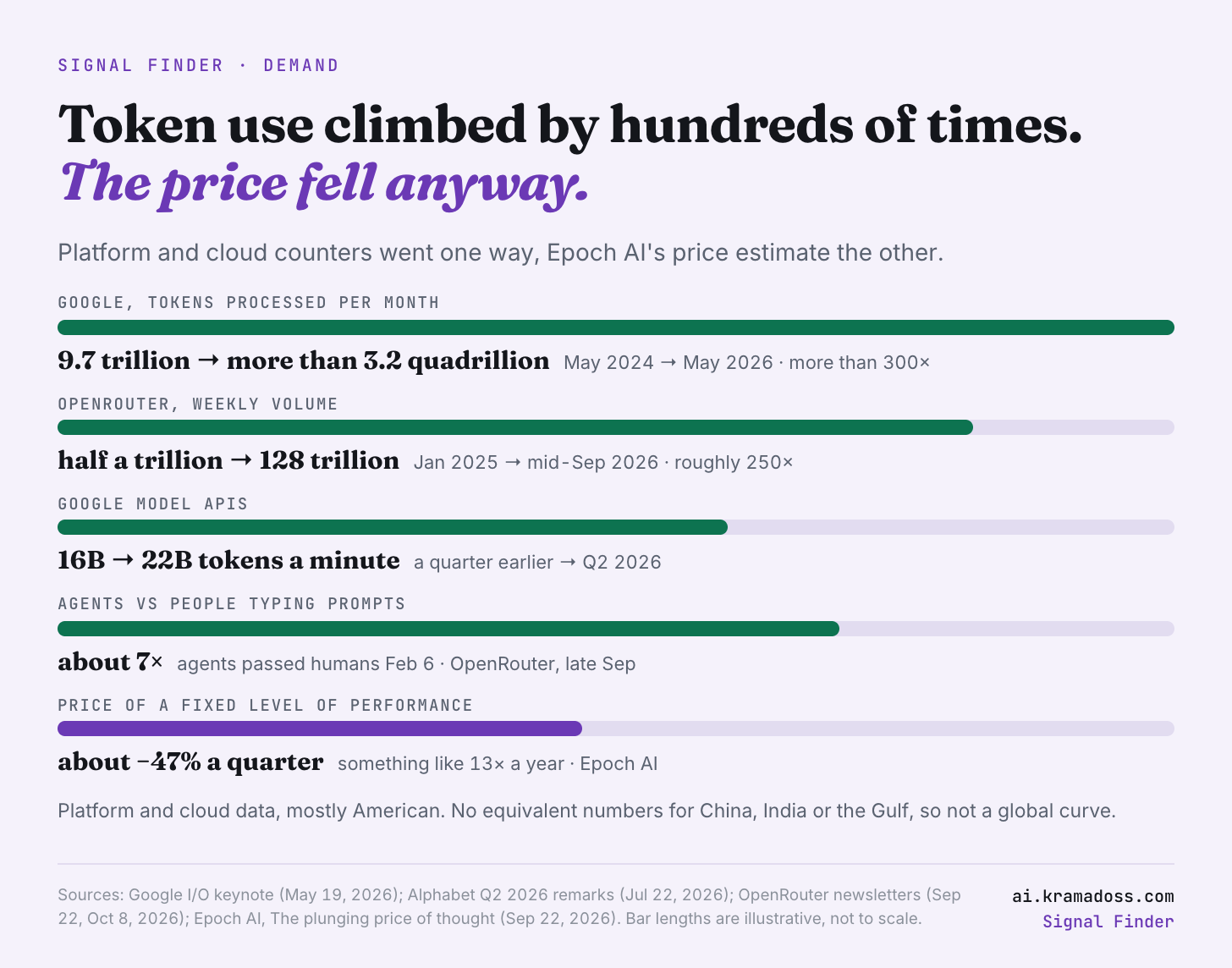
If you run FinOps, the team that grew up managing cloud spend and is now being handed AI spend too, this bill mostly won’t show up where the seat bill does. When a team runs Claude Code through Amazon’s Bedrock, Google Cloud or Microsoft’s Foundry, the charge goes to the cloud account, and Anthropic’s own usage dashboards don’t cover it.
To see which team spent it, you need telemetry export or a gateway.
I expected the scale to be easy to pin down. It wasn’t.
Anthropic’s published figure for Claude Code is about $13 per developer per active day across enterprise deployments, with 90 percent of users under $30.
OpenAI’s European report measures adoption instead: in EU businesses with 200 or fewer associated users, weekly agent users grew 8.1 times between May and early October.
Neither one is the mid-market itself. They’re stand-ins, so I’ll call them proxies every time I use them.
The vendors are already adjusting. GitHub moved Copilot to metered AI Credits on June 1 because, in its own words, the premium request model was “no longer sustainable”.
The FinOps Foundation’s 2026 survey has 98 percent of respondents managing AI spend, up from 31 percent two years ago, and its billing standard FOCUS is slated to get an AI and token release in December.
What I would do on Monday
If I were walking in Monday, I’d pull two numbers for every agent workload:
cost per accepted task, and
the cache-hit rate.
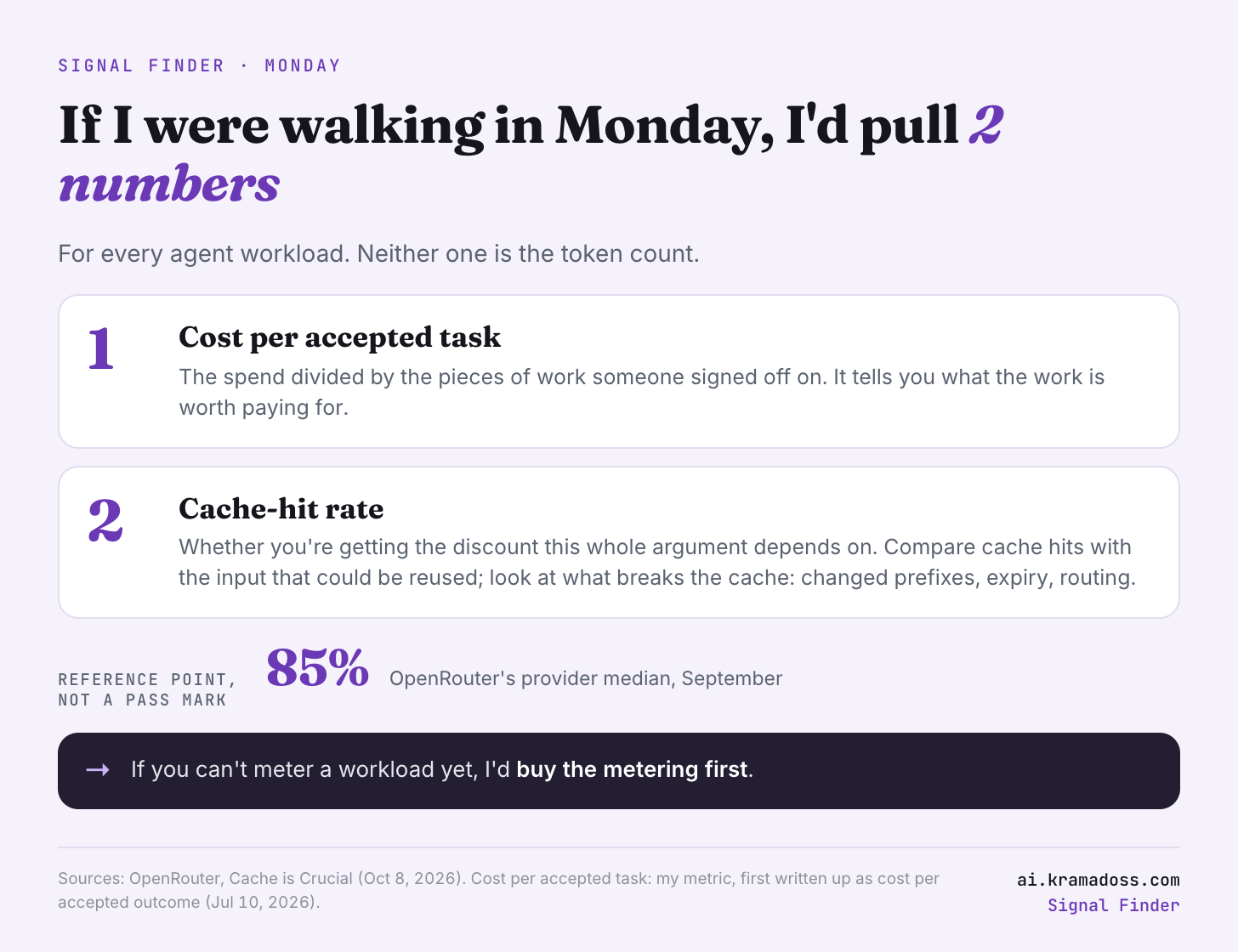
Cost per accepted task, which I called cost per accepted outcome in July, is the spend divided by the pieces of work someone signed off on. It tells you what the work is worth paying for.
The cache-hit rate tells you whether you’re getting the discount this whole argument depends on. If a workload re-sends a lot of context, compare its cache hits with the input it could reuse, and look at what breaks the cache: changed prefixes, expiry, routing.
OpenRouter’s 85 percent provider median is a reference point for that, not a pass mark. And if you can’t meter a workload yet, buy the metering first.
I’d treat a swarm like any other purchase. If the task splits, the coverage may be worth it. If it runs in sequence, the research I found says you’d be paying for coordination that makes the answer worse.
One limit on all of this: I’ve only looked at API, coding and platform bills. The agent meters inside Salesforce, ServiceNow and SAP are a different unit, and I haven’t looked at them here.
References:
OpenRouter, Cache is Crucial (Oct 8, 2026) and The Token State of Play (Sep 22, 2026): https://openrouter.ai/data/newsletter/cache-is-crucial
Google, Sundar Pichai’s I/O keynote (May 19, 2026) and Q2 2026 earnings remarks (Jul 22, 2026): https://blog.google/company-news/inside-google/message-ceo/alphabet-earnings-q2-2026/
Epoch AI, The plunging price of thought (Sep 22, 2026): https://epoch.ai/publications/the-plunging-price-of-thought
CIO Dive on Gartner, Advances in AI capabilities to outpace cost savings (Aug 17, 2026): https://www.ciodive.com/news/ai-systems-outpace-cost-savings/828068/
Anthropic, pricing and Claude Code cost docs (read 2026-10-20), Patterns and problems in multiagent systems (Aug 13, 2026), How we built our multi-agent research system (Jun 13, 2025): https://www.anthropic.com/research/multiagent-systems
Demirer, Fradkin, Tadelis and Peng, The Emerging Market for Intelligence (NBER Working Paper 34608, December 2025): https://www.nber.org/papers/w34608
Kim et al., Capable language models can outgrow the benefits of collaboration (Nature Machine Intelligence, Jul 24, 2026): https://doi.org/10.1038/s42256-026-01268-y
Prime Intellect, Rewriting Prime Agent in Rust (Oct 9, 2026): https://www.primeintellect.ai/blog/prime-agent-rust
Aaron Levie on X (Oct 18, 2026):

OpenAI, Europe’s Agentic Opportunity (October 2026): https://cdn.openai.com/pdf/europes-agentic-opportunity.pdf
GitHub, GitHub Copilot is moving to usage-based billing (Apr 27, 2026): https://github.blog/changelog/2026/04/27/github-copilot-is-moving-to-usage-based-billing/
FinOps Foundation, State of FinOps 2026 and FOCUS 1.5 Release Scope (read 2026-10-20): https://focus.finops.org/focus-1-5-release-scope/