


I publish esoteric science-y topics in this Science Sundays Series about a topic I am learning and about once a month. Check out previous posts linked at the bottom of this article!
What actually went up on October 1?
One satellite.
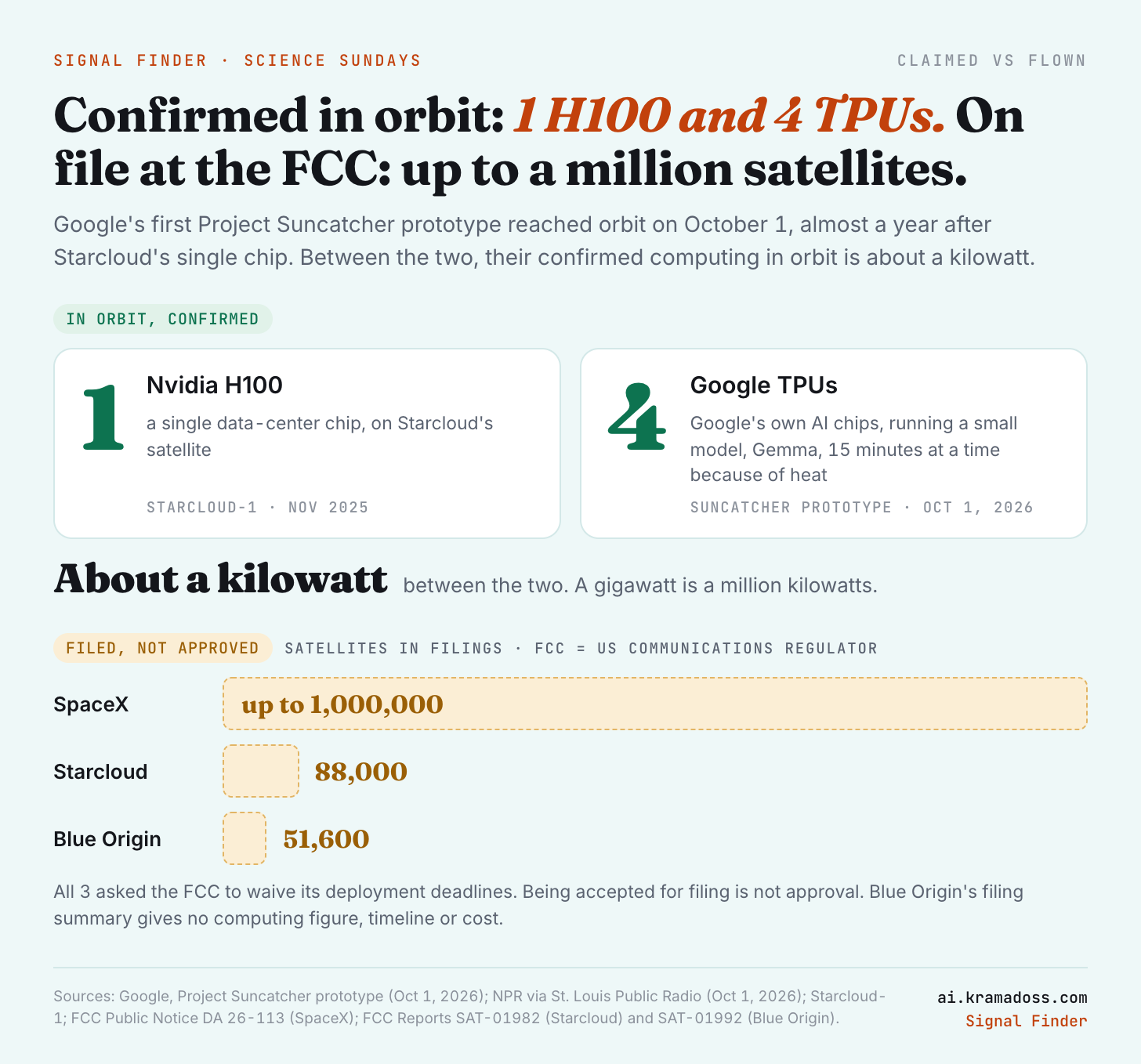
Google announced on October 1 that its first Project Suncatcher prototype was in orbit and “operating as expected”, after riding up on a SpaceX rideshare flight. NPR reported the same day what is on it: 4 of Google’s TPU chips, the processors it builds for its own AI work, running a small model called Gemma. NPR also reported that Gemma runs for 15 minutes at a time because of heat.
Travis Beals, who leads the project at Google, called it “a very minimal test”. He also told NPR: “I don’t see this being something where it’s cheaper to do this in the next five years. I think it will take longer than that.”
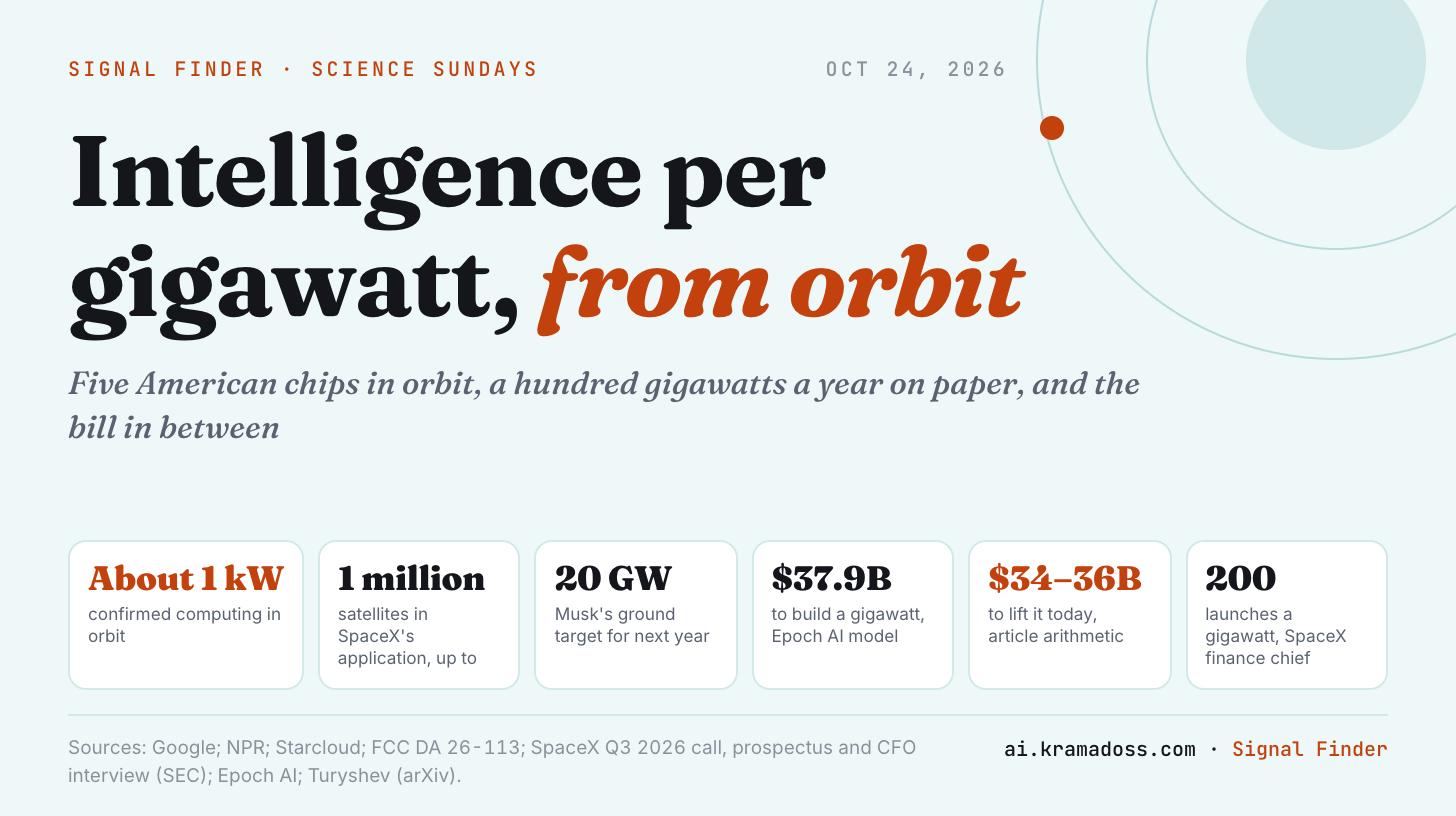
Almost a year earlier, in November 2025, a startup called Starcloud had put one Nvidia H100, a single data-center chip, on a satellite. Between the two, their confirmed computing in orbit is about a kilowatt. A gigawatt is a million kilowatts.
What did Musk actually say?
The 20 gigawatts attached to Musk’s space plans is 3 different numbers folded into one.
The 20 is real, and it is on the ground. On SpaceX’s third-quarter call on October 20, Musk said the company would “aim for an incremental 20 gigawatts” of power, cooling and infrastructure next year. That is power and cooling for its own AI data centers, not satellites. He hedged it in the same breath: “20 is difficult but not impossible.”
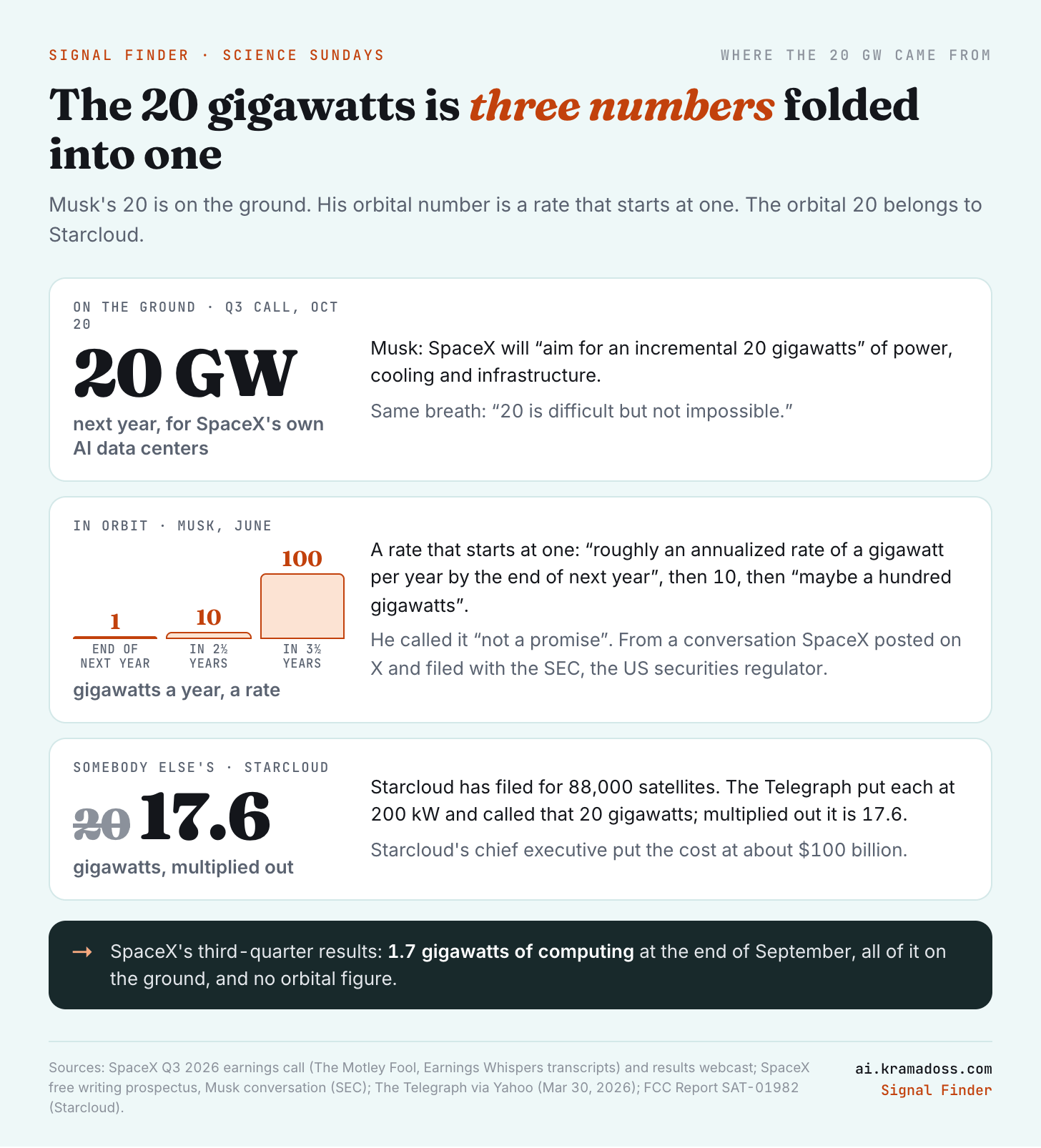
The space number is a rate, and it starts at one. In a conversation SpaceX posted on X in June and filed with the SEC, Musk described “roughly an annualized rate of a gigawatt per year by the end of next year” for AI computing in space, rising to 10 gigawatts a year in 2 and a half years and “maybe a hundred gigawatts” in 3 and a half.
He called it “not a promise”.
The 20-gigawatt orbital figure belongs to somebody else. Starcloud has filed for 88,000 satellites. The Telegraph, putting each at 200 kW, called that 20 gigawatts; multiplied out it is 17.6. Starcloud’s chief executive put the cost at about $100 billion.
SpaceX’s prospectus from June says the company expects “to begin deploying our orbital AI compute satellites as early as 2028”, with a long-term goal of 100 gigawatts launched per year. Its chief financial officer, in an interview filed the same week: “In 2028, we’ll start flying if we stay on target… in 2029, we’ll have meaningful amounts of compute in space.” He also said SpaceX could fly “pieces of these orbital compute satellites” as soon as 2027.
The risk section of that prospectus says its growth bets, orbital compute included, “may not achieve commercial viability”, that the 100-gigawatt timeline “may be difficult or impossible to determine”, and that at scale SpaceX will “need full Starship reusability to be economically compelling”.
SpaceX’s third-quarter results report 1.7 gigawatts of computing at the end of September, all of it on the ground, and no orbital figure at all.
Starship’s first orbital flight was in that same quarter.
Google’s plan is a research prototype, 2 more next year, and its project lead saying not cheaper within 5 years.
Amazon has announced no orbital data-center programme. It filed to block SpaceX’s plan at the FCC, calling it, according to Via Satellite, “a lofty ambition rather than a real plan”. Amazon competes with SpaceX in satellites, so read that as a rival’s view.
Blue Origin, Bezos’s rocket company, asked the FCC in March for up to 51,600 satellites “to operate as a data center in space”, with no computing figure, timeline or cost in the filing summary.
Count the filings against the hardware.
SpaceX’s application covers up to a million satellites.
Starcloud’s covers 88,000,
Blue Origin’s 51,600.
All 3 asked the FCC to waive its deployment deadlines, and being accepted for filing is not approval.
Confirmed in orbit from the companies here: 1 H100 and 4 TPUs.
Is power really running out?
The power shortage is real, with one complication.
PJM runs the grid for a large region of the eastern US. Its auction for 2027–28 came in 6,623 megawatts short of its reliability requirement, the first time the whole region fell short. Nearly 5,100 of the roughly 5,250 megawatts of forecast load growth is data centers.
A PJM executive, Bresler, put it plainly: “data centers’ demand for electricity continues to far outstrip new supply.”
The machines that make power are backed up too. GE Vernova, which builds gas turbines, reported in July that it had 116 gigawatts of turbines on order or reserved, against output of 20 gigawatts a year, rising to 24 in 2028.
Do the sum and that is 5 to 6 years of production already spoken for. The IEA says new transmission lines take 4 to 8 years in advanced economies and that around 20% of planned data centre projects could face delays.
A lot of the queue is paper.
Texas’s grid operator has 445.8 gigawatts of large-load applications on file; 5.9 gigawatts is actually switched on.
And power is not the only shortage. Jensen Huang said on Nvidia’s August call, “at this moment, we have supply for 70%” of the demand for its chips. The IEA said in April that the shortage of the memory stacked next to those chips runs through at least the end of 2027. Both are holding things up, and orbit only answers one of them.
Intelligence is being measured in gigawatts now, intelligence per gigawatt. The industry talks the same way. Huang’s version on the August call: “the perfect answer is actually infinity per gigawatt.”
Nadella’s: “The key metric we are optimizing for is tokens per watt per dollar.”
What does a gigawatt cost on the ground?
The ground half has answers, with owners attached. The orbit half has Forethought’s model and one pitch: Starcloud’s $100 billion for 88,000 satellites, with no working shown.
I found no operator publishing an all-in cost per gigawatt for its own sites, so every ground figure is a model or a pitch.
Epoch AI’s model of a typical US site, not a real one, puts a gigawatt at about $37.9 billion to build.
The servers are 56% of that.
The building, power and cooling are 30%.
Owning that gigawatt then costs about $8.5 billion a year in the same model, and
the electricity is about $594 million of it.
So the power bill is under a tenth of what it costs to own a gigawatt each year.
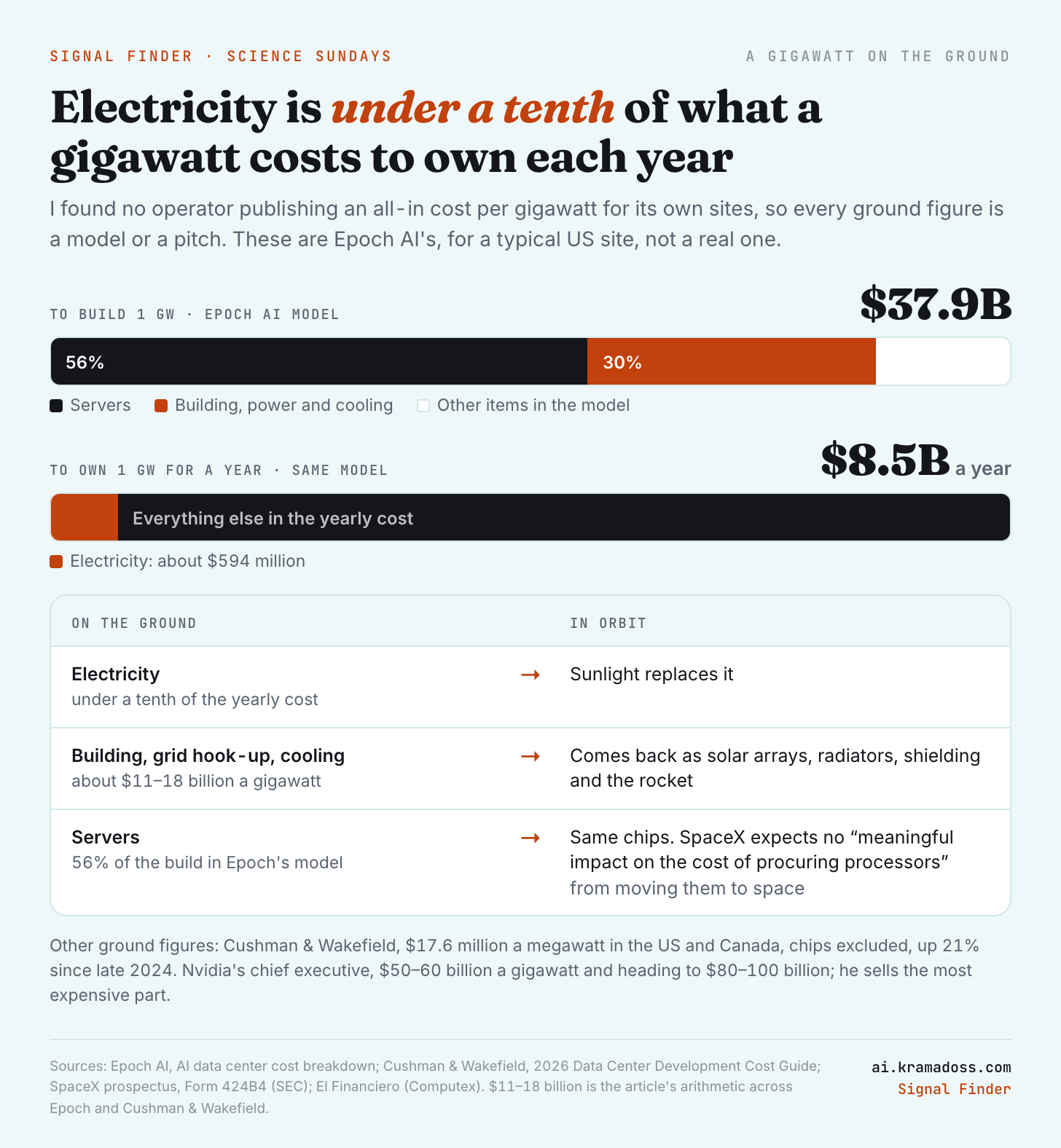
Nvidia’s chief executive has put the build cost at $50–60 billion a gigawatt and heading to $80–100 billion, as reported by El Financiero from Computex. He sells the most expensive part, so weigh it accordingly.
Microsoft’s chief financial officer said in July that “roughly two thirds of our capex was for short-lived assets, primarily CPUs and GPUs.”
Cushman & Wakefield’s 2026 cost guide puts the all-in cost of a new site, built from bare ground, at $17.6 million a megawatt in the US and Canada, chips excluded, up 21% since late 2024.
So the shell, the grid hook-up and the cooling run about $11–18 billion a gigawatt, depending on whose line you take.
Nvidia’s own take per gigawatt keeps rising. Its finance chief said in August that its “revenue opportunity has grown from roughly $18 billion per gigawatt to $25 billion with Blackwell to $40 billion with Vera Rubin”.
What does orbit save, and what does lifting it cost?
Orbit replaces the building, the grid connection and the power bill with solar panels and sunlight. It does not replace the chips. SpaceX’s own prospectus says so: “We do not believe that moving compute to space in and of itself will have a meaningful impact on the cost of procuring processors.”
Sunlight replaces the electricity line, which is under a tenth of a gigawatt’s yearly cost. The building and the power hook-up are a bigger target, $11–18 billion, but they come back in a different form: solar arrays, radiators, shielding and the rocket to lift it all. The servers are more than half the bill in Epoch’s model, and SpaceX expects their processors to cost the same up there.
So the orbital case is a case against the shell and the wait.
What does lifting a gigawatt cost?
SpaceX’s filing discloses no cost per watt; it says its case rests on launch costs falling “by 99% or more” from NASA’s historical $18,500 a kilogram.
The closest thing to a number is arithmetic on the figures they have published, so here it is.
Launch on a reusable Falcon 9 runs about $3,400–3,600 a kilogram today, on Google’s paper and on a JPL figure citing SpaceX’s price list. SpaceX’s target is about 100 kilowatts of computing per tonne launched; its CFO says the first generation is “about 5 megawatts per launch” and “roughly 200 launches for every gigawatt”.
At SpaceX’s target weight a gigawatt is about 10,000 tonnes. Multiply that out and lifting it costs some $34–36 billion at today’s price, and $2 billion at $200 a kilogram. Turyshev, a physicist at NASA’s Jet Propulsion Laboratory, estimates 34–59 kilograms per kilowatt all-in, in a preprint that is not yet peer-reviewed. At his weights the same gigawatt is $120–210 billion to lift today and $7–12 billion at $200.
That is launch only. It does not include building the satellites. Compare it to the $11–18 billion the shell and power cost on the ground.
So at today’s price, lifting a gigawatt costs 2 to nearly 20 times more than the building it replaces.
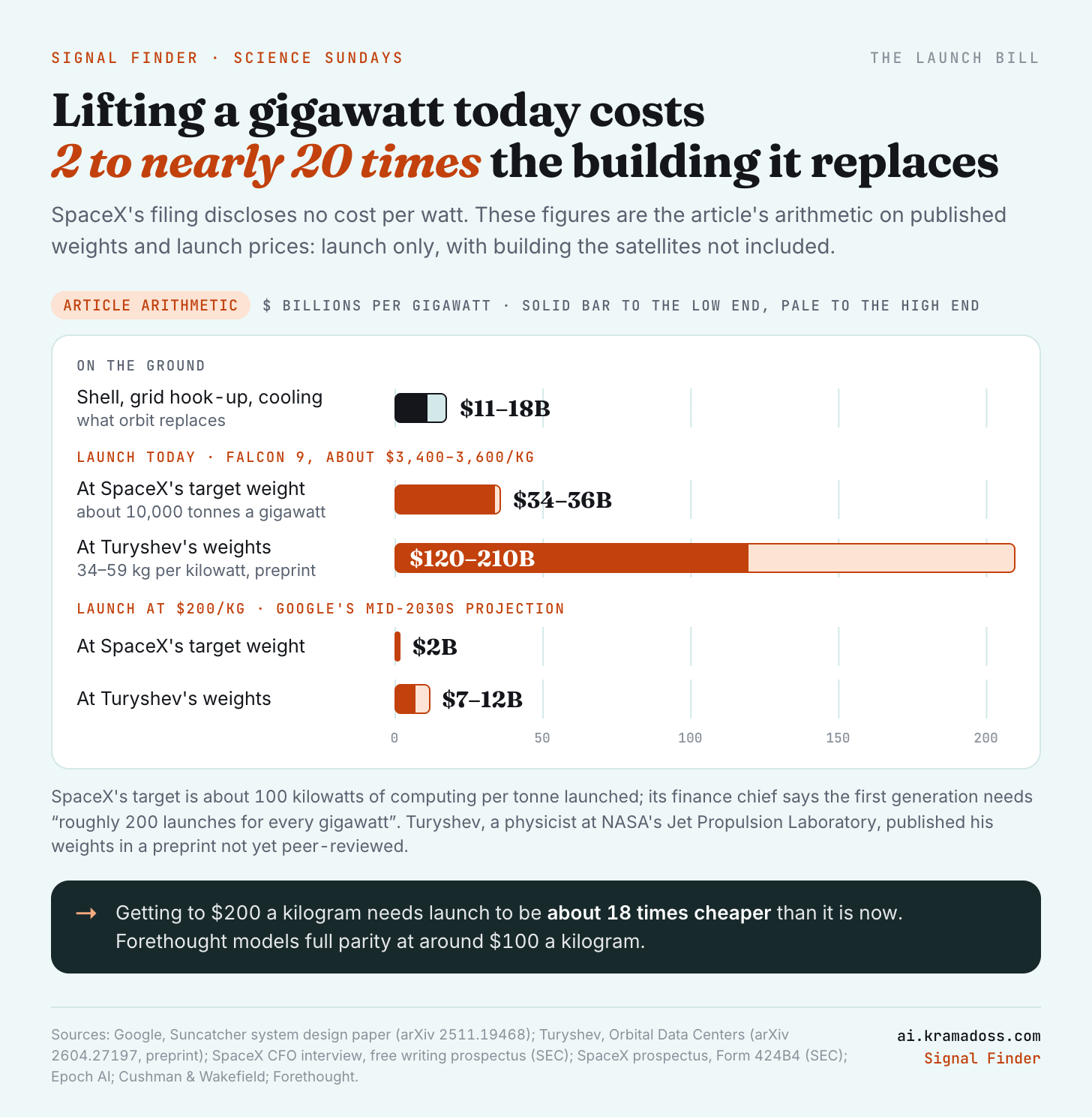
At $200 a kilogram it costs less, or about the same at his heaviest estimate. Google’s paper projects launch could reach about $200 a kilogram by the mid-2030s. At that price, Google estimates, launch spread over a satellite’s life would cost roughly what a ground data center pays for electricity. That is launch against the power bill, nothing more. Getting there needs launch to be about 18 times cheaper than it is now.
Forethought, an independent research group, models full parity at around $100 a kilogram and says the case “depends almost entirely on Starship achieving reusability comparable with what SpaceX achieved with Falcon”.
Why is it hard up there?
3 reasons, and the first is the one that keeps Gemma on 15-minute shifts.
ELI5: Why can’t you just dump the heat into space?
Space is the vacuum in a thermos. That is why your coffee is still hot at 4 pm: no air touches the cup, so the heat has nowhere to go. On Earth we cool servers by blowing air or water past them, like blowing on soup. In orbit there is nothing to blow. The only way out is to glow, so you bolt on big flat panels that shine their heat into the dark. For a megawatt, a small data hall’s worth, that is roughly a third of a soccer pitch of panel with the best designs on paper, and a full pitch with space-station technology.
Reason 1
The International Space Station’s main cooling system was designed for 70 kilowatts. Turyshev’s base case needs about 2,500 square metres of radiator per megawatt, about a third of a pitch. Multiply that out and a gigawatt needs about 2.5 square kilometres of radiator. At the space station’s radiator technology, on NASA’s figures, a megawatt needs about 6,800 square metres and 96 tonnes. Forethought says next-generation radiators are far lighter and that “the cooling problem is more tractable than commonly assumed”, while noting those designs rest on prototypes and estimates.
Reason 2
The second reason is sunlight, which is the good news with a catch. Do the sum against the US utility-scale solar fleet, which ran at 24% of capacity last year on the EIA’s figures: a panel in orbit collects about 5 to 6 times what the same panel makes on an average US solar farm. Even a dawn-to-dusk orbit has a shadow season. The PROBA-2 satellite, which flies one, sees about 80 days a year with eclipses of up to 18 minutes an orbit.
Reason 3
The third is radiation, and here 2 estimates differ. Google says a Trillium TPU it put in a proton beam on the ground ran to 15 krad, a unit of radiation dose, with no hard failures. The memory stacked next to it showed errors in stress tests from 2 krad. Google expects about 750 rad over 5 years behind about a centimetre of aluminium, so those errors start almost 3 times above the dose it expects. Turyshev’s order-of-magnitude estimate for 5 years at a similar orbit, behind a few millimetres, is about 5 krad. The two assume different shielding. Shielding is mass, and mass is launch dollars.
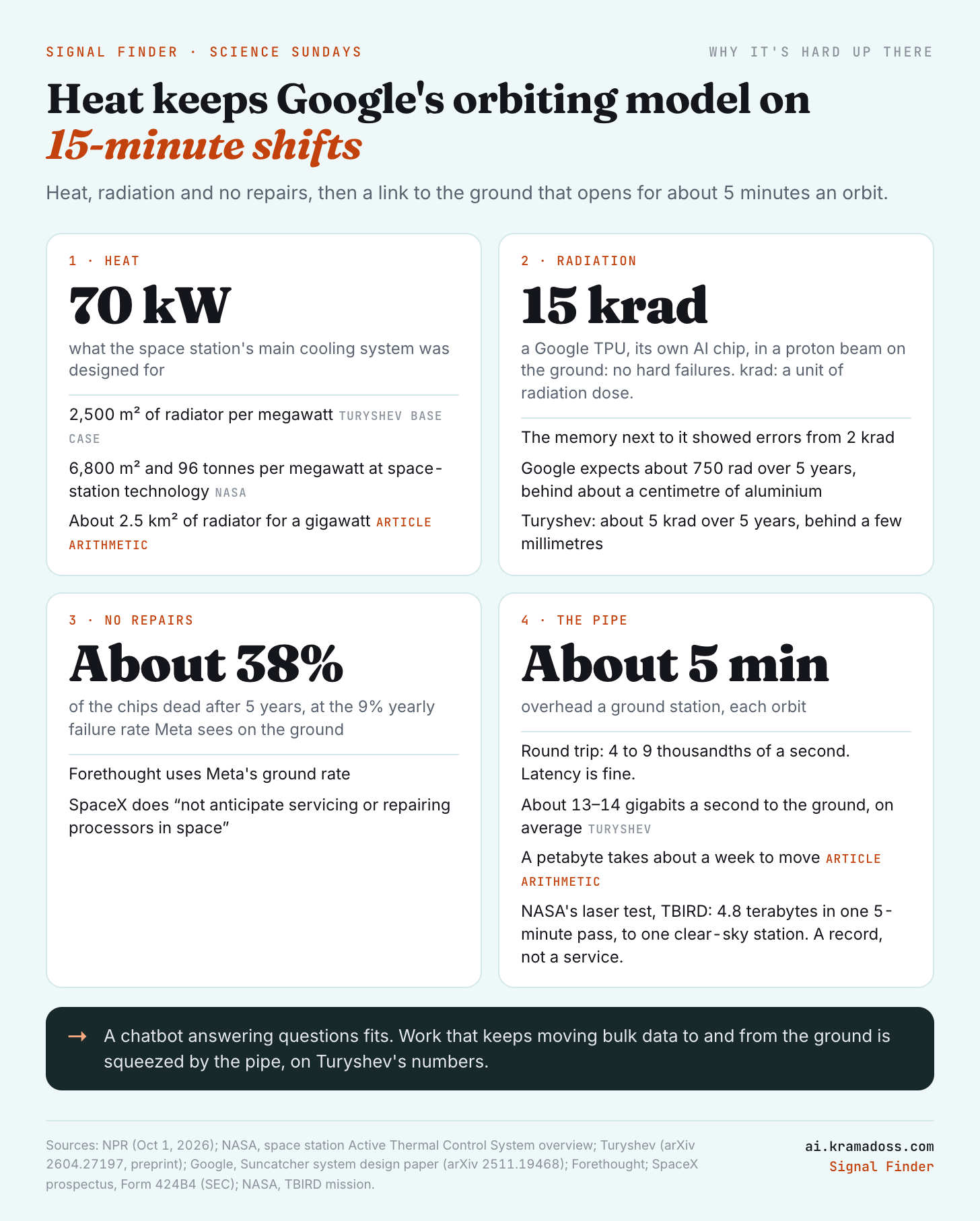
Then there is nobody up there to fix anything. SpaceX’s prospectus says it does “not anticipate servicing or repairing processors in space”. Forethought uses the 9% yearly failure rate Meta sees on the ground; at that rate about 38% of the chips are dead after 5 years.
Isn’t it too far away?
ELI5: Latency versus bandwidth, or the drive-through window
The kitchen is fast and close. An order up to a satellite and back takes a few thousandths of a second, less than a blink. The problem is the window. There is one, it is only open for about 5 minutes each time the truck drives past, and it shuts in fog. A burger order, a chatbot question, goes through easily. Delivering the week’s groceries, a petabyte of training data, takes about a week of window time.
A signal to a satellite a few hundred kilometres up and back takes about 4 to 9 thousandths of a second. Starlink, which runs on the same physics, reported a median peak-hour latency of 25.7 milliseconds in the US in mid-2025. Latency, the time per round trip, is fine.
The pipe is the limit. A satellite in low orbit is overhead a ground station for about 5 minutes an orbit. Lasers stop at clouds, and a 2004 study found you need 4 to 5 ground stations across the US to be connected 90% of the time.
NASA’s TBIRD experiment sent 4.8 terabytes in one 5-minute pass, peaking at 200 gigabits a second, from a small satellite to one clear-sky California station. That is a record, not a service. Turyshev estimates a node can average about 13–14 gigabits a second to the ground once weather and passes are allowed for.
At that kind of rate a petabyte takes about a week to move.
So a chatbot answering questions fits. Work that keeps moving bulk data to and from the ground is squeezed by the pipe, on Turyshev’s numbers.
So when does it add up?
Musk, speaking in June: a gigawatt-a-year rate in orbit by the end of 2027.
SpaceX, in its filing: deployment “as early as 2028”, and meaningful amounts in 2029 per its CFO.
Beals, running Google’s experiment: not cheaper “in the next five years. I think it will take longer than that.”
Google’s paper: launch matching a ground site’s power bill in the mid-2030s, at $200 a kilogram.
SemiAnalysis, a chip-industry research firm, in a projection from June: in its base case space is more than 4 times dearer in 2026, about 30% dearer by the early 2030s, and at cost parity around 2040; its “Elon Musk case” reaches near-parity by the early 2030s.
Bezos, October 2025: “in the next couple of decades”.
A 2024 EU study led by Thales Alenia Space: a goal of 1 gigawatt in orbit before 2050.
Unlike milestones, more than 20 years apart.
So back to intelligence per gigawatt. Orbit does not raise it. The chips cost the same, SpaceX says in its own filing, and up there they fight heat, take radiation, and stay broken when they break. On the money, orbit saves the cheaper half of the bill, the electricity and the shell. What orbit might change is a different number: gigawatts switched on per year. New transmission lines take 4 to 8 years, turbine orders fill 5 or 6 years of output, and a rocket does not wait for the grid. It waits for launches instead, about 200 a gigawatt for the first generation, by SpaceX’s count.
Whether it is worth it comes down mostly to one price, the kilogram to orbit.
Whether orbit adds gigawatts before the ground does depends on launch price and launch rate in 2030, and no one in this article, SpaceX included, claims to know the price yet.
Past Science Sundays
Science Sundays: The Healthspan Myth - Science, Data, and the Longevity Industry

I do Function blood panels, I track my steps, I wear an Oura ring, and I’m interested in health variables and supplements.
Science Sundays: The dire wolf came back. Sort of.

I know the dire wolf the way most people do — from Game of Thrones. The big loyal wolves the Stark kids raise from pups.
Science Sundays: The State of Brain-Computer Interfaces in 2026

Three things happened in the past twelve months that change the BCI picture for 2026. Apple released a native protocol for BCIs in iOS. Meta wrapped a six-year, billion-dollar moonshot by launching a wristband that reads muscle signals on the forearm. Vermont’s governor signed a bill recognizing “freedom of thought” as a legal category. Those are three …
References:
Project Suncatcher: our first prototype satellite is in orbit (Google)
Exploring a space-based, scalable AI infrastructure system design (Google Research)
Towards a future space-based, highly scalable AI infrastructure system design (arXiv 2511.19468)
SpaceX CFO interview and Musk conversation, free writing prospectus (SEC)
SpaceX Q3 2026 results webcast and replay (SpaceX Investor Relations)
FCC Public Notice DA 26-113, SpaceX orbital compute application
PJM auction procures 134,479 MW of generation resources (PJM Inside Lines)
2026 Data Center Development Cost Guide (Cushman & Wakefield)
Cushman & Wakefield releases 2026 Data Center Development Cost Guide (Business Wire)
Orbital Data Centers: Spacecraft Constraints and Economic Viability (Turyshev, arXiv 2604.27197)
Active Thermal Control System overview, International Space Station (NASA)
Optical ground station availability (Alliss, Link, Craddock, AMS 2004)
Starcloud CEO on 88,000 satellites and $100bn (The Telegraph via Yahoo, March 30 2026)