


I do Function blood panels, I track my steps, I wear an Oura ring, and I’m interested in health variables and supplements.
I pay for the panels, the Oura subscription and the supplements myself; nobody sponsors any of it. Nothing in this article is medical advice nor paid endorsements.
Lifespan is how long you live. Healthspan is how many of those years you spend in good health. I’m interested in exploring the latter in this Science Sundays series.
Every product in this article promises you one or the other. In the US, the gap between them has been growing since 2000.
Are people actually living longer?
US life expectancy at birth hit 79.0 years in 2024, the highest in the modern federal series, a series that switched methods in 2018 and does not run cleanly against earlier figures. But the previous high was 78.9, set in 2014, and the whole decade from 2010 to 2019 added a tenth of a year. From 2014 to 2017 it fell in 3 consecutive years, before COVID existed.
The longest documented human life ended in 1997, when Jeanne Calment died at 122. In the 29 years since, nobody with validated records has come within 3 years of her.
Whether that is a wall or a pause is a live fight among demographers. One camp notes that best-country life expectancy has climbed about 2.5 years per decade since 1840 and expects the climb to continue. The other, writing in Nature Aging in 2024, examined the 8 longest-lived countries plus Hong Kong and the US since 1990 and found improvement decelerating overall.
They share one escape hatch: everything changes if biological aging itself can be slowed.
Are the added years healthy ones?
In 1980 the physician James Fries predicted that lifespan would press against a natural ceiling while medicine squeezed the sick years into a shorter window at the end.
A December 2024 study in JAMA Network Open, NIH-funded with no industry money, compared lifespan against healthy lifespan across 183 WHO member states. The United States has the widest gap of all 183, and it grew from 10.9 to 12.4 years between 2000 and 2019. The worst of it is American women: their life expectancy rose 1.5 years over that period while their healthy life expectancy did not move.
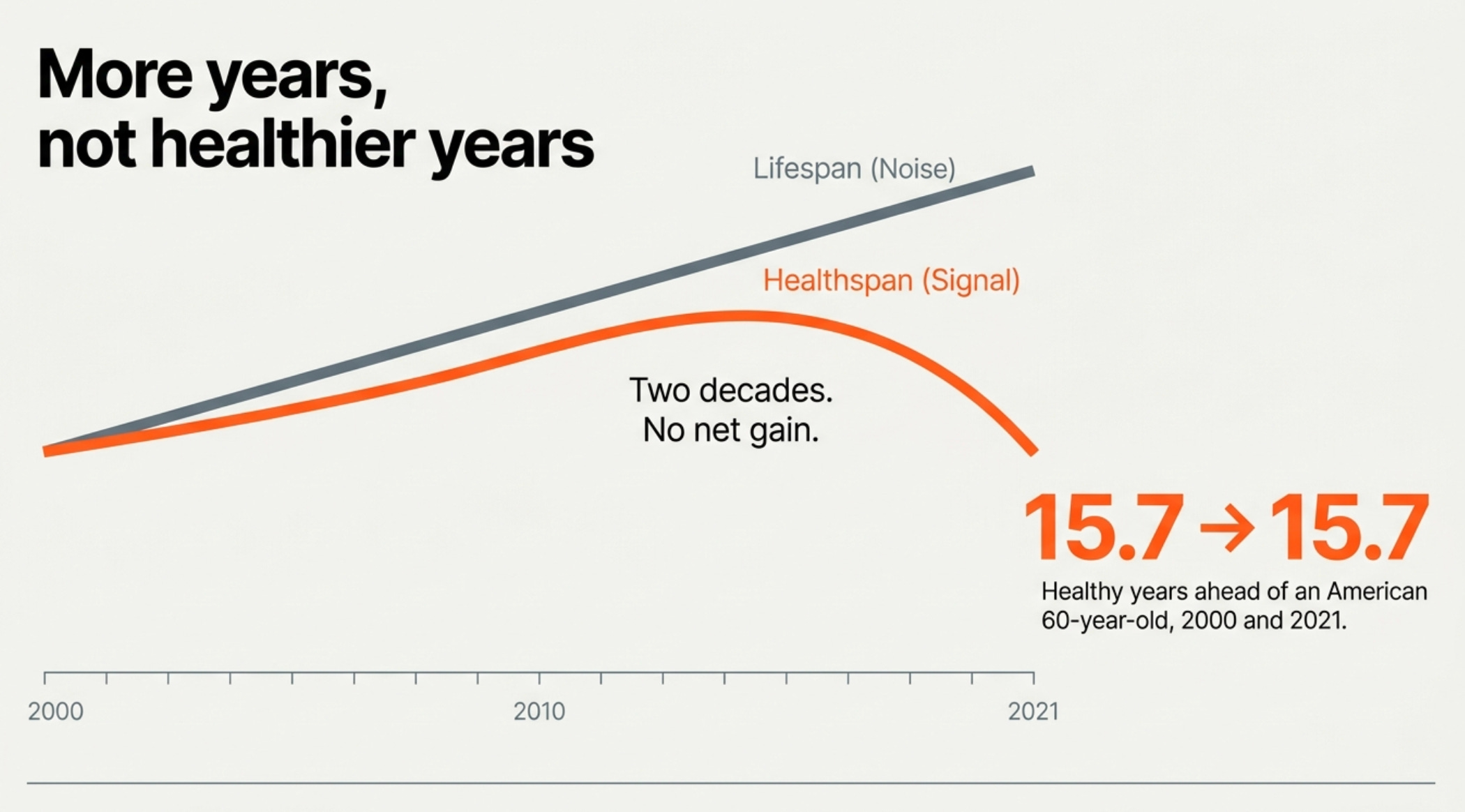
WHO’s own series agrees. An American 60-year-old could expect 15.7 healthy years in 2000. That climbed to 16.7 by 2010, sat at 16.6 in 2019, and by 2021, a pandemic year, was back to 15.7. Two decades, no net gain.
Healthy life expectancy is a modelled number, built by giving each disease a weight and subtracting the sick time, not by asking anyone how they feel. And the WHO series and the JAMA paper draw on the same underlying data. Their agreement is one source counted twice. Even so, nothing in the record supports the squeeze Fries predicted.
What about the weight-loss drugs?
Most of what gets written this year will glorify GLP-1 as the next miracle drug. I wanted to explore the reality.
The FDA labels for Wegovy, Ozempic and Zepbound carry a short list of approved uses between them: weight reduction, blood-sugar control in diabetes, cardiovascular and kidney risk in specific sick populations, sleep apnea, and a liver disease approved provisionally.
Extending life or slowing aging is on none of them.
TL;DR: the GLP-1 numbers in one place
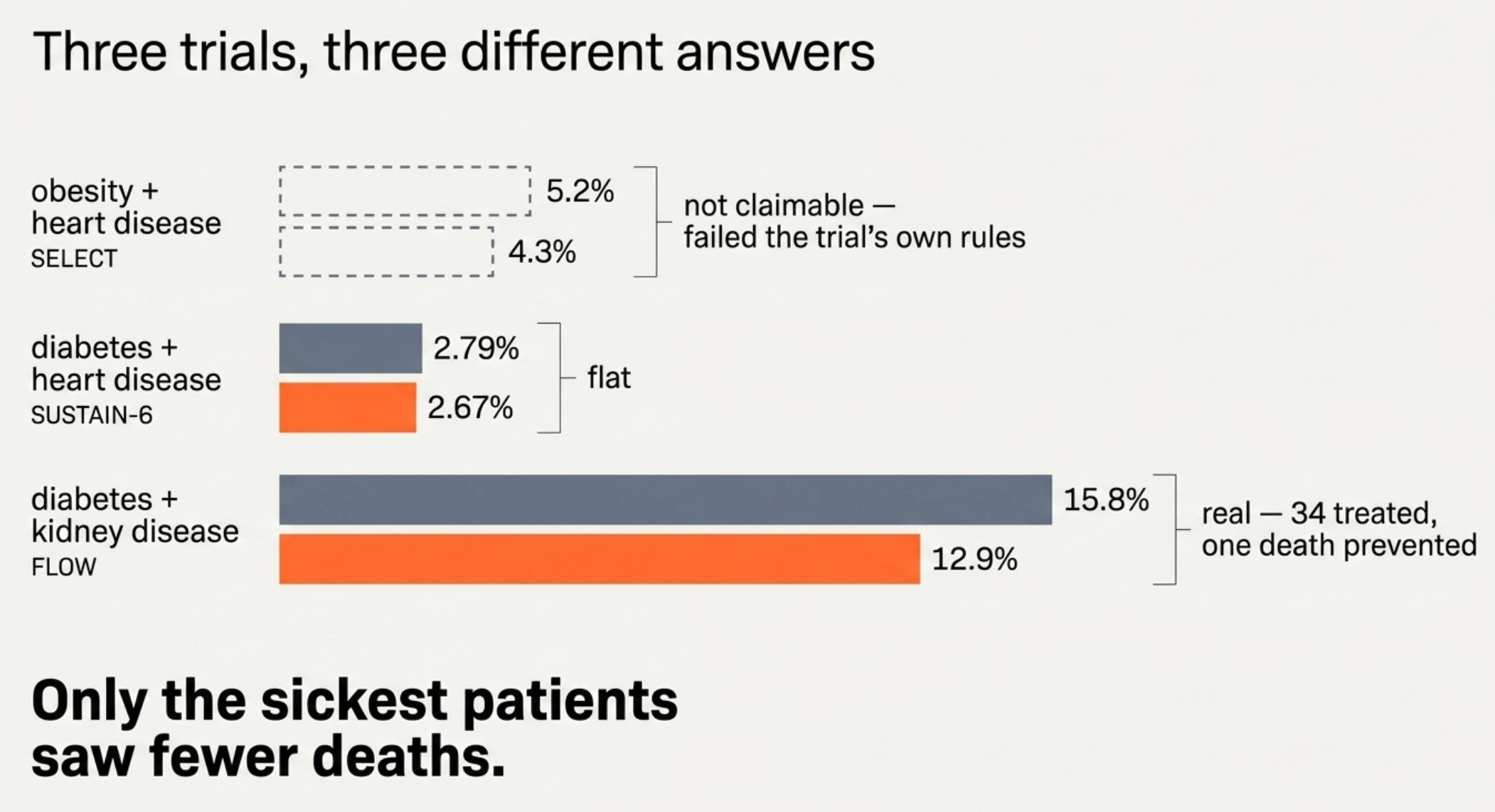
SELECT — semaglutide, 17,604 people who already had heart disease, 3.5 years. Major cardiovascular events fell from 8.0% to 6.5%: 67 treated to prevent one. Deaths from any cause fell from 5.2% to 4.3%, or 106 treated to prevent one, and the trial’s testing order disqualifies that one.
SUSTAIN-6 — semaglutide, 3,297 people with diabetes and heart disease. Cardiovascular deaths flat: 2.79% on placebo, 2.67% on the drug.
FLOW — semaglutide, 3,533 people with type 2 diabetes and kidney disease. Deaths from any cause fell from 15.8% to 12.9%: 34 treated to prevent one. 1 in 6 of the untreated died in about 3.5 years.
SURMOUNT-1 — tirzepatide, people with prediabetes. 1.2% developed diabetes against 12.6% on placebo: 9 treated to prevent one case. Take the drug away and the rate doubles in 17 weeks.
Stopping — about 45% quit inside 6 months, usually over cost. Randomised withdrawal brought back about 56% of the lost weight in a year; the STEP 1 extension recorded 67%.
Fractures over 75 — 2.4% on semaglutide against 0.6% on placebo in SELECT, one extra per 55 treated. The pure obesity trials enrolled 13 tirzepatide and 23 semaglutide patients over 75 between them.
The trial that comes closest is Novo Nordisk’s SELECT: 17,604 people on semaglutide or placebo for a median of 3 and a half years. Every participant had already had a heart attack, a stroke, or diagnosed artery disease. In that group the drug cut major cardiovascular events by 20%. In absolute terms, the same result: events fell from 8.0% to 6.5%, which means treating 67 people for 3 and a half years to prevent one event.
Deaths from any cause looked 19% lower on the drug: 4.3% against 5.2%, which is 106 people treated for 3 and a half years to prevent one death. Novo Nordisk can’t claim that number. The trial’s prespecified testing order disqualifies it.
ELI5: How can a trial’s own good news not count?
Testing many outcomes gives chance many opportunities to produce a fluke, so before a trial starts, its claims are locked into a fixed order, like a tournament bracket. Each claim counts only if the one ahead of it cleared. In SELECT, the claim ahead of overall deaths was cardiovascular deaths, and that one failed to clear. Everything behind it in line, the 19% included, is officially a maybe. The FDA label says so in a footnote: “Not statistically significant based on the prespecified testing hierarchy.”
SELECT is not the whole mortality record. In SUSTAIN-6, an earlier semaglutide trial in 3,297 people with diabetes and established heart disease, deaths from cardiovascular causes were flat: 2.79% on placebo, 2.67% on the drug.
And in one trial a GLP-1 did formally cut deaths — FLOW, in 3,533 people with type 2 diabetes and chronic kidney disease, where deaths from any cause fell from 15.8% to 12.9%: 34 patients treated to prevent one death. That population was sick enough that 1 in 6 of the untreated died in about 3 and a half years. The survival benefit is real in that population; it is not established in healthy people.
Fewer deaths in FLOW is a clinical outcome; whether semaglutide slows aging remains a separate, unanswered question. The chain runs: weight loss (measured), to better blood pressure and cholesterol (measured), to fewer cardiovascular events over 3.5 years (measured, real), to fewer deaths (not established in the obesity population), to a longer life (never studied by anyone).
In Eli Lilly’s SURMOUNT-1 trial, participants with prediabetes developed type 2 diabetes at 1.2% over roughly 3 and a half years on tirzepatide, against 12.6% on placebo. 9 people treated to prevent one case. Then the trial took everyone off the drug, and within 17 weeks the tirzepatide rate had doubled. And in practice roughly 45% of people stop within 6 months; cost and insurance were the most common reason recorded in the one study that asked, 288 patients in a single health system. The withdrawal experiments are a different kind of evidence. Trials that switched part of the group to placebo at random, while the rest stayed on the drug, found about 56% of the lost weight returning within about a year of stopping; an exploratory extension of Novo Nordisk’s STEP 1 trial, with 327 completers taken off both drug and lifestyle support and nothing randomised, recorded 67%.
Among SELECT patients aged 75 and older, hip and pelvis fractures occurred in 2.4% on semaglutide against 0.6% on placebo: one extra fracture per 55 people treated. The counts are small and fractures were not something the trial set out to measure, but the FDA judged the signal worth printing on the label. Meanwhile the pure obesity trials enrolled a total of 13 tirzepatide and 23 semaglutide patients over 75.
What can my own bloodwork tell me?
The question a tracking habit lives or dies on: how much does a number have to move between 2 of my own draws before the move is meaningful?
Clinical chemistry has an answer.
ELI5: Why isn’t one blood test one fact?
Blood is less like a document and more like weather. Hydration, sleep, a hard workout, an infection you barely noticed, last night’s dinner: all of it moves the numbers in the same healthy person from week to week. Laboratory scientists have measured that personal weather for each marker, drawing the same people repeatedly. A real change has to climb over it.
The European Federation of Clinical Chemistry and Laboratory Medicine maintains the reference database, 191 markers deep. The estimated minimum move between 2 draws, assuming a perfect lab with zero measurement error:
Marker Estimated threshold between 2 draws HbA1c (long-run blood sugar) ±3.2% LDL cholesterol ±21% Ferritin ±36% Total testosterone ±41% TSH (thyroid) ±49% Triglycerides ±55% Fasting insulin ±70% hs-CRP (inflammation) ±96% Free testosterone ±152%
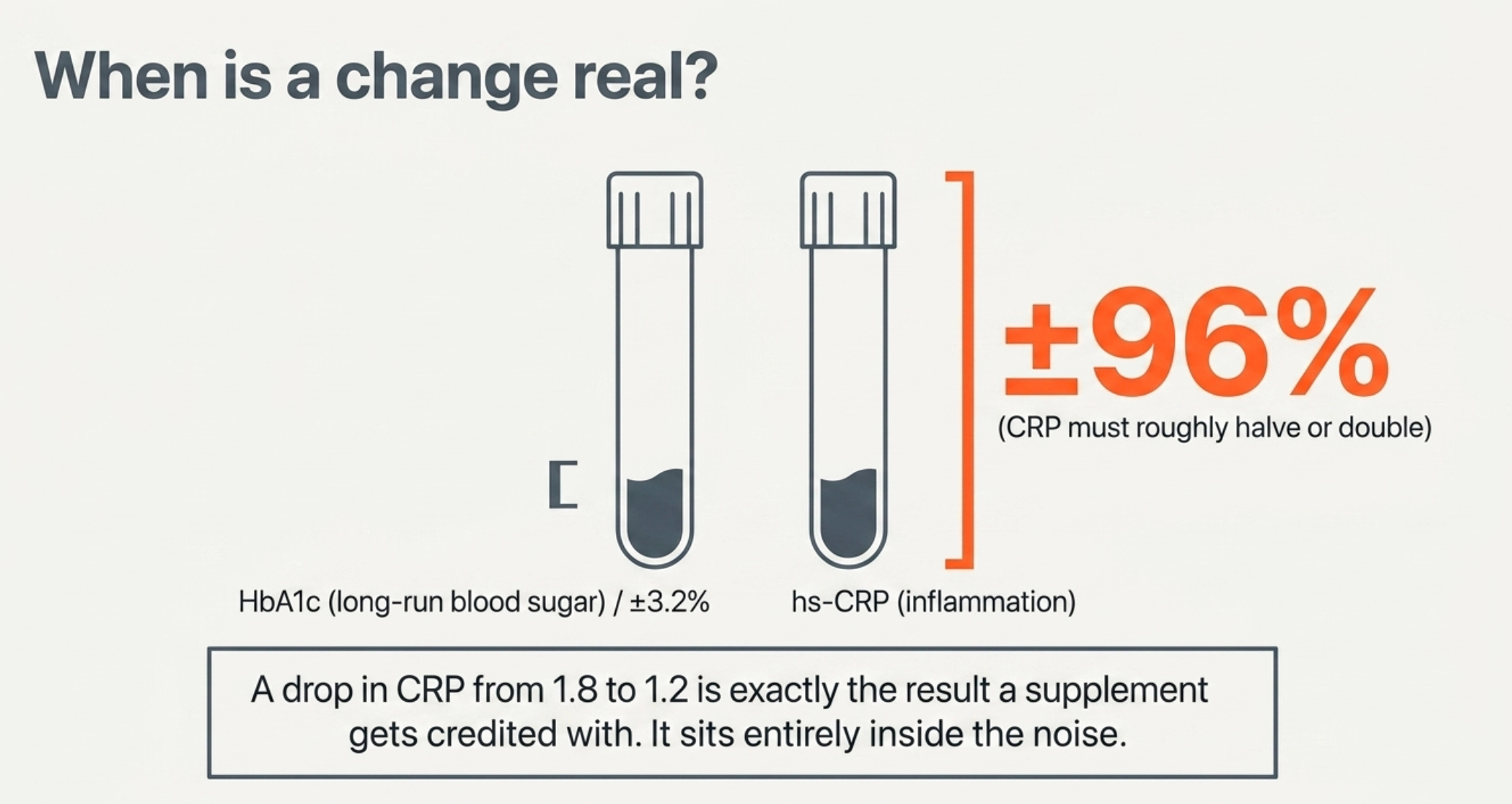
CRP, the number anti-inflammatory protocols promise to move, has to roughly halve or double before the change is bigger than the noise in one healthy person. A drop from 1.8 to 1.2 is the kind of result a supplement gets credited for, and it sits well inside that noise. Two draws, one before and one after, can’t show the supplement did it. Free testosterone is worse: its noise estimate rests on exactly one study, and it is among the most heavily marketed numbers in the industry.
For almost every marker on these panels, the gap between people is far bigger than the bounce within one person. That makes the normal range on the report nearly useless for judging any single person. That leaves comparing a result with my own previous value. The table above scores one pair of draws; it does not make smaller moves or longer trends meaningless. “In range but not optimal“ fails in both directions, and “optimal“ itself has no definition from any standards body: not the laboratory-standards organisations (CLSI and IFCC), not the FDA.
Each vendor sets its own range, usually narrower. A narrower range means more customers get told something is wrong.
A reference range is built to contain the central 95% of healthy people, so each marker carries a built-in 5% false-alarm rate. Run 100 markers on a perfectly healthy person and the chance of at least one flag is 99.4%.
Markers move together, so the real chance is somewhat lower. But consumer panels run 60 to 110 markers, so a healthy person ordering one should expect at least one number to come back out of range. That flag says more about how many things got measured than about my health.
What about my biological age?
The flagship tracking product is the biological-age test, most versions built on epigenetic clocks, which read patterns of chemical marks on DNA.
I am way out of my depth on the chemistry here. The field’s own reliability study was published in Nature Aging in 2022.
The researchers took 36 tubes of blood, split them, and ran both halves. Same person, same day, same blood. The two readings differed by a median of 0.9 to 2.4 years depending on the clock, and by up to 8.6 years at the extreme. The entire biological signal these tests hunt for, the distance between your reading and your calendar age, has a spread of 3 to 5 years across the population. So two halves of one blood sample can disagree by more than the whole range the test is trying to detect.
The authors’ own conclusion: changes in a person’s measured biological age after starting a treatment or lifestyle change “would be suspect.”
The study had an Elysium Health co-author and drew on company datasets; Elysium sells age tests and NAD supplements. The same paper also carries a fix: rebuilt on principal components, the clocks’ median disagreement fell to 0.3 to 0.8 years, with the extreme near 1.6. The unreliability depends on the implementation, not the idea. And even a reliable reading is still just a number. No trial has shown that improving a clock score makes anyone healthier.
TRIIM, the 2019 study that reportedly reversed epigenetic age by 2 and a half years, enrolled 10 men and analysed 9, had no control group, and tested a 5-drug stack, funded by the company that sells the protocol. The clock calculations were run by the clock’s own inventor, who owned a stake in that company.
And 7 years later nobody has replicated the reversal.
And the ring?
Against all sleep labs Oura does some things well. Total sleep time comes within a few minutes of the lab once you average across people, so a weekly average means something, and resting heart rate is the most reliable thing the ring produces, though that rests on the one independent comparison, 21 people over a week.
Even in the validation study Oura itself funded, the ring called awake time sleep roughly a quarter of the time, which is how it can score a night you spent staring at the ceiling as a decent one.
A single night’s HRV (heart-rate variability) is no better: a comparison against overnight ECG (an electrocardiogram) found the ring excellent on heart rate “but not HRV.” And the Readiness Score is a blend mixed to Oura’s own recipe, never independently validated, so there is no number to check it against.
Do wearables improve health? They reliably add about 1,800 steps a day, which is real.
Across 39 systematic reviews covering 163,992 people, effects on blood pressure, cholesterol and blood sugar were “small and often non-significant,” and essentially no randomised trial has tested a wearable against death or disease, because almost none was designed to. The one large trial that isolated the device itself points the other way: 470 adults aged 18 to 35 got identical diet and coaching, half also got a tracker, and after 2 years the tracker group had lost 2.4 kilograms less.
For me the biggest change, regardless of the rings’ effectiveness tracking teh data, is a habit change of being mindful going to bed at my chronotype intervals, drinking less, eating better, etc overall. Call it a placebo, effect but a pretty darn good one.
Does anything on the supplement shelf work?
I’m interested in supplements, which makes me this shelf’s target audience.
The shelf holds rapamycin, metformin, senolytics (drugs meant to clear out aged, damaged cells), NAD boosters, taurine. Exactly one of them has reached a full phase 3 trial. That means large, randomised, placebo-controlled, and scored on whether older adults got sick rather than on what their lab numbers did. The compound is RTB101, a rapamycin-family drug. It was tested in 1,024 people over 65 to see whether it cut respiratory illness: 26% got sick on the drug, 25% on placebo. The drug did what its lab numbers promised, the target genes switched on, and people got sick at the same rate. 6 of the 8 authors owned stakes in the company funding it and published the negative result anyway.
The only randomised senolytic trial enrolled 60 people, with everyone aware of who was getting the drug, and scored them on a bone-turnover marker rather than on fractures; it missed the outcome it was designed to measure. The 2 studies enthusiasts cite instead enrolled 14 and 9 people, with no control groups, and the primary endpoints of the 14-person study were retention and completion rate. NMN is sold to top up NAD, the molecule it becomes in the body, on the theory that more of it slows aging. It does raise NAD in the blood. Across the roughly 15 small randomised trials, almost nothing else moves: not blood sugar, not cholesterol, not muscle, not grip strength, not walking speed.
The exception is preliminary: diastolic blood pressure fell 2.15 mmHg pooled across 349 people, a result that still needs confirming.
Taurine’s 2023 mouse-lifespan paper rested on the premise that taurine declines with human age; a 2025 National Institute on Aging study measured the same people over time rather than different people at different ages, and the decline vanished. No human taurine aging trial has ever been run. TAME, the metformin-for-aging trial, has no ClinicalTrials.gov registration: after 11 years of public discussion it has not started. The rapamycin dog-lifespan trial is real, funded and running, with no result possible before about 2029.
Who is selling the longer life?
Peter Diamandis founded and chairs the XPRIZE Foundation, whose Healthspan prize lists him as a benefactor, and his own investment and advisory portfolio includes Fountain Life, Human Longevity, Lifeforce, OneSkin and other longevity companies. His book’s sales page promises “an extra 20 or 30 years of health.”
XPRIZE Healthspan does not measure lifespan. Teams run 1-year trials in roughly 100 people aged 50 to 90 — the prize’s own website says 50 to 80 — and win by improving muscle, cognition and immune markers by as much as a reference population typically declines over 10, 15 or 20 years. So “restores ten years of function” means the test scores moved as much as an average person loses in 10 years. The rules also grant sponsors the right to buy into up to 5% of any equity round a winning team raises, during the competition and for a year after it.
Bryan Johnson has zero peer-reviewed publications on PubMed: not on Blueprint, his protocol, not on his own biomarkers. His own protocol site says as much in its disclaimer: “These tests are experimental and intended solely for research purposes.“
The same page also advertises “telomerase activity of a 12 year old.”
So: a 40-year retirement, or aging less badly?
What would it look like for a 40-year retirement, or are we looking at a much healthier and more active older age versus the current way of aging badly?
The average man across rich countries leaves work at about 64.7 and the average woman at 63.6; the years that follow could span 18.6 and 22.8. A 40-year retirement therefore requires average death at about 105 for men and 104 for women. The EU’s official projections out to 2070, a baseline with no anti-aging miracle in it, put the longest average retirement anywhere at 30.8 years, for women in Luxembourg.
Nobody reaches 40.
And “people will just work longer“ is already failing as a fix. US labour-force participation past 65 peaked at 20.2% in 2019 and has slipped to 19.1%. (The 2025 figures skip October, when the shutdown stopped collection.) Among the 29% of Americans over 65 who report a disability, it runs 8.3%, against 23.5% for those without one. Which is not the same as saying older people can’t work: the best cross-country evidence finds real unused capacity to work past 65, and no sign that older workers displace younger ones.
What has stalled is the doing, not the ability.
The promise with any room left in it is converting existing years from sick to well, and that is exactly what the healthspan data says has not been happening.
There is one more version of the question, the one I asked first: what would longer lives mean for humans in the evolutionary cycle?
That literature does not exist. Searching for it turns up a philosophy paper cited twice, an uncited preprint, and a paper about moths.
What does exist is 2 pieces of theory and one measurement.
Hamilton worked out in 1966 that natural selection’s pressure on survival falls to roughly zero past reproductive age.
Lee added a second channel in 2003: what older generations transfer to descendants still counts.
And Moorad showed in 2013, in records from a 19th-century American population, that the shift has already happened once: as far more infants survived, survival’s share of natural selection fell from about a third to about a seventh, and selection on reproductive traits picked up the difference.
I’m the one extrapolating when I say a much longer old age would push that shift further. The papers don’t claim it, and nobody has joined the 3 findings into an answer.
Back to my own numbers
What my ring and panels can report that clears its own noise is a short, boring list.
A weekly average of sleep time. Resting heart rate. Step count, the one thing trackers reliably raise. And HbA1c, the quietest marker in the table above at ±3.2%. Even that number rests on just 6 studies, whose own estimates range from 0.29% to 7.0%.
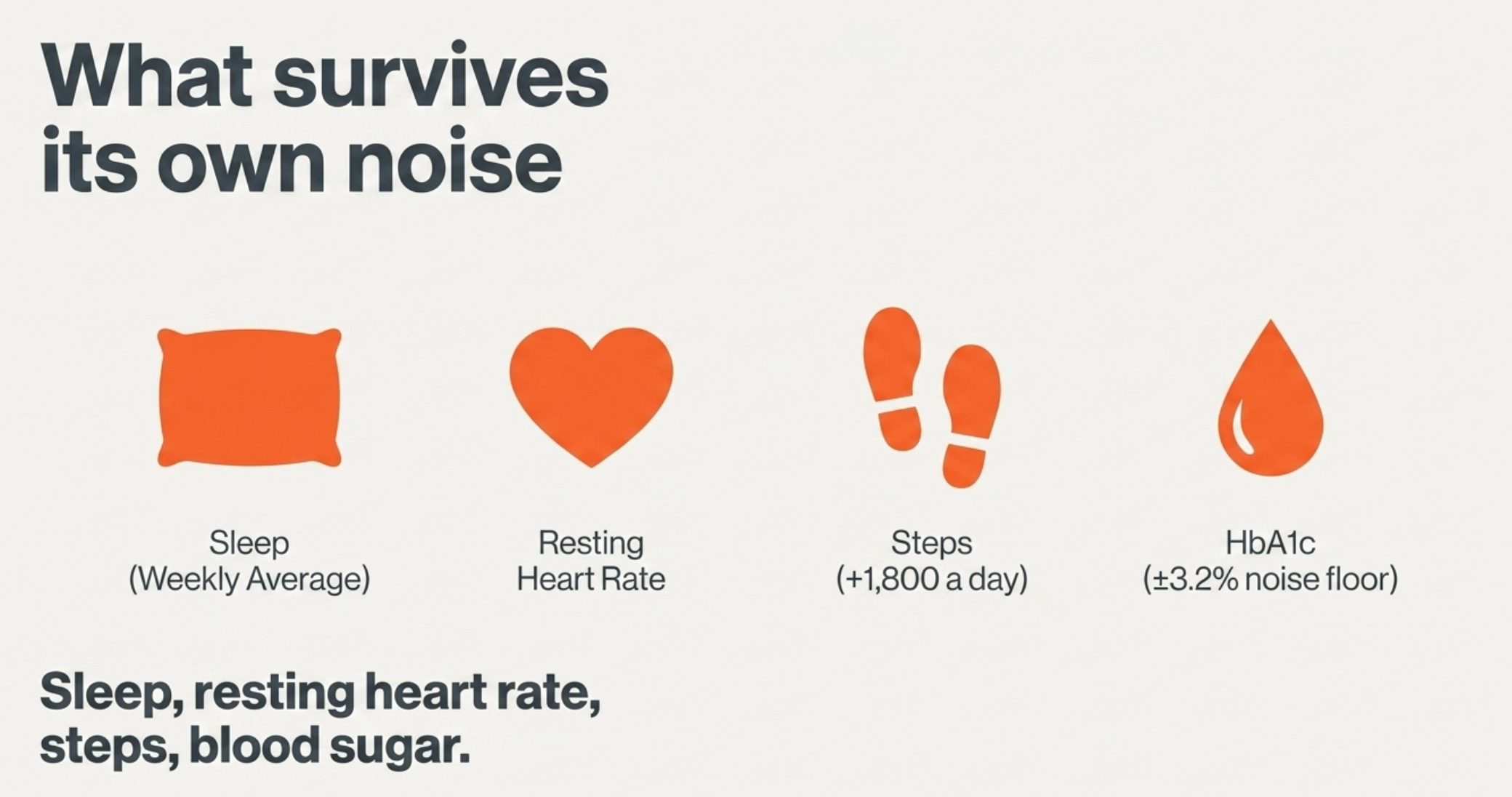
None of this is sold as longevity, and all of it predates the industry by decades.
Meanwhile the 2 numbers the whole question hangs on have not moved: the lifespan record has stood since 1997, and the healthy years ahead of an American 60-year-old have not gained ground on 2000.
Set side by side, the trials in this article diverge.
RTB101 switched on its target genes, and people got sick at the same rate.
NMN raises blood NAD, with no established benefit behind that number.
Semaglutide cut cardiovascular events in SELECT, and in FLOW it formally cut deaths: 15.8% to 12.9%, 34 treated to prevent one death, in patients with type 2 diabetes and chronic kidney disease.
Tirzepatide prevented diabetes in people with prediabetes, 9 treated to prevent one case.
Those are clinical benefits; none of them establishes slower aging or a longer life in healthy people.
And a healthier, more active old age is an outcome: the kind of change that has to show up in health and function, not in a pair of inflammation readings or a shift on an age clock, even one that reads reliably.
This is a fascinating area to continue to keep an eye out for! And I hope you are walking away with a window into this longevity-pilled world!
References:
Implausibility of radical life extension in humans in the twenty-first century
Global Healthspan-Lifespan Gaps Among 183 World Health Organization Member States
WHO Global Health Observatory, healthy life expectancy at 60
Semaglutide and Cardiovascular Outcomes in Obesity without Diabetes (SELECT)
EFLM Biological Variation Database · meta-calculations endpoint
Direct-to-Consumer Testing: Benefits and Concerns of Commercially Accessed Laboratory Tests
A computational solution for bolstering reliability of epigenetic clocks
Reversal of epigenetic aging and immunosenescent trends in humans (TRIIM)
openFDA 510(k) database, Oura query · openFDA registration listing 3015599655
Effectiveness of wearable activity trackers to increase physical activity and improve health
Effect of Wearable Technology Combined With a Lifestyle Intervention on Long-Term Weight Loss (IDEA)
Targeting the biology of ageing with mTOR inhibitors to improve immune function in older adults
Effects of intermittent senolytic therapy on bone metabolism in postmenopausal women · registry record NCT04313634
Diamandis portfolio companies · about · Fountain Life founding partners · book sales page
PubMed E-utilities searches for Bryan Johnson publications · Blueprint protocol page
European Commission, 2024 Ageing Report (Institutional Paper 279)
Social Security and Retirement Programs Around the World: The Capacity to Work at Older Ages
The Ethics of Human Life Extension: The Second Argument from Evolution