


Three things happened in the past twelve months that change the BCI picture for 2026. Apple released a native protocol for BCIs in iOS. Meta wrapped a six-year, billion-dollar moonshot by launching a wristband that reads muscle signals on the forearm. Vermont’s governor signed a bill recognizing “freedom of thought” as a legal category. Those are three different stories moving at three different speeds, and the news cycle keeps mashing them together. The question for 2026 is which one lands on your desk.
Disclaimer: I’m not a neuroscientist. I went looking for an answer to one question: what should a leader pay attention to when they hear “brain-computer interface” and the first instinct is to file it under hype?
Most coverage I’ve read in the last six months tells the story one of two ways.
MIT Technology Review’s June 1, 2026 piece by You Xiaoying makes it a horse race: “China beat Neuralink to the first commercial approval.”
Bloomberg’s coverage of Sam Altman’s Merge Labs makes it the next AI-merger moonshot.
Both are good stories. Both are one slice of something bigger.
There are three BCI stories happening at the same time. Each has different owners, different timelines, and different stakes.
One of them seems like a horse race. The other two are quieter, and more useful for figuring out where this is going.
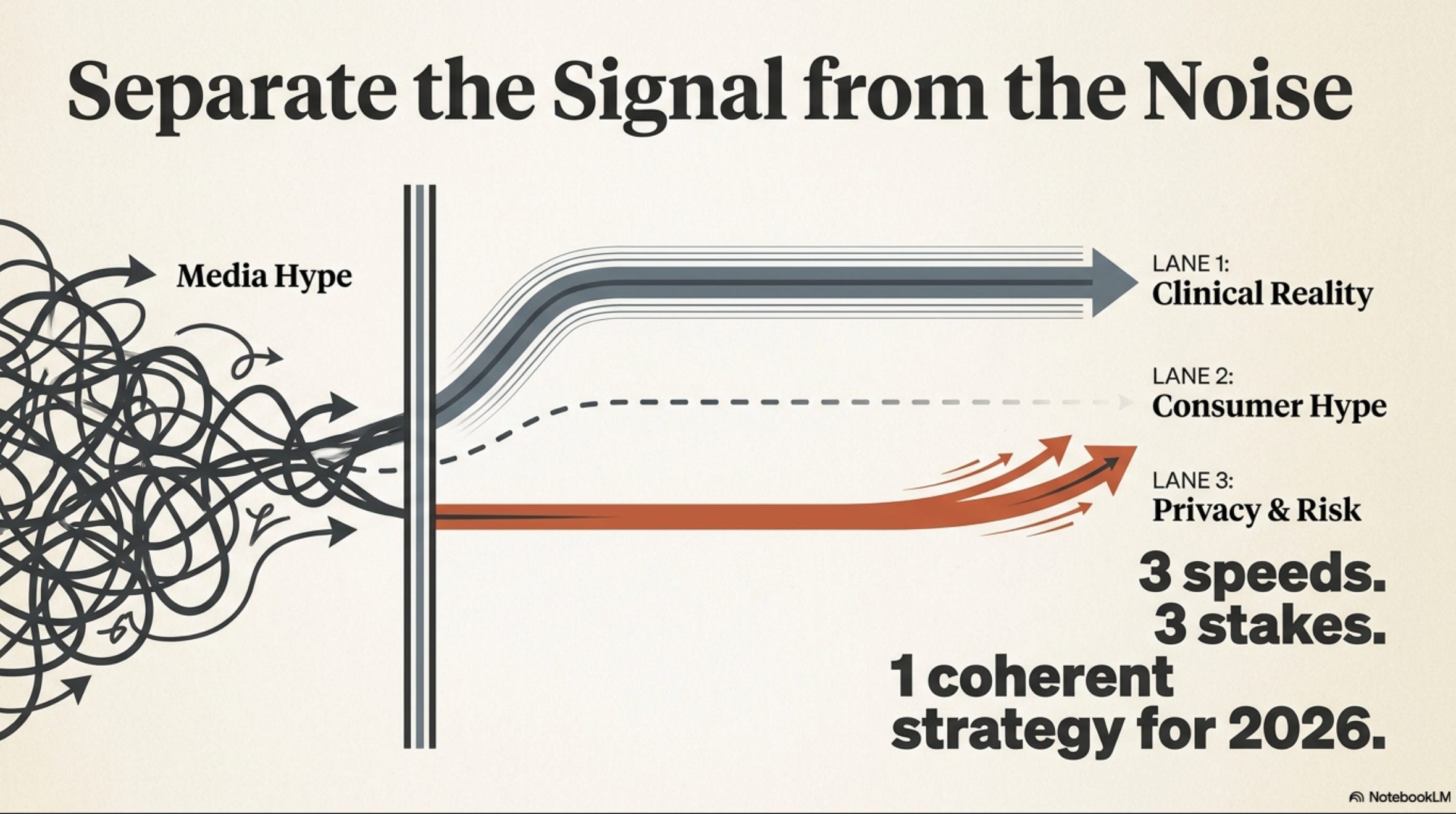
Lane 1 is clinical reality
Roughly 107 people on Earth live with a chronic brain-computer interface. The number rises to around 200-220 once you include intraoperative procedures, removed implants, and the harder-to-count Chinese programs.
Either way, the global cohort is smaller than what a single dental practice serves in a month.
The science is real and the engineering is hard-won and incremental.
If you run a hospital network or a healthcare payer, this is the year to track it. The chief medical officer and CTO are the right pair to own it.
Lane 2 is consumer and cognitive enhancement
From what I gather, it’s mostly hype.
Some $700 headphones that read your focus.
A lot of podcast talk about merging with AI.
If your company touches the consumer story (a wearable, a wellness program, anything with an electroencephalography (EEG) sensor in it), this could be a Chief Marketing Officer and brand-risk problem.
Lane 3 is neural data privacy
This lane has been moving through state legislatures, the European Union, and UNESCO for the last 18 months with almost no tech-press coverage.
Five US states already have laws on the books,
the EU’s medical-device deadline for standard manufactured BCIs lands December 31, 2027, and
UNESCO adopted the first global standard for the ethics of neurotechnology in November 2025.
This is a General Counsel and Chief Privacy Officer problem in 2026, not 2028.
The MIT TR piece I mentioned is a great read on Lane 1. Lane 3 isn’t in it at all.
How many humans have a brain implant in 2026?
From the research I ran, the number people quote ranges from “fewer than 50” to “thousands.” Both seem wrong, and the spread is itself a signal about how loose the definition has become.
The best aggregator I found (BCI Intel’s running tally as of May 2026) puts the chronic implant count at roughly 107 people across the named US/EU research programs. Add in temporary intraoperative procedures, Chinese trial cohorts, and undisclosed smaller programs, and the broader aggregate reaches roughly 200-220.
The full breakdown:
Precision Neuroscience: 100+ (mostly short-term, intraoperative, placed during other surgery and removed within days)
NeuroXess (China, flexible electrodes): 50+ procedures since 2021
Blackrock Neurotech: 40+ (longest-running, since 2004)
Neuralink: 28 (21 in the PRIME trial across the US, UK, Canada, and UAE, plus 7 outside it)
BrainGate consortium (academic): ~15-19
Synchron: 10 (US plus Australia)
ONWARD Medical brain-spine system: 7
INBRAIN Neuroelectronics (Barcelona, graphene): 8 surgically treated
Beinao-1 (China): 5-7
Paradromics: 1 (temporary intraoperative placement, May 2025, removed same day)
Neuracle NEO (China, commercial): 32 from the approval trial, plus a post-approval ramp
Those line items sum past the aggregate because the categories overlap and most of the entries are temporary: the bulk of Precision’s placements were removed within days, Paradromics’s single placement came out the same day, and the Chinese figures count procedures, not people walking around with devices.
Even the upper-bound aggregate is a rounding error against the patient pool that could use one:
roughly 5.4 million Americans with some form of paralysis,
~30,000 living with amyotrophic lateral sclerosis (ALS) at any given time,
~20 million people worldwide with spinal cord injury.
Set 220 against the ALS population alone and BCIs have reached well under 1% of it.
The other reason the count is contested: “BCI” isn’t one thing.
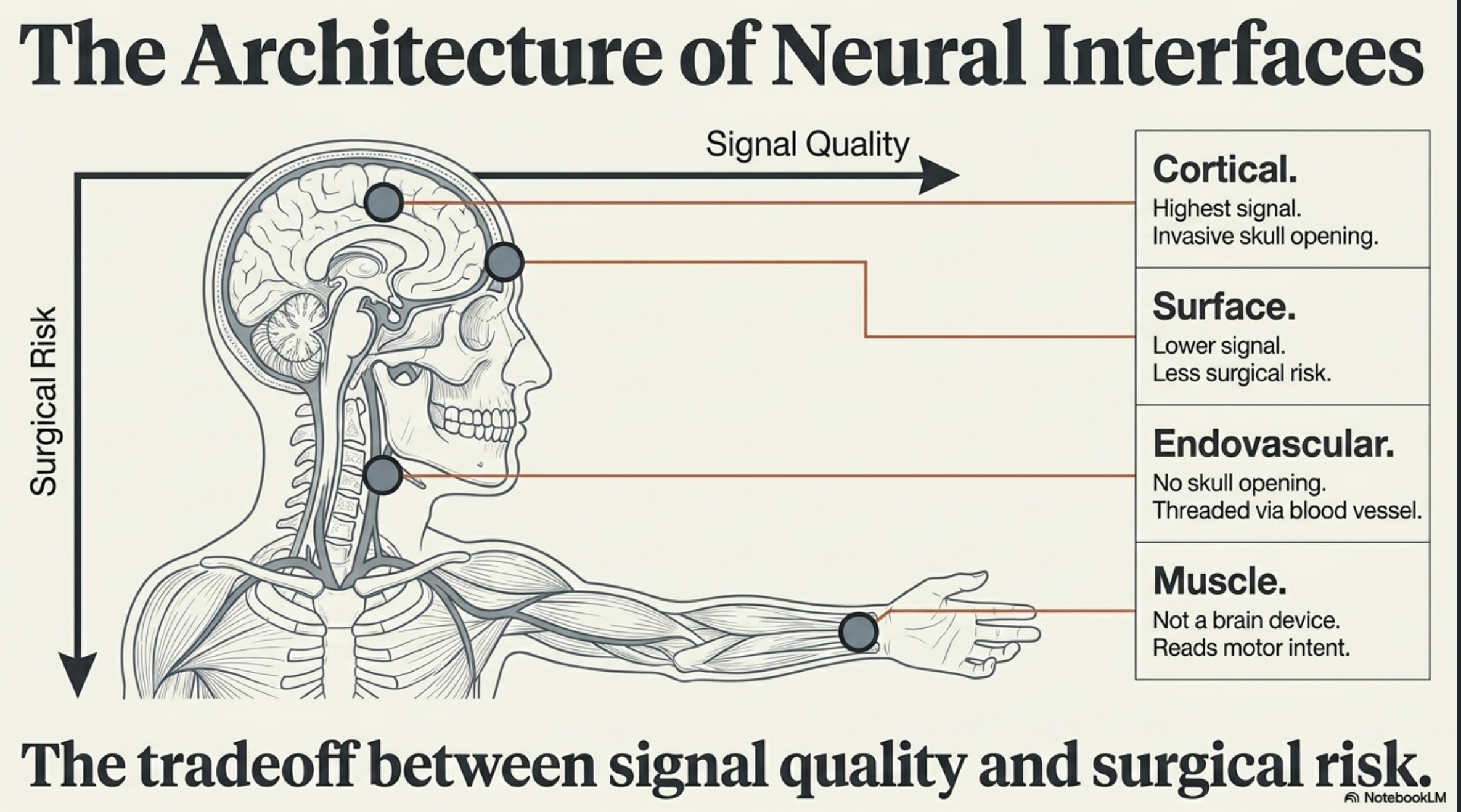
It’s at least four different ways of getting a signal out of the nervous system, with different surgical risk, signal quality, and regulatory category.
ELI5: The four flavors of BCI
All four get called “BCI” in the press. They’re not the same.
Cortical-penetrating (Neuralink N1, the Utah array used by BrainGate and Blackrock, Paradromics): tiny electrodes pushed through the dura into the brain itself. Highest signal quality. Requires opening the skull. Brain tissue tries to wall off the foreign object over time, which is what caused most of Noland Arbaugh’s threads to retract.
Cortical-surface (on the dura) (Precision Neuroscience Layer 7, Neuracle NEO, Beinao-1): a flexible film sitting on top of the brain’s protective wrapper. Less signal, much less surgical risk, easier to remove.
Endovascular (Synchron Stentrode): a mesh-and-electrode array threaded up through a blood vessel in the neck and parked against the inside wall of a vein near the motor cortex. No skull opening. Interventional neurologists already know how to do the procedure for stroke prevention.
Muscle-derived (Meta Neural Band, the wristband Meta launched in September 2025): electrodes on the wrist that read tiny muscle signals when you intend to move your fingers. Not technically a brain device. Often counted as one because Meta acquired CTRL-Labs in 2019 specifically to build a brain reader, and the muscle wristband is what they released six years later instead.
Reading “China beat Neuralink”
In March 2026, China’s National Medical Products Administration (NMPA) approved Neuracle Technology’s NEO device for commercial use. This is genuinely the first commercial approval of an invasive BCI anywhere in the world.
The MIT TR piece I mentioned earlier covered it well. The reporter went to Xuanwu Hospital in Beijing and wrote about Dong Hui, the spinal-injury patient who learned to use the device.
The story that “China beat Neuralink” is technically accurate. The story that “China is ahead of the US in BCI” is harder to defend.
What’s true:
NEO did get NMPA approval first, two-plus years before any US BCI is realistic for US Food and Drug Administration (FDA) premarket approval.
The device is functional for the narrow indication it was approved for: people aged 18-60 with cervical spinal cord injury who retain some arm function but have lost useful hand control.
China designated BCI one of six “future industries” in its 15th Five-Year Plan, adopted in March 2026, alongside quantum, fusion, 6G, and embodied AI. That’s real state-level commitment.
NEO was added to China’s health insurance system the same week as the approval. Contrast that with the United States, which currently has no Category I billing code for any BCI at any vendor.
What the headlines leave out:
The approval rested on a clinical evidence base of 36 trials, 32 of them completed in “a few months in 2025.” That pace is fast for an invasive medical-device program by any standard.
NEO is dura-mounted with 8 sensors. The Precision Neuroscience Layer 7 device that cleared the FDA’s 510(k) pathway in April 2025 has 1,024 electrodes. Neuralink’s N1 has 1,024.
Dong Hui completed 2.5 hours of training per day to use the device.
The MIT TR piece does mention these tradeoffs, but in passing.
NEO is a meaningful first commercial approval in a narrow indication, made possible by a regulatory pathway that accepts more risk in exchange for more speed.
The two biggest US clinical wins of the last two years (a BrainGate consortium paper in the New England Journal of Medicine (NEJM) in August 2024, and Synchron’s COMMAND study) are technologically more ambitious.
They’re also slower to commercialize.
Where the money is going (and what it’s buying)
The BCI sector raised more than $1.6 billion in 2025-2026 alone. By any normal medical-device benchmark, that’s an absurd amount of money for a field with under $50 million in global commercial revenue.
The deals are concentrated in a handful of names.
Neuralink raised a $650 million Series E in June 2025 at a roughly $9 billion pre-money valuation. The Bloomberg pitch deck reporting suggests the company projects roughly $100 million in revenue by 2029 (from about 2,000 procedures) and $1 billion by 2031 (from about 20,000 procedures per year).
That projection requires three things the company doesn’t have yet:
FDA premarket approval,
an automated surgical robot scaled 1,000x from today’s pace, and
insurance coverage.
Today’s commercial revenue is effectively zero.
Synchron closed a $200 million Series D in November 2025 ahead of its pivotal trial starting in 2026. Its endovascular approach (no craniotomy) plus native integration with Apple’s iPhone, iPad, and Vision Pro via the BCI Human Interface Device (HID) protocol Apple announced in May 2025 gives Synchron more distribution lined up than any other US invasive BCI. Microsoft and NVIDIA partnerships add to that.
Merge Labs is Sam Altman’s new BCI venture. It raised $252 million in January 2026 at an $850 million valuation, led by Bain Capital. Merge Labs is positioned explicitly as a research lab, not a product company. It has no device, no patients, no FDA submissions. That’s unusual, and not a criticism. It’s the positioning the founders chose, and the right call for where the science is.
Science Corporation (founded by Max Hodak, a Neuralink co-founder) raised a $230 million Series C in March 2026 at a $1.5 billion valuation. Its flagship product, PRIMA, is a retinal photovoltaic chip for vision restoration rather than a cortical BCI. PRIMA launches in Europe in 2026; across the European trials, 47 patients received the implant and 80% achieved meaningful visual improvement. That makes it one of the few BCI-adjacent commercial products shipping.
Paradromics has raised more than $105 million plus $18 million in National Institutes of Health (NIH) and Defense Advanced Research Projects Agency (DARPA) money. The device is the Connexus, with 420 micro-needle electrodes on a chip smaller than a dime. Its first human implant and trial approvals came in 2025.
Precision Neuroscience is the closest thing to a regulatory milestone outside of China, and the furthest along on the FDA path of any next-generation BCI in the US. Its Layer 7 device got FDA 510(k) clearance in April 2025 for up to 30 days of implantation. That’s the first wireless next-generation BCI with a full FDA clearance, but the 30-day limit means it’s cleared for surgical monitoring, not chronic assistive use. The Nature Biomedical Engineering paper on its 5-patient pilot was published in October 2025.
ONWARD Medical is the only company combining a BCI with spinal cord stimulation in a single system, and the only meaningful publicly traded BCI-adjacent pure-play, listed on Euronext Brussels as ONWD with a market cap around $234 million as of May 2026 (down from a 52-week high).
Neuracle Technology (the NEO maker) is Tsinghua University-affiliated, Shanghai-based, and now the only BCI vendor with commercial revenue. The number isn’t disclosed; likely under $10 million annualized for 2026.
Beinao-1, NeuroXess, StairMed (all China-based) are the second wave. Beinao-1 has 5-7 implants today, plans 50 by end of 2026, and is targeting NMPA approval by 2028. StairMed raised $72.8 million and is on the Chinese regulator’s expedited “Green Channel” with a commercial-launch target of 2028.
Other notable programs: BrainGate (the academic consortium across Brown, Mass General, Stanford, UC Davis) and ABILITY Neurotech (Geneva, spun out of the Wyss Center, with first chronic implantation scheduled for September 2026 at UMC Utrecht).
ELI5: What “FDA Breakthrough Device” designation actually means
Companies and the press both like to wave around “FDA Breakthrough Device” status as if it were approval. It isn’t. Breakthrough designation is a faster lane through the FDA review process for a device that could meaningfully improve treatment of a serious condition. The company gets prioritized meetings and more responsive review. The device itself hasn’t been shown to work, isn’t approved for sale, and can’t be marketed. Neuralink has several Breakthrough designations and zero approvals. Synchron has one designation and zero approvals. Treat the term as a process update, not a product update.
ELI5: Why nobody’s insurance pays for a BCI in the US (yet)
US Medicare and private insurers pay for procedures based on billing codes maintained by the American Medical Association (AMA), called CPT codes. Category I CPT codes are for established procedures with a fixed payment rate. Category III codes are tracking codes for emerging technology. They let a surgeon record that the procedure happened, but each regional Medicare contractor decides on a case-by-case basis whether to pay, and they typically deny coverage for investigational devices. No invasive BCI has a Category I code in 2026. That means even after a vendor gets FDA approval, there’s a separate multi-year fight to get an insurance billing code that actually pays. Until both happen, US BCI use is cash-pay, and the population that can pay $50,000-$100,000 cash for an experimental implant is limited.
Add up every disclosed commercial BCI dollar across every vendor on the planet in 2025 and the total comes in under $50 million.
One adjacent market keeps inflating BCI’s numbers in casual coverage: deep brain stimulation (DBS), a mature $1.7-1.8 billion global market owned mostly by Medtronic and Abbott.
DBS implants a wire that delivers electrical pulses to suppress symptoms of Parkinson’s, dystonia, or obsessive-compulsive disorder.
DBS doesn’t read brain signals. BCIs decode brain signals and don’t stimulate.
The two share some hardware history and surgical workflows, which is why the press conflates them.
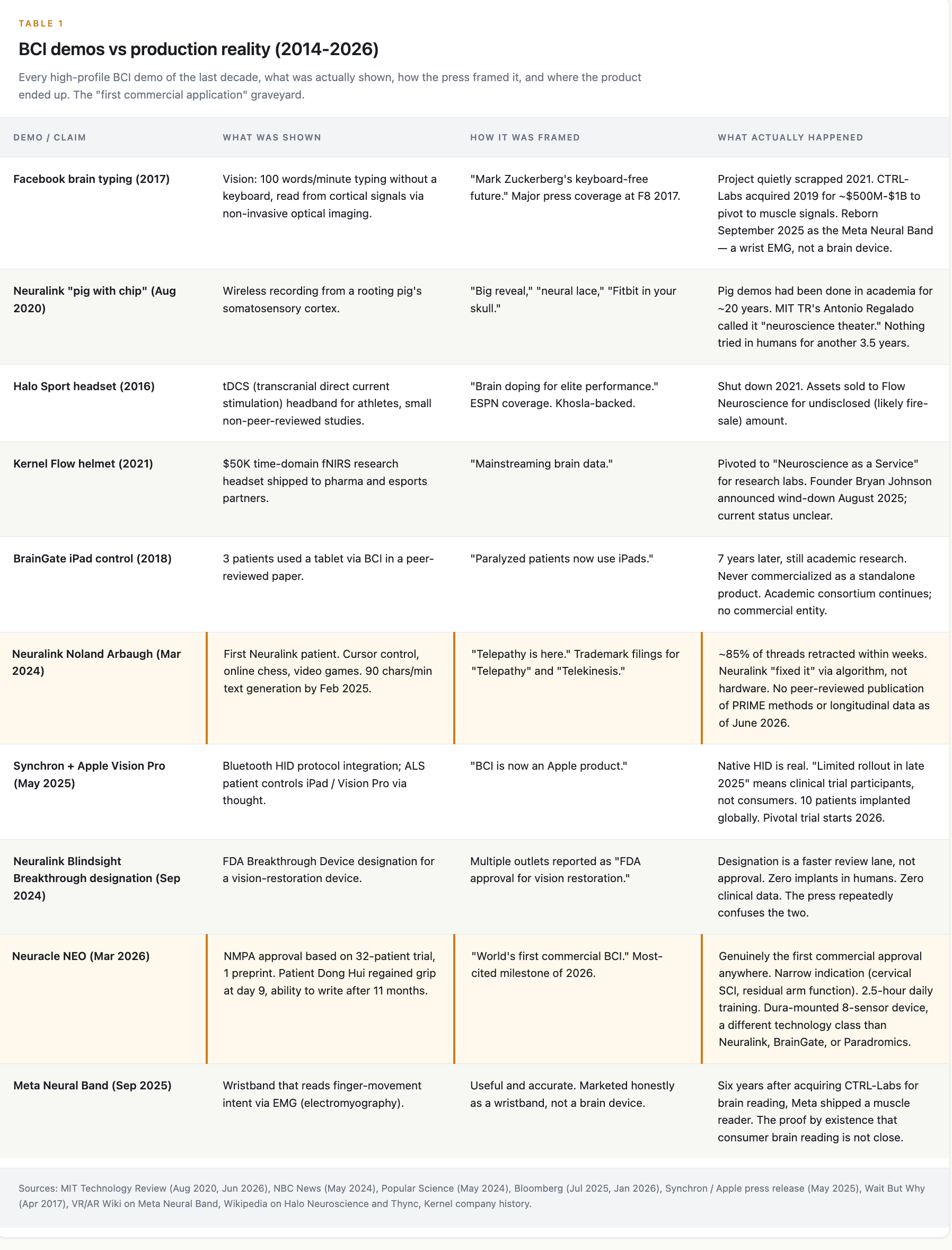
The “first commercial application” track record, in one place: every demo of the last decade that was sold as the imminent product, and where it ended up.
Neural data privacy laws are already on the books
I went looking through the MIT TR piece, the Bloomberg pieces, the STAT News pieces, the entire US English-language press cycle of the last six months on BCI. None of them gave more than a passing mention to the five US state laws on neural data, the UNESCO Recommendation, or the EU MDR deadline.
Five US states have passed neural data privacy laws in the last 24 months.
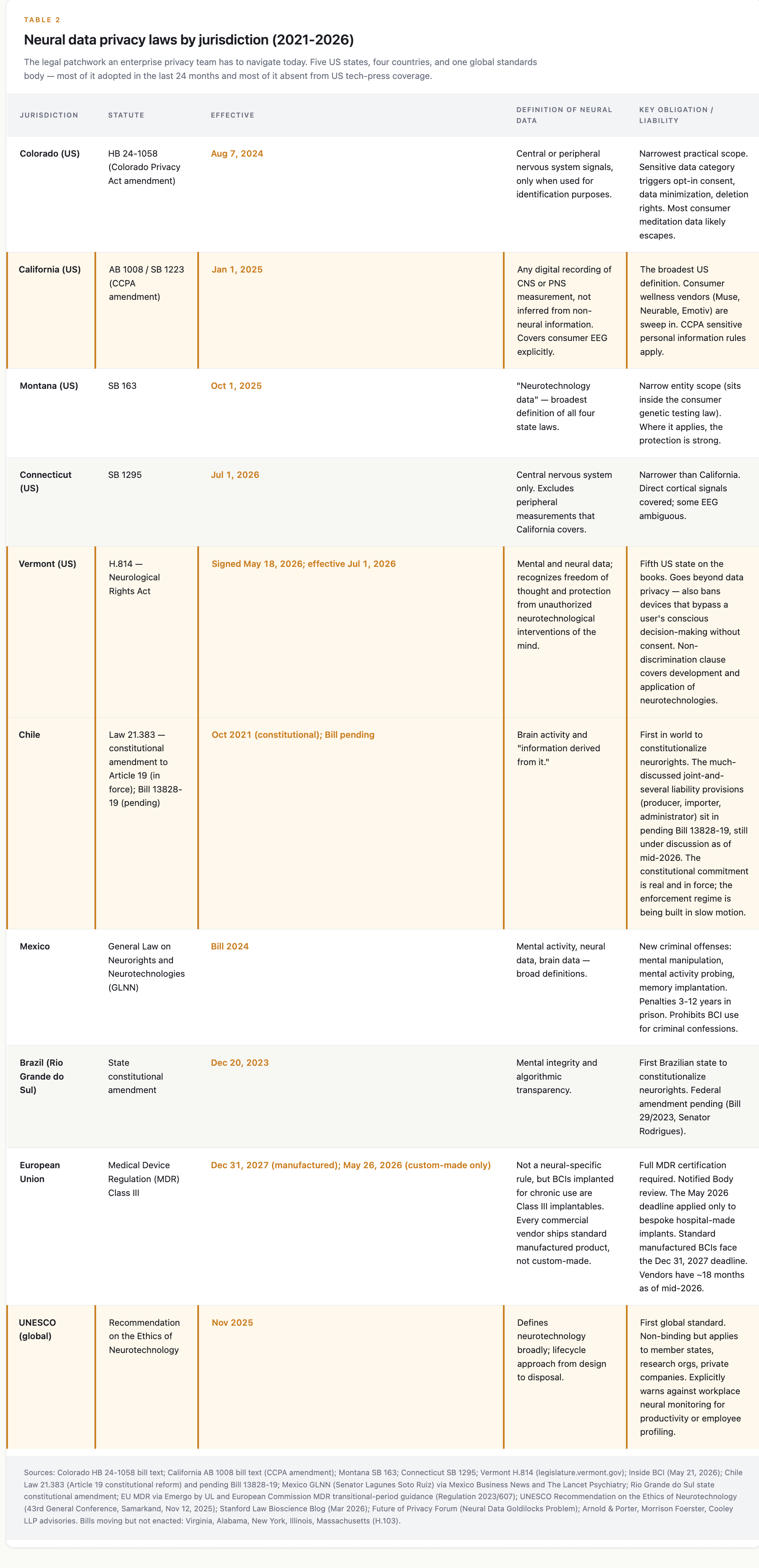
Colorado HB 24-1058 was first, signed in April 2024 and effective August 7, 2024. It amends the Colorado Privacy Act to add neural data to the definition of sensitive data. The definition covers signals from the central or peripheral nervous system, but only when the data is used for identification purposes. That’s a narrow definition. Your meditation app data likely escapes.
California AB 1008 amended the California Consumer Privacy Act (CCPA) effective January 1, 2025. The definition is broader. It covers any measurement of neural activity from the central or peripheral nervous system, and explicitly notes it covers data that isn’t inferred from non-neural information. A consumer EEG meditation device like the Muse S Athena is collecting neural data under California law. So is a Neurable MW75 Neuro headphone. So is anything else with an EEG sensor in it that ships to a California consumer.
Montana SB 163 is effective October 1, 2025. Its definition of “neurotechnology data” is the broadest among the early states, but its scope of covered entities is the narrowest (it sits inside the Montana law on consumer genetic testing).
Connecticut SB 1295 is effective July 1, 2026. It covers central nervous system signals only and is narrower than California.
Vermont H.814 was signed by Governor Phil Scott on May 18, 2026, making Vermont the fifth US state on the books. Vermont residents will have a legal right to mental and neural data privacy from July 1, 2026. The statute also recognizes freedom of thought, non-discrimination in the development and application of neurotechnologies, and protection from unauthorized neurotechnological interventions of the mind. The Virginia, Alabama, New York, Illinois, and Massachusetts legislatures all have neural data bills moving in 2026. None passed yet.
Internationally, the picture moves faster.
Chile constitutionalized neurorights with Law 21.383 in October 2021. The reform of Article 19 protects mental integrity and the information derived from brain activity, and it remains the only constitutional-level neurorights protection in the world. The much-discussed joint-and-several liability provisions (naming producer, importer, AND administrator as liable for consumer harm) sit in a separate pending bill (Bill 13828-19) that’s still under discussion as of mid-2026. The constitutional commitment is in force; the enforcement piece is taking its time.
Mexico’s General Law on Neurorights and Neurotechnologies was introduced in July 2024 by Senator Alejandra Lagunes Soto Ruiz. It creates a Neuroethics Commission, prohibits the use of BCI to obtain criminal confessions, and creates new criminal offenses for mental manipulation, mental activity probing, and memory implantation with penalties of 3 to 12 years in prison.
Brazil’s Rio Grande do Sul state amended its constitution in December 2023 to include neurorights. A federal constitutional amendment is pending.
UNESCO adopted the Recommendation on the Ethics of Neurotechnology at its 43rd General Conference in Samarkand in November 2025. It’s the first global standard on neurotech ethics. It applies a lifecycle approach (from design through disposal), recommends against non-therapeutic neurotech use on developing brains, and explicitly warns against workplace neural monitoring for productivity tracking or employee profiling. It’s non-binding but applies to UNESCO member states, research organizations, and private companies that interact with them.
EU MDR. The May 26, 2026 deadline that the headlines cited applies only to custom-made Class III implantables, the hospital-bespoke devices, not commercial product. The deadline that actually catches standard manufactured BCIs (every commercial vendor) is December 31, 2027. BCIs implanted for chronic use are Class III.
ELI5: What “neural data” actually means under the new laws
The five US state laws all use slightly different definitions, and that matters for what gets swept in. The broadest is California: any digital recording of nervous-system activity, including from devices the consumer wears at home. That means your $400 Muse meditation headband is collecting neural data subject to California’s strongest privacy protections, with all the consent, deletion, and breach-notification rules that come with sensitive personal information. The narrowest is Colorado: only when the data is used to identify you specifically. Vermont’s new H.814 (signed May 18, 2026) goes furthest on the rights side, recognizing freedom of thought and a prohibition on devices that bypass conscious decision-making. Same device, same data, different rules in different states. Most consumer EEG vendors I checked have a single privacy notice that doesn’t yet reflect the patchwork.
One more issue US employers should be tracking, and I haven’t seen it flagged anywhere: the Americans with Disabilities Act (ADA) and Section 504 question.
The ADA and Section 504 of the Rehabilitation Act both require reasonable accommodation for employees with qualifying disabilities.
Synchron has publicly disclosed that at least one ALS patient with its BCI implant returned to a desk job, using the device to control an iPad on a Vision Pro. That patient is an employee somewhere, working under a manager. There’s no case law on what a BCI-using employee is entitled to as accommodation. Battery charging? Magnetic-field restrictions in the office? Privacy of the neural data being collected by the device while the employee is at work? Whether an employer can use a BCI’s data stream for productivity monitoring?
The Office of Personnel Management’s published list of reasonable accommodations doesn’t contemplate neural interfaces yet. No US court has ruled on a BCI-specific employment dispute as of mid-2026.
The first one will create precedent. If I ran HR or Legal at a big company, I’d build the playbook before the first request lands.
Lane 1: where the science is working
The narrowest BCI story in 2026 is the assistive-device lane for severe paralysis, ALS, locked-in syndrome, and spinal cord injury. The science here is real, the patient outcomes are documented in peer-reviewed journals, and the cost-benefit math is at least in sight.
The two big wins:
The BrainGate consortium published the biggest BCI paper of the decade in NEJM in August 2024. Card, Willett, and colleagues reported 97% accuracy decoding attempted speech in an ALS patient at UC Davis, using four microelectrode arrays in the left precentral gyrus. One patient, months of careful calibration. No other BCI has clinical evidence this strong.
Synchron’s COMMAND study reported a positive primary safety endpoint with its 6-patient US cohort. Add the 4-patient SWITCH study in Australia (published in JAMA Neurology in January 2023; the full COMMAND publication is pending) and Synchron has 10 implants total, more patient-years of documented safety data than any other US invasive BCI program. Its pivotal trial begins in 2026. First FDA premarket approval filing is likely 2027 at the earliest.
The rest of the Lane 1 picture:
ONWARD Medical’s brain-spine system has 7 implanted patients as of January 2026. The ARC-BCI work happens in Lausanne with EPFL (the Swiss Federal Institute of Technology), and the work to restore walking in spinal cord injury patients has produced multiple Nature and NEJM publications. ONWARD has FDA approval for its ARC-EX non-invasive device (December 2024). ARC-IM (the implantable version) has FDA Breakthrough designation for four separate indications.
INBRAIN Neuroelectronics in Barcelona implanted the world’s first graphene-based BCI in September 2024. The surgeries are happening at Salford Royal in Manchester, UK. Ten patients enrolled, 8 surgically treated as of April 2026. The device is ultra-thin (under 10 micrometers) and aims to distinguish healthy from cancerous tissue with micrometer precision.
Blackrock Neurotech’s Utah array remains the substrate for most US academic BCI research. The company has FDA Breakthrough designation for its MoveAgain system (November 2021), more than 40 cumulative patients across all research, and no commercial product yet.
Paradromics implanted its first patient in May 2025 at the University of Michigan and got FDA Investigational Device Exemption (IDE) approval for its Connect-One speech-restoration trial in November 2025.
ELI5: Why “the brain rejects the electrodes” matters
Brain tissue is squishy, alive, and protective. When the body senses a foreign object (like a Neuralink thread or a Utah array electrode), it tries to wall it off the way it would wall off a splinter. Scar tissue forms around the electrode, the signal degrades, and over months the device works less well. Companies are still solving this problem. Cortical-penetrating designs (Neuralink, Utah array) get the strongest signal but face the worst foreign-body response. Surface designs (Precision, Neuracle NEO) get less signal but provoke less of an immune response. The thread retraction that hit Neuralink’s first patient is one version of this problem. Every BCI vendor I’ve looked at is in some stage of trying to solve it.
If you run a healthcare organization, this is the lane where tracking vendor news pays off. The decisions made here in the next two years set the commercial baseline for the rest of the decade.
Lane 2: the consumer hype
The consumer BCI story appeqrs to be mostly marketing.
Neuralink makes the biggest consumer-BCI claims in 2026. The trademark filing for “Telepathy” as the product name. Musk’s public claims about merging with AI and eventual human-to-human telepathy. The “wizard hat in your brain” line from a 2017 Tim Urban piece on Wait But Why that everyone in the field still references.
The actual product: a cursor controller for paralyzed users. The PRIME trial has 21 enrolled participants across the US, UK, Canada, and UAE as of January 2026, with another 7 patients in non-PRIME contexts.
After 28 implants and 2.5 years of human trials, Neuralink hasn’t published a peer-reviewed paper in Nature, NEJM, or Science as a primary author. Updates come from company blog posts and press events. STAT News flagged this gap in a January 2026 piece: for a company valued at $9 billion, the evidence-to-valuation gap is unusual
The consumer EEG vendors that actually ship products:
Interaxon’s Muse line has been the consumer-EEG-for-meditation leader for over a decade. The Muse S Athena (March 2025) added near-infrared sensing for sleep and meditation tracking. About $400. Used for wellness, not BCI in the active-control sense.
Neurable’s MW75 Neuro headphones (built into Master & Dynamic headphones, $699) measure focus. Tom’s Guide and Gizmodo reviews both reached the same conclusion: the data is real, the price is high relative to what it can do.
Emotiv’s EPOC X ($850) is research-grade EEG, used widely in academic BCI work.
Kernel (Bryan Johnson’s company) developed the Flow time-domain functional near-infrared spectroscopy (fNIRS) helmet. Johnson announced a wind-down in August 2025; the company’s current status is unclear.
BrainCo’s FocusEDU headband has been used in Chinese schools to monitor student attention. Controversial. Not in use anywhere else at scale.
Two of the better studies I found on consumer EEG for cognitive enhancement (a 2023 PLOS One scoping review and a 2025 PMC meta-analysis) both concluded the evidence is limited, controls are inadequate, and the measured signal is often dominated by eye-movement and facial-muscle artifacts rather than brain activity.
The proof by existence that consumer brain-reading isn’t close: Meta’s Neural Band, which Meta released in September 2025. Meta acquired CTRL-Labs in 2019 specifically to build a non-invasive brain reader for typing without a keyboard. It was an electromyography wristband. It reads tiny muscle signals on the wrist when the user intends to move their fingers. That’s a useful product.
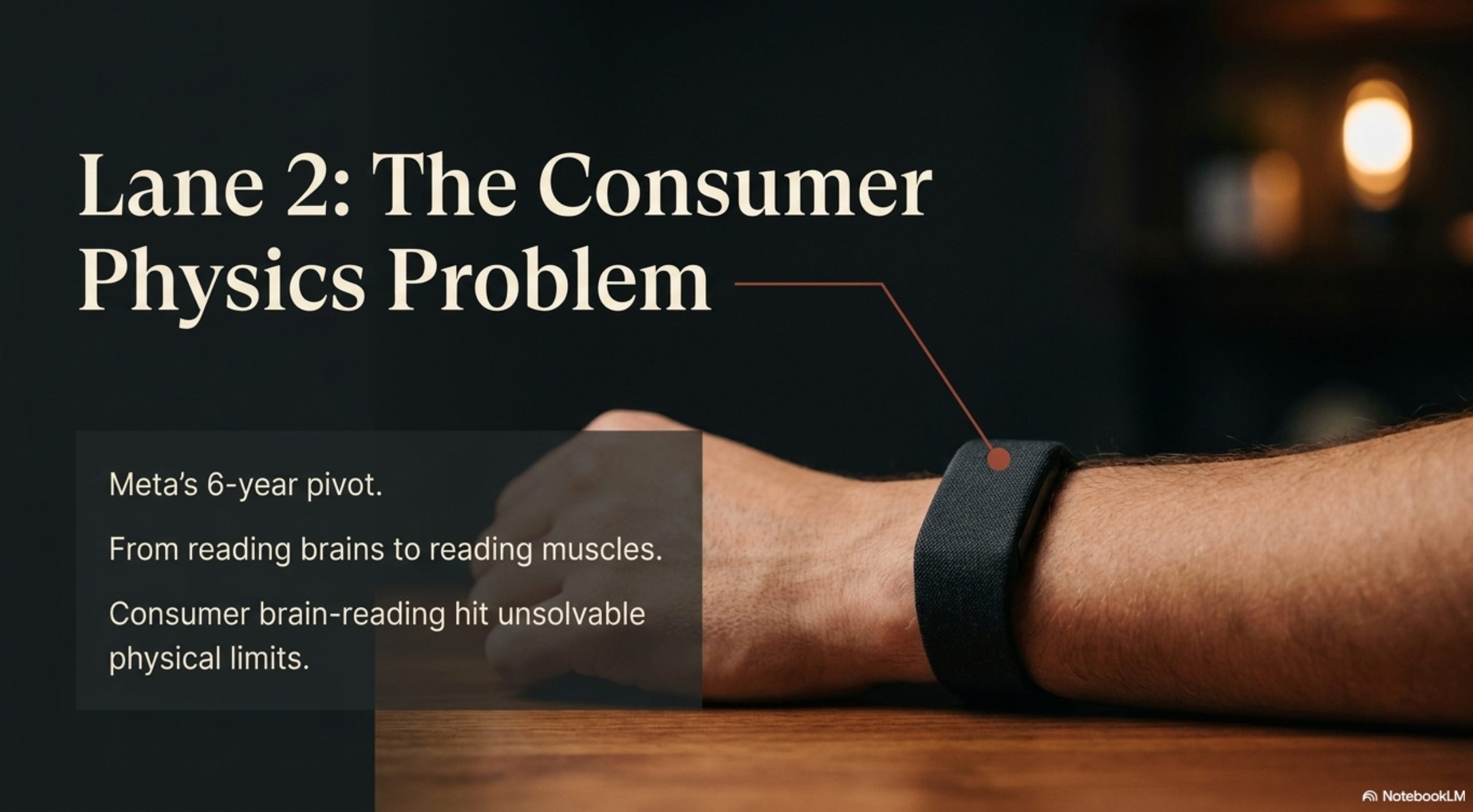
Is it Meta conceding the brain-reading goal hit physics they couldn’t solve at consumer cost and timeline?
What consumer brain wearables did at scale over the last decade:
Halo Neuroscience raised meaningful Khosla-backed money for a transcranial direct current stimulation (tDCS) headset for athletes, claimed “brain doping for elite performance,” and shut down in 2021. Assets sold to Flow Neuroscience.
Thync raised Khosla-backed money for a mood-modulation tDCS patch. Reviewers couldn’t reliably feel anything. Asset auction in 2016.
Cyberkinetics, the original BrainGate commercial entity, ran out of money by 2008 and sold its assets to Blackrock. BrainGate the research consortium continued. BrainGate the company didn’t.
Consumer cognitive enhancement for healthy adults hasn’t survived a hype cycle yet.
Lane 3: what the privacy storm means in practice
If your organization touches any of the following, you have work to do in 2026.
If you’re a healthcare payer or provider organization: there’s no Category I CPT code for any pure BCI procedure in 2026. The available Category III tracking codes don’t guarantee payment. Whatever pilot or vendor watch list you build needs to reflect that reimbursement requires FDA approval, which arrives years after the demos.
If you’re a benefits or HR leader at any large employer: ADA reasonable accommodation requests from BCI-using employees are starting to arrive. There’s no precedent, no case law, and OPM’s accommodation list doesn’t yet contemplate neural interfaces. Three questions that have no answer yet: (1) Is a BCI a reasonable accommodation that the employer must support? (2) Can an employer require BCI-based attention monitoring as a condition of employment, given the new state neural data privacy laws? (3) What does workplace privacy mean when the device the employee uses to do their job is also collecting brain-signal data the employer might have legal access to under a corporate monitoring policy?
If you run a consumer product with any kind of brain-signal sensor in it (a wellness wearable, an EEG-enabled feature, a sleep tracker that reads brain waves, a “focus” headphone): California AB 1008 sweeps you in. The compliance work is CCPA-grade.
If you’re an insurer pricing cyber and Errors & Omissions (E&O) coverage: neural data breach is a new exposure class. Lloyd’s of London has flagged quantum-computing risk as a systemic cyber issue; the equivalent flag on neural data hasn’t been raised yet. The category is small but the per-record sensitivity is high (neural data is at least as sensitive as health information under most US state laws, often more).
If you operate cross-border: Chile’s pending joint and several liability proposal is the broadest exposure on the horizon. A US consumer BCI vendor selling into the Chilean market would, if Bill 13828-19 passes as currently drafted, be on the hook alongside the local importer and the administering clinic. Mexico’s criminal penalties for mental manipulation (3-12 years in prison) are unique in the world. The EU MDR Class III deadline for standard manufactured implants is December 31, 2027. Vendors have eighteen months to get certified before selling a long-term implant into Europe is closed off.
Most large companies have done CCPA-grade inventories for personal information, payment card data (PCI), and protected health information (PHI).
A neural data inventory asks a different question: does any product, employee program, research partnership, or vendor relationship collect or process neural signals?
For most companies today the answer is no. For more of them every quarter, the answer will be yes.
How urgent is this, really?
The urgency varies by who you are.
For a healthcare provider with a neuro program, a consumer wearable company selling anything with an EEG sensor into California, or an employer with a Synchron-implanted ALS patient on payroll, the work is real and the calendar is short.
For most large companies with no BCI surface area today, the right move is a single addition to the existing California Consumer Privacy Act inventory (add “neural data” as a row, ask procurement whether any vendor is sweeping it in) and a watch on the next state Attorney General enforcement action.
That’s a one-page memo, not a privacy program.
Three moves that pencil out in 2026
For most companies (not pure-play neurotech, not Department of Defense, not academic medical centers), these three moves hold up:
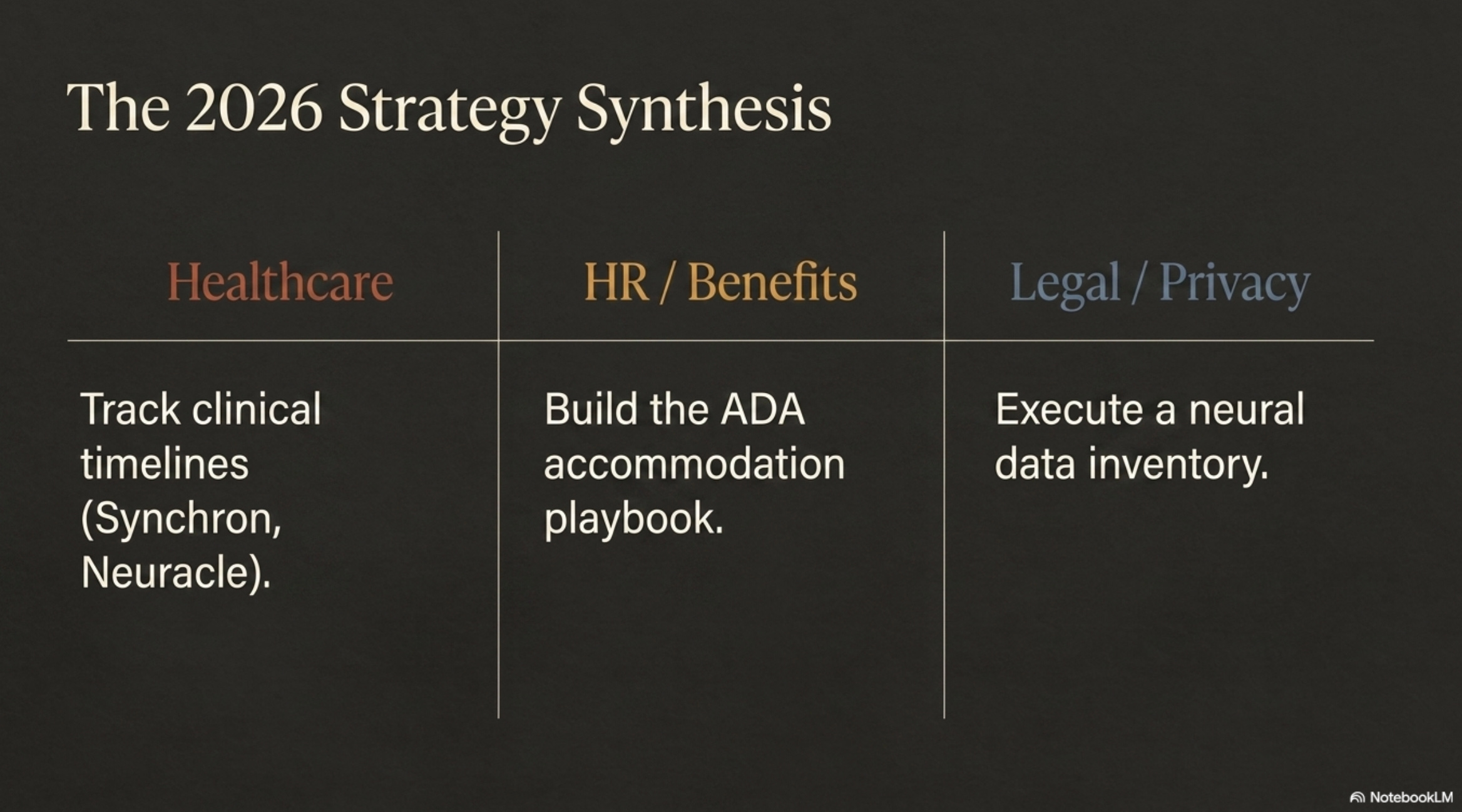
1. Neural data privacy inventory. This quarter.
The same shape as a CCPA-grade personal information inventory. Three questions to map across the company:
Does any product collect, process, or transmit neural signals (EEG, fNIRS, electromyography, or any signal from the central or peripheral nervous system)?
Does any HR or wellness program involve devices that do?
Does any research partnership or vendor relationship touch the same?
If the answer to any is yes, the next layer: under which of the five state laws does this fall, and what does the consent flow currently say?
2. BCI accommodation policy framework. This year.
Synchron has implanted patients working desk jobs today. The numbers are small; the precedent is forming.
The framework needs three things:
a position on whether the employer recognizes BCI use as a reasonable accommodation under ADA
explicit handling of neural data privacy in the workplace (what the employer can see, what it can’t, what it must not collect)
a guidance document for managers that names BCI use without making it strange.
3. Vendor watch list, not pilot.
For almost everyone, BCI isn’t a buy decision in 2026. Track a small number of vendors and a small number of regulatory dates. My shortlist:
Synchron for clinical credibility and US commercial timeline.
Neuracle for the first commercial product and the China-market read.
Precision Neuroscience for the FDA clearance pace.
ONWARD Medical for the brain-spine integration and the only public-equity read.
INBRAIN for the European graphene track.
The regulatory calendar items that matter:
FDA Breakthrough Device updates twice a year.
Synchron pivotal trial enrollment and primary endpoint dates.
State legislative tracker for the five neural data bills currently moving (VA, AL, NY, IL, MA).
UNESCO member-state implementation reports.
EU MDR Class III standard manufactured deadline (December 31, 2027) and Notified Body capacity.
Reassess in 2028. By then Beinao-1’s NMPA filing, Synchron’s FDA filing, Paradromics’s first speech-restoration results, and the second wave of state laws will give the next clean snapshot. Most companies don’t need to build a BCI capability between now and then. They need to track it and protect themselves from the privacy and accommodation exposures that are already live.
Where it lands
The clinical lane is real. It’s narrow, slow, and especially relevant for healthcare organizations.
Track it as a 10-year curve, not a 2-year curve.
The consumer lane is mostly marketing in 2026 and isn’t getting more credible fast. The Meta Neural Band arriving as a wristband instead of a brain reader is the tell. The proof of cognitive improvement from EEG headbands has failed control conditions for a decade and is still failing them.
The privacy lane is real, live, and underplayed. Five US state laws on the books. The European Union MDR Class III deadline for manufactured implants arriving December 31, 2027 (with custom-made already in force). UNESCO’s first global framework adopted. Chile’s pending joint and several liability provisions. Mexico’s criminal penalties. The ADA precedent forming under the surface. This is the lane where I see the biggest gap between what the trade press is covering and what’s happening in legislatures and standards bodies.
If your company collects any biometric brain or nervous-system data (through a consumer product, an employee wellness program, or a research partnership), where does your privacy team stand on Colorado HB 24-1058 and California AB 1008? If you can’t answer with a date, that’s the work for this quarter.
Not the Neuralink pilot.
References
Government / regulator / academic / peer-reviewed (Tier 0):
Card, Willett et al., “An Accurate and Rapidly Calibrating Speech Neuroprosthesis,” NEJM August 14, 2024 — nejm.org
Synchron SWITCH study, JAMA Neurology January 2023 — mountsinai.org
Precision Neuroscience pilot, Nature Biomedical Engineering October 2025 — fiercebiotech.com
Colorado HB 24-1058 bill text — leg.colorado.gov
California AB 1008 bill text — leginfo.legislature.ca.gov
UNESCO Recommendation on the Ethics of Neurotechnology, November 2025 — unesco.org
Chile Law 21.383 analysis — jurist.org
Chile Bill 13828-19 (pending joint-and-several liability for neurotechnology) — Chilean Congress Boletin 13828-19
Mexico Senate review of neurorights bill (Senator Lagunes, 3-12 year penalties for mental manipulation) — mexicobusiness.news
The Lancet Psychiatry, “The regulation of neurotechnology: the neurorights bill in Mexico” (2024) — thelancet.com
Vermont H.814 bill text (signed May 18, 2026; effective July 1, 2026) — legislature.vermont.gov
Inside BCI, “Vermont signs H.814 into law, becoming the fifth US state with a neural rights statute” — insidebci.com
Wall Street Journal, Neuralink thread retraction reporting (May 2024; primary source for the 85% figure) — WSJ archive
BCI Intel chronic implant tracker (107 chronic figure) — bciintel.com
ABILITY Neurotech first chronic implantation (scheduled September 2026, UMC Utrecht) — Wyss Center Geneva press materials
Bain Capital lead investment in Merge Labs ($252M, January 2026) — Bloomberg / TechCrunch coverage
ClinicalTrials.gov BrainGate2 (NCT00912041) — clinicaltrials.gov
ClinicalTrials.gov GB-PRIME (NCT07127172) — Neuralink UK trial
Stanford Law Bioscience Blog on UNESCO Recommendation, March 2026 — law.stanford.edu
Future of Privacy Forum, Neural Data Goldilocks Problem — fpf.org
EU Medical Device Regulation Class III timeline — emergobyul.com
Adam Marblestone et al., “Physical Principles for Scalable Neural Recording,” Frontiers in Computational Neuroscience 2013 — frontiersin.org
First-party company (Tier 1):
Neuralink Updates page — neuralink.com
Neuralink Series E announcement, June 2025 — neuralink.com
Synchron / Apple BCI HID announcement, May 2025 — businesswire.com
Paradromics first-in-human announcement, May 2025 — paradromics.com
Paradromics Connect-One FDA IDE, November 2025 — paradromics.com
Science Corporation Series C announcement, March 2026 — science.xyz
OpenAI investment in Merge Labs — openai.com
ONWARD Medical ARC-IM program — onwd.com
Blackrock Neurotech MoveAgain Breakthrough designation — blackrockneurotech.com
Established journalism (Tier 2):
MIT Technology Review, You Xiaoying, “China has approved the world’s first invasive brain-computer chip” (June 1, 2026) — technologyreview.com
MIT Technology Review, Antonio Regalado, “Neuralink demo is neuroscience theater” (August 2020) — technologyreview.com
Bloomberg, “Neuralink Sees $1B of Revenue by 2031” (July 2025) — bloomberg.com
Bloomberg, “Altman’s Merge raises $252 million” (January 2026) — bloomberg.com
TechCrunch, “OpenAI invests in Sam Altman’s brain computer interface startup Merge Labs” (January 2026) — techcrunch.com
STAT News, “What does Neuralink want?” (January 2026) — statnews.com
STAT News, “Brain-computer implants are coming of age. 3 trends to watch in 2026” (December 2025) — statnews.com
NBC News, Neuralink thread retraction coverage (May 2024) — nbcnews.com
Scientific American, “China just approved its first brain implant” — scientificamerican.com
Scientific American interview with Noland Arbaugh — scientificamerican.com
KFF Health News, “States Pass Privacy Laws To Protect Brain Data” — kffhealthnews.org
Nature, “China moves AI brain implants from trials towards real-world use” — nature.com
Fierce Biotech, “China approves first BCI for paralyzed patients” — fiercebiotech.com
Fierce Biotech, “FDA clears Precision Neuroscience’s minimally invasive BCI” — fiercebiotech.com
South China Morning Post, “Inside China’s 15th Five-Year Plan” — scmp.com
Popular Science, “85% of Neuralink wires detached” — popsci.com
Gizmodo, MW75 Neuro review — gizmodo.com
Tom’s Guide, MW75 Neurable review — tomsguide.com
Industry analysis / law firm advisories (Tier 3, color only):
BCI Intel implant count tracker — bciintel.com
BCI Intel State of BCI 2026 — bciintel.com
Cooley LLP, “Your Brain, Their Rules” (February 2026) — cooley.com
Arnold & Porter, Neural Data Privacy Regulation (July 2025) — arnoldporter.com
Morrison Foerster, More States Propose Privacy Laws (March 2025) — mofo.com
ArentFox Schiff, “The BCI Race: Is the Law Ready?” — afslaw.com
PLOS One, Consumer-grade EEG scoping review — journals.plos.org
PMC, Consumer-grade neurofeedback meta-analysis — pmc.ncbi.nlm.nih.gov
Pew Research, Human Enhancement attitudes (2022) — pewresearch.org
Precedence Research, Deep Brain Stimulation market — precedenceresearch.com
The media keeps mashing three distinct BCI vectors into one generic hype cycle. 🧬 That is an architectural error.
Lane 1 is clinical reality. Exactly 107 humans currently live with a chronic brain implant. The total aggregate sits around 220 once you include temporary intraoperative procedures. Compare 220 against the 5.4 million paralyzed Americans or 30,000 ALS patients. We're looking at under 0.01% penetration. While China's Neuracle NEO snagged the first commercial approval with an 8-sensor dura film, Precision Neuroscience is testing 1,024 electrodes in 30-day windows. The bottleneck isn't commercial ambition. It's biological signal encapsulation and scar-tissue buildup degradation.
Lane 2 is consumer enhancement. It's mostly marketing theater. 🎧 Meta spent six years and a billion dollars building a brain reader. They shipped a wristband that reads muscle twitches on the forearm. That isn't a failure of engineering, it's a concession to physics. Direct cortical EEG suffers from severe signal-to-noise degradation through the skull. Peripheral electromyography is simply the only viable low-latency path for consumer input.
Lane 3 is where the actual crisis sits: neural data privacy. ⚖️ California's AB 1008, Colorado's HB 24-1058, and Vermont's new H.814 have quietly made neural telemetry a protected legal category. If your $699 focus headphones or wellness headband record central nervous system signals, you're handling sensitive data under strict compliance laws today.
Neural decoding cannot live as probabilistic cloud API calls. Biological intent must compile into local, SRAM-bound fast-weight operators gated by hardware-attested AST execution boundaries at the OS level. If the decoder isn't running isolated on-device, you're streaming raw cognitive state straight into an un-sanitized data sink.
Are your privacy architecture teams tracking California AB 1008, or are they still waiting for Neuralink press releases? 👁️🗨️