


I know the dire wolf the way most people do — from Game of Thrones. The big loyal wolves the Stark kids raise from pups.
So last year, when the news went around that a company had actually brought the dire wolf back — the real animal, not the HBO version — it stuck with me.
Wait, that’s a real thing now?
It sat in the back of my head for months, and I finally went and looked into whether it was true.
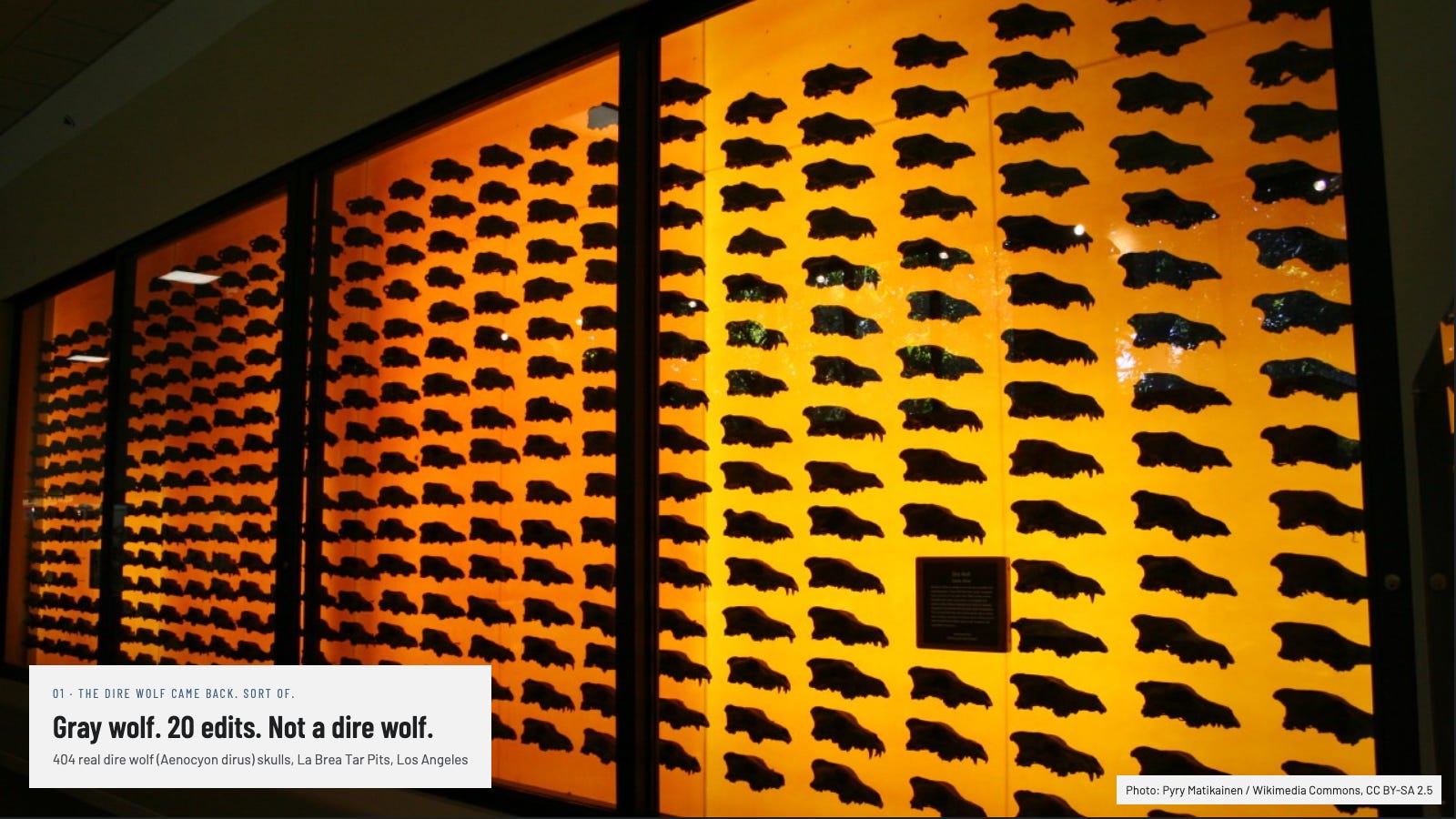
On April 7, 2025, a Dallas company called Colossal Biosciences announced that the dire wolf was back. Not as a metaphor — three actual animals.
Two males, Romulus and Remus, born that October, and a female named Khaleesi. White coats, already big, filmed running around in the snow on some undisclosed preserve. The real dire wolf had been gone for something like twelve thousand years, and here it was on the cover of Time with the word EXTINCT crossed out in red. The internet lost its mind, and honestly, fair enough.
Here’s what they actually did.
They took a gray wolf’s genome — the kind you can see in Yellowstone — and made 20 edits across 14 genes. 15 of them copied real dire-wolf DNA, pulled from a 13,000-year-old tooth and a 72,000-year-old ear bone. The other 5 had nothing to do with dire wolves at all; they were for a white coat, and the team picked those on purpose, because copying the real dire-wolf color genes could have left the animals deaf or blind. Then they cloned the edited cells — using blood cells instead of cutting into an animal, which is a neat trick — and grew the embryos in dog surrogates.
Dire wolves and gray wolves last shared an ancestor around 5.7 million years ago — different enough that the gray wolf you’re picturing is actually closer kin to an African jackal than it is to the dire wolf.
So 20 edits isn’t bringing the real dire wolf back.
The clearest description of what they actually made came from Colossal’s own chief scientist, the paleogeneticist Beth Shapiro, who called them “gray wolves with 20 edits.”
So are the wolves fake? No, and but it helps to understand more.
Romulus, Remus, and Khaleesi are real, healthy animals, each now well over 120 pounds, living on a 2,000-acre preserve with no plan to ever let them go. What they pulled off is real engineering.
They’re just not dire wolves. They’re gray wolves in dire-wolf clothes.
And the gap between what got announced versus what got built is representative of the whole story of this field.
What “de-extinction” really means
This is a whole branch of science I didn’t know existed!
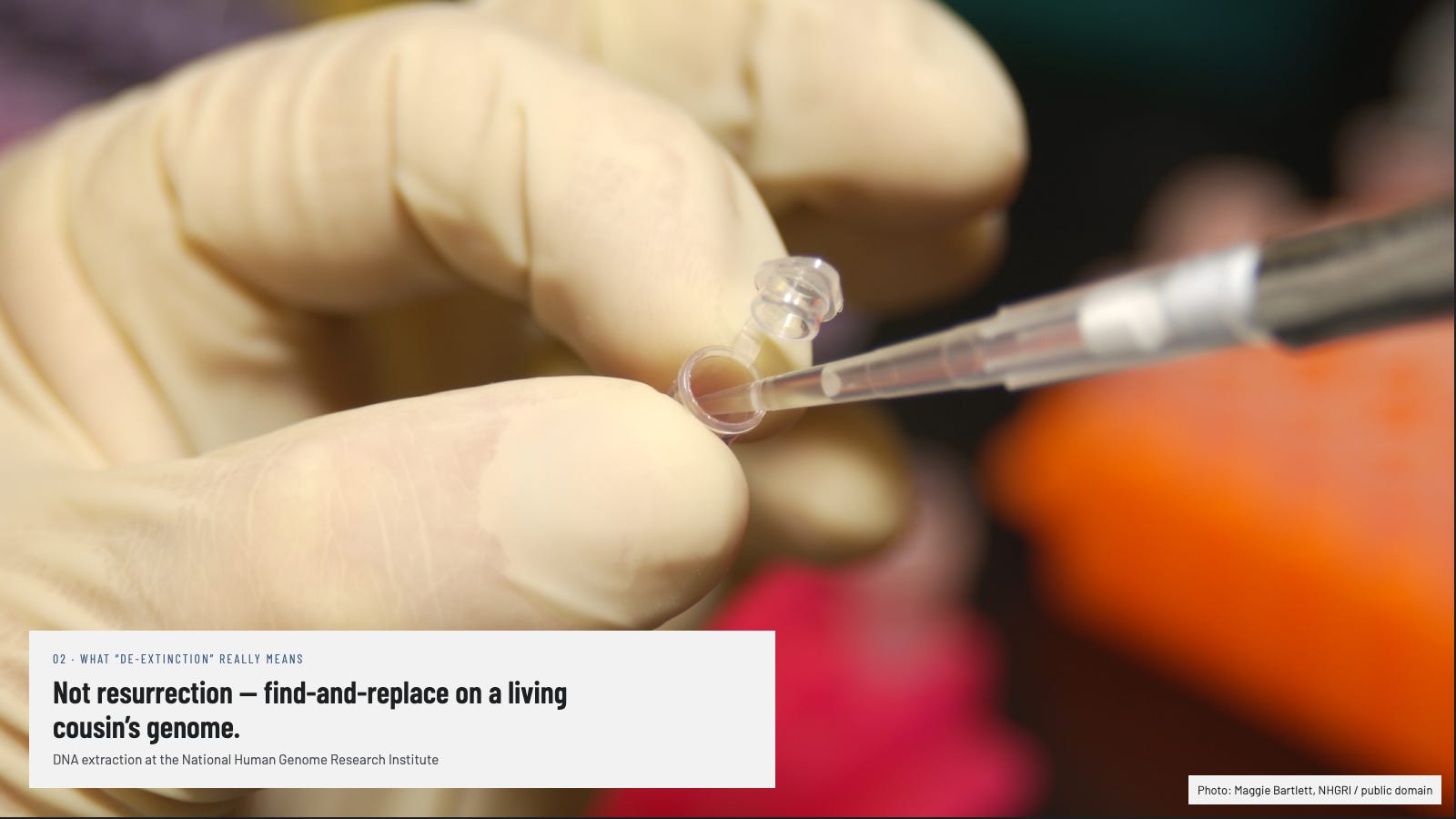
The basic idea is the same every time. You take whatever DNA you can get from the extinct animal — usually a few scraps in bad shape — and compare it to its closest living relative. Wherever they differ, you pick a few changes that seem to matter and use CRISPR to make them in the living animal. Then you need something to give birth to it: for a mammal, you clone the edited cell into a surrogate; for a bird, where cloning doesn’t work the same way, you edit the cells that turn into eggs and sperm and let a surrogate bird carry it.
ELI5: Why can’t they just copy the extinct animal directly?
Because you never have the whole book — only shredded pages. Ancient DNA comes in short, broken, contaminated fragments. You can reconstruct a rough reference and spot the important differences, but you can’t recover a complete, error-free genome to copy. So instead of reprinting the lost animal, you take its living cousin and find-and-replace a few genes. What you get resembles the original. It isn’t the original.
Here’s the catch the marketing skips: none of this rebuilds the extinct animal. The people who set the rules for conservation a body called the IUCN, won’t even use the word “de-extinction.” They call these animals “proxies.”
And a lot stands in the way. You can only make a few dozen edits at a time, but a mammoth is over a thousand genes off from an elephant — so you’re not rewriting the book, you’re swapping a few dozen words and hoping it reads like a different story. The DNA you start from is patchy to begin with. And for anything big, there’s no artificial womb and something alive still has to carry the pregnancy, which is why a mammoth would need an elephant, and nobody’s pulled that off.
So the most anyone can do right now is tweak a living animal to look like a dead one.
Could we rebuild it? No. Everything so far is a proxy.
Who’s in the race
Almost all of this runs through one company. Colossal Biosciences, out of Dallas, started by the entrepreneur Ben Lamm and the Harvard geneticist George Church, is the giant of the whole business. They are worth around $10 billion in early 2025, and reportedly in talks since to raise at $20 to $30 billion. Nearly every animal in this piece is theirs. The one other serious American outfit is Revive & Restore, a nonprofit that’s worked on the passenger pigeon for more than a decade and takes a quieter, more academic road.
Then it gets interesting, because the rest of the world is doing the weirder, harder parts.

Australia is after the thylacine, the Tasmanian tiger — out of a University of Melbourne lab run by Andrew Pask, working with Colossal. New Zealand is chasing the giant moa, a flightless bird that stood up to 12 feet, through the Ngāi Tahu Māori research center, the University of Canterbury, and Canterbury Museum, bankrolled with $15 million from the filmmaker Peter Jackson.
Russia has the strangest and most romantic piece of it. In the Siberian Arctic, a father-and-son team — Sergey and Nikita Zimov — run Pleistocene Park, a reserve where they’re rebuilding the ancient “mammoth steppe” grassland a real mammoth would need to survive. They’re doing it with bison, musk ox, camels, and horses, letting the animals trample the tundra back into pasture. They are, in other words, building the house before anyone’s built the tenant. The project limped through the last few years with no expeditions in 2022 and stays alive mostly on American and German donations.
Japan has the saddest near-miss. In 2019, a team at Kindai University led by Akira Iritani pulled 88 cell nuclei from “Yuka,” a 28,000-year-old mammoth dug out of the permafrost, and slipped them into mouse eggs. A few flickered. Spindle proteins started to assemble, the very first motion a cell makes before it divides. And then nothing. The DNA was too broken to go further. It wasn’t a step toward a mammoth so much as a gorgeous, final proof of the wall.
South Korea gave the story its most human turn. Sooam Biotech, founded by Hwang Woo-suk — the cloning celebrity whose stem-cell papers were exposed as fraud back in 2005 — spent years on a splashy plan to clone a mammoth from Siberian cells. It never found a single usable nucleus. Hwang has since moved to a lab in Abu Dhabi, where he now clones prize camels for rich Gulf owners. The mammoth dream quietly turned into a camel business.
China isn’t chasing anything extinct, but it’s quietly built the best cloning shop on the planet — the first cloned monkeys, back in 2018, and, in 2025, cloned Tibetan yaks — a livestock-breeding program first, with conservation as a side benefit. And the UAE, besides hosting Hwang’s camels, shows up the way it usually does: as money. Gulf capital is part of what’s funding Colossal.
If we step back, the map tells a story.
The glossy, well-funded work is American. The rest of the world is stuck with the slow, hard, often stalled parts like the habitat, the cell biology, the patient cloning which never make the headline.
What’s actually been brought back so far
Strip away the marketing, and the real scorecard is brutal: one birth, dead within minutes.
Her name was Celia — a Pyrenean ibex, a wild mountain goat also called the bucardo. The last one died in 2000 when a tree fell on her, but a year earlier scientists had frozen a bit of her skin. In 2003 they cloned her and put the embryo in a domestic goat. The clone was born alive and died within minutes, from a lung that never formed right. It holds a genuinely strange double record: the first extinct animal ever brought back, and the first to go extinct twice. That was more than twenty years ago, and nobody’s cleanly beaten it since.
Everything since has been a stand-in. The dire wolves are gray wolves with 20 edits. The other headline animal, the “woolly mouse” from early 2025, is a lab mouse given 8 edits for mammoth-ish fur — a real proof that you can stack that many edits at once, and also, at the end of the day, a fuzzy mouse that has nothing to do with mammoths, written up in a paper that hasn’t even cleared peer review. Cool science but definitely not a resurrection.
Here’s the part that surprised me: the genuinely impressive wins from all this gear are for animals that never went extinct at all.
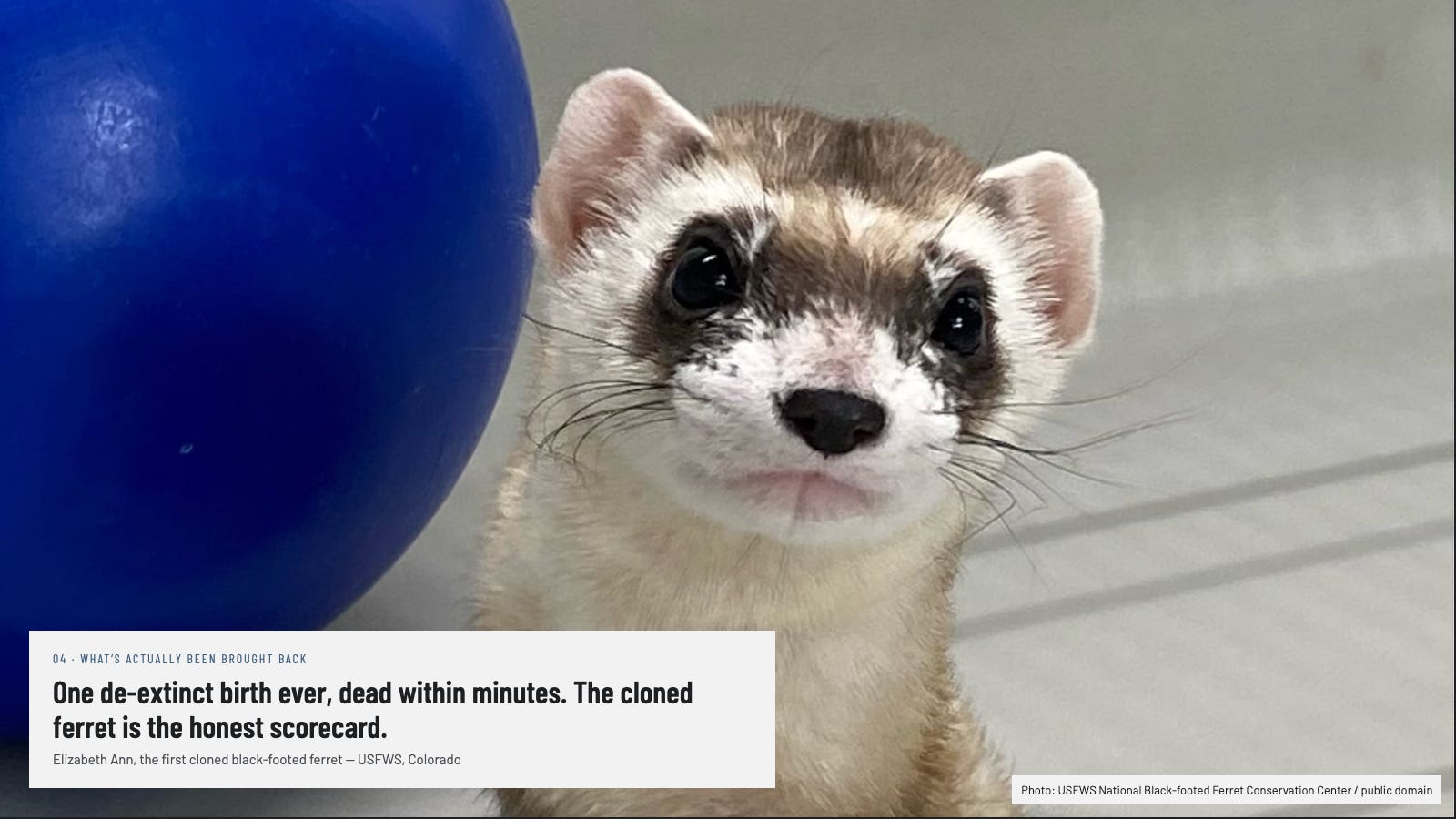
A black-footed ferret named Elizabeth Ann, cloned in 2020 from cells frozen since the 1980s — from a female named Willa with no living descendants. She couldn’t breed herself, but later clones of the same donor could, and one of them, Antonia, had a litter in 2024. That pushed a long-dead female’s genes back into a population descended from just seven animals. Willa now counts as the eighth.
Two Przewalski’s horses, Kurt and Ollie, cloned from a cell line banked decades ago — for the same reason. Every one of the roughly 2,000 alive today descends from just 12 ancestors, and the clones widen a scarily narrow gene pool.
The northern white rhino, down to two females and no males left anywhere on Earth. Scientists have banked 39 embryos and tried six transfers into surrogate rhinos as of April 2026. No pregnancy has held. No calf.
Every one of them does more real good for an actual species than the dire wolves ever will.
What’s being worked on
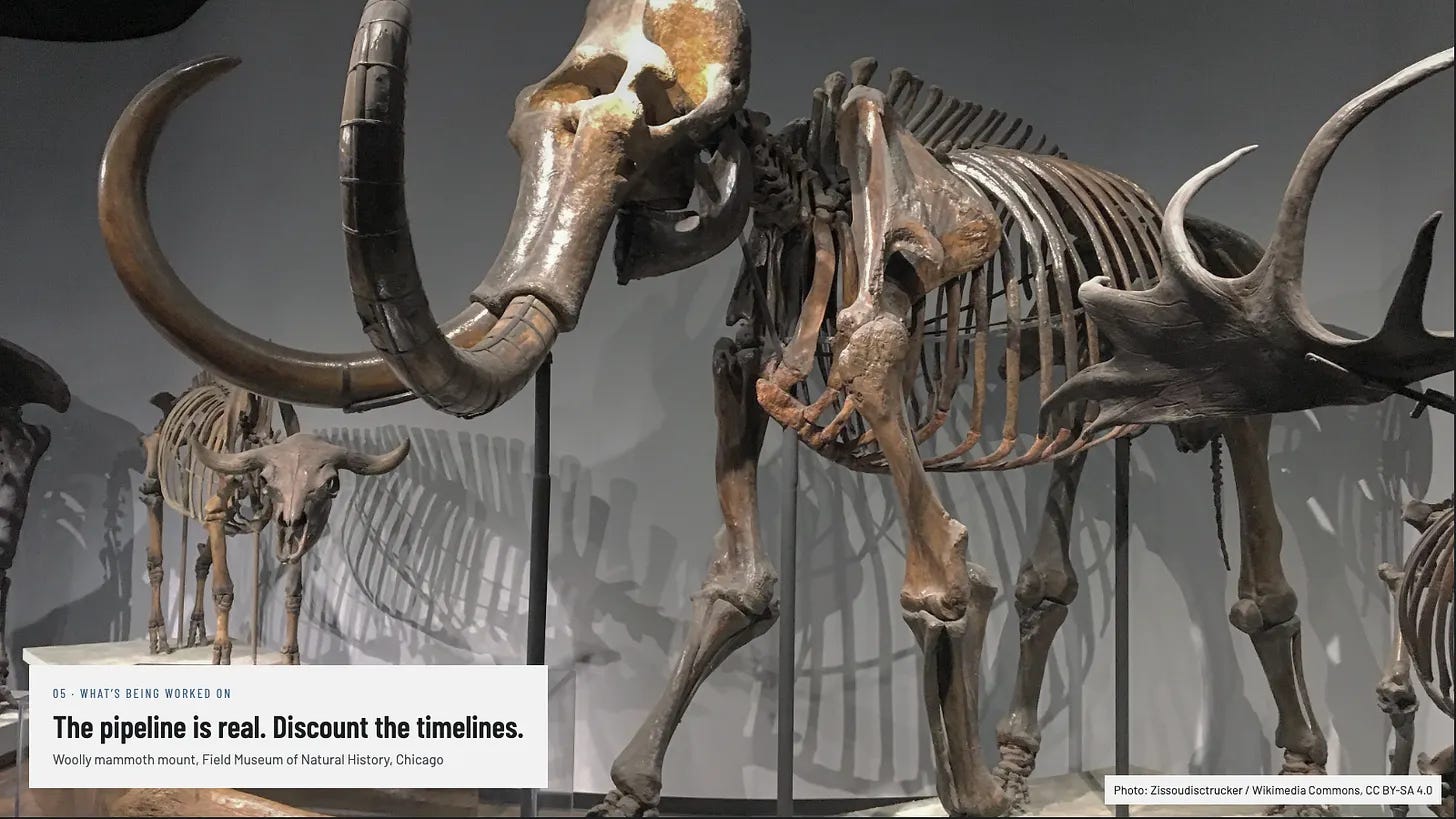
The de-extinction pipeline is real, and so is the ambition. It’s the timelines I’d take with a grain of salt.
The woolly mammoth is the flagship. Colossal wants a mammoth-like calf which is really a heavily edited Asian elephant by the end of 2028. That’s their number, not an outsider’s, and the scientists I read put it closer to a decade out, or never. The real holdup isn’t the editing; it’s the pregnancy. An edited embryo has to implant and survive 22 months inside an elephant, which has never been done, and as Colossal’s own chief scientist Beth Shapiro put it, that’s “22 months of biology that’s really out of our control.”
The dodo is further back than it sounds. Birds can’t be cloned the way mammals are, so the work goes through the cells that become eggs and sperm, carried by a Nicobar pigeon, the dodo’s nearest living cousin. They hit a real milestone in September 2025 but there’s no edited embryo yet, and no hatch date.
The thylacine, the Tasmanian tiger, has a genome the company calls basically complete. The problem is the womb. The planned surrogate is a fat-tailed dunnart, a marsupial about the size of a mouse — and a thylacine grew to somewhere around 17 kilograms. Nobody has figured out how you get from one to the other.
The moa is the newest and flashiest, but it has no living relative big enough to carry it, which makes “walking by 2035” sound more like a wish than a plan. And the passenger pigeon, worked on for over a decade, is refreshingly honest about its own math: no bird in the wild before about 2040, and none exists yet.
Every timeline that ends in a living, breathing animal is measured in years-to-never. Every milestone you can actually point at today is a lab step — a cell line, a genome, an embryo. Not a creature.
So where does the dinosaur fit in?
Right about here, because I know it’s the question you actually came in with.
Can any of this get us a dinosaur?
No. But it’s worth knowing why, because the why is the best part.
Let’s go back to those moa bones. In 2012, scientists ground up 158 of them in New Zealand to measure how fast DNA falls apart. The answer was a half-life of about 521 years. That number gets quoted a lot and it is easy to misread, because it does not mean half the molecule dissolves every 521 years. DNA snaps at random points along its length, and what halves is the supply of fragments still long enough to read. The individual chemical bonds are far tougher than that, lasting well over a hundred thousand years. It is the long stretches that go first, and long stretches are the only thing carrying usable information.
Cold slows it down, heat speeds it up, but it only runs one way. Even frozen in a perfect deep freeze, the most generous math says the code goes unreadable after about 1.5 million years, with the last bonds gone by around 7 million.
The oldest DNA anyone has ever pieced back into something like a genome came from a mammoth tooth frozen for 1.2 million years. Non-avian dinosaurs died out 66 million years ago at fifty times past the line.
No sample, no lab, no amount of money gets you there.
ELI5: But didn’t they find soft tissue in a T-Rex bone?
They found what look like preserved protein fragments — and that’s real, and it genuinely shook up the field. But proteins aren’t DNA. Proteins are far tougher, and they carry no instructions you can build an animal from. Earlier claims of actual dinosaur DNA turned out to be contamination from modern humans, fungi, and plants. The amber-mosquito premise from Jurassic Park was fiction when the movie came out, and it’s still fiction now.
Here’s the twist, and it’s a good one.
We already share the planet with dinosaurs. Birds are dinosaurs and not descendants of them, but the one branch of the family, the feathered theropods, that lived through the asteroid. A chicken is more closely related to Tyrannosaurus rex than T. rex was to a Stegosaurus.
That rotisserie chicken in your cart is, no joke, a dinosaur.
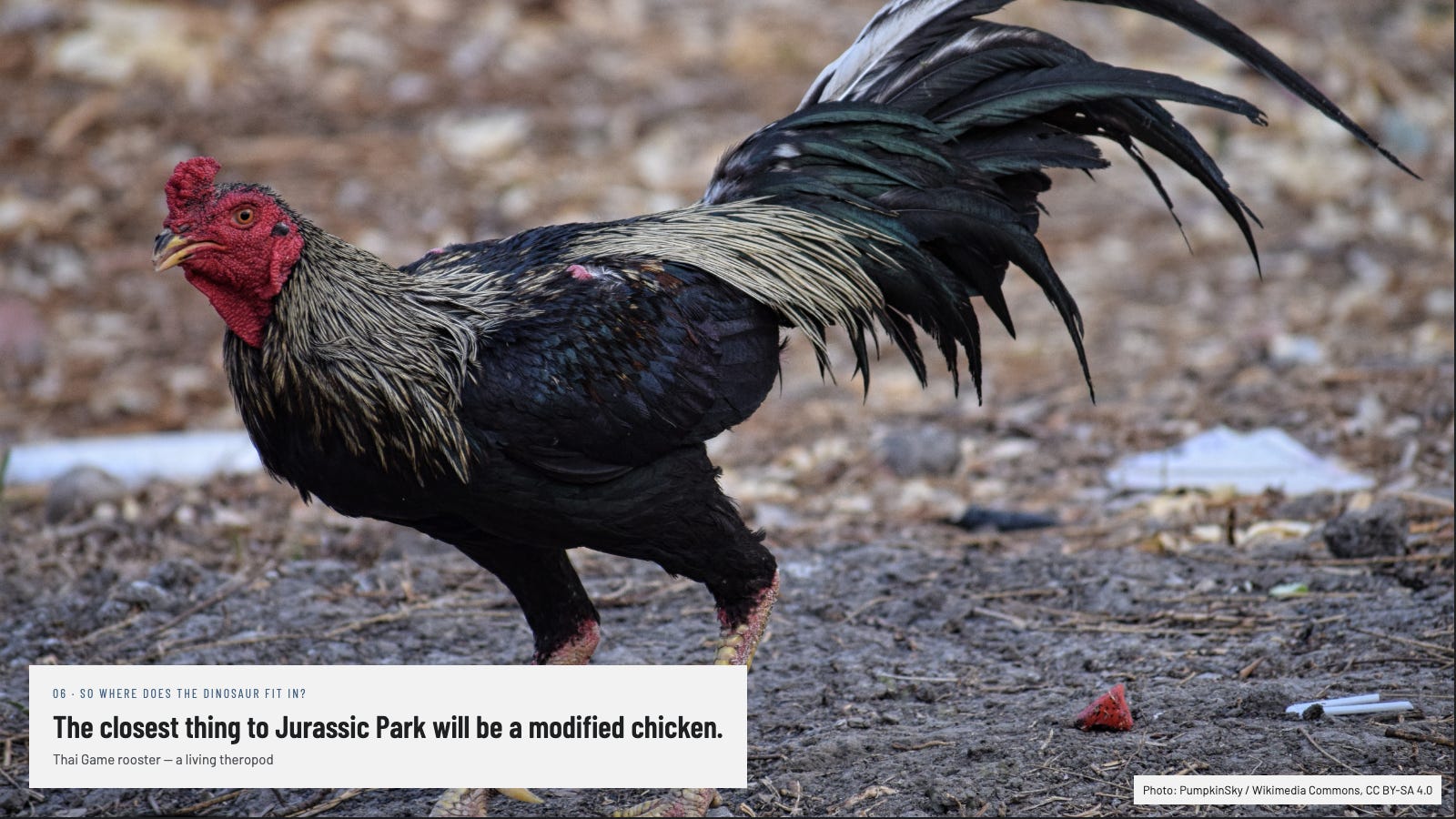
So the closest anyone gets to building one doesn’t go through ancient DNA at all. It goes through a chicken.
A living bird still carries the old dinosaur instructions, switched off over a hundred-odd million years but never thrown away. Turn some of them back on, and ancestral traits start showing up. This is a real project, not a gag: the paleontologist Jack Horner, who advised the Jurassic Park movies, has spent years on what he calls the “chickenosaurus” — trying to bring back four dinosaur features in a chicken: a snout instead of a beak, teeth, clawed hands instead of wings, and a long tail.
Three of the four already work, at least in the egg:
In 2015, researchers at Yale and Harvard switched off one signal in chicken embryos and watched the beak grow back toward a dinosaur-like snout. They didn’t hatch them, and the researchers were careful about what they claimed: the embryos grew an ancestral-looking snout, which is not the same as giving a bird a dinosaur face.
In 2006, a mutant chicken grew little cone-shaped, alligator-ish teeth — because birds lost their teeth about 116 million years ago but never deleted the recipe. It was just switched off, waiting.
In 2016, another team coaxed a chicken’s lower leg bone back toward the long, tubular dinosaur shape.
The tail is the holdout. There’s no single switch to flip, so a real dinosaur tail is still out of reach. And nobody has ever put the traits together, or hatched any of these embryos. They stay in the dish because some of it is partly ethics, partly the fact that a chicken with a dinosaur snout might not be able to eat.
And even if someone built the whole thing and let it hatch, Horner is the first to tell you what you’d get: a modified chicken. A bird in dinosaur clothes. Not a T. rex, not a Velociraptor, not any actual animal that ever lived which is the exact same gap as the gray wolf in dire-wolf clothes I started with.
So that’s where it all points to.
No T-Rex, ever. No mammoth for years. A handful of engineered look-alikes — real, remarkable animals, but not the ones on the label.
And underneath the whole show, a genuinely useful set of tools for keeping the species we’ve still got from slipping away.
The closest thing to Jurassic Park anyone will ever build is a chicken with teeth.
What a fascinating read! Thanks for researching and the awesome level of detail. it would be very interesting to explore the ethical implications of this technology.