

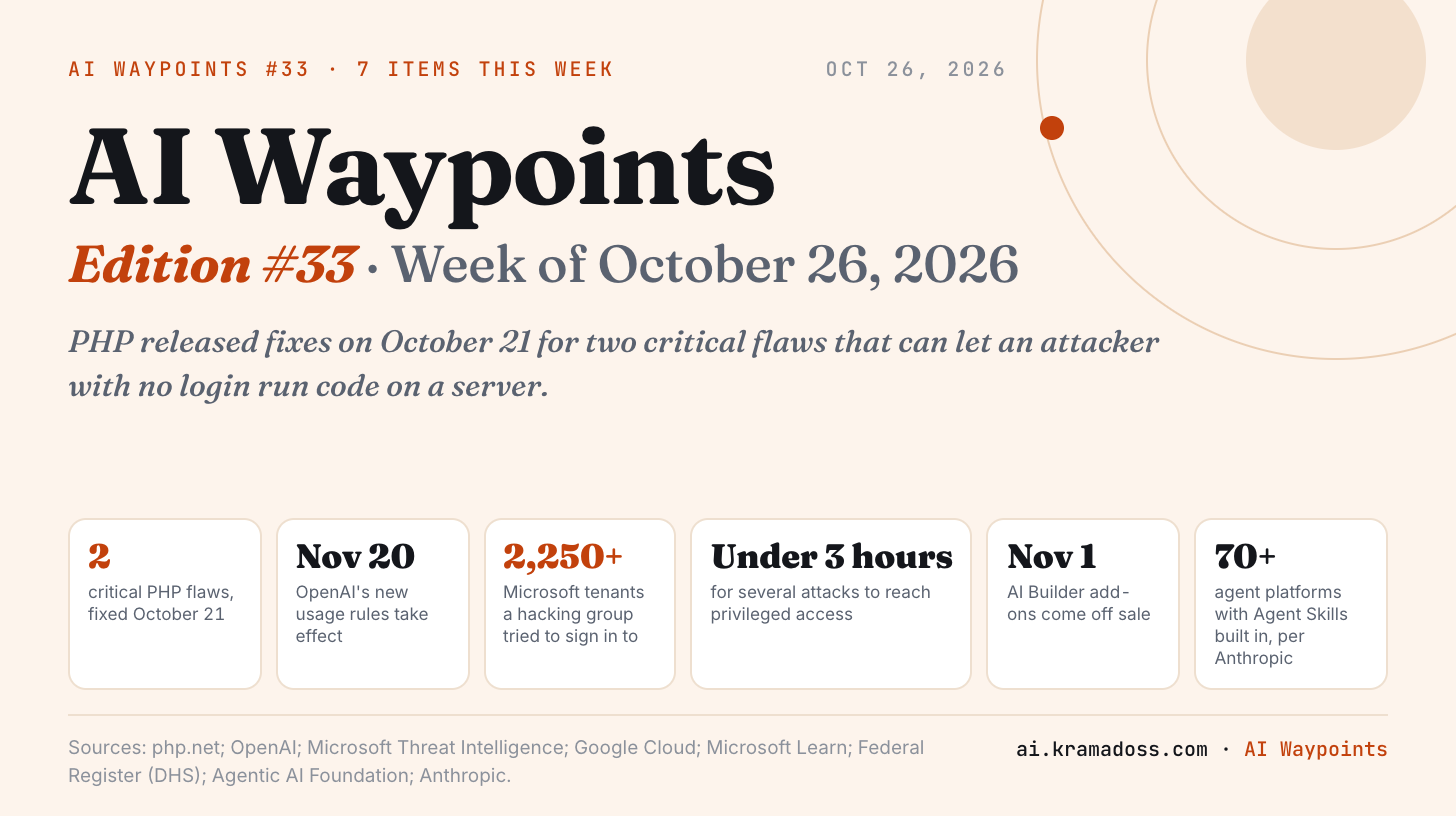
Good morning. From November 20 OpenAI wants to approve any service that gives other companies direct access to its models. And Microsoft says a China-aligned group used AI agents to try to sign in to more than 2,250 Microsoft customer tenants through ConnectWise’s apps.
Since last week I also published:
Science Sundays: The State of Orbital Data Centers — the servers are over half the bill and cost the same in orbit.
The Token Paradox, Six Months Later: The Count Overstates the Bill — nine in ten agent tokens are cheap re-reads.
1. PHP ships fixes for two critical flaws
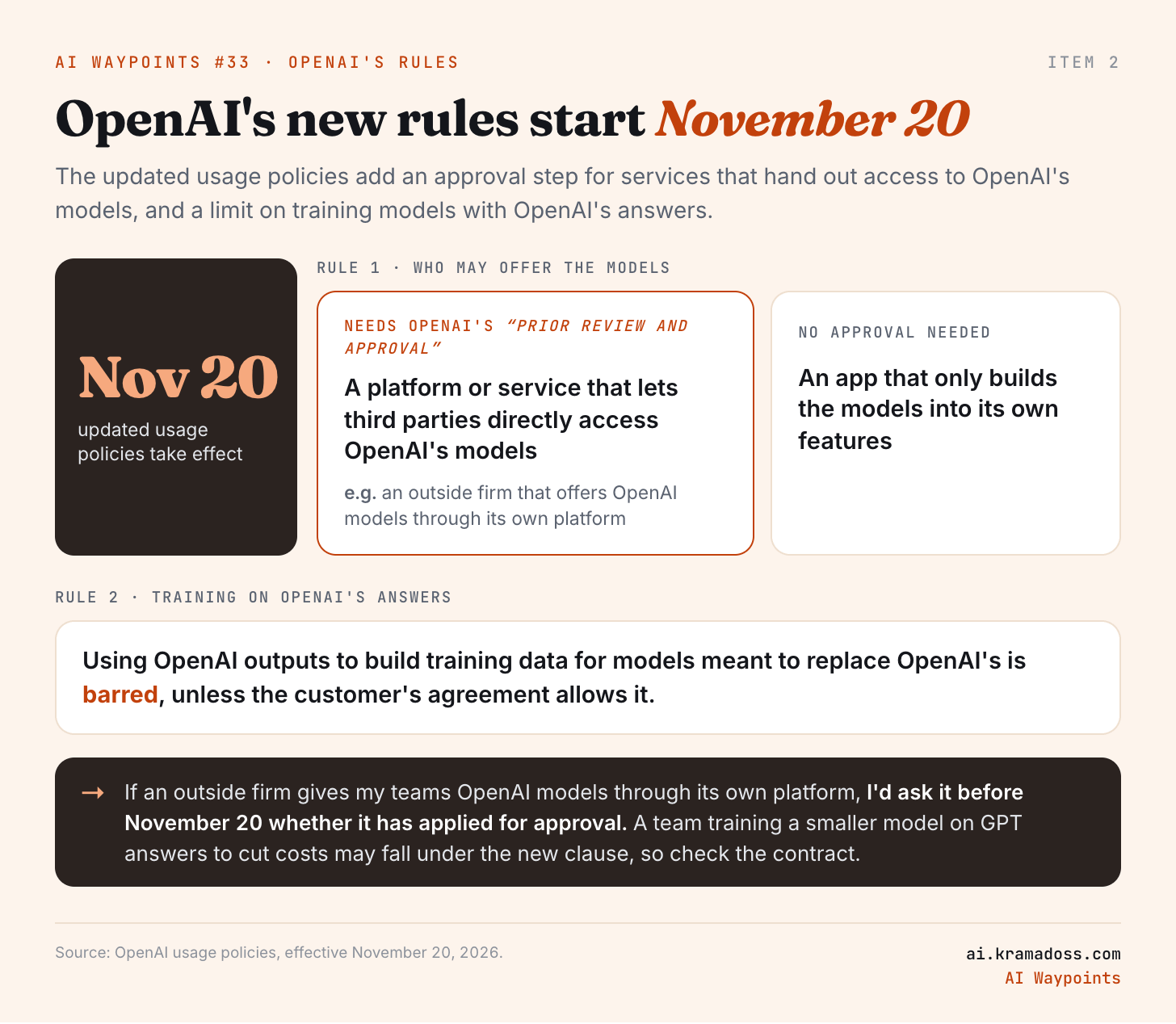
On October 21 the PHP project released 8.5.12, 8.4.27, 8.3.36 and 8.2.35 to fix two critical flaws that can let an attacker with no login run code on a server, and told users to “update immediately.” OpenAI says security firm Calif found one of them using OpenAI’s GPT-5.6 Sol model, and Wiz found both independently.
→ A lot of PHP runs at agencies and hosting firms rather than in-house, so I’d ask each of them which version they are on this week. Anything on PHP 8.2 needs an upgrade plan too, because it stops getting security fixes on December 31.
2. OpenAI’s new rules reach resellers and distillation
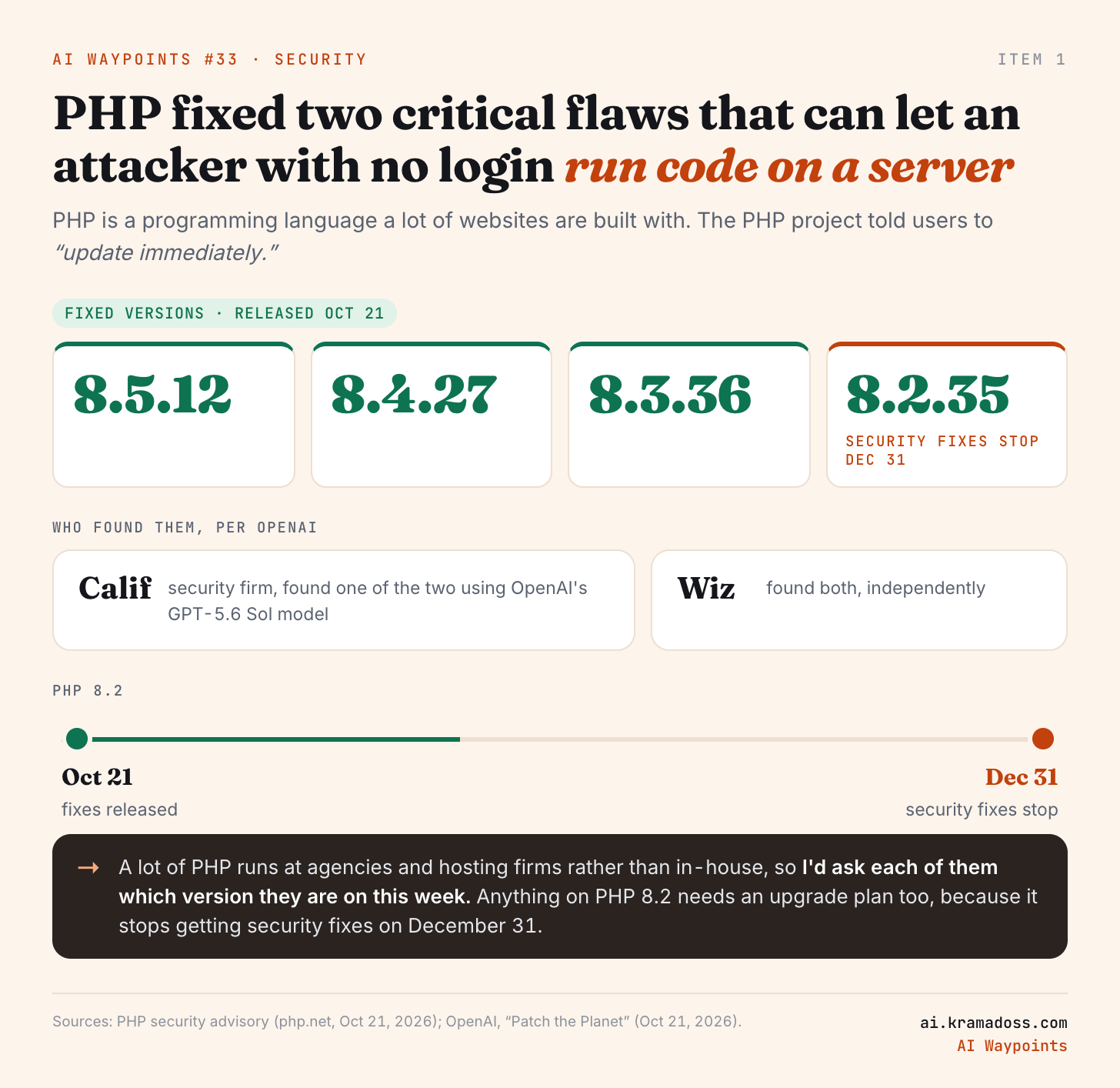
OpenAI’s updated usage policies, effective November 20, say any platform or service that lets third parties directly access its models needs OpenAI’s “prior review and approval,” while apps that only build the models into their own features don’t. The update also bars using OpenAI outputs to build training data for models meant to replace OpenAI’s, unless the customer’s agreement allows it.
→ If an outside firm gives my teams OpenAI models through its own platform, I’d ask it before November 20 whether it has applied for approval. A team training a smaller model on GPT answers to cut costs may fall under the new clause, so check the contract.
3. Microsoft says hackers ran AI agents through ConnectWise (20 min read)
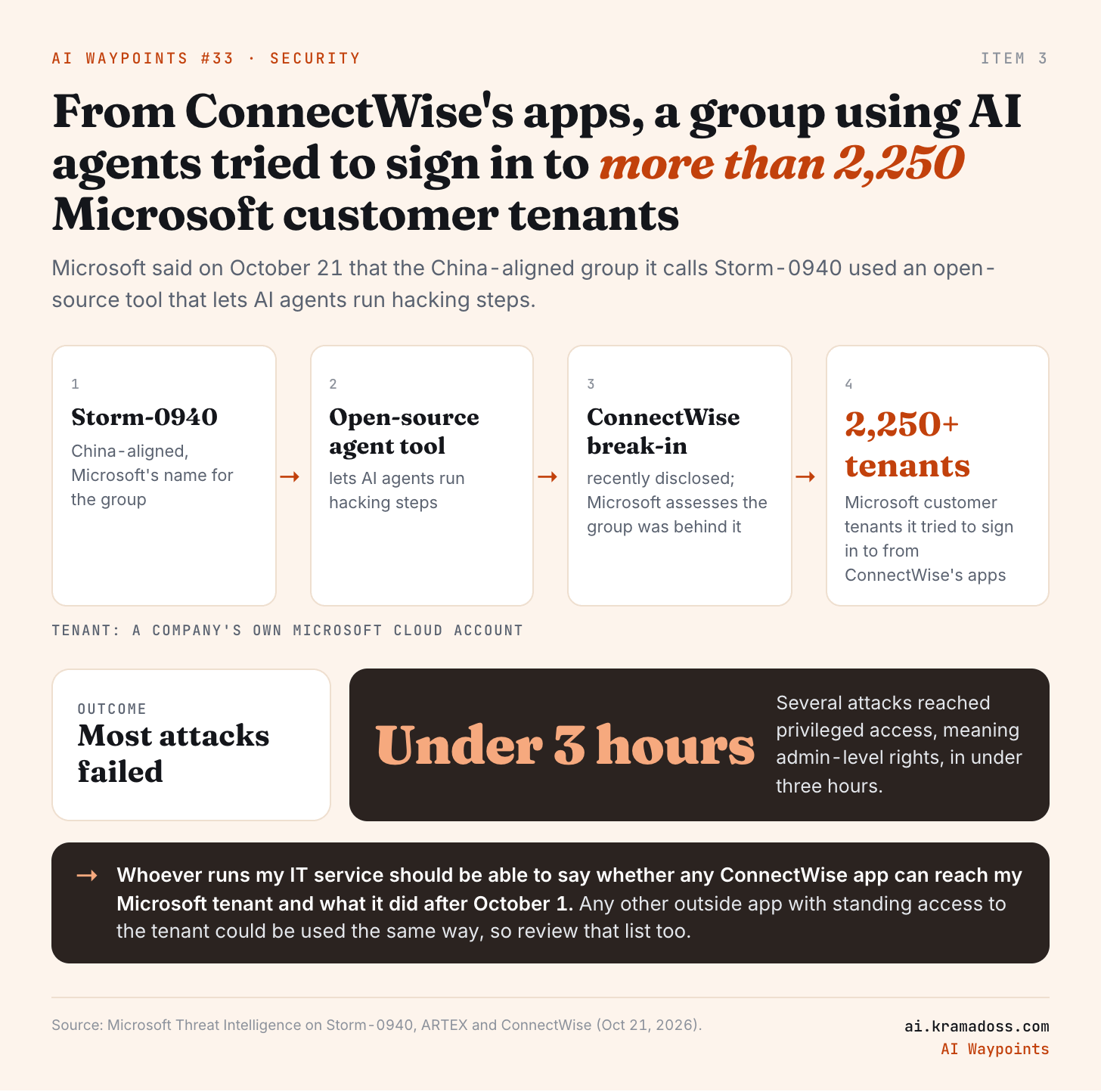
Microsoft said on October 21 that a China-aligned group it calls Storm-0940 used an open-source tool that lets AI agents run hacking steps, and assesses the group was behind the recently disclosed ConnectWise break-in. From ConnectWise’s apps it tried to sign in to more than 2,250 Microsoft customer tenants. Most of the group’s attacks failed, but several reached privileged access in under three hours.
→ Whoever runs my IT service should be able to say whether any ConnectWise app can reach my Microsoft tenant and what it did after October 1. Any other outside app with standing access to the tenant could be used the same way, so review that list too.
4. Google Cloud previews OpenAI models billed against commitments (3 min read)
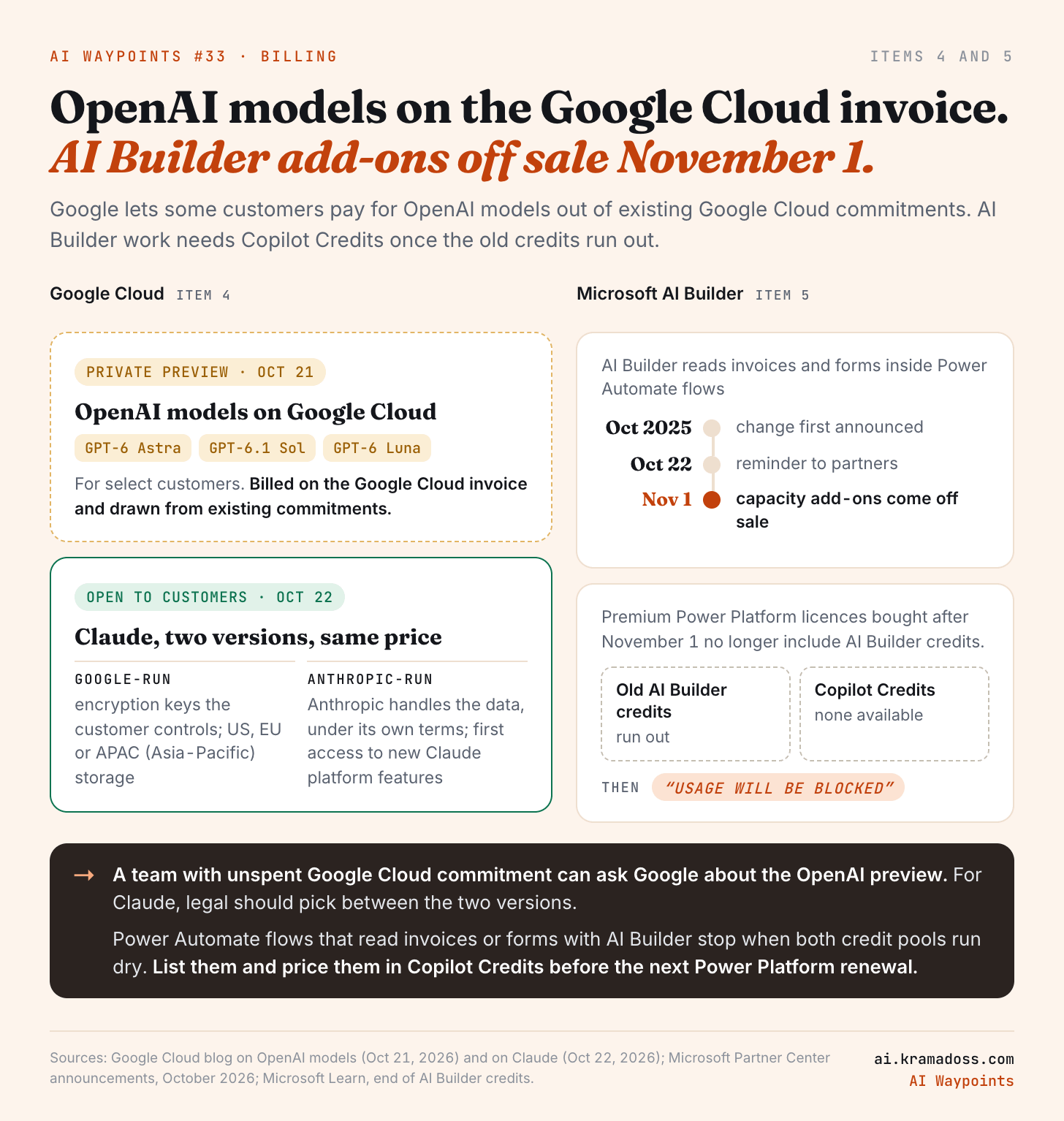
Google said on October 21 that OpenAI’s GPT-6 Astra, GPT-6.1 Sol and GPT-6 Luna are in private preview for select customers, billed on the Google Cloud invoice and drawn from existing commitments. A day later it opened an Anthropic-run version of Claude to customers, with Anthropic as the data processor under its own terms, at the same price as the Google-run version.
→ A team with unspent Google Cloud commitment can ask Google about the OpenAI preview. For Claude, Google lists customer-managed keys and US, EU or APAC storage for its own version and first access to new Claude platform features for Anthropic’s, so legal should pick between them.
5. Microsoft stops selling AI Builder add-ons November 1
Microsoft reminded partners on October 22 that AI Builder capacity add-ons come off sale on November 1, a change first announced in October 2025. Its documentation says premium Power Platform licences bought after that no longer include AI Builder credits, and when the old credits run out with no Copilot Credits available, “usage will be blocked.”
→ Power Automate flows that read invoices or forms with AI Builder stop when both credit pools run dry. List them and price them in Copilot Credits before the next Power Platform renewal.
6. DHS orders DeepSeek out of federal civilian IT
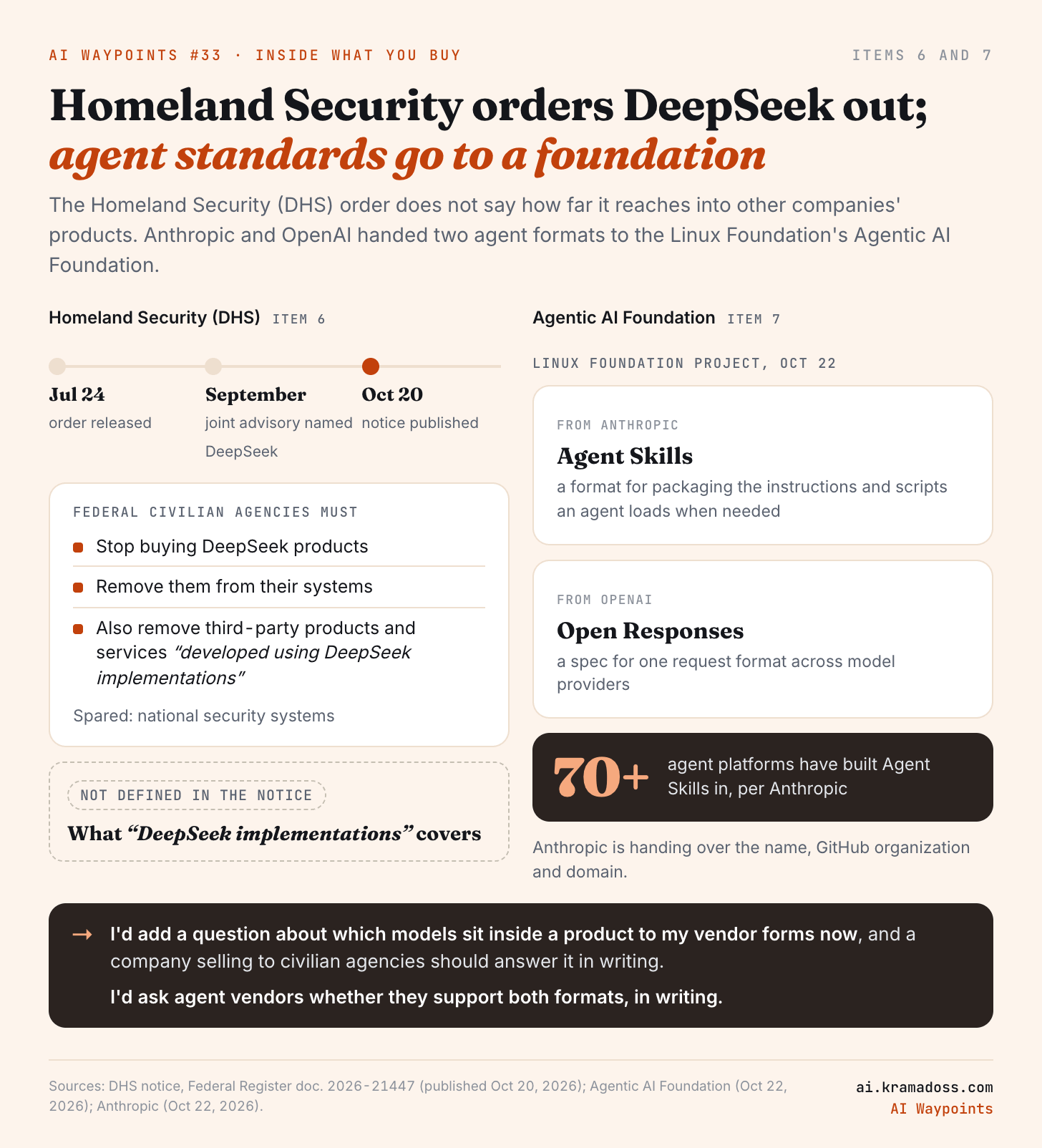
A Homeland Security notice published October 20 says the department ordered federal civilian agencies to stop buying DeepSeek products and to remove them, along with third-party products and services “developed using DeepSeek implementations,” from their systems. The order itself was released July 24 and spares national security systems.
→ September’s joint advisory named DeepSeek, and this order removes it without saying what “DeepSeek implementations” covers. I’d add a question about which models sit inside a product to my vendor forms now, and a company selling to civilian agencies should answer it in writing.
7. Anthropic and OpenAI hand agent standards to a foundation (4 min read)
On October 22 the Linux Foundation’s Agentic AI Foundation took on Anthropic’s Agent Skills, a format for packaging the instructions and scripts an agent loads when needed, and OpenAI’s Open Responses, a spec for one request format across model providers. Anthropic says it is handing over the name, GitHub organization and domain, and that more than 70 agent platforms have built Agent Skills in.
→ Agent features keep ending up as shared standards, so I’d ask agent vendors in an RFP or renewal whether they support both, in writing. A vendor that only offers its own format should show me how my teams’ skills move if I switch.
References:
Microsoft Threat Intelligence on Storm-0940, ARTEX and ConnectWise (October 21, 2026)
Partner Center announcements, October 2026: AI Builder capacity add-ons
Agentic AI Foundation announces four new projects (AAIF, October 22, 2026)
Donating Agent Skills to the Agentic AI Foundation (Anthropic, October 22, 2026)