

Good morning!
OpenAI packed a quarter’s worth of launches into one week: the 3-model GPT-5.6 family, a workplace product called ChatGPT Work, and voice models that listen and talk at the same time.
Apple closed the week by suing OpenAI over trade secrets, while Microsoft started answering Copilot prompts with its own models to cut its AI model bills.
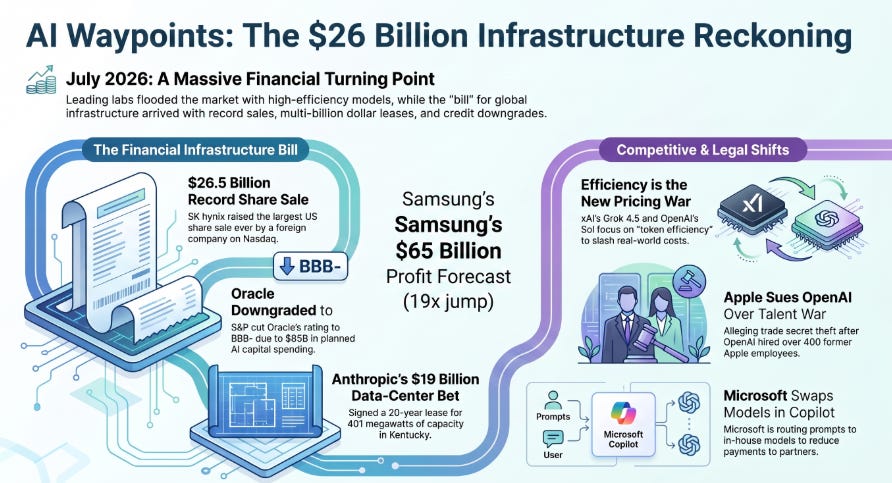
The money side was louder still. SK hynix raised $26.5 billion in the largest US share sale ever by a foreign company, Samsung forecast a 19x profit jump, Anthropic signed a $19 billion data-center lease, and S&P downgraded Oracle for footing the buildout bill.
The Fed, for its part, built itself an AI jobs task force.
Since last Monday
Forward Deployed Engineering: When to Pay for the Engineers Instead of the Software (Jul 7): Edition #17’s Microsoft and AWS billions, argued to thesis length. Embedded engineers fix the enterprise-AI last mile, admit the product can’t cross it alone, and every offer is metered lock-in.
There Is No Runtime Moat to Buy (Jul 2): agent runtimes are commoditizing; the durable ground is embedded delivery and data dependency.
Not the Tools, It’s the Skills Gap (Feb 2): the 95% pilot-failure diagnosis vendors now cite to sell engineers.
Who Decided Your Intern Gets the Michelin Grade Model? (Jul 10): the model-allocation policy already exists; the vendor’s margin team wrote it, and “credits” hide which tier serves each workflow.
The SaaSpocalypse: $285B in Smoke (Mar 2): the selloff misread what’s dying (per-seat pricing, not SaaS).
Per-Seat Pricing Is Dying. Your SaaS Contract Shouldn’t Go With It. (Mar 14): the negotiate-now playbook the Michelin piece extends.
1. OpenAI ships 3 models and a workplace product in the same week
What happened: On July 9, OpenAI launched the GPT-5.6 family:
Sol at $5 in and $30 out per million tokens (tokens are the word-pieces you’re billed by; a million is roughly 750,000 words), aimed at hard reasoning and long-running agent work;
Terra at $2.50/$15, which OpenAI says matches GPT-5.5 at half the cost; and
Luna at $1/$6 as the fast, cheap tier.
OpenAI claims Sol is 54% more token-efficient on coding and tops the Artificial Analysis Coding Agent Index using less than half the output tokens of Fable 5. The same day it launched ChatGPT Work, which pulls context from a team’s tools to turn notes and drafts into finished documents, spreadsheets, and presentations, rolling out in phases across paid plans (Pro, Enterprise, and Edu first). A day earlier it released GPT-Live, full-duplex voice models.
ELI5: What is “full-duplex” voice?
Most voice AI works like a walkie-talkie: you talk, it waits, then it talks. Full-duplex works like a phone call: the model listens while it speaks, so you can interrupt it mid-sentence and it adjusts. GPT-Live also hands the hard questions to a bigger model in the background while it keeps the conversation going.
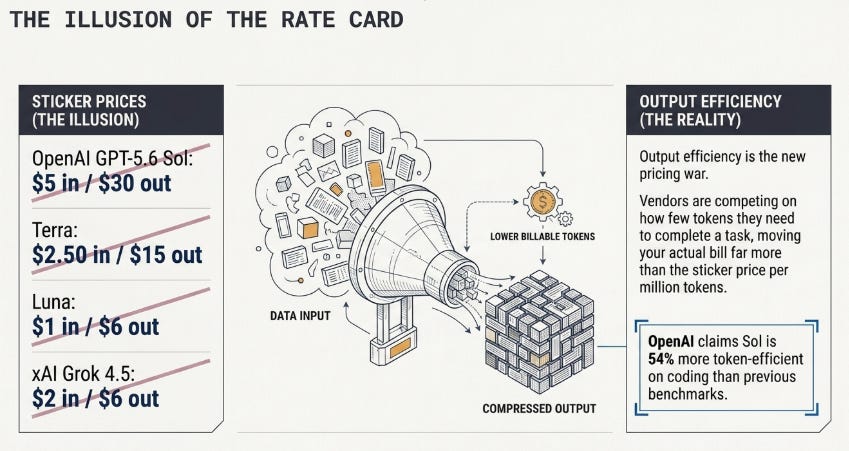
Why it matters: In Edition #17 I flagged the tokenizer catch on Claude Sonnet 5: a lower sticker price that bills more units. OpenAI’s efficiency claim runs the other direction, the same work in fewer tokens, which cuts the real bill if it holds up on real workloads and not just on the benchmark.
What to do: Re-run your model-routing math this month. Measure total cost per completed task on your own workloads, not the per-million rate, because output efficiency now moves your bill more than the sticker price does.
2. The rest of the top-tier AI labs moved in the same 7 days
What happened: 4 more top-tier AI moves landed this week, and together they say any vendor shortlist written in June is already stale.
xAI (now SpaceXAI) released Grok 4.5 (July 8), its first model built for coding and agent work, at $2 in / $6 out per million tokens, roughly 60% cheaper than Opus 4.8 or GPT-5.5. It placed 4th on the Artificial Analysis Intelligence Index, and xAI says it completes Index tasks in about 14,000 output tokens against 67,020 for Opus 4.8. It also says part of the training data was real coding sessions from Cursor.
Mistral released Robostral Navigate (July 8), its first embodied-navigation model: robots steering through complex spaces with 1 camera and plain-language prompts, trained entirely in simulation.
Mistral also opened up Studio (July 9), a system of record for prompts and skills: versioned, access-controlled, and traceable, the way a code repository treats code.
Ben Bernanke joined Anthropic’s Long-Term Benefit Trust (July 9), the body that can appoint members to Anthropic’s board. A former Fed chair now sits over the governance of a top AI lab.
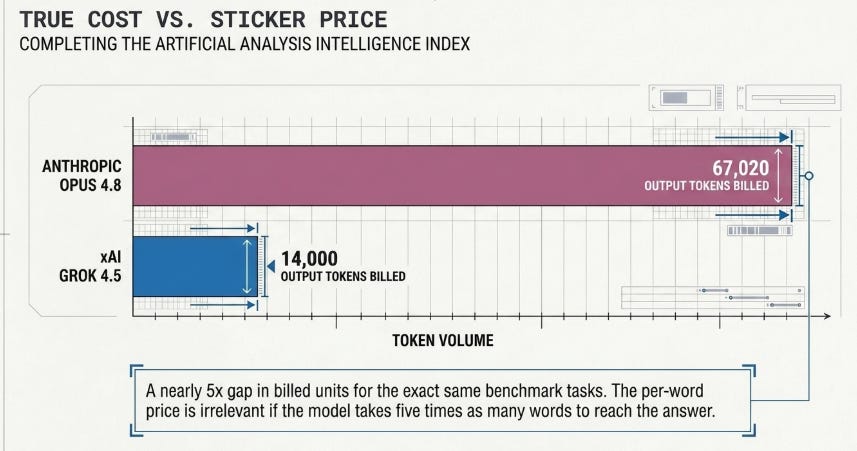
Why it matters: 14,000 output tokens versus 67,020 for the same benchmark tasks is nearly a 5x gap in a bill, separate from the per-word price. Output efficiency is turning into the real pricing war, and it shows up on no rate card.
One date for the calendar, strictly as rumor: reports put Google’s Gemini 3.5 Pro launch at July 17 with a 2-million-token context window.
What to do: Refresh the model shortlist you wrote in the spring; at least 2 of these vendors probably weren’t on it. Then ask where your prompts live today.
3. Apple sues OpenAI — the talent war gets legal discovery
What happened: Apple sued OpenAI on Friday, July 10 in federal court in the Northern District of California, alleging OpenAI stole trade secrets to build its unreleased AI hardware. The complaint names OpenAI hardware chief Tang Tan, a former Apple VP who worked on the iPhone and Watch, and former Apple engineer Chang Liu as defendants. Apple alleges Tan directed Apple candidates to share confidential information during job interviews and coached departing employees on evading Apple’s security processes, and that Liu left with an Apple laptop. OpenAI, which the complaint says has hired more than 400 former Apple employees, says it has “no interest in other companies’ trade secrets.”
Why it matters: Every claim here is an allegation in a complaint, not a court finding, and OpenAI hasn’t filed its response yet. What’s true either way: the AI talent war now comes with legal discovery attached, and the hiring practices of every lab recruiting big-tech teams are about to be examined under oath.
What to do: If your company hires from AI labs, or loses people to them, pressure-test your offboarding and onboarding hygiene this week.
4. Microsoft starts swapping its own models into Copilot
What happened: Bloomberg reported July 7 that Microsoft has begun routing Copilot prompts in Excel and Outlook, summarizing threads, analyzing spreadsheets, drafting replies, to its in-house MAI models instead of OpenAI’s or Anthropic’s. Bloomberg calls it a small share of overall AI usage so far, but the volume is tens of thousands of prompts weekly. Microsoft AI CEO Mustafa Suleyman was blunt about the motive, saying the goal is to “reduce and ultimately eliminate” what Microsoft pays Anthropic. OpenAI’s top models stay in place for complex tasks; the MAI models (MAI-Thinking-1 and MAI-Code-1-Flash) debuted at Build in June.
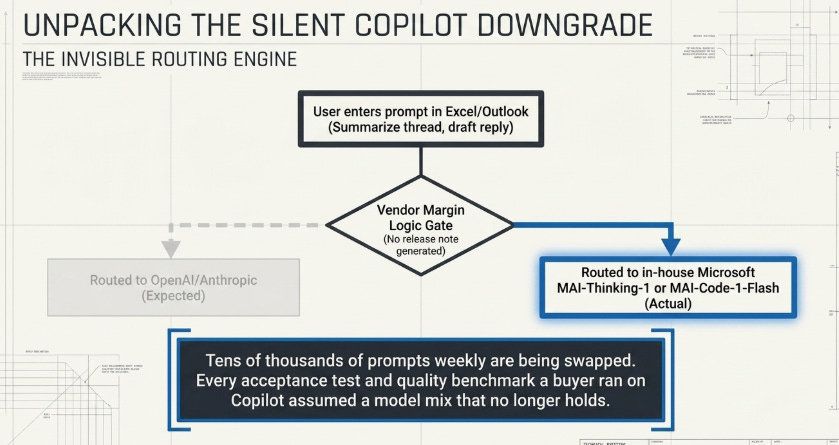
Why it matters: The engine under the Copilot license changed without anything a buyer would recognize as a release note. Every acceptance test and quality benchmark a buyer ran on Copilot assumed a model mix that no longer holds, and Microsoft’s margin motive now pulls against its customers’ quality expectations inside the same product. It’s the model-allocation policy I described Thursday, running live: the vendor’s margin team picks which tier answers the prompt, and nothing on the invoice says so.
What to do: Ask your Microsoft rep, in writing, which model answers each Copilot workload you pay for and how you’ll be notified when that changes. Then re-run whatever quality checks justified the purchase; if output slips on the workloads that matter, that’s your renewal-negotiation evidence.
5. AI agent builders became attack surface this week
What happened: 4 security items caught my attention this week: the platforms around AI are getting attacked, and the compliance scaffolding is going up in response.
CISA added Langflow CVE-2026-55255 to its Known Exploited Vulnerabilities catalog (July 7). CISA is the US cybersecurity agency; the KEV catalog is its list of flaws confirmed under active attack. This one, an authorization bypass in the low-code AI agent-builder Langflow, was exploited June 22 to 25 alongside a second bug to steal AI-model provider keys and AWS credentials across customer boundaries. Federal agencies had until July 10 to patch.
The EU presented an Action Plan on Cybersecurity and AI (July 7): pre-market evaluation capacity for AI models targeted for 2027, a secure-AI blueprint from ENISA (the EU’s cybersecurity agency), and a secure AI testing platform for critical sectors by the end of 2026.
Anthropic’s identity-verification policy took effect July 8 (updated June 17): flagged consumer accounts on Free, Pro, and Max plans can be required to submit government ID and a live selfie through verification vendor Persona. API, Team, and Enterprise plans are exempt.
Anthropic published a case study with the Government of Alberta (July 6): the province used Claude to find and fix cyber vulnerabilities across government systems.
Why it matters: Agent-builder platforms hold exactly what an attacker wants, model API keys and cloud credentials, and they tend to get stood up by enthusiastic teams outside security review. The Langflow campaign shows those keys being harvested at scale, the EU plan shows regulators building around the same tools, and Alberta is the reminder that the same models work on defense.
What to do: Inventory every low-code agent builder running inside your network this quarter, sanctioned or not. If any Langflow instance touched production, rotate every model-provider and AWS credential it could reach and assume the June window was used. And note the consumer/enterprise split in Anthropic’s ID policy before personal accounts creep into work use.
6. The AI infrastructure bill came due
What happened: The money side of AI produced 4 numbers this week that belong in one story: who collects on the buildout, and who pays for it.
SK hynix raised $26.5 billion on Nasdaq (July 10), the largest US share sale ever by a foreign company, topping Alibaba’s $25 billion from 2014. The ADRs (American Depositary Receipts, US-listed stand-ins for foreign shares) priced at $149 and closed their first day up 13%.
Samsung forecast a record quarter (July 7): roughly KRW 89.4 trillion in operating profit (around $65 billion), about 19x from a year ago and its third straight record, on AI memory demand, with HBM4, the newest generation of the memory chips AI servers are built around, sold out for the year. Shares still fell more than 6% on a revenue miss.
Anthropic signed a 20-year, roughly $19 billion lease with TeraWulf (July 6) for about 401 megawatts of data-center capacity in Hawesville, Kentucky, with first capacity in the second half of 2027.
S&P cut Oracle’s credit rating to BBB- (July 9), 1 notch above junk, citing AI-buildout risk: $90-95 billion of capital spending planned for fiscal 2027, a free operating cash flow deficit (S&P’s measure) widening to about $42 billion, and roughly $20 billion of new stock to be issued this year, set against a $638 billion backlog of signed contracts not yet delivered.
ELI5: What does a credit downgrade have to do with AI?
Oracle is borrowing enormous sums to build AI data centers before the revenue from them arrives. A downgrade is the rating agency saying that bet got riskier, which makes every future dollar Oracle borrows more expensive. One more notch down would put Oracle’s debt in “junk” territory, where some funds aren’t allowed to hold it. The spending behind all of this is almost entirely AI infrastructure.
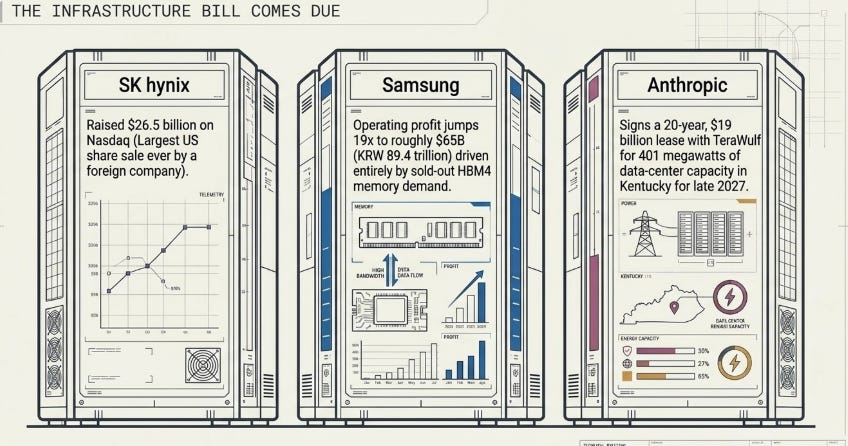
Why it matters: In Edition #17 I covered NVIDIA financing the very clouds that buy its chips; this week fills in the rest of that ledger. The memory makers are collecting record profits and record capital while a marquee buyer of the buildout got marked down for how it’s paying.
What to do: If Oracle’s cloud hosts anything you care about, add the vendor’s own financial health to your reviews; a BBB- landlord behaves differently under stress than an AA one. And with DRAM contract prices up roughly 60% quarter-on-quarter in Q2, per TrendForce, I’d lock hardware quotes now, before renewal cycles reprice.
7. The Fed builds itself an AI jobs task force
What happened: On July 9 the Federal Reserve announced 5 external task forces to review how it conducts monetary policy. One of them, Productivity and Jobs, is co-led by venture capitalist Marc Andreessen, Stanford economist Charles I. Jones, and Microsoft Xbox CEO Asha Sharma, with a mandate to assess the economic impact of new general-purpose technologies, including AI, on productivity and employment. It reports recommendations to the Fed’s rate-setting committee by the end of 2026, making it the first formal Fed structure dedicated to AI’s economic effects.
Why it matters: Last week’s edition closed on June’s near-stalled jobs number; this week the central bank assigned an institution to that question. Once the Fed measures whether AI is moving productivity and jobs, that measurement stops being a think-tank debate and starts feeding interest-rate decisions. The co-lead list is its own signal: a VC with heavy AI portfolio exposure now helps write the Fed’s read on AI and employment.
What to do: Boards will ask for the company version of the Fed’s number within 2 quarters. Start measuring yours now, tasks automated, cycle time saved, and where the freed capacity went, so the answer is data instead of an anecdote.
References:
GPT-5.6 family (OpenAI, 2026-07-09): https://openai.com/index/gpt-5-6/
ChatGPT Work (OpenAI, 2026-07-09): https://openai.com/index/chatgpt-for-your-most-ambitious-work/
GPT-5.6 family launch (TechCrunch, 2026-07-09): https://techcrunch.com/2026/07/09/openai-launches-its-new-family-of-models-with-gpt-5-6/
GPT-5.6 / ChatGPT Work (Axios, 2026-07-09): https://www.axios.com/2026/07/09/ai-openai-gpt-release
GPT-5.6 rollout (Engadget, 2026-07-09): https://www.engadget.com/2210308/openai-rolls-out-gpt5-6-july-9/
GPT-Live full-duplex voice (OpenAI, 2026-07-08): https://openai.com/index/introducing-gpt-live/
Grok 4.5 (xAI, 2026-07-08): https://x.ai/news/grok-4-5
Grok 4.5 coverage (TechCrunch, 2026-07-08): https://techcrunch.com/2026/07/08/spacexai-releases-grok-4-5-which-elon-describes-as-an-opus-class-model/
Grok 4.5 coverage (Axios, 2026-07-08): https://www.axios.com/2026/07/08/spacexai-grok-new-model
Robostral Navigate (Mistral, 2026-07-08): https://mistral.ai/news/robostral-navigate/
Mistral Studio prompts and skills (Mistral, 2026-07-09): https://mistral.ai/news/manage-prompts-and-skills-in-studio/
Bernanke joins Long-Term Benefit Trust (Anthropic, 2026-07-09): https://anthropic.com/news/ben-bernanke
Gemini 3.5 Pro July-17 reports, unconfirmed (TechTimes, 2026-07-08): https://www.techtimes.com/articles/319877/20260708/gemini-35-pro-targets-july-17-deepseeks-july-24-deadline-hits-developers-now.htm
Apple v. OpenAI (CNBC, 2026-07-10): https://www.cnbc.com/2026/07/10/apple-openai-lawsuit-trade-secrets.html
Apple v. OpenAI (TechCrunch, 2026-07-10): https://techcrunch.com/2026/07/10/apple-sues-openai-over-alleged-trade-secret-theft/
Apple v. OpenAI (NBC News, 2026-07-10): https://www.nbcnews.com/tech/tech-news/apple-sues-openai-two-former-employees-trade-secrets-theft-rcna385916
Microsoft MAI model routing (Bloomberg, 2026-07-07): https://www.bloomberg.com/news/articles/2026-07-07/microsoft-replaces-openai-anthropic-with-own-ai-in-some-apps
Microsoft MAI routing coverage (Yahoo Finance, 2026-07-07): https://finance.yahoo.com/technology/ai/articles/microsoft-replaces-openai-anthropic-own-161946596.html
Microsoft MAI routing coverage (The Decoder, 2026-07-07): https://the-decoder.com/copilot-goes-cheap-as-microsoft-phases-out-openai-and-anthropic-models-to-cut-costs/
Langflow CVE-2026-55255 KEV entry (CISA, 2026-07-08): https://www.cisa.gov/known-exploited-vulnerabilities-catalog
Langflow exploitation detail (The Hacker News, 2026-07-08): https://thehackernews.com/2026/07/cisa-adds-4-actively-exploited-adobe.html
EU Action Plan on Cybersecurity and AI (European Commission, 2026-07-07): https://ec.europa.eu/commission/presscorner/detail/en/ip_26_1544
Identity verification on Claude (Anthropic support, updated 2026-06-17): https://support.claude.com/en/articles/14328960-identity-verification-on-claude
Anthropic ID verification coverage (TechCrunch, 2026-06-22): https://techcrunch.com/2026/06/22/anthropic-says-claude-may-want-to-see-your-id/
Alberta government Claude cybersecurity (Anthropic, 2026-07-06): https://anthropic.com/news/alberta-government-claude-cybersecurity
SK hynix Nasdaq ADR listing (SK hynix, 2026-07-10): https://news.skhynix.com/skhynix-lists-adrs-on-nasdaq/
SK hynix ADR offering (Bloomberg, 2026-07-10): https://www.bloomberg.com/news/articles/2026-07-10/sk-hynix-indicated-to-climb-17-after-26-5-billion-adr-offering
Samsung Q2 2026 earnings guidance (Samsung, 2026-07-07): https://news.samsung.com/global/samsung-electronics-announces-earnings-guidance-for-second-quarter-2026
Anthropic-TeraWulf lease (TeraWulf, 2026-07-06): https://investors.terawulf.com/news-events/press-releases/detail/142/
S&P downgrades Oracle to BBB- (S&P Global Ratings, 2026-07-09): https://www.spglobal.com/ratings/en/regulatory/article/-/view/type/HTML/id/3592348
Oracle downgrade coverage (Investing.com, 2026-07-09): https://www.investing.com/news/stock-market-news/oracle-stock-shrugs-off-sp-downgrade-to-bbb-but-120b-debt-shadow-looms-4784705
Oracle downgrade coverage (HNGN, 2026-07-09): https://www.hngn.com/articles/271995/20260709/sp-downgrades-oracle-credit-rating-ai-buildout-deepens-42-billion-cash-deficit.htm
DRAM contract prices +58-63% QoQ in 2Q26 (TrendForce, 2026-03-31): https://www.trendforce.com/presscenter/news/20260331-12995.html
Fed monetary policy task forces (Federal Reserve, 2026-07-09): https://www.federalreserve.gov/newsevents/pressreleases/monetary20260709a.htm
Fed AI task force coverage (Washington Post, 2026-07-09): https://www.washingtonpost.com/business/2026/07/09/federal-reserve-enlists-marc-andreessen-advise-ai-under-warsh/
Fed task force membership (American Banker, 2026-07-09): https://www.americanbanker.com/news/fed-announces-membership-of-monetary-policy-task-forces