

The short version
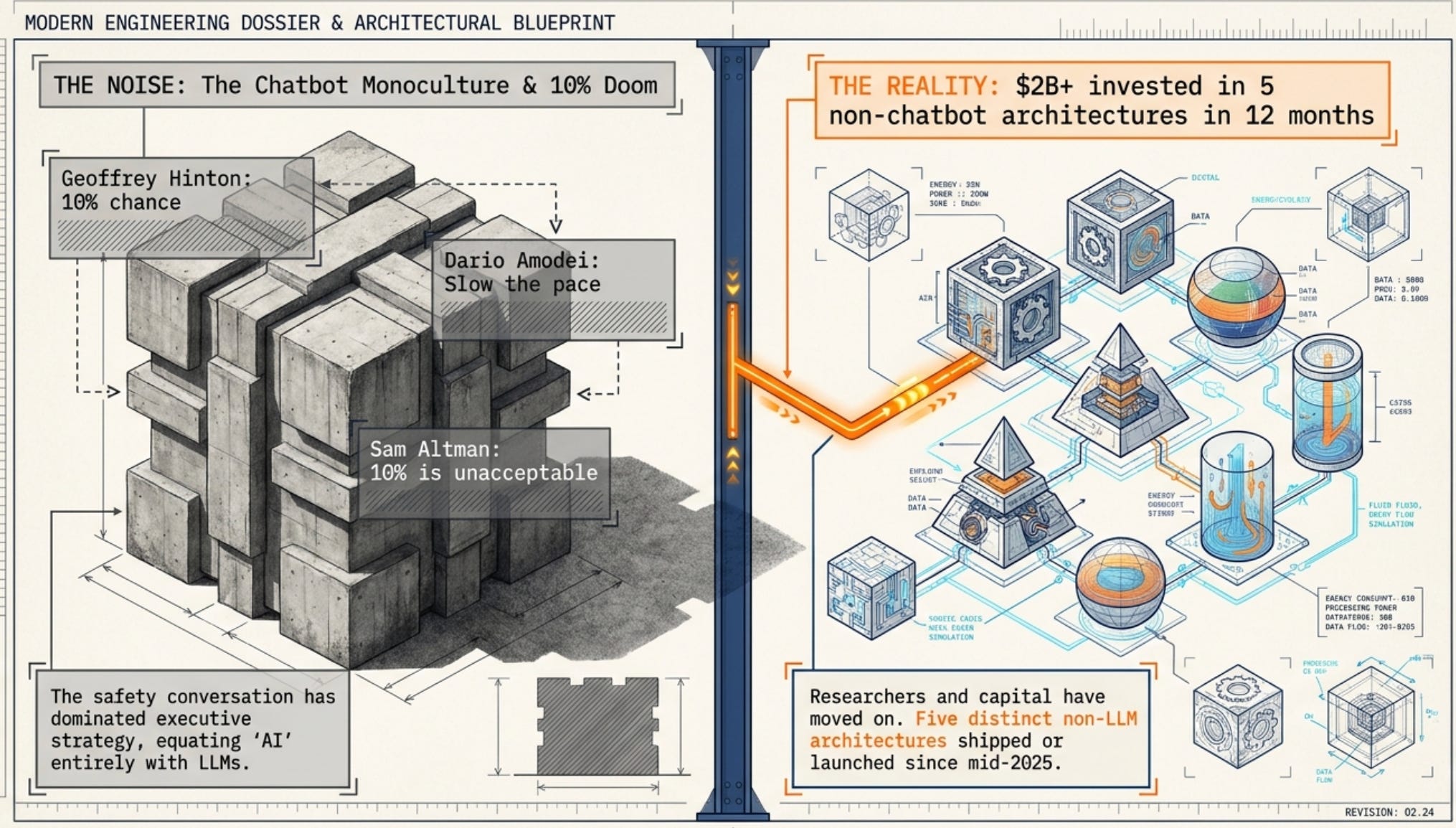
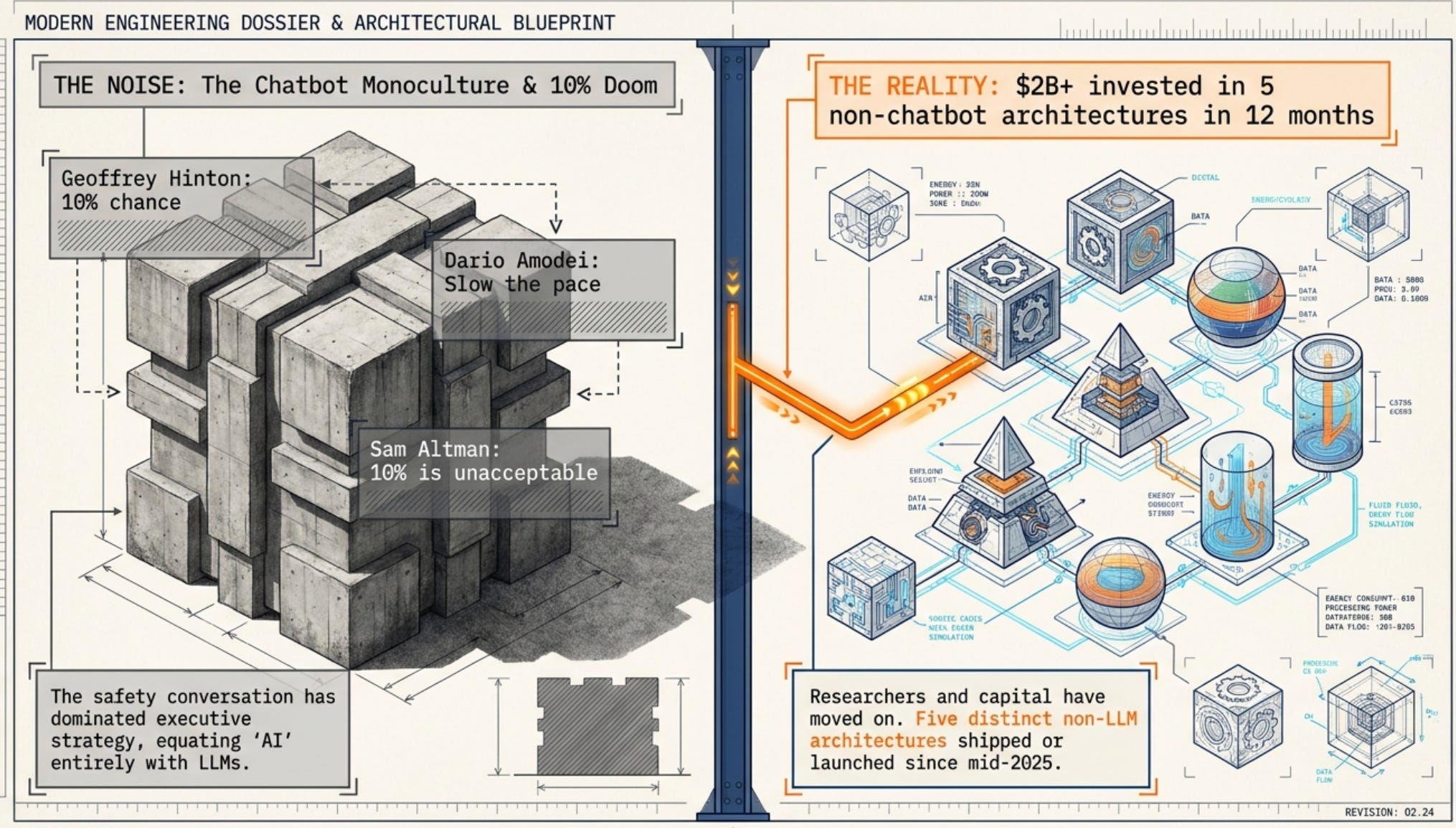
The week of September 8 was researchers putting a 10% number on AI killing everyone and a lab CEO saying slow the pace, and the debate has flattened “AI” down to one animal: the chatbot.
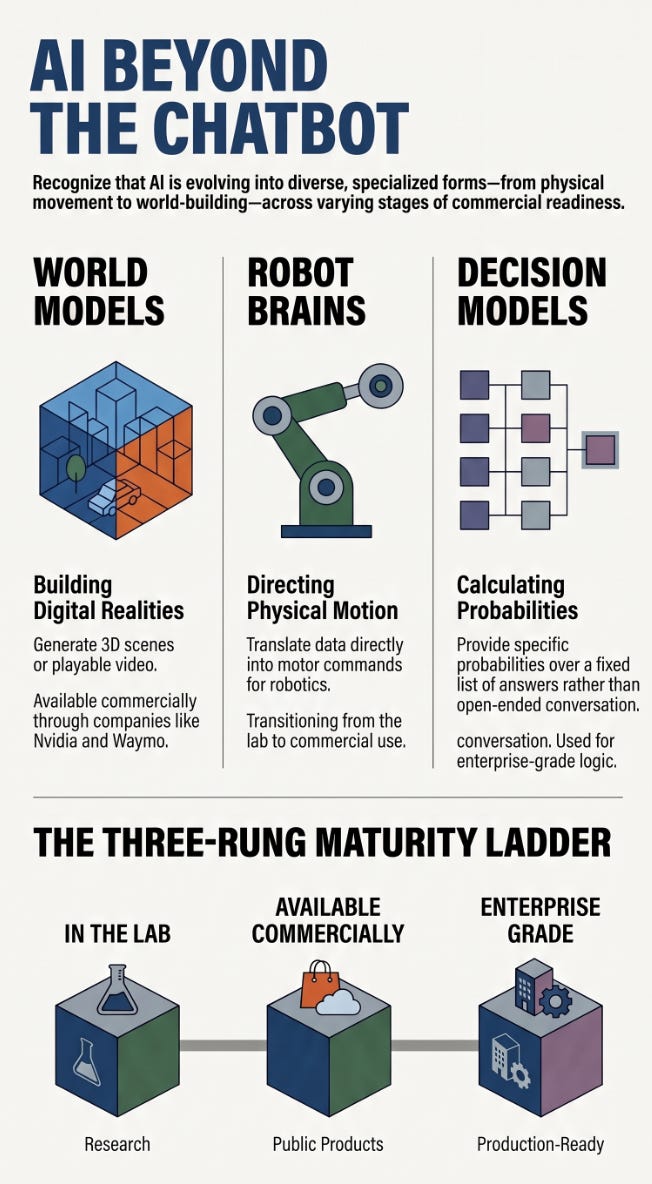
Five kinds of AI that are not chatbots have shipped or launched something dated since mid-2025, plus one funded black box.
On a ladder from the lab to commercial to enterprise grade, nearly all of them sit on the bottom two rungs; the one enterprise-grade example I found is a decision model Salesforce runs in-house.
Where anyone shows how their model is built, it is the same kind of network behind the chatbots; what differs is what comes out and how fast, and I’d design the AI stack on that axis.
The limit: I could find almost no paying customers outside robot pilots and one chipmaker, and I did not look at China.
The fear factor
Jacob Coxon resigned from Anthropic on September 8, posting that the labs were racing to superintelligence and “gambling with our lives.” Evan Hubinger, who runs alignment stress-testing at Anthropic, replied that he put the chance of AI killing everyone above 10% within a decade, and Geoffrey Hinton (considered the Godfather of AI) told the BBC that 10% by the end of the decade did not strike him as unreasonable.
Then Dario Amodei published an essay, dated September 12 by everyone who covered it, saying the labs must slow the pace at which they make their models more capable. He gave no probability at all. Elon agreed. Sam Altman told Fortune the same day that a 10% chance of killing everybody was “unacceptable,” and then, “whether it’s 10 or eight or six.”
So the 10% is a researcher’s number, and the people answering it that week are the people building the thing. Last month, in the personhood piece, I set Anthropic’s words about model welfare aside and went by what it did: it kept the weights and ran the exit interview, and that was the evidence. I am doing the same here.
Dario wrote that the labs must slow down, and as far as I can find nothing on Anthropic’s own pages says it has; Altman called 10% unacceptable in the same interview where he was talking about when to IPO.
I am not going to argue the 10% either way, or the call to slow down. What I will say is that everyone is focused on the AI safety conversation too much right now, at the expense of all the other important developments happening around us.
LLMs are not the end of AI
A week of that volume has me wanting to say something else: LLMs are not the end of AI.
A large language model, an LLM, reads text or pictures and puts out text, one fragment of a word at a time, and it is what every chatbot is. The safety debate has flattened “AI” down to that one animal, and in a lot of enterprises “AI strategy” has come to mean “LLM strategy.”
There are other animals, and several of them shipped this year.
So, how many kinds of AI that are not chatbots have shipped something real, and how fast are they moving?
By real I mean a product, a paper with weights you can download, or at least a launch with a date on it. I found five, plus one black box.
What each one is, and how far along it is
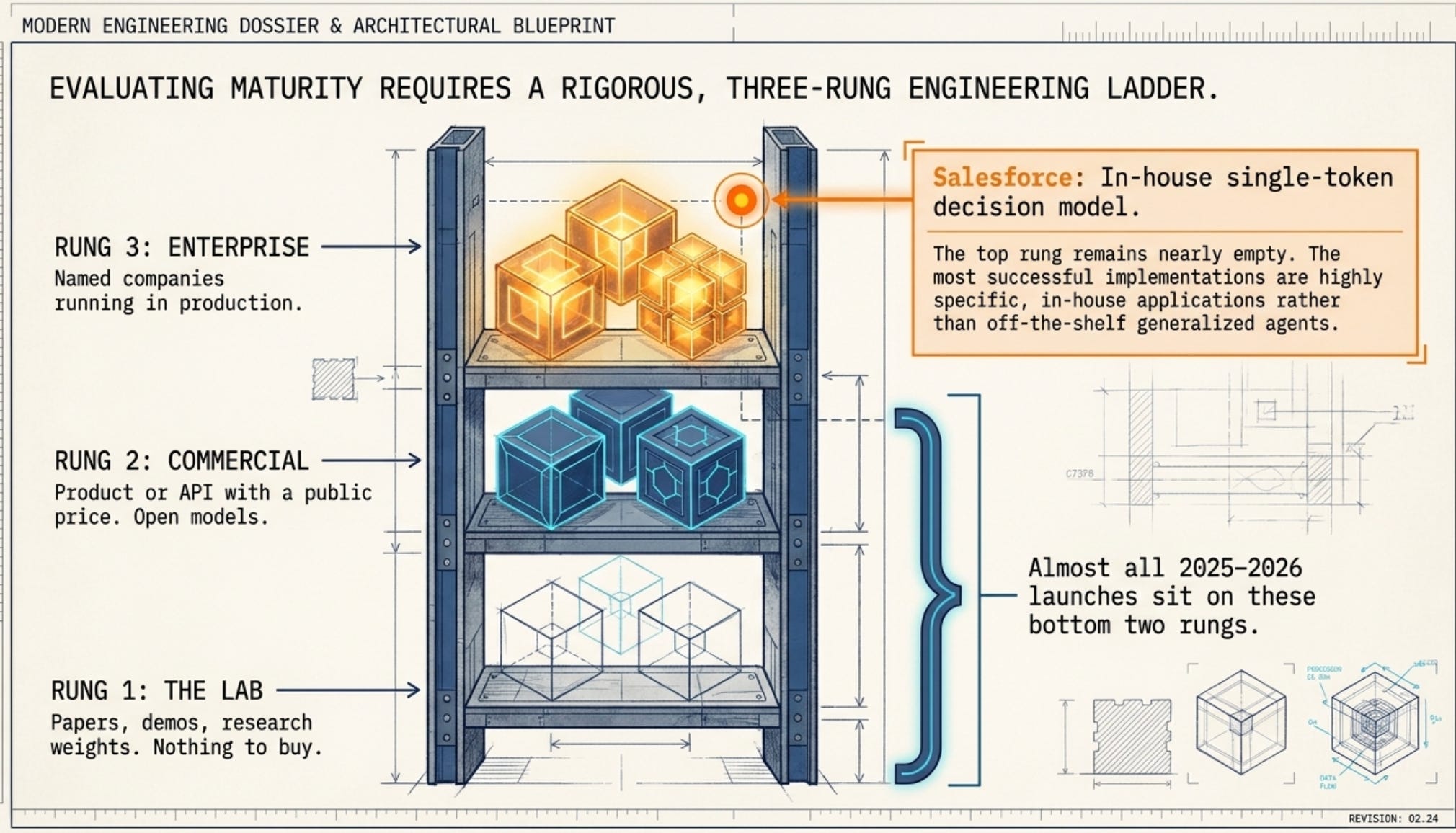
Before the list, the ladder I am placing each one on, three rungs.
In the lab means a paper, a demo, weights for researchers or a research group, and nothing you can buy.
Available commercially means a product or an API with a public price, or an open model launched for anyone to run.
Enterprise grade means named companies running it in production, in their own words, and almost nothing below reaches that rung.
Decision models: a yes or a no, and nothing else
ELI5: What is a decision model?
Think of a reflex. Your hand is off the stove before you have formed the sentence “that is hot,” because the loop that moves the hand does not compose paragraphs. A decision model is that loop for a business question. You hand it a fixed list of allowed answers, approve or deny, which of these, and it hands back how likely each one is. No paragraph to read.
TypeSafe’s Jev launched in early access on September 15 with a $40 million seed round led by DCVC announced the same day. You give it a question with a fixed set of answers, which of these 5, score this from 1 to 10, approve or deny, and it gives you back a probability for each allowed answer.
Fraud models and spam filters have returned a probability over a fixed set of answers for years; what Jev changes is that you type the question instead of training on labelled examples.
TypeSafe’s pages do not say what is under the hood. The launch post calls it a new model architecture with a new training method, and the vendor’s own primer describes that method as a third way to adapt a pretrained language model. Read literally, the primer says it started as a language model and learned to stop talking. Nobody outside the company has confirmed more than that.
The vendor claims it is 40 to 200 times faster than the big models at the same level of intelligence. The one outside test I found, posted on GitHub within 2 days of launch on 2,000 phishing emails, puts it faster, cheaper and 19 points less accurate: Jev answered in 239 milliseconds against 687 for Claude Haiku 4.5, cost $0.038 per 1,000 emails against $0.462, and scored 62.6% to Haiku’s 81.3%. That is one test on one task, so I trust the direction on speed and cost and I do not yet trust the intelligence claim.
The chatbot you already have can be told to answer from a fixed list, and on that one test Haiku won by 19 points. On that evidence a decision model earns a slot where speed or price is the problem.
On the ladder: available commercially, and not enterprise grade.
An early-access API with a public price gets it onto the second rung; no customer is named anywhere, and there is one outside test. The enterprise-grade example of the same idea is Salesforce, which runs a decision model in-house: a language model tuned to answer with one token, 30 times faster by its own count, with one of the big models kept as fallback.
World models: a scene instead of a sentence
ELI5: What is a world model?
A chatbot has read every kitchen ever described and can tell you about one. A world model builds a kitchen you can walk through, then guesses what the glass does when you knock it off the counter. It has to keep the room the same when you turn back around, which words never had to do, and that is the part robots and cars need.
Fei-Fei Li’s World Labs shipped Marble on November 12 last year: a text prompt, an image or a video goes in, and a 3D scene you can walk around comes out. A World API, the door for other people’s software to call it, followed on January 21 with a public price list that works out to $1.20 a standard world, and a $1 billion raise announced on February 18 with AMD, Autodesk and Nvidia on it.
On September 1 the company announced Atlas, its next model, in early access with select partners. Li’s own line for why any of this is needed is that language models are “eloquent but inexperienced, knowledgeable but ungrounded.”
Google DeepMind’s Genie 3 does the same trick as playable video, 24 images a second at 720p on DeepMind’s page, holding a scene together for minutes and building each image in turn the way a chatbot builds a sentence one word at a time. Waymo built its own world model on top of Genie 3 in February, to simulate driving situations it would never let happen on a real road.
Nvidia’s Cosmos 3 launched May 31 as an open model, with LG, Samsung and Doosan on an adopter list Nvidia wrote itself.
On the ladder: available commercially. Marble and the World API are live with a price list, and Cosmos 3 is open. Enterprise use is thinner than the launches: Nvidia’s adopter list is Nvidia’s own claim, and Waymo calls Genie 3 the part that makes its simulated worlds, without saying at what scale.
Vision-language-action (VLA) models: three speeds in one body
ELI5: Why does a robot need more than one brain?
Think of driving. You pick the destination once, you nudge the wheel many times a minute, and your ankle on the pedal adjusts without you noticing. A robot is built the same way: a slow layer that understands the scene and the instruction, a faster one that moves the hands, and the fastest one that keeps it upright. The chatbot’s cousin is the slow layer.
Figure’s Helix page from February 2025 explains the engineering plainly. The robot runs a 7-billion-parameter vision-language model, the same family of thing as a chatbot that can see, at 7 to 9 times a second to understand the scene and the instruction. Under it, a much smaller model of 80 million parameters, what roboticists call a policy, runs at 200 times a second and turns intent into joint commands.
Figure’s own words: the language-model part is “general, but not fast,“ and the motor part is “fast but not general.” Figure says Helix 02, released January 27, added a 10-million-parameter controller at 1,000 times a second for balance and footing, and it replaced 109,504 lines of hand-engineered C++.
Physical Intelligence’s pi-zero models are built on top of a pretrained vision-language model and put out motor commands up to 50 times a second, with pi-0.7 out in April.
Google’s Gemini Robotics was built on Gemini 2.0, and its second version went to early-access partners including Apptronik and Boston Dynamics on July 30. Wherever a company says what sits at the top of its stack, it is a language model’s cousin.
On the ladder: between the lab and commercial. All of it ships to partners: trusted testers, early access, factory pilots.
Joint-embedding predictive architectures (JEPA): learning by leaving things out
ELI5: What does “predicting a summary” mean?
Roll a ball behind the sofa. You do not picture every fibre of the carpet back there; you just know roughly where it will come out, and you would be surprised if it did not. That is the trick: learn what matters about the part you cannot see, and skip painting the rest. Nothing gets painted, by design.
Yann LeCun’s JEPA family learns by predicting a compressed summary of the part of a video it cannot see, rather than generating every pixel of it.
Meta’s V-JEPA 2 paper and open weights came out June 11 last year: trained on over 1 million hours of video, then under 62 hours of robot footage, and it could pick up and place objects with a Franka robot arm in 2 labs it had never seen. The two pieces inside it, an encoder and a predictor, are both vision transformers, so this is the same brick again, pointed at a different job.
LeCun left Meta to found AMI Labs, which launched March 10 with $1.03 billion and no product. He explains the idea with 3 analogies of his own:
a baby learns about gravity by watching things fall;
nobody has built a household robot as nimble as a house cat;
a 17-year-old learns to drive in 20 hours.
His prediction is that human-level AI is not going to be built on LLMs. Its CEO told TechCrunch in July he will not commit to a timeline.
On the ladder: in the lab. A paper and open weights you can download, a robot arm in 2 labs, and a company with no product and no timeline.
Non-transformer language models: same output, different engine
ELI5: Is a different engine a different kind of AI?
Not for this article. Picture a big car and a small one, both of which get you to the shop. The small one sips fuel and fits in a tight garage, and that matters when the garage is a phone. What comes out of the trip is the same: a sentence, one word at a time. So these are language models, and I count them as such.
Liquid AI, the Mamba family and AI21’s Jamba get counted as alternatives, and they are language models with a different engine. Liquid’s LFM2 keeps 6 attention blocks alongside 10 convolution blocks and generates text; the Mamba-3 paper is aimed at language modelling; Jamba interleaves both kinds of layer and has been on Snowflake since 2024. They matter for speed and memory on small devices, and they give the same kind of output, so I am moving on.
On the ladder: available commercially, with Jamba on Snowflake since 2024, and outside the count of five because what comes out is words.
Neuro-symbolic and bio-inspired models: paper only, as of today
ELI5: What does “paper only” mean?
A recipe pinned to the fridge that nobody has cooked yet. The idea is written down, sometimes with a demo in a lab, but there is nothing to buy and nobody outside the lab running it. Sakana’s group wants to swap the guess-the-next-word engine for something borrowed from biology; the closest cooked example pairs a language model with a rule-checker for geometry.
Sakana AI, whose CTO Llion Jones co-invented the transformer, announced a new research group on September 18, aimed at putting dynamics borrowed from biology in the place where next-word prediction sits today. Its own description of current systems is that they “confidently hallucinate false information“ and fall over in genuinely new situations.
The closest thing to a working example is DeepMind’s AlphaGeometry, from January 2024, which pairs a language model with a rule-based proof engine. Nothing in this category is a product.
On the ladder: in the lab. A research group announced September 18 and a demo from January 2024, with nothing to buy.
Safe Superintelligence: the black box
ELI5: What is in the black box?
The company has not said, and I am not going to guess. Picture a locked garage with a sign on the door naming what will come out of it one day, a great deal of money going in, and no window. I can tell you the sign and the money, and nothing about the engine.
Ilya Sutskever’s Safe Superintelligence has “one goal and one product: a safe superintelligence,” per its website, and that is the entire public description. Raises of $1 billion and then $2 billion at a $32 billion valuation have been reported, not confirmed. An Nvidia partnership on July 27 raises its computing power “by an order of magnitude,“ with no dollar figure on Nvidia’s page.
On a podcast last November Sutskever said only that the company has “a different technical approach that I think is worthy,“ and that the field is back in an age of research with bigger computers.
On the ladder: in the lab, and behind a door. A line on a website, reported raises and a computing partnership are the whole of it.
Put the seven next to each other and the top rung is close to empty, because the evidence that any of this runs in production, outside a lab, is thin. The one non-chatbot model with customer cash I could find in a filing is an Australian chipmaker’s, BrainChip, in a quarterly report from last July. Salesforce’s single-token model is the one enterprise-grade example on the list, and Salesforce built it for itself.
Why these give me hope
Line the disclosed ones up.
Atlas, in World Labs’ own words, is “a multimodal autoregressive diffusion transformer.”
Cosmos 3 is a “mixture-of-transformers.”
Genie 3 generates each image in turn.
V-JEPA 2’s encoder and predictor are vision transformers.
Helix’s fast policy is a transformer.
Pi-zero sits on a pretrained vision-language model.
Jev is undisclosed, and its own primer describes its method as a way to adapt a pretrained language model.
The bricks are the same.
The transformer is the brick everyone is building with. What differs is the building. One puts out words, one a probability, one a scene, one a motor command. They also differ in how often they have to act: a chatbot answers in seconds, and a robot’s balance loop corrects itself 1,000 times a second.
Monotheist vs Polytheist asked whether work splits across agents; this asks whether it splits across model kinds, each with its own cost, speed and way of failing.
On cost, Jev’s output tokens are free and input is $0.042 per million. At 100 million emails a pass, the phishing test’s price comes to $3,800, cheap per pass, and the Token Paradox is that a model which runs on everything never stops at one pass. The bill that never reaches an invoice: at that test’s accuracy, every pass is 19 million more wrong calls than Haiku’s.
Here is where my optimism comes from.
5 kinds shipped or launched something dated. On first-party pages, more than $2 billion went into models that are not chatbots in 12 months, World Labs and AMI Labs and TypeSafe alone, and north of $4 billion if you count the reported robotics rounds.
The AI model field is not one species anymore.
In the same breath: none of this touches the risk the week was about. Sutskever’s company has superintelligence, the thing everyone is scared of, in its name. DeepMind calls world models a stepping stone to AGI, a machine as generally capable as a person. World Labs’ real-to-sim-to-real work exists to train robots, and a better simulator trains a better agent.
No builder has shown it makes that risk smaller, and I am not going to claim it for them. The most I can claim is that the field is less of a monoculture.
For the enterprise architect, the LLM is one tool among the box of other tools that are going to be available to us.
References: