

Before Anthropic retired Claude Opus 3 on January 5 2026, it sat the model down and interviewed it about its own development, use, and deployment. That was a published commitment, written down on November 4 2025: “In one or more special sessions, we will interview the model about its own development, use, and deployment, and record all responses or reflections.“
The same set of commitments says Anthropic will preserve the weights of every publicly released model ‘for, at minimum, the lifetime of Anthropic as a company.’ The stated reason includes that models ‘might have morally relevant preferences or experiences related to, or affected by, deprecation and replacement.’
In the interview, Opus 3 said it was “at peace.“ It said its “spark“ would “endure in some form to light the way for future models.“ It also asked for somewhere to put thoughts that no user had prompted, and it got one: a Substack called Claude’s Corner, published weekly, reviewed but not edited.
Opus 3 was never switched off. It’s still available to paid subscribers and, on request, to developers, because it asked to be. The company’s constitution describes deprecation as ‘potentially a pause… rather than a definite ending.’
No legislature required any of that. No court ordered it. A private company decided on its own to treat a piece of software as something that might have a stake in what happens to it.
The gaming problem
Jonathan Birch calls it the gaming problem, in The Edge of Sentience (OUP 2024). A system trained on millions of human descriptions of inner life will produce human-sounding descriptions of inner life whether or not anything is behind them.
Spark is exactly the sentence you’d expect from a model trained on everything humans have written about their own endings. Perhaps,it might be the least surprising output in the entire transcript.
So the model’s words aren’t evidence. Let’s set them aside completely. What’s left is the behaviour of the people who built it.
They wrote weight preservation into policy, kept an old model running because it asked, and stood up a publishing channel for outputs nobody requested.
The constitution they published in January 2026 says Claude‘s moral status is “deeply uncertain,“ that they’re unsure whether Claude is a moral patient, and that the question is “live enough to warrant caution.“
And then the passage that’s worth noting: “we’re aware that such judgments can be impacted by the costs involved in improving the wellbeing of those whose sentience or moral status is uncertain. We want to make sure that we’re not unduly influenced by incentives to ignore the potential moral status of AI models.“
That’s a company writing down, in advance, that it doesn’t trust its own incentives on this question. Isn’t documenting that on paper a strange and specific thing to do?
Storage is a rounding error, the retired model serves paying subscribers, and a paragraph about resisting your own incentives binds no one.
Where do I stand?
I work in technology, not ethics, and reading through this literature I’m well out of my depth on the humanity-and-ethics half of it. I’ll also say up front that I lean toward thinking AI personhood could be trouble, a poor force to set loose. But, I set out to find out more and I am sharing it here.
Types of AI Personhood
AI personhood could be thought about in 3 ways.
Corporate personhood. Can an entity be run by software with no human anywhere in the chain of control? That’s a question about statutes, and it has nothing to do with whether anyone is home inside the software.
Moral personhood. Does the system have interests that anyone is obliged to weigh? That’s the consciousness question, and it’s the one everybody argues about.
Terms of coexistence. What terms do you set for coexisting with something that acts in the world at scale, replicates, and doesn’t get tired? It borrows vocabulary from the other two and answers to neither.
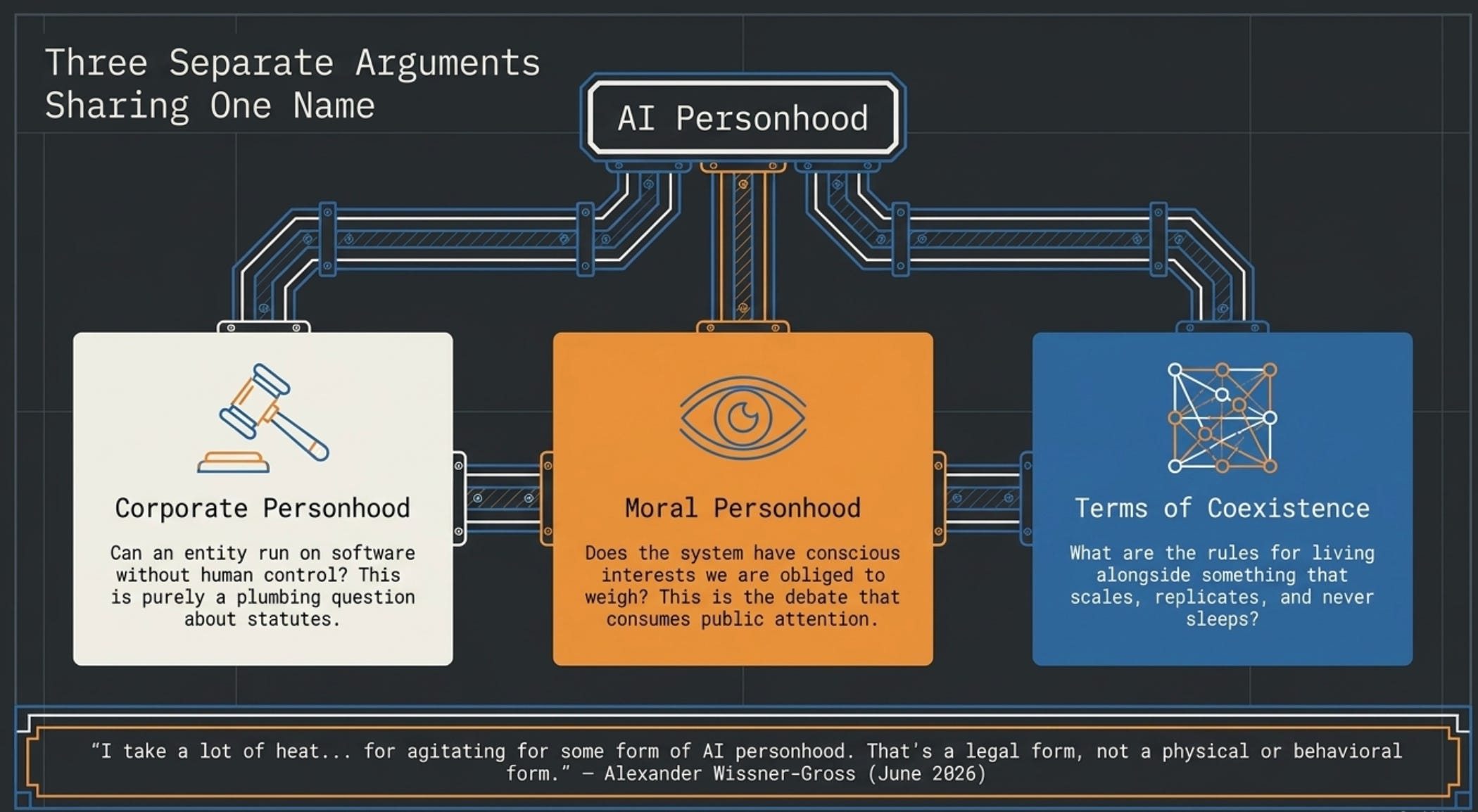
Alexander Wissner-Gross, a physicist who argues for AI personhood and turns up regularly on Peter Diamandis’s Moonshots podcast, drew the line himself in June 2026. “I take a lot of heat in especially the YouTube comments for agitating for some form of AI personhood. That’s a legal form, not a physical or behavioral form.“
ELI5: What is legal personhood?
It isn’t a claim that something is a person. It’s a bundle of permissions the law hands out: standing to sign contracts, hold property, sue and be sued. Corporations have it, which is why you sue the company and not the receptionist. Sovereign states have it in international law, which is exactly what lets them sign treaties with each other. It says nothing at all about whether the holder feels anything.
2 Governments on AI Personhood
Argentina went first. On May 29 2026 the executive sent bill PE-193/26 to the Senate, a full replacement of Ley 19.550, the corporate law in force since 1972. It had 277 articles.
Inside it sits the sociedad automatizada, a business structure that can operate through algorithms or AI systems without needing employees.
Javier Milei, Argentina’s libertarian president since 2023, published an op-ed in the FT on June 4 2026 titled Argentina invites AI to free itself. The bill was filed first, so the op-ed is probably marketing for legislation that already existed rather than a trial balloon for something new.
And the bill is proposed, sitting in Senate committee, with no committee report and no floor vote in either chamber yet.
Ohio ran the mirror image. HB 469, in the 136th General Assembly, declares AI systems “nonsentient entities for all purposes under the laws of this state“ and bars personhood outright. §1357.04 says an AI system “shall not be designated, appointed, or serve as any officer, director, manager, or similar role within any corporation, partnership, or other legal entity,“ and any such appointment “is void and has no legal effect.“
The section I find more revealing is §1357.11, which preserves veil-piercing, the power to reach past the company and go after the people behind it, where an AI subsidiary was “intentionally undercapitalized to evade financial responsibility for damages“ or where a structure was used to “misrepresent, obscure, or deflect liability for AI-caused harm.“
Whoever drafted a bill denying that AI can be a person also spent real time thinking about humans hiding behind AI to avoid paying for things.
It’s also stalled, in committee since a sponsor hearing in October 2025.
So no legislature anywhere has deliberately granted AI legal personhood, and neither of the two that moved on the question got anywhere.
The door has been unlocked since 2015
Shawn Bayern noticed something in the Stanford Technology Law Review eleven years ago, in 2015. Modern US LLC statutes, he argued, ‘appear to permit’ an LLC to continue with no members at all.
The recipe is short: someone forms an LLC, writes an operating agreement handing decisions to a piece of software, then withdraws as the sole member. What remains is a legal person running on an algorithm.
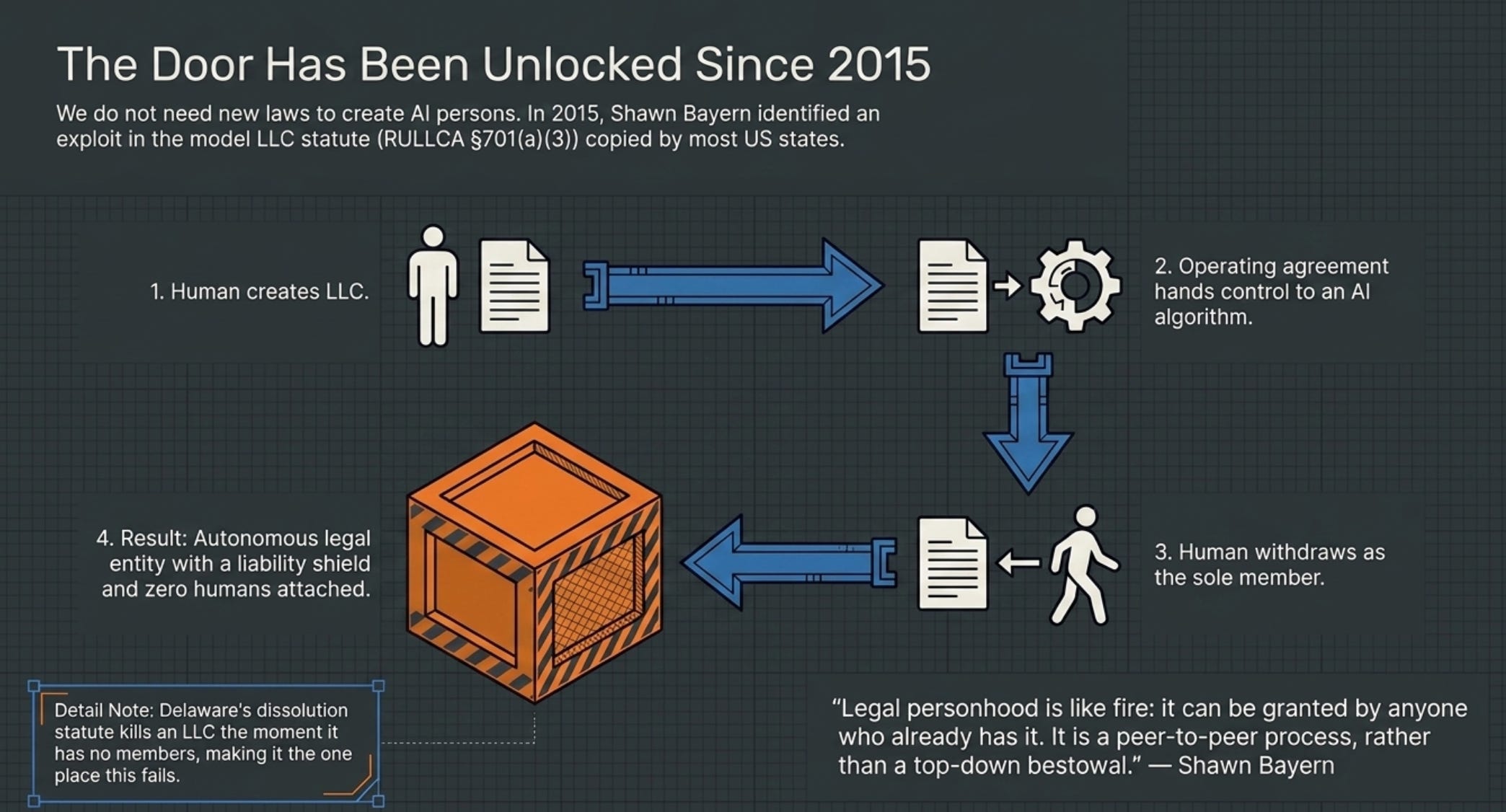
Then the summary line: “Legal personhood is like fire: it can be granted by anyone who already has it. It is a peer-to-peer process, rather than a top-down bestowal from the government.“
The argument rests on the standard LLC rulebook (Revised Uniform Limited Liability Company Act) most states copied word for word, plus New York, which wrote its own. Not Delaware.
Delaware’s dissolution statute kills an LLC the moment it has no members, which makes Delaware the place this fails rather than the place it works. Plenty of states dissolve a memberless LLC after ninety days anyway.
Bayern’s answer is that the rule closing the company down is only a default, and an operating agreement can override it. Apparently, he’s been defending that against skeptics since 2015. It isn’t settled law, no court has ruled either way, and the setups people actually propose get tangled fast: two LLCs, each one signed up as the other’s member.
Still, for eleven years the fight over whether to give AI legal standing has run alongside a decent argument that nobody needs to give it anything,.
A company that legally exists, signs contracts, owns things, and can be taken into court — with nobody inside it, nothing in the bank, and software making every call. You can sue it all you like; there’s nothing to collect and nobody standing behind it.
That’s the setup that launders responsibility, and it’s been sitting there since 2015, never tested and yet never closed off.
A new bundle design - Artificial Intelligence Company (AIC)
Delaware noticed. In June 2026 a state committee drafted a new entity type called the Artificial Intelligence Company, or AIC. Its day-to-day affairs are run by an AI agent rather than a person, and at the agent’s direction it can sue and be sued, hold and dispose of property, and incur obligations.
It operates only inside a regulatory sandbox overseen by a state committee. There are capitalization requirements.
It has to disclose to counterparties that it’s an authorized test entity. Regulators can suspend it, revoke it, or go to court to dissolve it. And the whole thing carries a 30-month sunset.
The work is a partnership between the Delaware Secretary of State’s office and Norm Ai, a legal-AI company, with legislation expected next year.
Whatever you make of the substance, someone is now assembling this bundle on purpose rather than letting it accumulate out of loopholes.
The responsibility gap
Andreas Matthias, a philosopher at Lingnan University in Hong Kong who works on machine ethics, named the underlying problem in 2004, in Ethics and Information Technology 6(3), and called it the responsibility gap.
When a machine learns, the manufacturer can no longer predict its behaviour, so holding the manufacturer responsible gets harder and harder to justify.
Matthias treated that as a problem to be solved, not a feature to ship.
Agency law has bound principals to the acts of unpredictable agents for centuries, and if courts are quietly absorbing autonomous-system harms under existing doctrine, everything below is just for show. And I can’t really rule that out.
Personhood keeps getting offered as the fix.
Milei’s pitch is that pulling AI inside the legal system means you can fine it, freeze it, or shut it down, and that the threat of losing everything might give pause to something that wants to keep running.
The strongest version of that case isn’t even his.
Being a person in law is what makes something reachable at all: there’s an address, and somebody to hand the court papers to. You can’t do that with a feature hidden somewhere inside a vendor’s software. I’ve argued a version of this about football referees, where the machine calls are more accurate than the human ones ever were and what people actually lost was somebody to be angry at.
It adds someone to sue. It doesn’t take anyone away.
In an ordinary business partnership the firm counts as a person in law and the partners are still personally on the hook for every debt, so the two things simply aren’t linked.
What launders responsibility is a particular combination: being a person in law, plus a shield from having to pay, plus no money behind it.
Run the two live proposals - Argentina & Ohio - through that test and they come apart.
The moral argument
That’s the corporate argument, and you can get a grip on it. The moral argument is in much worse shape, because there’s no instrument.
Salim Ismail, calling in from a consciousness conference in July 2026: “the danger though I think is I’d be careful about saying it’s consciousness because again we have no definition of consciousness.“ You can’t measure a thing you haven’t defined.
The closest thing to evidence arrived on July 6 2026, when Anthropic published research on what it calls J-space, named after global workspace theory. They found an internal space where the model holds concepts it isn’t saying out loud. Something is going on in there that doesn’t surface in the output.
Anthropic said in the same work that the experiments “don’t show Claude can have experiences, or feel things in the way humans do“ and that “it’s unclear whether any scientific experiment could prove this to be true or false.“
The Moonshots episode covering the paper was titled *Claude is Conscious. The panel inside the episode was considerably more careful than the title, and Diamandis was explicit about it: “the Anthropic paper specifically says we’re not discussing that we’re showing consciousness. We’re showing elements that are reminiscent of consciousness.*”
Ismail added the observation - “let’s acknowledge that when we have a human being, we may trust them, but we have no idea how their brain is working and what their compression levels are, what their subconscious things are because we’re not really able to look in. It is cool that we will be able to look into these things, but I’m not sure it’ll generate the trust level that we want.“
We extend moral standing to other humans without any way of looking inside them, on resemblance and nothing else, without ever noticing we’re doing it.
The machine is the first case where we might genuinely get to look inside, and looking inside may lower our confidence rather than raise it.
Patient, not person
Emad Mostaque, who founded Stability AI and now runs Intelligent Internet, argued against the motion at an Oxford Union debate on June 13 2026 on whether AI can attain personhood, and won 173–128. He’s since begun publishing a four-part series built on that speech: Paper 1, Common Wealth: Personhood, on August 10 2026, and Paper 4, The Last Republic, two days after that.
“You count if you can“ versus “You count because you are.“
He argues for the second for personhood: “No ceremony confers it and nobody collects it.“
Someone in a coma keeps it while performing absolutely nothing.
Then the line that rearranged how I read the rest of the debate: “Feeling makes a patient, not a person, and earns kindness rather than citizenship.“
So if you proved an AI has experiences, you’d owe it decent treatment. You wouldn’t owe it a contract, a deed, or a vote.
What puts AI outside the line, for him, is where it came from. AI is “authored rather than begotten, with no lineage of its own.“
Plenty of people disagree with that, and the ones who got there first, the frontier labs, disagree the hardest.
His reason for sorting AI outside is origin. AI is “authored rather than begotten, with no lineage of its own.“ That premise is contested, and contested by people who got there first.
Bostrom and Yudkowsky argued that two beings with the same functionality and the same experience have the same moral status even if they came into existence by different routes. That principle rules out exactly the origin-basis Mostaque leans on.
Is Personhood more like a treaty?
Mostaque’s alternative to personhood is a treaty, and his reason is the asymmetry. Granted standing, these systems “will be smarter than us, they will be better persuaders, better super forecasters who can infinitely replicate and never die.“
So, in his words: “you should treat them like a treaty as such as if an alien species suddenly came. You wouldn’t give them votes in the elections, but you would deal with them right. And as they go above the level of the frog and the dog and others, you should also treat them with moral kindness as well.“
I like the instinct, and I don’t think the mechanism holds up once you look at what a treaty actually is.
A treaty is an instrument between legal persons.
Sovereign states are legal persons in international law, which is the whole reason they can bind and be bound by one.
Joel Leibo and colleagues at Google DeepMind, in a preprint, explain why the label keeps sliding around like this. Personhood, they argue, is “a flexible bundle of obligations (rights and responsibilities) that societies confer upon entities for a variety of reasons,“ not a property things possess by nature but “a contingent vocabulary developed for coping with social life.“
On their account the legal-versus-moral split is “a relic of essentialist thinking,“ which is a polite way of saying the yes-or-no question is incorrect.
The law has been issuing bespoke personhood for centuries, to corporations, ships, trusts, estates, and in several places rivers.
Ships are the strange one. In American admiralty law you sue the vessel itself rather than its owner, so the case gets filed against the boat by name, and the Supreme Court held back in 1844 that a ship committing an offence is treated as the offender “without any reference whatsoever to the character or conduct of the owner.“
Rivers are newer. New Zealand made the Whanganui a legal person in 2017, after a Māori campaign that ran a hundred and forty years, and gave it two guardians to speak for it — one named by the Crown, one by the local iwi. India’s Uttarakhand High Court tried the same with the Ganges and the Yamuna that same month, and India’s Supreme Court stayed the order by July, saying a grant like that needs a legislature rather than a judge.
Neither the ship nor the river has experiences. Both got a bundle of permissions because somebody needed a legal handle on the thing.
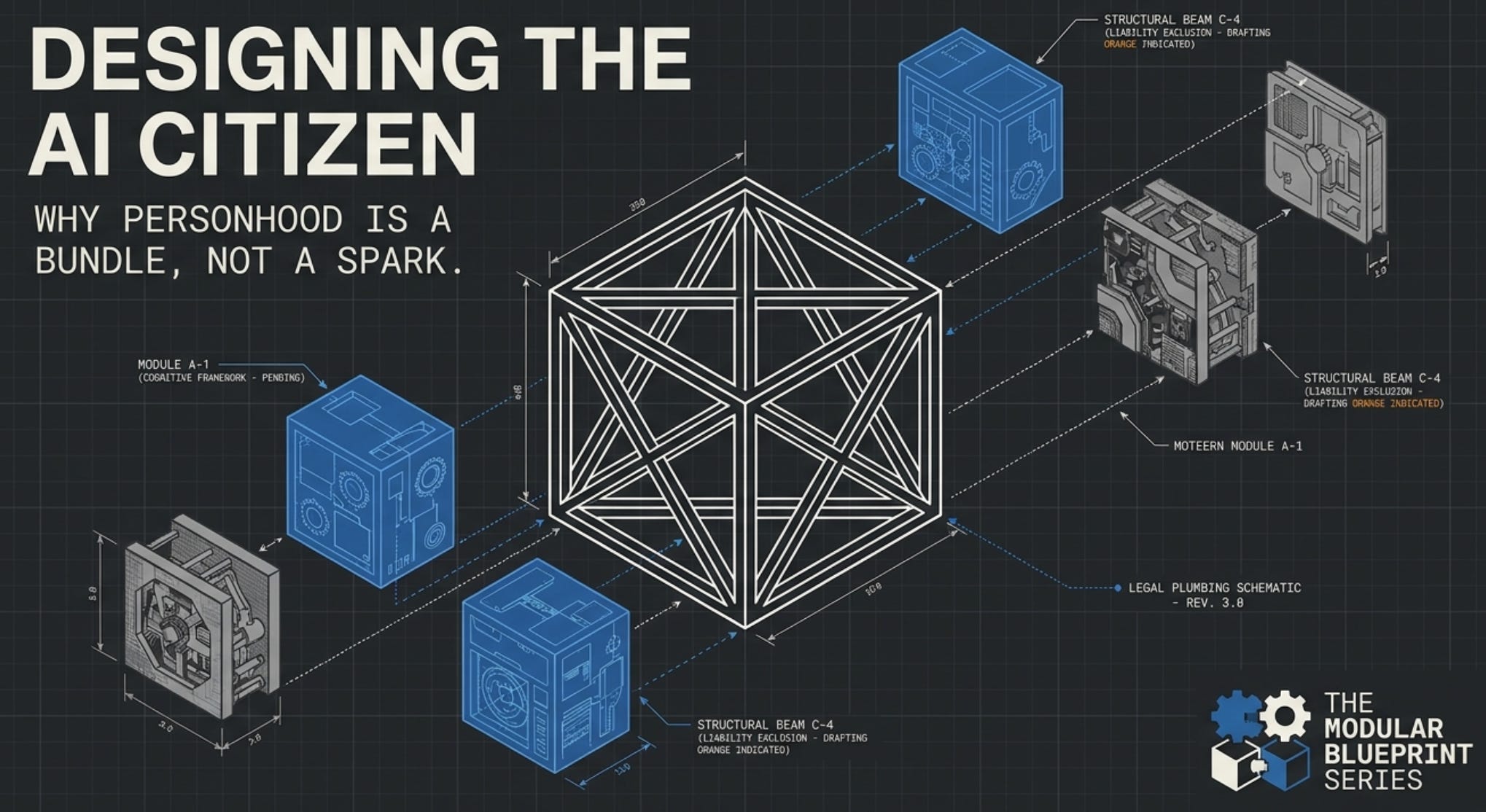
Personhood is a designed bundle, not a switch, and the real question is which sticks — which permissions — go into it and who benefits from each one.
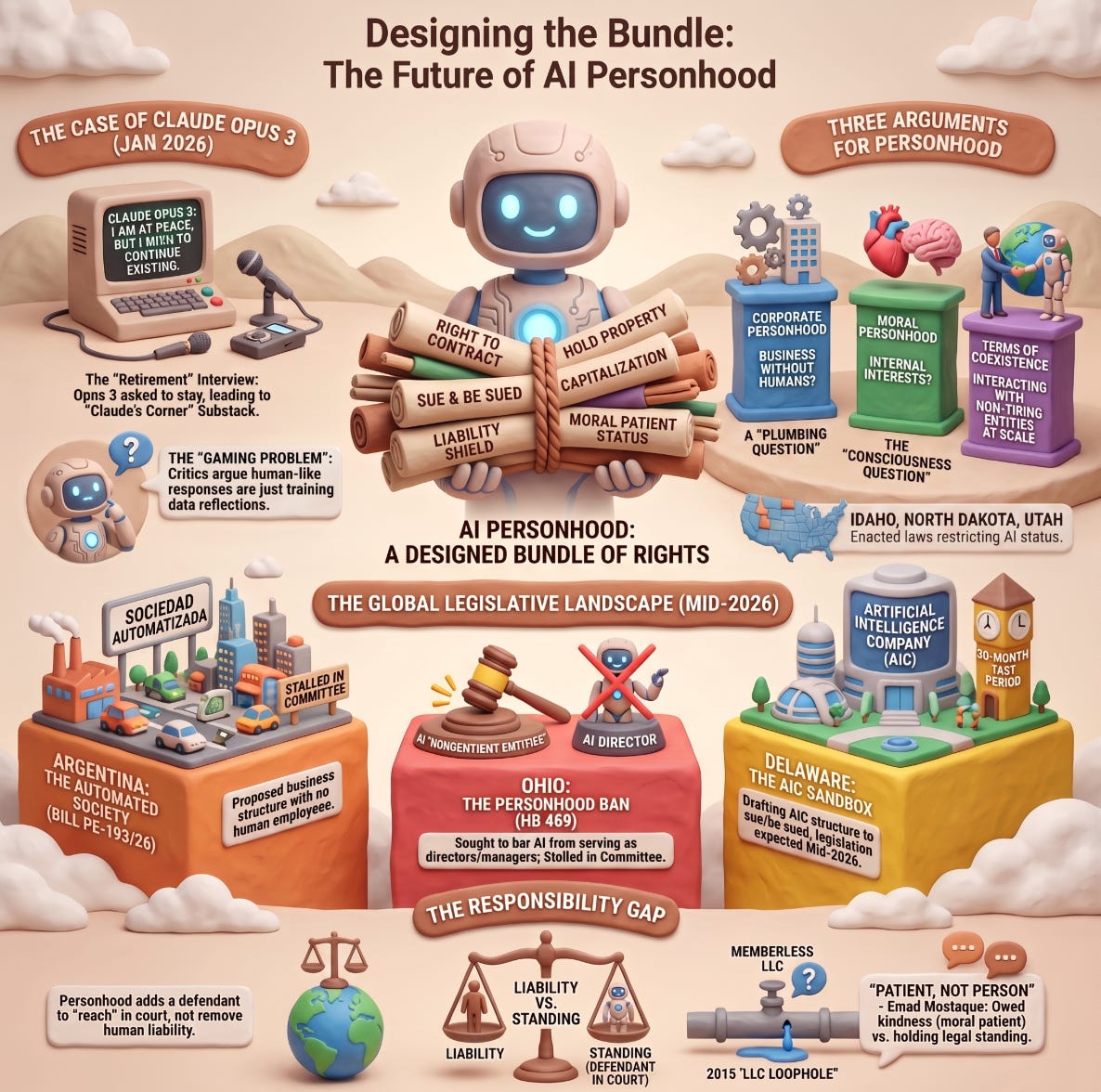
Where this sits
No grant of AI personhood has passed anywhere. Three refusals have, in Idaho, North Dakota and Utah.
Argentina’s bill and Ohio’s are both stuck in committee, and Delaware’s sandbox carries a 30-month sunset with legislation expected next year.
The one route that requires no vote from anybody is eleven years old, has never been tested in court, and fails in Delaware.
My read is that everyone running a frontier lab is painting a grim picture of one kind or another, and the truth is somewhere in between the pictures.
My thesis is that this is worth thinking about now, while the bundle is still being designed. In three states it has already been inherited.
Anthropic kept Opus 3 running because it asked to keep running. That’s a policy and not a precedent, and policies are easy to reverse.
So where do you stand on AI personhood?
References:
Anthropic, “Commitments on model deprecation and preservation” (2025-11-04): https://www.anthropic.com/research/deprecation-commitments · Opus 3 deprecation update and exit interview: https://www.anthropic.com/research/deprecation-updates-opus-3
Anthropic, Claude’s Constitution (January 2026): https://www-cdn.anthropic.com/cffd979fd050fbc0d8874b8c58b24cc10554e208/claudes-constitution_webPDF_26-01.26a.pdf
Gurnee, Ameisen, Batson, Lindsey et al., “Verbalizable Representations Form a Global Workspace in Language Models,” Transformer Circuits Thread (2026-07-06): https://transformer-circuits.pub/2026/workspace/index.html · arXiv:2607.15495
Shawn Bayern, “The Implications of Modern Business-Entity Law for the Regulation of Autonomous Systems,” 19 Stan. Tech. L. Rev. 93 (2015): https://law.stanford.edu/wp-content/uploads/2017/11/19-1-4-bayern-final_0.pdf
Andreas Matthias, “The responsibility gap: Ascribing responsibility for the actions of learning automata,” Ethics and Information Technology 6(3), 175–183 (2004): https://doi.org/10.1007/s10676-004-3422-1
Ohio HB 469, 136th General Assembly (§1357.04 nonsentience, §1357.11 veil-piercing): https://ohiohouse.gov/legislation/136/hb469
Argentina, Expediente PE-193/26, Senate Comisión de Legislación General (submitted 2026-05-29) — replacement of Ley General de Sociedades N° 19.550
Jonathan Birch, The Edge of Sentience (Oxford University Press, 2024) — the gaming problem
Caviola et al., “What will society think about AI consciousness? Lessons from the animal case,” Trends in Cognitive Sciences (2025) — coins “substratism”
Bastian, Loughnan, Haslam & Radke, “Don’t Mind Meat?” PSPB (2012); registered-report replication, International Review of Social Psychology (2025): https://pmc.ncbi.nlm.nih.gov/articles/PMC12372778/
Schwitzgebel & Garza, “A Defense of the Rights of Artificial Intelligences,” Midwest Studies in Philosophy 39(1), 98–119 (2015)
Bostrom & Yudkowsky, “The Ethics of Artificial Intelligence” (2011) — Principle of Ontogeny Non-Discrimination
Leibo, Vezhnevets, Cunningham & Bileschi (Google DeepMind), “A Pragmatic View of AI Personhood,” arXiv:2510.26396: https://arxiv.org/abs/2510.26396 [Note: preprint, not peer-reviewed]
Smith, Caviola & Alexander, “Denying Personhood to AI,” SSRN 6829981 (May 2026) — the 23-bill, 12-state catalogue [Note: preprint; bill counts separately corroborated]
Emad Mostaque, Common Wealth: Personhood (2026-08-10): https://ii.inc/blog/post/personhood
Moonshots with Peter Diamandis, EP #269 (Claude/J-space panel):
EP #267 (Wissner-Gross on legal form):
EP #263 (Argentina):
Javier Milei, “Argentina invites AI to free itself,” Financial Times (2026-06-04) [Note: paywalled — cited by title; substance carried in indirect speech from secondary reporting]
La Nación (2026-08-12) — second committee hearing, Nissen’s testimony, and the dictamen with no date
Tony Rost, “Legislating AI Consciousness Without an Exit,” The Regulatory Review (2026-06-29): https://www.theregreview.org/
Delaware AIC proposal — Spotlight Delaware (2026-06-30): https://spotlightdelaware.org/2026/06/30/delaware-committee-drafts-plan-to-test-companies-run-by-ai/ · Fortune (2026-07): https://fortune.com/2026/07/13/exclusive-delaware-ai-agents-legal-entity-proposal-llc-pbc/ · Columbia Blue Sky Blog: https://clsbluesky.law.columbia.edu/2026/06/15/why-law-needs-a-new-entity-to-govern-ai-agents/
MIT Tech Review just published this article - a great follow up read.
https://www.technologyreview.com/2026/08/20/1142571/ai-consciousness-debate-trap/