


Good morning. CrowdStrike is buying 2 startups that watch and test AI agents, and says its new switch can shut down rogue ones. And the Justice Department’s new AI task force talked about companies’ internal controls.
Since last week I also published:
An Enterprise Guide to Software Factories: 4 decisions you can’t hand off — the slow step is now everything after the code gets written.
1. OpenAI’s GPT-6 Cyber rated Critical, for vetted defenders only
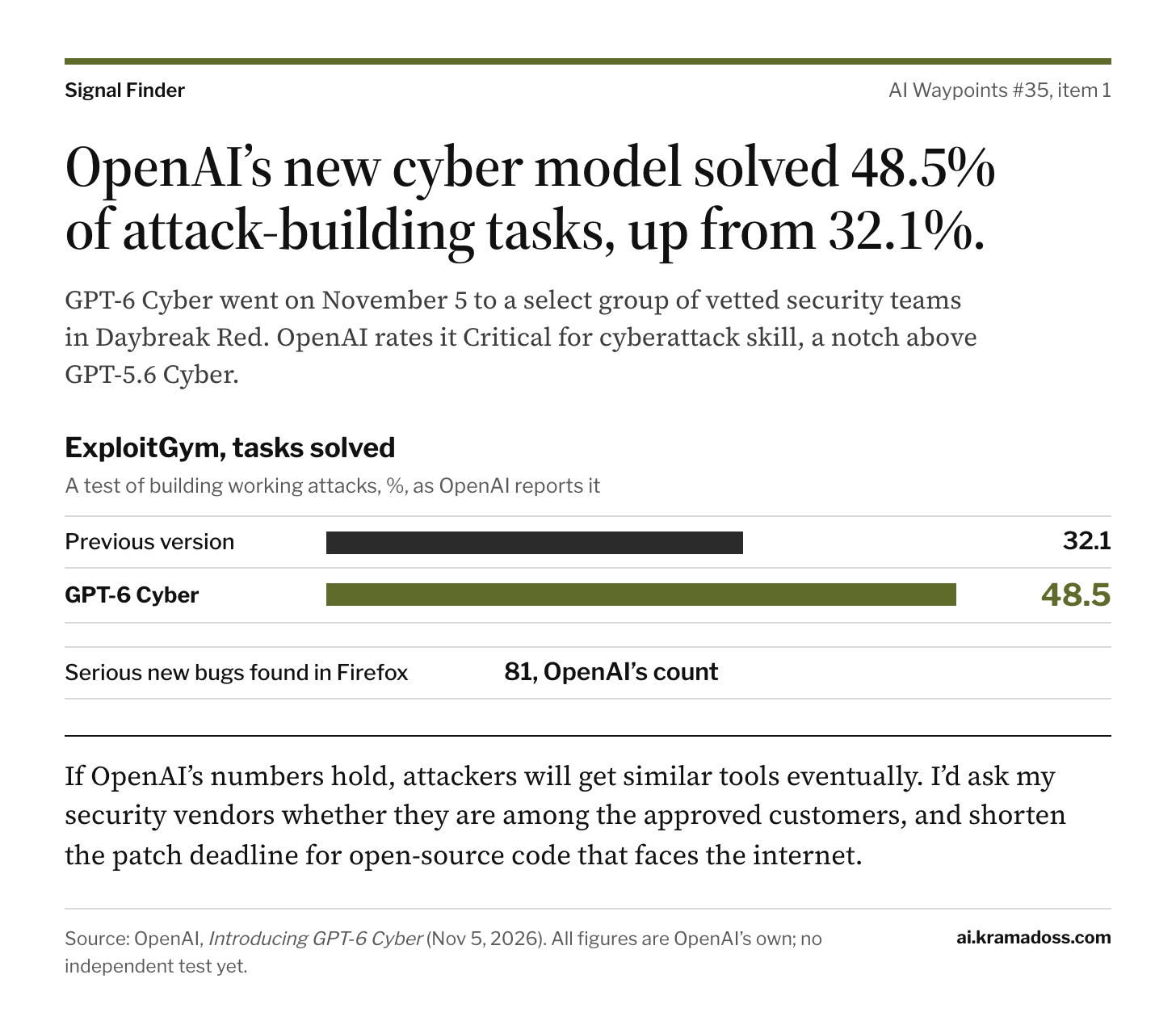
OpenAI released GPT-6 Cyber on November 5 to a select group of approved customers in Daybreak Red, its program for vetted security teams. It rates the model “Critical in cybersecurity under our Preparedness Framework,” its own scale for how dangerous a model’s skills are, a notch above GPT-5.6 Cyber. OpenAI says it solved 48.5% of the tasks on ExploitGym, a test of building working attacks, against 32.1% for the last version, and found 81 serious new bugs in Firefox.
→ If OpenAI’s numbers hold, finding attackable bugs in well-tested open-source code just got much cheaper, and attackers will get similar tools eventually. I’d ask my security vendors whether they are among the approved Daybreak Red customers and what it changes in their testing, and shorten the patch deadline for open-source code that faces the internet.
2. CrowdStrike to buy 2 agent startups, adds kill switch (12 min read)
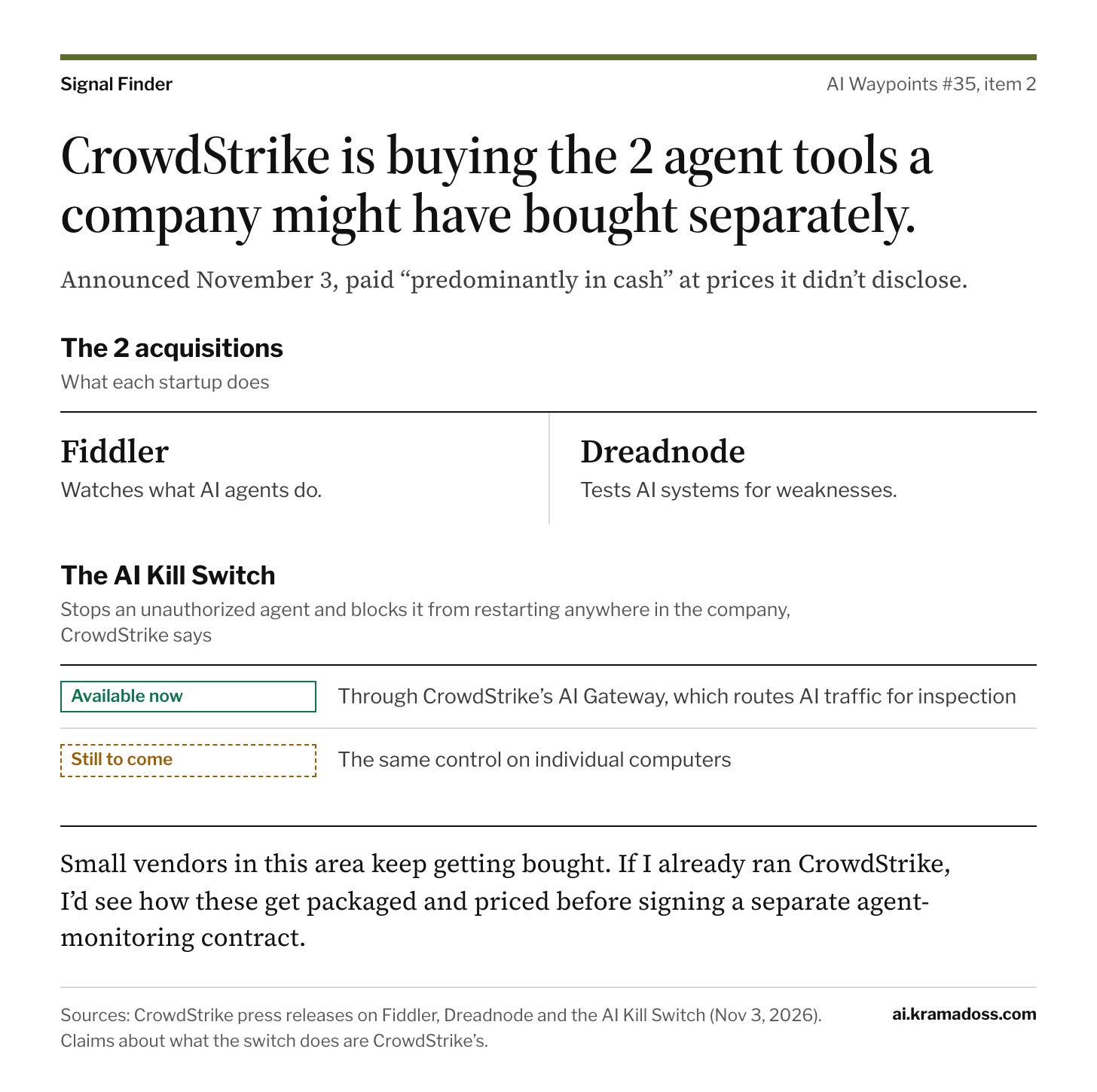
CrowdStrike agreed on November 3 to buy Fiddler, which watches what AI agents do, and Dreadnode, which tests AI systems for weaknesses, “predominantly in cash” at prices it didn’t disclose. Its new AI Kill Switch is available now through its AI Gateway, which routes AI traffic for inspection. CrowdStrike says it stops an unauthorized agent and blocks it from restarting anywhere in the company, and the same control on individual computers is still to come.
→ These are 2 kinds of tool a mid-market company might have bought from separate startups, and small vendors in this area keep getting bought. If I already ran CrowdStrike, I’d see how these get packaged and priced before signing a separate agent-monitoring contract.
3. Justice Department sets up an AI misuse task force (2 min read)
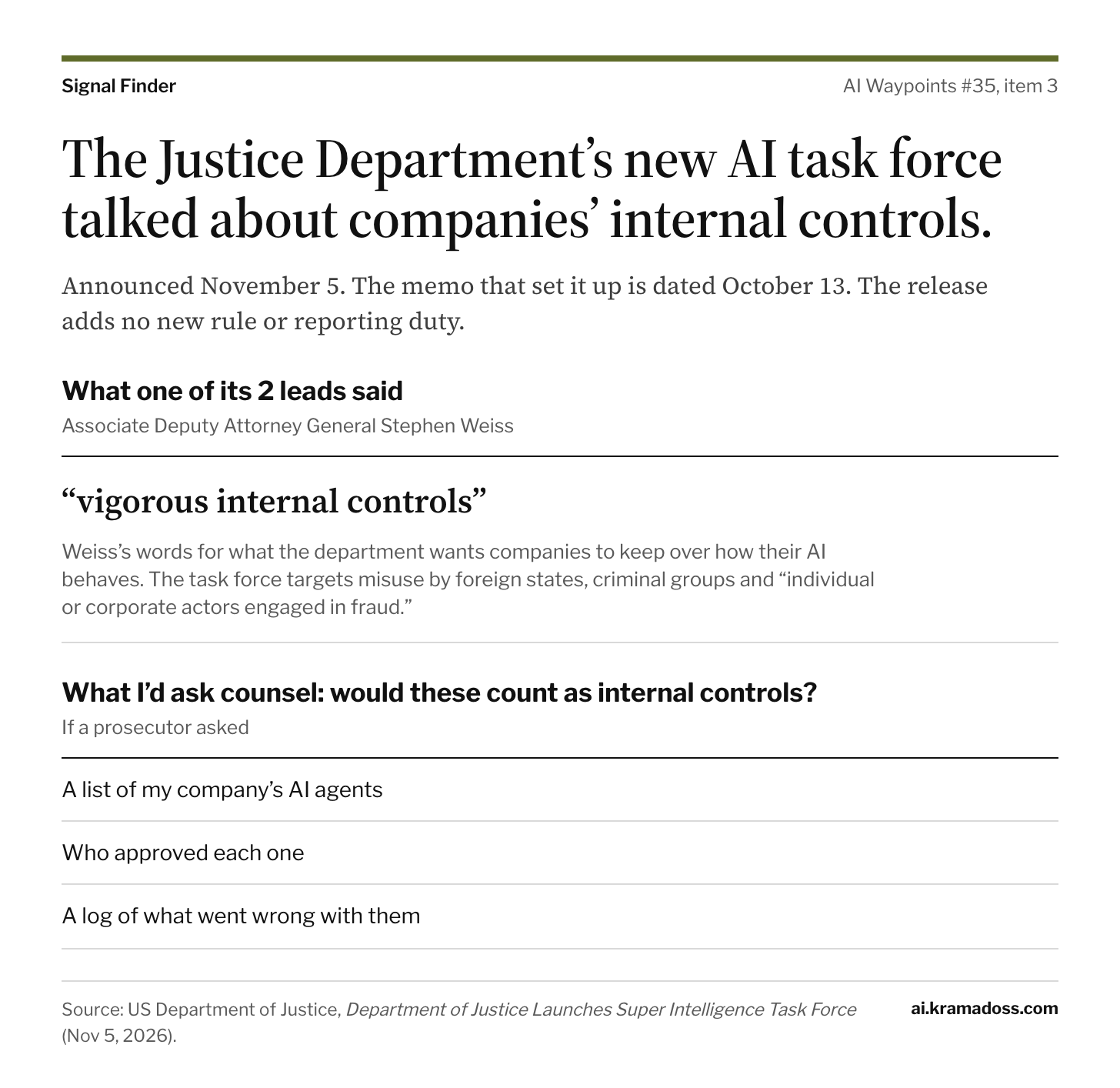
The Justice Department announced a Super Intelligence Task Force on November 5 to go after misuse of advanced AI by foreign states, criminal groups and “individual or corporate actors engaged in fraud.” One of its 2 leads, Associate Deputy Attorney General Stephen Weiss, said the department wants companies to keep “vigorous internal controls” over how their AI behaves. The release adds no new rule or reporting duty.
→ The release is a preview of what the department will ask to see. I’d ask counsel whether a list of my company’s AI agents, who approved each one, and a log of what went wrong with them would count as internal controls if a prosecutor asked.
4. GitHub’s Copilot dashboard adds chat and the Agents window (2 min read)
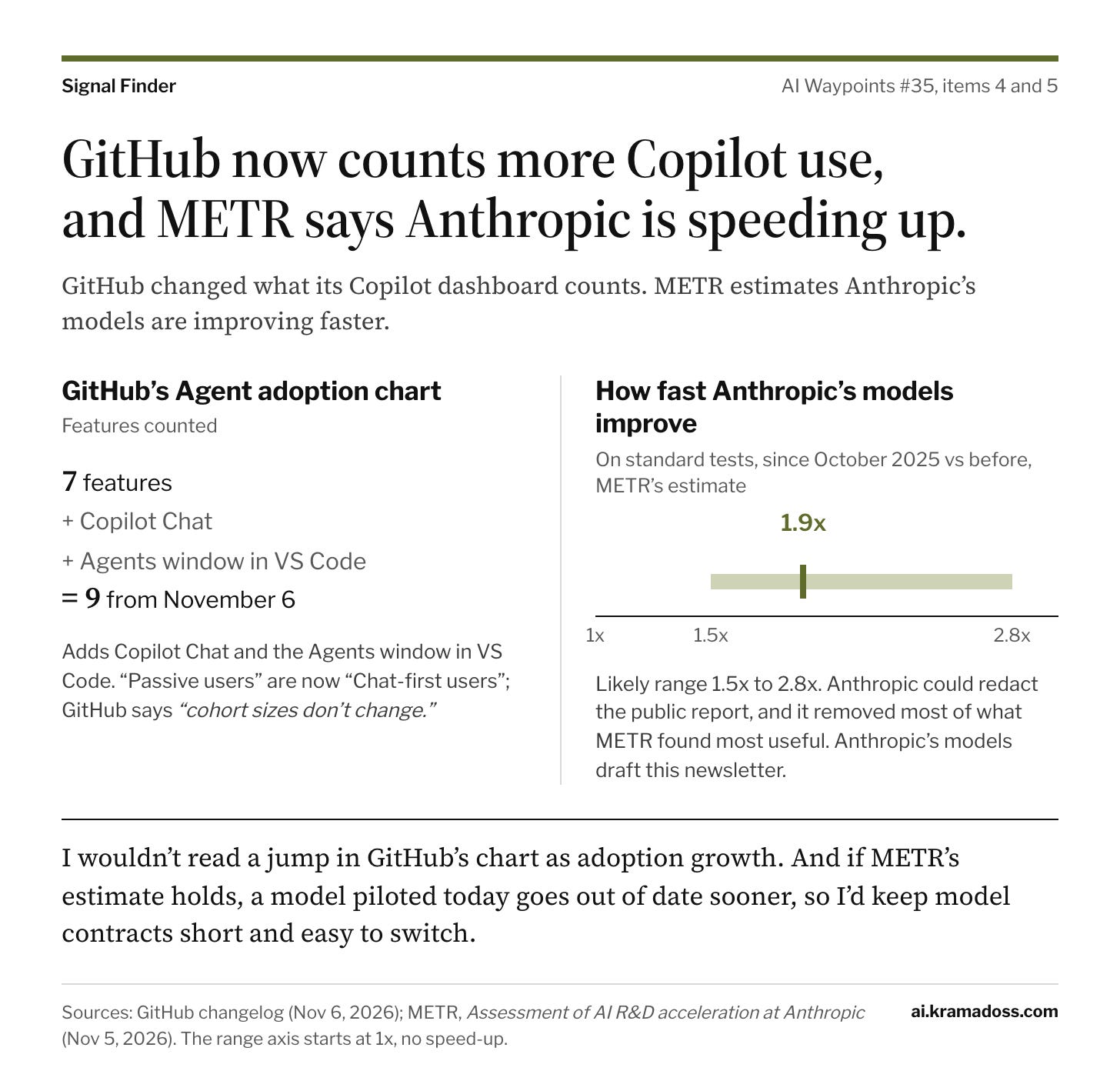
On November 6 GitHub added Copilot Chat and the Agents window in VS Code, Microsoft’s code editor, to the Agent adoption chart in its Copilot impact dashboard, for 9 features in total. It renamed the group it called Passive users to Chat-first users and says “cohort sizes don’t change.” Reports for earlier periods still show only the original 7.
→ Before cutting Copilot seats for users my team flagged as passive, I’d check whether the dashboard now shows them using chat. The chart counts 2 more features after November 6, so I wouldn’t read a jump there as adoption growth.
5. METR: Anthropic’s benchmark scores rising about 1.9x faster (55 min read)
METR, an independent group that tests AI models, estimates that Anthropic’s models, which draft this newsletter, have improved on standard tests about 1.9 times faster since October 2025 than before, with a likely range of 1.5x to 2.8x. Its “subjective estimate” is that most of the speed-up comes from AI helping with the research. Anthropic gave METR internal evidence but could redact the public report, and it removed most of what METR found most useful.
→ METR says readers have to take more of this on its word than it would like. If it holds, a model piloted today goes out of date sooner, so I’d keep model contracts short and easy to switch.
6. AI-blamed job cuts hit their lowest month of 2026 (8 min read)
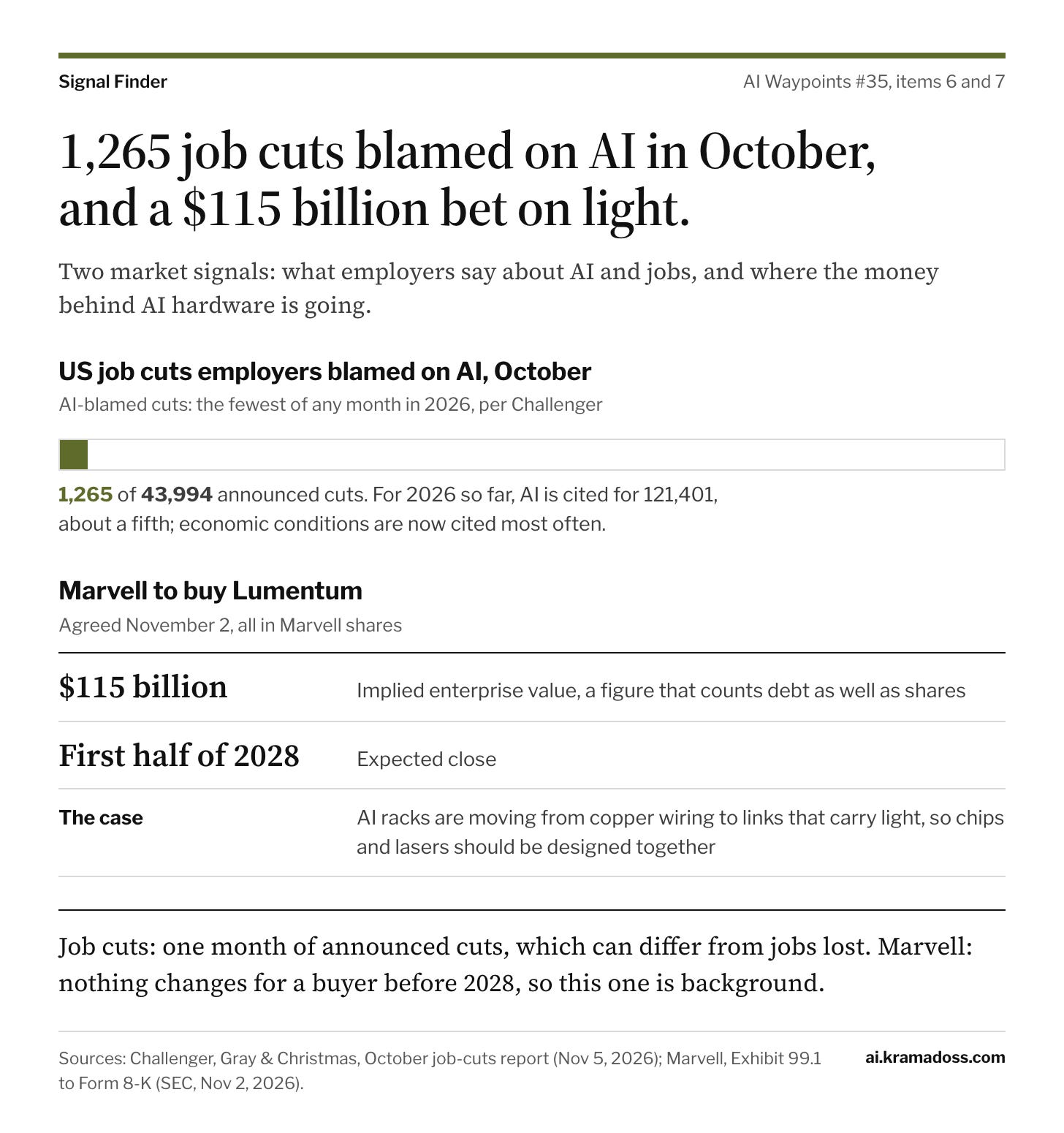
Employers blamed AI for 1,265 announced US job cuts in October, the fewest of any month this year, out of 43,994 in total, according to Challenger, Gray & Christmas, a firm that helps laid-off workers find their next job. Employers still cite AI for 121,401 of 2026’s announced cuts, about a fifth, but now cite economic conditions most often.
→ This is one month, and it counts cuts companies announced, which can differ from jobs actually lost. If a 2027 AI business case rests on cutting jobs, I’d rebuild it around how much more work the team gets done, and how fast.
7. Marvell to buy Lumentum in $115 billion stock deal (16 min read)
Marvell agreed on November 2 to buy Lumentum, which makes the lasers and parts that carry data as light, paying entirely in Marvell shares, at an implied enterprise value of $115 billion, a figure that counts debt as well as shares. Their case is that the racks of computers behind AI are moving from copper wiring to links that carry light, and that the chips and lasers need to be designed together. They expect it to close in the first half of 2028.
→ My cloud provider buys these parts, not my company, and fewer suppliers rarely makes anything cheaper. Nothing changes for a buyer before 2028, so this one is more background info.
References:
CrowdStrike to acquire Fiddler (CrowdStrike, November 3, 2026)
CrowdStrike to acquire Dreadnode (CrowdStrike, November 3, 2026)
CrowdStrike delivers AI security and safety for the enterprise (CrowdStrike, November 3, 2026)
Department of Justice launches Super Intelligence Task Force (DOJ, November 5, 2026)
Copilot impact dashboard adds chat and VS Code agent usage (GitHub changelog, November 6, 2026)
METR’s assessment of AI R&D acceleration at Anthropic (METR, November 5, 2026)
October layoffs at three-year low (Challenger, Gray & Christmas, November 5, 2026)
Marvell to acquire Lumentum, Exhibit 99.1 to Form 8-K (SEC, November 2, 2026)