

The short version
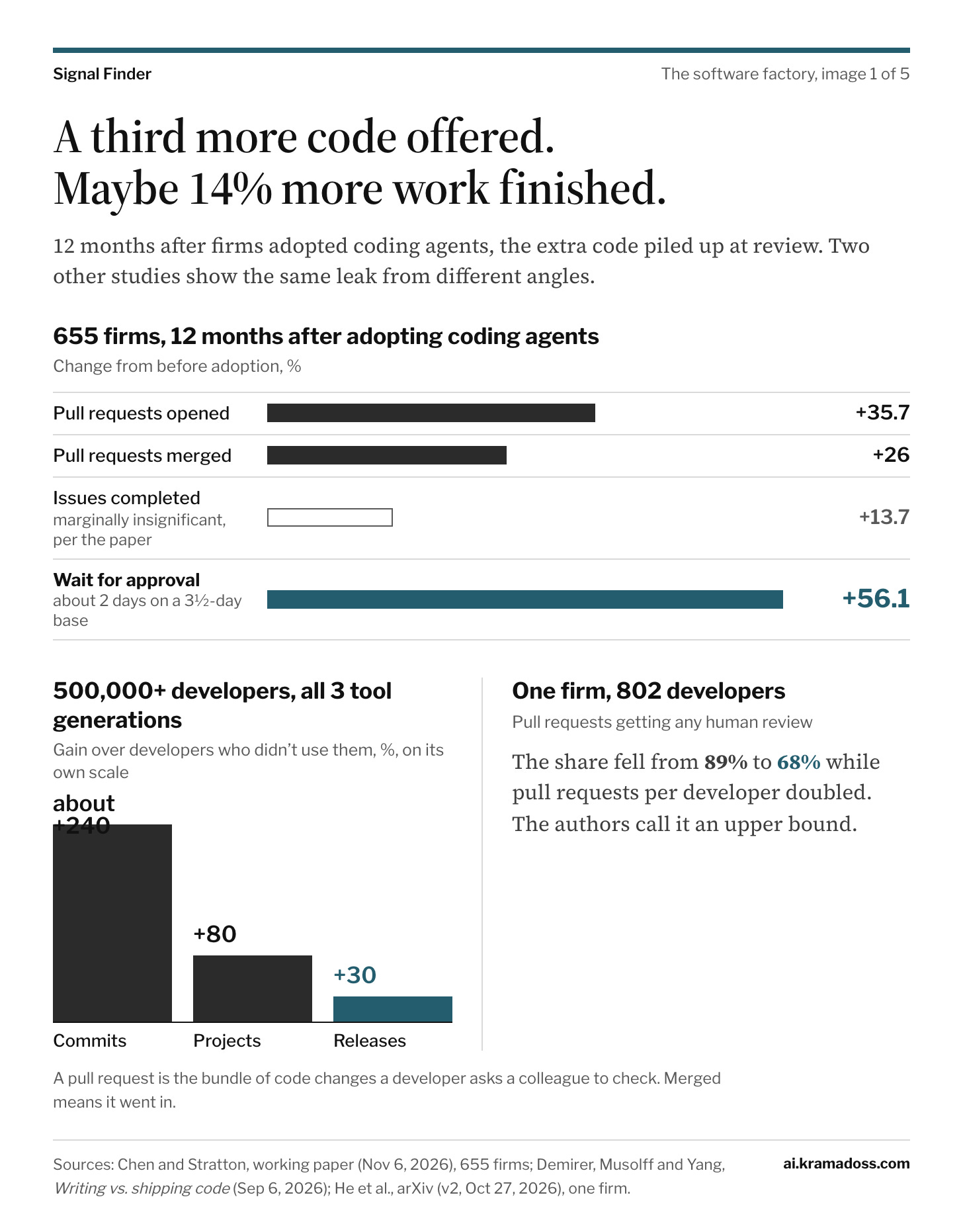
In one working paper, firms adopting coding agents saw 36% more pull requests and a 56% longer wait for approval. The constraint moved from writing code to everything after it.
Some firms are answering by building shared systems around the agents. I think they’re right to try, but nobody has shown it beats a good engineer with a good interactive tool.
The machine is older than the agents. Spotify says half its pull requests were automated before the agent showed up, and the first factory goes back to Hitachi in 1969.
I’d measure first. If you still want one, buy it from the platform you already pay for. 4 decisions don’t come with the purchase: where the traces live, what the credentials reach, who owns the gate, who sees the meter.
Where I’d be wrong: if firms that build these systems show no better pass-through from pull requests opened to work shipped than firms that don’t.
Did the waiting part move somewhere else?
In August I wrote that the AI engineering ladder has 5 rungs and most enterprise work needs the bottom 2 and a chat. Software delivery may be the exception, and this article is me working out why.
One disclosure: I’m building one with my team in-house, so I have a stake.
The number came from a working paper by Fiona Chen and James Stratton (researchers at Harvard — cited for the review bottleneck). It covers 655 medium-to-large firms, 720,542 workers, through August 2026. 12 months after a firm adopted coding agents, pull requests opened were up 35.7%, and the wait from submitting one to getting it approved went up 56.1%, about 2 extra days on a baseline of 3 and a half.
Their line for it: “Code review becomes the bottleneck.“
(Quick definition, if you’ve never had to approve one: a pull request, or PR, is the bundle of code changes a developer asks a colleague to check before it goes in. “Merged” means it went in.)
Merged PRs rose 26%. Completed issues, the unit closest to “work somebody asked for“, rose 13.7%, and the paper itself calls that marginally insignificant.
So those firms got a third more code offered, a quarter more accepted, and maybe 14% more work finished.
The constraint moved from writing code to everything after it.
Where’s the leak?
This is the 3rd time it’s happened.
Mert Demirer and colleagues (at MIT, Wharton and Boston University — cited for the 3 generations of coding tool) tracked more than 500,000 GitHub developers from 2022 to 2026, using public GitHub data plus Microsoft usage data that isn’t public. They split the tools into 3 generations: autocomplete, agents you watch while they work, and agents you hand a task and come back to.
Developers using all 3 made about 240% more commits. That 240% falls to 80% when you count projects and 30% when you count releases, and for the newest generation the paper says “we do not report a release effect.”
Each generation got more code written; the 2 with release numbers shipped far less of it.
One company’s internal numbers show the leak up close. Hao He and colleagues (at Carnegie Mellon and Stanford, with an independent researcher — cited for one firm’s review load) studied 802 developers and 196,212 PRs at a single firm.
PRs per developer doubled. The load on each reviewer doubled too, and the share of PRs getting any human review fell from 89% to 68%. The authors call it an upper bound, and it’s one firm.
It also doesn’t square with Chen and Stratton, who found 79.1% of their 655 firms had adopted AI review tools and reviews were still overwhelmingly human. One firm against 655, and they point different ways on who does the reviewing.
I can’t reconcile them.
2 lines met - Coding tools & the Delivery system
My going-in version of this story was an evolution: prompt engineering grew up and became a factory.
The research I found says it’s 2 distinct lines that met.
Line 1 is the coding tools, in Demirer’s 3 generations.
Line 2 is older than any of this: the delivery system, the build pipelines and test runners and scripts that fix the same thing across a thousand code repositories.
Firms are now plugging the agents into line 2.
(Quick definition: by software factory I mean a shared system that takes work from a ticket or a chat message, runs coding agents on it with a fixed set of tools and permissions, checks the result, and opens a PR for a person to review. That’s my working definition, not a standard.)
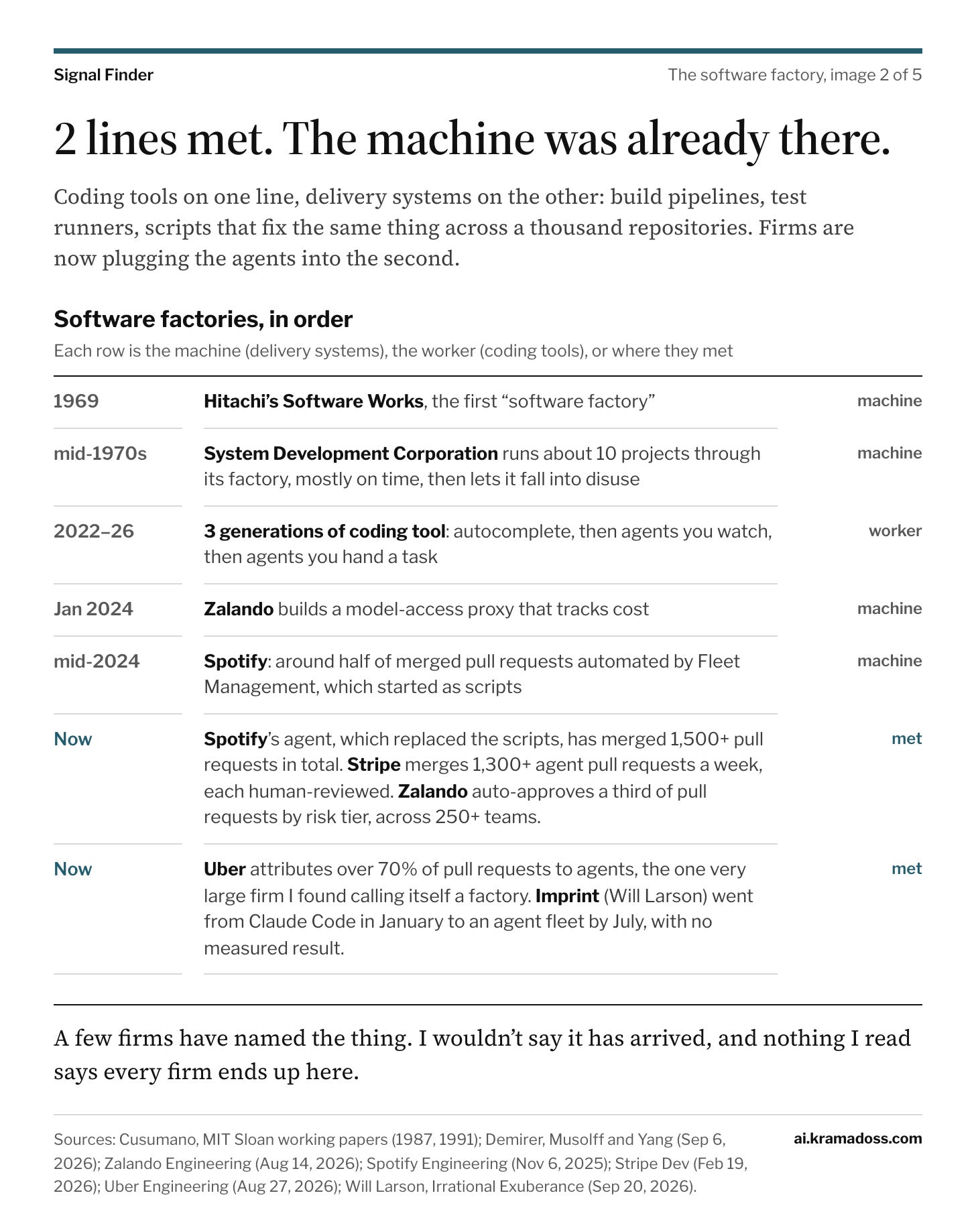
Spotify’s engineers describe the machine side without ever using the word. Since mid-2024, around half of the PRs merged at Spotify have been automated by its Fleet Management system, which started as scripts. They then swapped the scripts for a prompted agent inside the same machine, and more than 1,500 of its PRs have merged.
The machine was already there; the agent is the new worker on it.
Zalando’s engineering blog tells a similar story: a proxy for API model access, dating from January 2024, that tracks cost, a local proxy that injects credentials, and PR approval tiered by risk. A third of PRs are auto-approved across 250+ teams.
Will Larson (at Imprint — cited for one firm walking the sequence) wrote up his company’s path from January to July: Claude Code in January, shared state in Linear by June, an orchestrated fleet of agents by July. He reports the steps but no measured result.
Uber is the one very large firm I found using the word about itself. Uday Kiran Medisetty (Distinguished Engineer at Uber — cited for Uber’s factory) writes that over 70% of Uber’s PRs are now attributed to local or cloud agents, and that “The core strategic shift is moving from interactive developer workflows to fully managed agents.”
Stripe reports 1,300+ fully agent-produced, human-reviewed PRs merging every week and never says factory.
So a few firms have named the thing. I wouldn’t say it has arrived, and nothing I read says every firm ends up here.
The phrase software factory is older than the agents.
Michael Cusumano (MIT Sloan — cited for the history) traces the first “software factory” to Hitachi’s Software Works in 1969. System Development Corporation built one in the United States in the mid-1970s and ran about 10 projects through it, mostly on time. It worked well enough that the chief executive made it a corporate standard.
Then it fell into disuse: the tools weren’t portable, managers wanted control of their own projects back, and in the words of John Munson (who led SDC’s factory work — cited for how it ended), “we did not have the work to sustain it.”
The practices lived on after the factory closed.
What’s the factory for, then?
Here’s the hypothesis I’m working on.
Some firms are answering the review problem by building shared systems. I think they’re right to try. Nobody has shown it beats good interactive use.
The argument for a shared system is that it turns agent use into something a team can measure and improve. When the whole setup is written down as code, a bad step shows up in the data and somebody can change and improve it.
This is also where my August article takes a hit. I wrote then that drawing the work out as a graph only pays when somebody will later need to reconstruct the decision. Factory sellers claim a 2nd payoff: the system can read its own run history and improve itself.
If they are able to show it, my “only statement” was wrong. They haven’t shown it yet.
Zach Lloyd (founder and CEO of Warp, which sells Warp Factories — cited for the stack and for its limits) described agents proposing changes to the factory definition, then said of replaying past runs to check whether a proposed change would have helped: “we don’t have this yet”.
My test is simple, and nobody has the data yet: independent numbers showing that teams running a factory beat teams using interactive agents well, on accepted work per dollar.
If firms that build these systems show no better pass-through from PRs opened to work shipped than firms that don’t, I’m wrong.
What’s wrong with cost per PR?
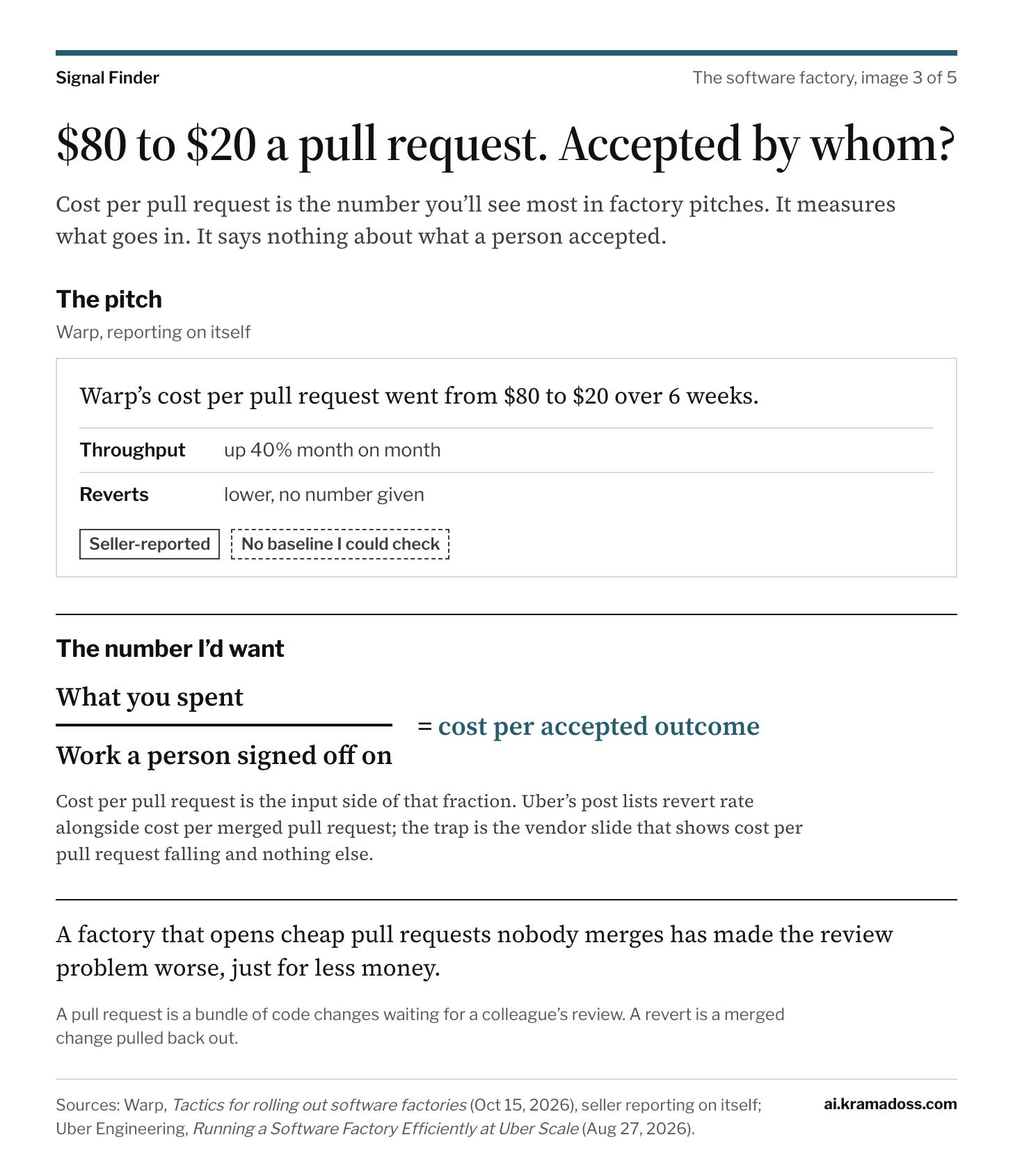
You’ll see one number a lot in the factory pitches: cost per PR. Warp’s own post says its cost per PR went from $80 to $20 over 6 weeks, with throughput up 40% month on month and reverts lower. It’s the vendor slide that shows cost per PR falling and nothing else.
A factory that opens cheap PRs nobody merges has made the review problem worse, just for less money.
The number I’d want is the one I called cost per accepted outcome in July: what you spent, divided by the work a person signed off on. Cost per PR is the input side of that fraction.
4 decisions you can’t hand off
I also went in thinking leaders need to understand the stack. No study I found tests whether a leader who understands it gets better results.
What I did find is that a few decisions inside it are contract and risk questions, and you can’t make those calls without knowing where each piece runs.
You don’t need to draw the stack. You need to own 4 decisions in it.
Where the traces live
Anthropic’s own page on self-hosted environments says your code checkouts, build artifacts and secrets stay in your cloud. The conversation, tool results included, still goes to api.anthropic.com, even when you route the model through Bedrock or Google. Cursor’s page on the same feature says “your codebase, tool execution, and build artifacts never leave your environment” and, further down, that results “flow back to Cursor for the next round of inference.” Both can be true. You need to know which bytes each sentence covers.What the credentials reach
I found published failures across the whole chain. OpenAI’s Codex let a model-generated working directory move its writable root, rated High, 8.6. Google’s Gemini CLI, run headless in yolo mode, ignored its allowlist, letting prompt injection execute code, rated Critical, 10.0. Anthropic’s Claude Code on macOS let attacker-controlled code in its sandbox overwrite files outside the workspace, rated High, 7.7. All 3 are patched. On October 29 Cursor said it pulled 2 malicious versions of the Claude Code extension, not built by Anthropic, from its marketplace.Who owns the gate
One way through the review queue is to have humans review fewer PRs: Zalando lets a third of PRs skip human review, by risk tier. That’s a policy somebody wrote. I’d want to know who signs it and how often anyone re-reads it.Who sees the meter
GitHub says Fusion, out of preview October 28, routes work across models, meters each model separately, and only uses the models enabled in your organization’s model policy. Someone sets that policy. Uber’s CTO said the company spent its annual AI budget in 4 months. Bloomberg reported a $1,500 monthly cap per employee per tool.
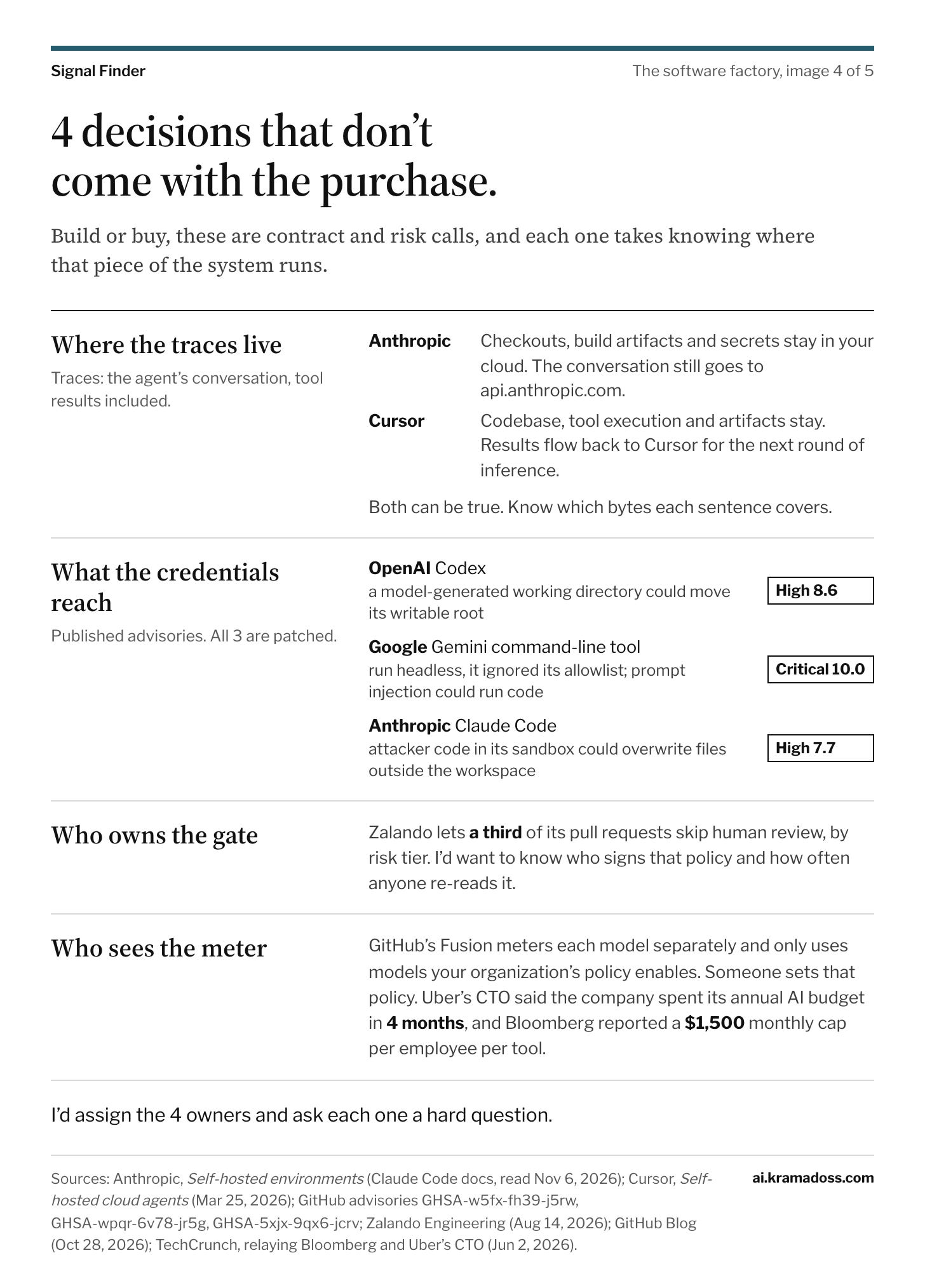
Britain’s financial regulator put the leadership half of this well. I’m borrowing it as an analogy only, since the document isn’t about software. The FCA says it doesn’t “expect senior managers to be technical specialists”, and lists handing AI development entirely to technical teams, without understanding or challenge, as a weakness. That’s about where I’ve landed: enough to assign the 4 owners and ask each a hard question.
If you want one, I’d buy it
By their own accounts, the platforms you already pay for now sell pieces of a factory. Fusion ships on every Copilot plan, in the clients GitHub named. GitLab announced general release of a scoped secrets manager on October 6 under the banner “governed software factory.” Anthropic’s self-hosted page says “Most teams are better served by Anthropic-hosted environments”, which is a vendor recommending its own service.
Even the seller says so for small teams. Lloyd, asked who needs all 6 layers: for a few people “this is overkill. Don’t do this.” His floor, maybe, is “around like five to 10 engineers”, and that’s a seller’s floor.
Build or buy, I’d check the account terms, because they keep moving. In April Anthropic began withdrawing subscribers’ Claude plan limits for third-party harnesses, and its legal page says the advertised limits “assume ordinary, individual usage.” Check the authentication, credential handling and billing your factory needs. I won’t tell you where billing stands today, because it may have moved again by the time you read this.
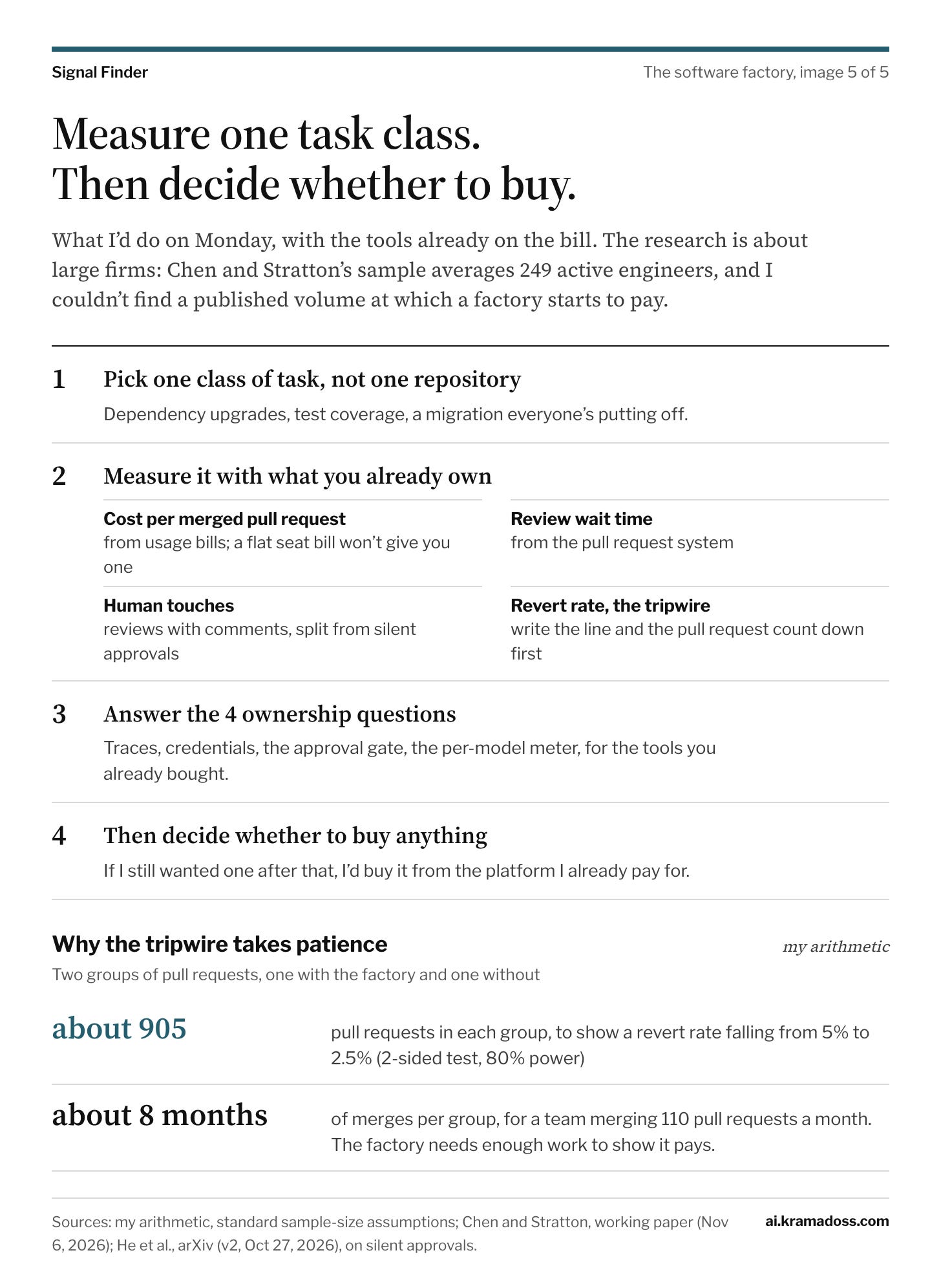
One limit if you’re mid-market: the research is about large firms. Chen and Stratton’s sample averages 249 active engineers and leaves out smaller firms by design. I couldn’t find a published volume at which a factory starts to pay, and I won’t make one up.
What I can say is the shape.
You need enough volume to watch cost move, and that’s not enough to prove quality held. My own arithmetic, with the usual assumptions for a 2-sided test at 80% power: to show a revert rate falling from 5% to 2.5% you’d want about 905 PRs in each arm. A team merging 110 PRs a month would wait about 8 months per arm. That’s the SDC lesson again: the factory needs the work to sustain it.
What I’d do on Monday
If I were walking in Monday, I’d pick one class of task rather than one repository: dependency upgrades, test coverage, a migration everyone’s putting off. Then:
Measure it with what you already own. Cost per merged PR, from usage bills; a flat seat bill won’t give you one. Review wait time, from the PR system. Human touches, split into reviews with comments and silent approvals, because the 2nd kind is the leak He and colleagues measured. Revert rate as a tripwire, with the line you’ll act on and the PR count written down before you start.
Answer the 4 ownership questions for the tools you already bought. Where do the traces go? What can the agent’s credentials reach? Who signed the approval policy? Who can see the per-model meter?
Then decide whether to buy anything. Not before.
So what changes?
Developer experience (DevEx) moves from the developer’s tools to the system around them, and the first thing that system changes is who reviews.
If your own PR queue is telling a different story, I’d like to hear it.
References:
Chen and Stratton, Artificial Intelligence in the Firm: Bottlenecks in Software Production (job market paper, Current Nov 6, 2026): https://fion.ac/jellyfish.pdf
Demirer, Musolff and Yang, Writing vs. shipping code (Sep 6, 2026): https://www.mertdemirer.com/Papers/Demirer_Writing_vs_shipping_code.pdf
arXiv, He et al., AI Writes Faster Than Humans Can Review: A Longitudinal Study of an Enterprise “2x” Mandate (v2, Oct 27, 2026): https://arxiv.org/abs/2607.01904
Spotify Engineering, 1,500+ PRs Later: Spotify’s Journey with Our Background Coding Agent (Honk, Part 1) (Nov 6, 2025): https://engineering.atspotify.com/2025/11/spotifys-background-coding-agent-part-1
Zalando Engineering, Agentic engineering at Zalando: a snapshot (Aug 14, 2026): https://engineering.zalando.com/posts/2026/08/agentic-engineering-at-zalando-a-snapshot.html
Irrational Exuberance (Will Larson), Trying the Software Factory pattern (Sep 20, 2026): https://lethain.com/software-factory-experiment/
Uber Engineering, Running a Software Factory Efficiently at Uber Scale (Aug 27, 2026): https://www.uber.com/us/en/blog/efficient-software-factory/
Stripe Dev, Minions, part 2 (Feb 19, 2026): https://stripe.dev/blog/minions-stripes-one-shot-end-to-end-coding-agents-part-2
Cusumano, The Software Factory: An Entry for the Encyclopedia of Software Engineering, MIT Sloan WP BPS-3268-91 (draft Mar 29, 1991), hosted at gregorystrachta.com: https://www.gregorystrachta.com/resources/Touchstones/swp-3268-23661042.pdf
Internet Archive, Cusumano, System Development Corporation: Defining the Factory Challenge, MIT Sloan WP 1887-87 (1987, rev. 1988): https://archive.org/stream/systemdevelopmen00cusu/systemdevelopmen00cusu_djvu.txt
Warp, Tactics for rolling out software factories: human and organizational changes (Oct 15, 2026): https://www.warp.dev/blog/rolling-out-software-factories
Anthropic, Self-hosted environments and Legal and compliance (Claude Code docs, undated, read Nov 6, 2026): https://code.claude.com/docs/en/self-hosted-environments
Cursor, Self-hosted cloud agents (Mar 25, 2026) and Security notice — malicious version of Anthropic.claude-code (2.1.312 and 2.1.313) identified in the Cursor VS Code Extension Marketplace (Oct 29, updated Oct 30, 2026): https://cursor.com/blog/self-hosted-cloud-agents
GitHub, Codex advisory GHSA-w5fx-fh39-j5rw (Sep 19, 2025) and run-gemini-cli advisory GHSA-wpqr-6v78-jr5g (Apr 24, 2026) and Claude Code advisory GHSA-5xjx-9qx6-jcrv (Oct 26, 2026): https://github.com/openai/codex/security/advisories/GHSA-w5fx-fh39-j5rw
GitHub Blog, Route and orchestrate models with GitHub Copilot Fusion (Oct 28, 2026): https://github.blog/changelog/2026-10-28-route-and-orchestrate-models-with-github-copilot-fusion/
TechCrunch, Uber caps employee AI spending, relaying Bloomberg and Uber’s CTO (Jun 2, 2026) and Anthropic says Claude Code subscribers will need to pay extra for OpenClaw usage (Apr 4, 2026): https://techcrunch.com/2026/06/02/uber-caps-employee-ai-spending-after-blowing-through-budget-in-four-months/
FCA, AI in financial services: good practice and areas for improvement (Oct 19, 2026, updated Oct 20): https://www.fca.org.uk/publications/good-poor-practice/ai-financial-services
GitLab, GitLab announces the foundation for the governed software factory (Oct 6, 2026): https://about.gitlab.com/press/releases/2026-10-06-gitlab-announces-the-foundation-for-the-governed-software-factory/
Latent Space (YouTube), Zach Lloyd interview, auto-captions (Nov 3, 2026):