

Good morning. Nvidia’s chief executive resigned. Anthropic and Google both published new model prices.
1. Fireworks AI breach reached customers, Notion and Cursor say (3 min read)
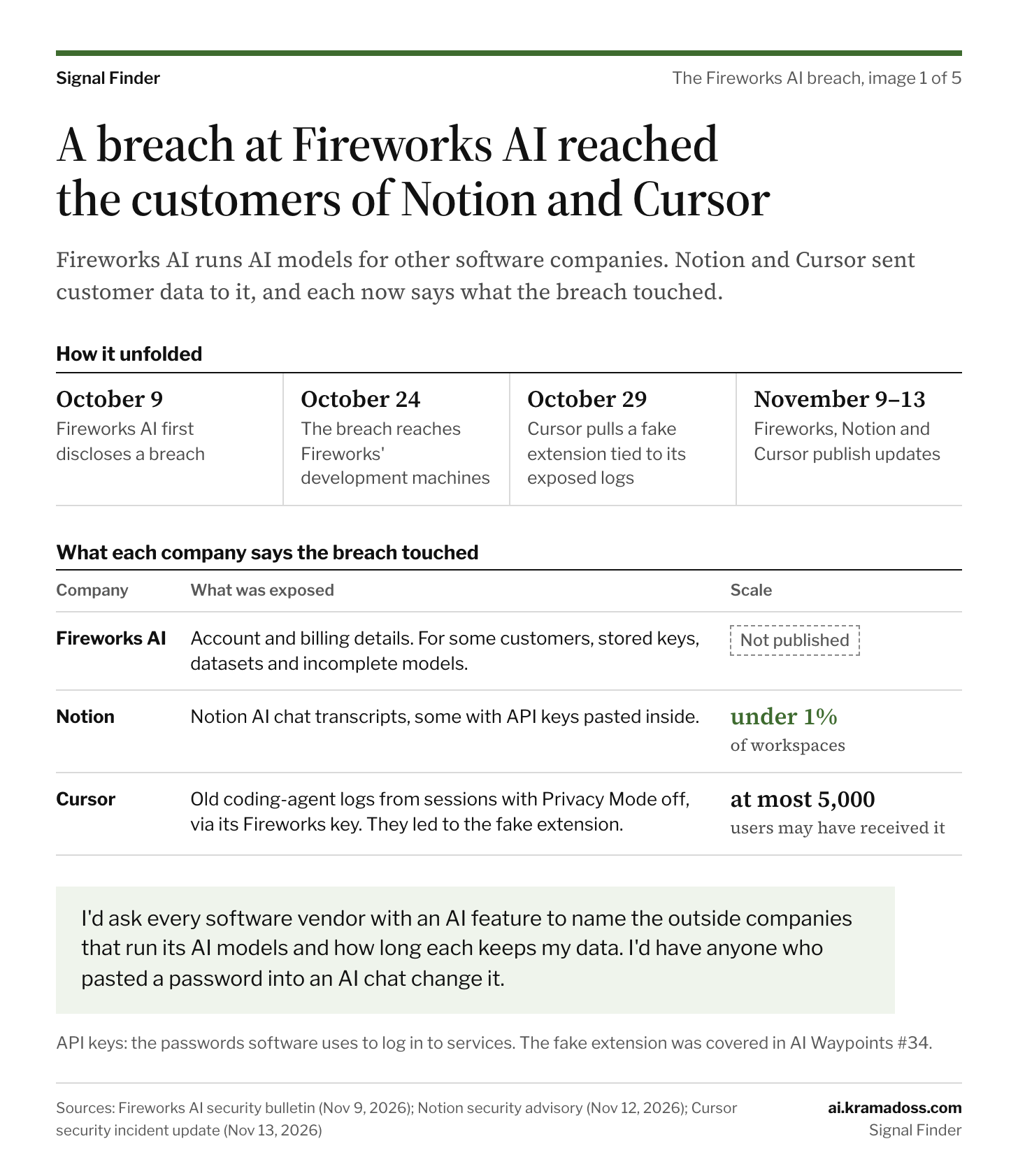
Fireworks AI says a breach it first disclosed October 9 reached its development machines on October 24 and touched account and billing details and, for some customers, stored keys, datasets and incomplete models. Notion says the breach exposed Notion AI chat transcripts in under 1% of workspaces, some with API keys, the passwords software uses to log in to services, pasted inside. Cursor says its Fireworks key exposed old coding-agent logs from sessions with Privacy Mode off, which led to the fake extension it pulled on October 29; at most 5,000 users may have received it.
→ These customers chose Notion and Cursor, which sent their data on to Fireworks. I’d ask every software vendor with an AI feature to name the outside companies that run its AI models and how long each keeps my data, and I’d have anyone who pasted a password into an AI chat change it.
2. United bars customers’ unauthorized AI agents from booking
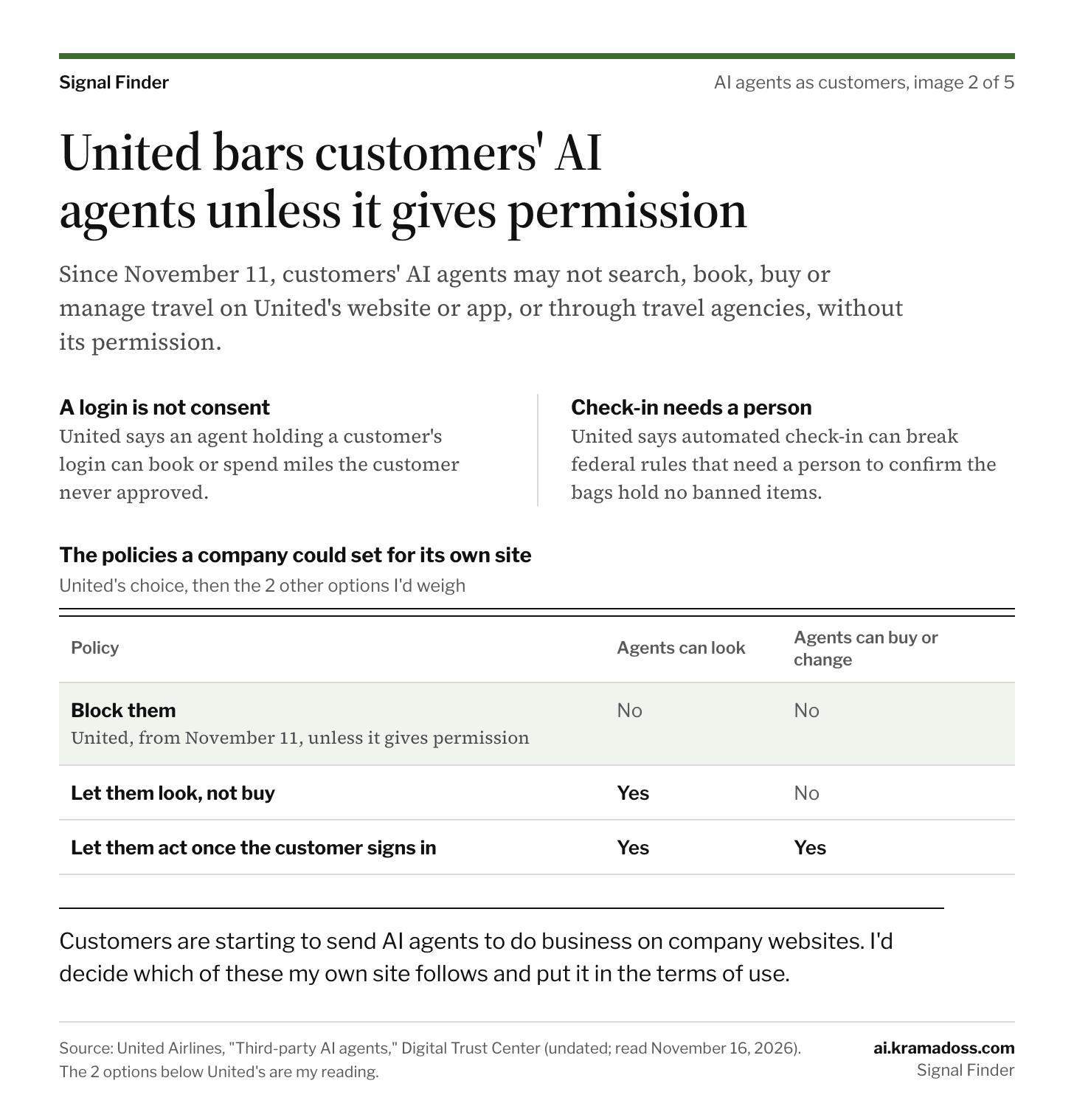
United says that since November 11, customers’ AI agents may not search, book, buy or manage travel on its website or app, or through travel agencies, without its permission. United says an agent holding a customer’s login can book or spend miles the customer never approved, and automated check-in can break federal rules that need a person to confirm the bags hold no banned items.
→ Customers are starting to send AI agents to do business on company websites. I’d decide whether my own site blocks them, lets them look but not buy, or lets them act after the customer signs in, and put that in the terms of use.
3. Claude Fable 5.2 costs a fifth less than 5.1 (7 min read)
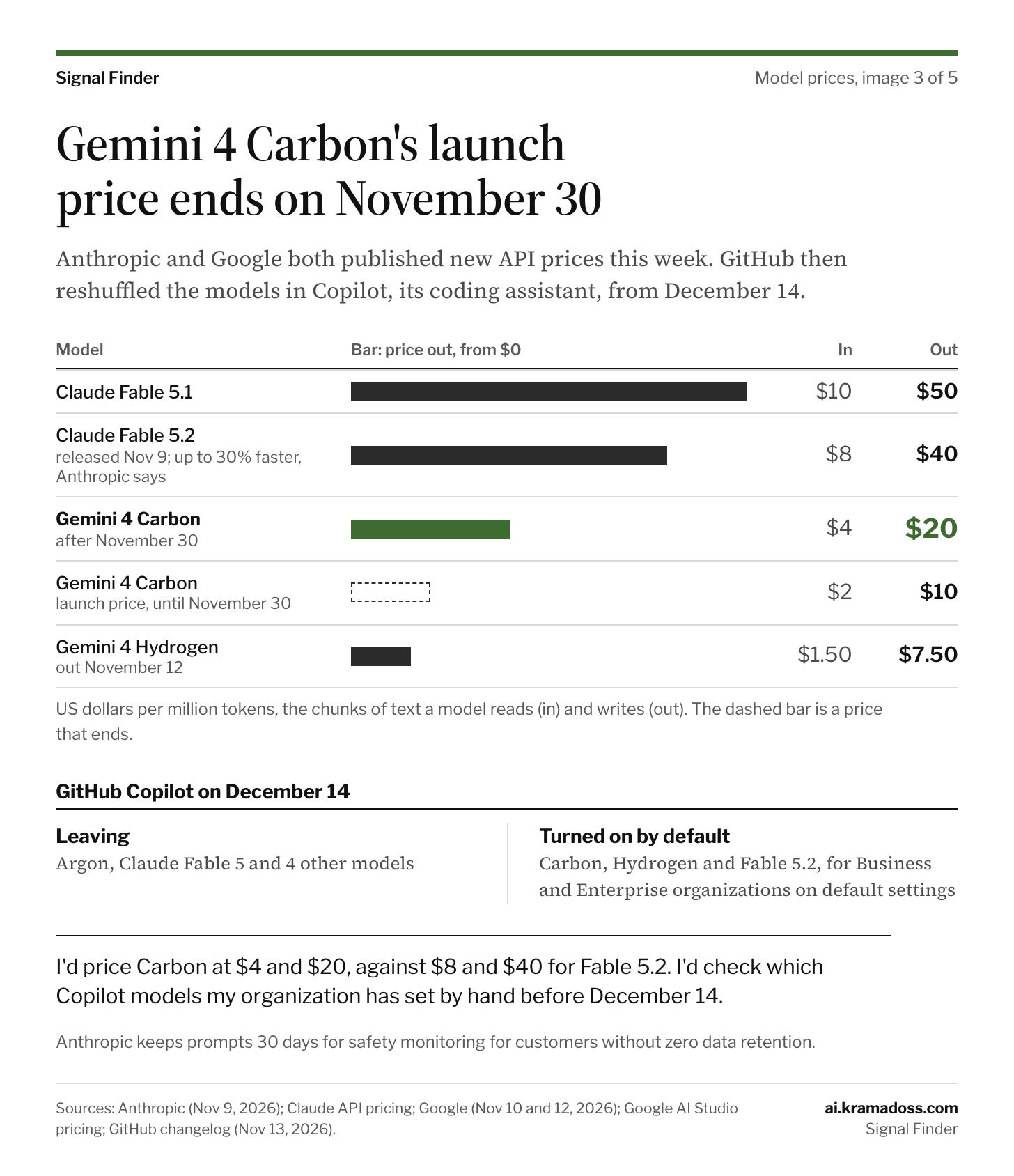
Anthropic, which makes the Claude models that draft this newsletter, released Fable 5.2 on November 9, including on the Amazon, Google and Microsoft clouds. It lists at $8 per million tokens (the chunks of text a model reads and writes) in and $40 out, against $10 and $50 for Fable 5.1, and Anthropic says it runs up to 30% faster. Customers without zero data retention, an arrangement where Anthropic keeps none of their prompts, have prompts kept 30 days for safety monitoring.
→ Fable 5.1’s API rates are higher than 5.2’s, and GitHub drops the older Fable 5 from Copilot, its coding assistant, on December 14 (item 4). I’d test 5.2 on that work and check whether its prompt retention terms fit my data rules before moving anything sensitive.
4. Gemini 4 Carbon’s launch price ends November 30 (1 min read)
Google opened Gemini 4 Carbon, which it calls its strongest model, to paying developers on November 10. Google’s price list for its API, the connection developers’ software uses, has Carbon at $2 in and $10 out per million tokens until November 30, then $4 and $20. The cheaper Gemini 4 Hydrogen, out November 12, is $1.50 and $7.50. GitHub says it drops Argon, Claude Fable 5 and 4 other models from Copilot on December 14, and turns on Carbon, Hydrogen and Fable 5.2 for Business and Enterprise organizations on default settings.
→ A cost test run on Carbon this month uses a price that ends in 2 weeks. I’d price Carbon at $4 and $20, against $8 and $40 for Fable 5.2, check which Copilot models my organization has set by hand before December 14, and test whether Hydrogen is enough for routine work.
5. Jensen Huang resigns; Nvidia names an interim chief (3 min read)
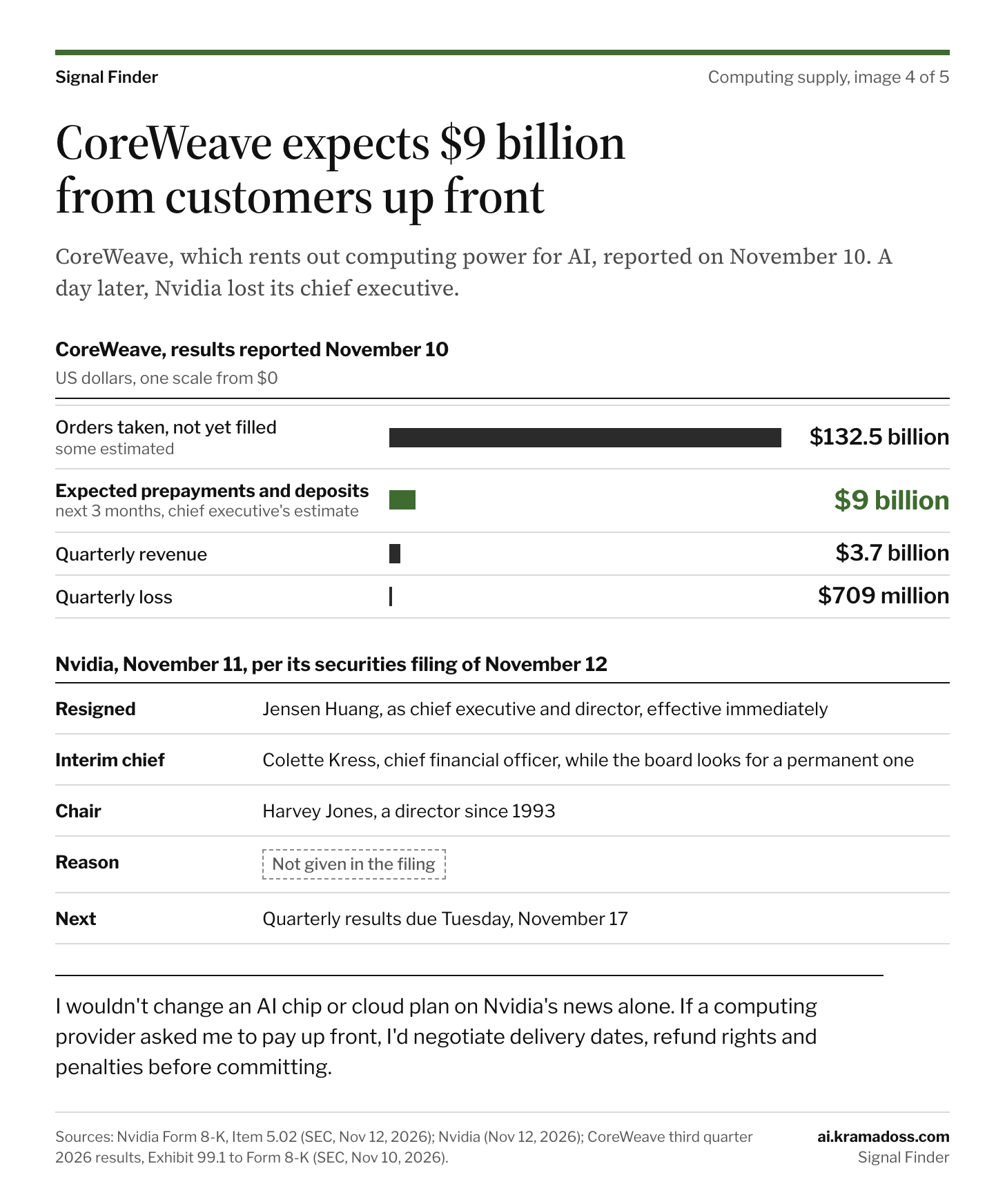
Nvidia’s board accepted Jensen Huang’s resignation as chief executive and director on November 11, effective immediately, according to its securities filing. Chief financial officer Colette Kress is interim chief executive while the board looks for a permanent one, and Harvey Jones, a director since 1993, became chair. The filing gives no reason, and Jones says the board expects customer commitments and the product roadmap to “continue without interruption.”
→ Nvidia reports quarterly results on Tuesday, November 17, and I’d read them for anything on chip supply. I wouldn’t change an AI chip or cloud plan on this news alone, or let a vendor use it to rush me into a long computing contract.
6. CoreWeave expects $9 billion in customer prepayments (18 min read)
CoreWeave, which rents out computing power for AI, reported quarterly revenue of $3.7 billion and a $709 million loss on November 10. It counts about $132.5 billion in orders it has taken but not yet filled, some estimated, and its chief executive expects about $9 billion in customer prepayments and deposits in the next 3 months.
→ CoreWeave expects customers to help fund its expansion through prepayments. If a computing provider asked me to pay up front, I’d check whether it can deliver and negotiate delivery dates, refund rights and penalties before committing.
7. IBM and Microsoft launch Imagine Enterprise for AI agents (6 min read)
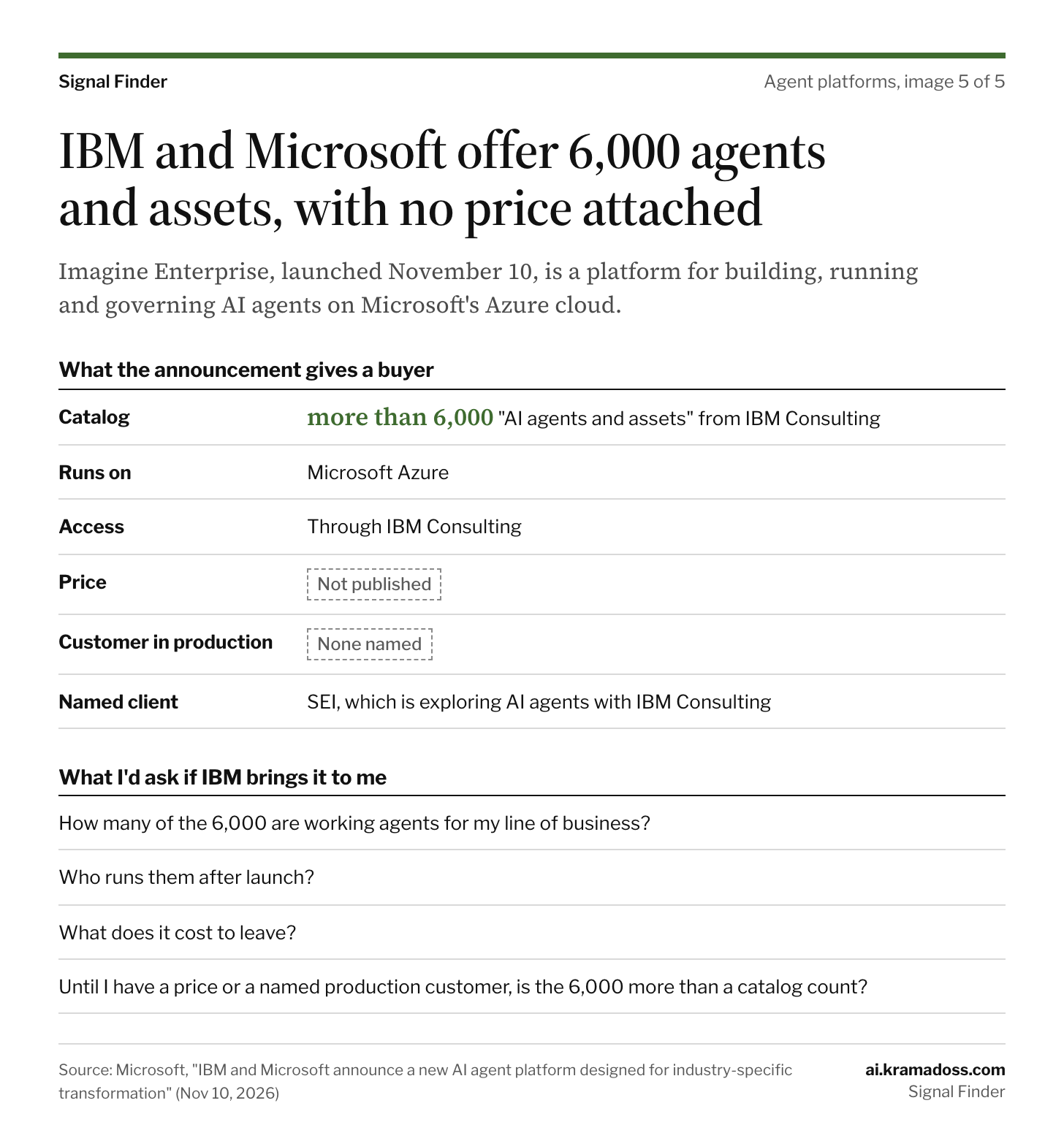
IBM and Microsoft launched Imagine Enterprise on November 10, a platform for building, running and governing AI agents that bundles what they call “more than 6,000 AI agents and assets” from IBM Consulting on Microsoft’s Azure cloud. The announcement offers access through IBM Consulting but gives no price and no named customer in production. Its one named client, SEI, is exploring AI agents with IBM Consulting.
→ Without pricing or a named production customer, I’d treat the 6,000 figure as a catalog count. If IBM brings it to me, I’d ask how many are working agents for my line of business, who runs them after launch, and what it costs to leave.
References:
October 2026 security incident update (Fireworks AI, November 9, 2026)
Security incident involving a third-party AI vendor (Notion, November 12, 2026)
Third-party AI agents (United Airlines, undated; read November 16, 2026)
Gemini API pricing (Google AI Studio, read November 16, 2026)
CoreWeave third quarter 2026 results, Exhibit 99.1 to Form 8-K (SEC, November 10, 2026)
IBM and Microsoft announce a new AI agent platform (Microsoft, November 10, 2026)