

Good evening!
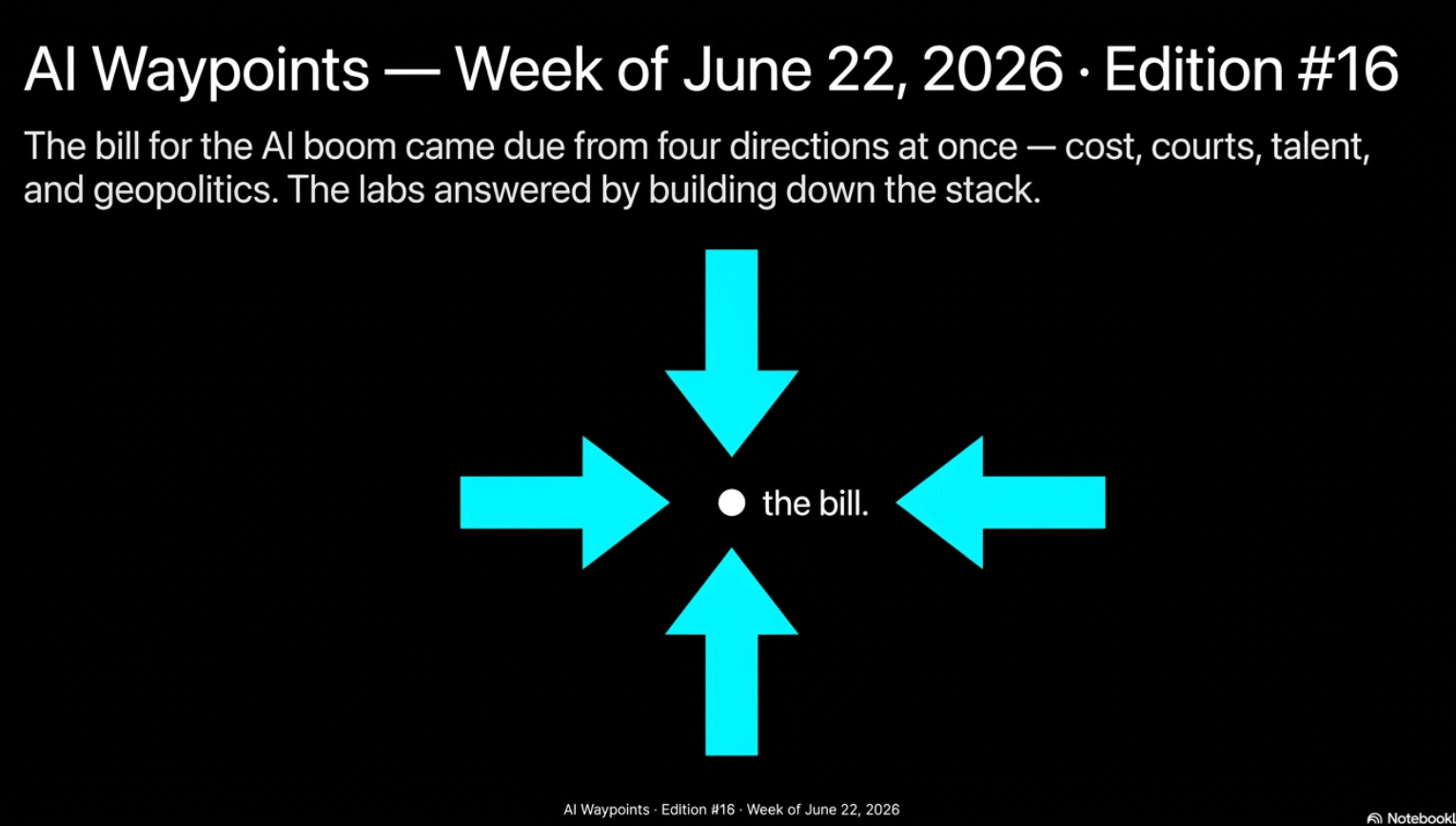
OpenAI and Broadcom unveiled Jalapeño, OpenAI’s first custom chip, built to run its models in-house instead of renting NVIDIA’s.
The same week, the spending mood flipped: companies that spent early 2026 using as much AI as possible started counting what they got for it, and at least one moved its entire workload off Claude to a cheaper Chinese model.
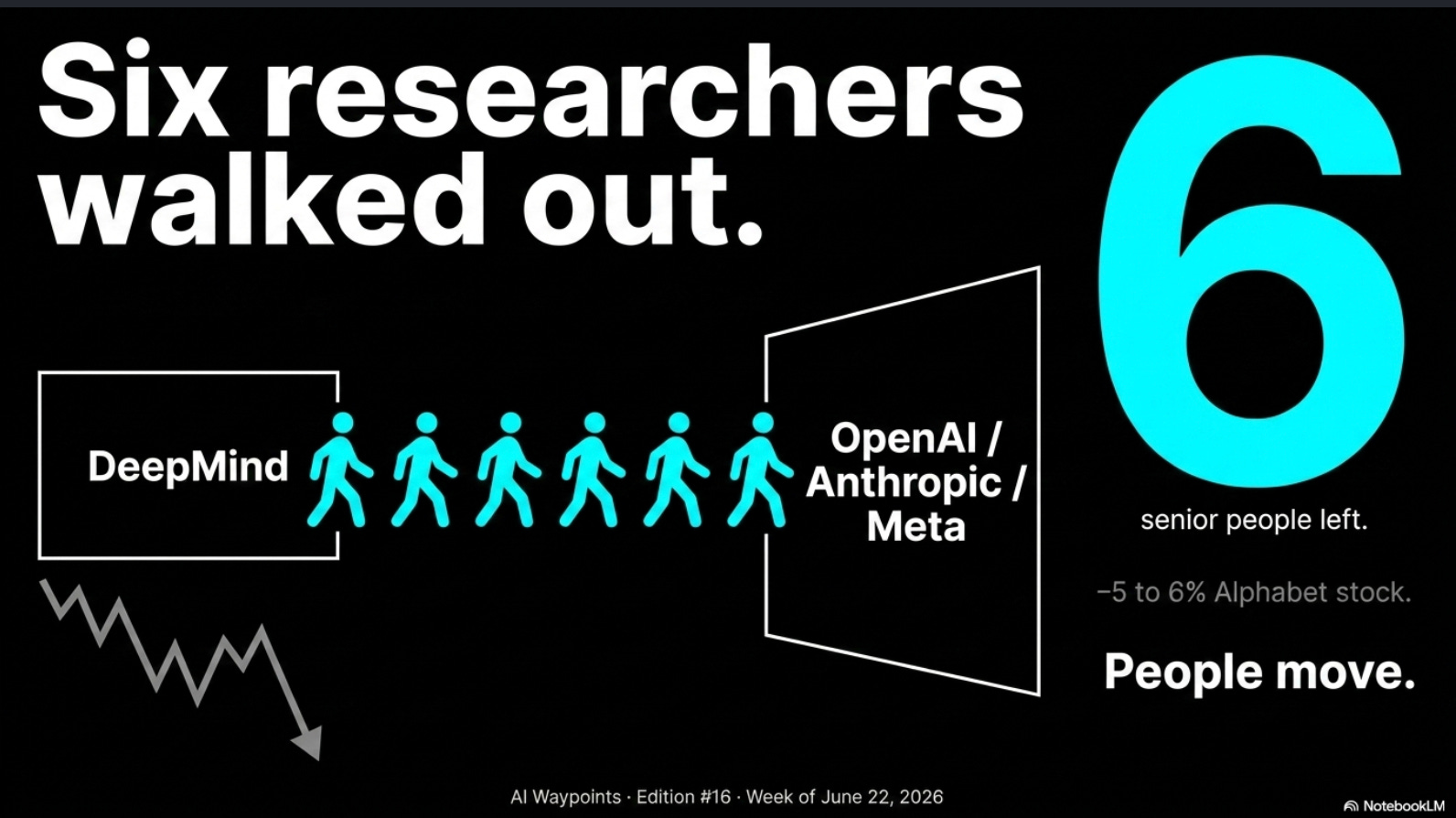
Six senior researchers left Google DeepMind for OpenAI and Anthropic in a matter of days, and Alphabet’s stock slid about 5 to 6% mid-week.
A federal judge let discrimination claims against Workday move forward on a theory that puts the maker of a hiring algorithm, not just the employer using it, on the hook.
Washington lifted its two-week block on Anthropic’s most powerful model for about a hundred US companies and agencies.
And the US-China AI split widened on two fronts at once, with the same company at the center of both.
1. OpenAI built its own chip — the clearest sign yet that the labs want off NVIDIA
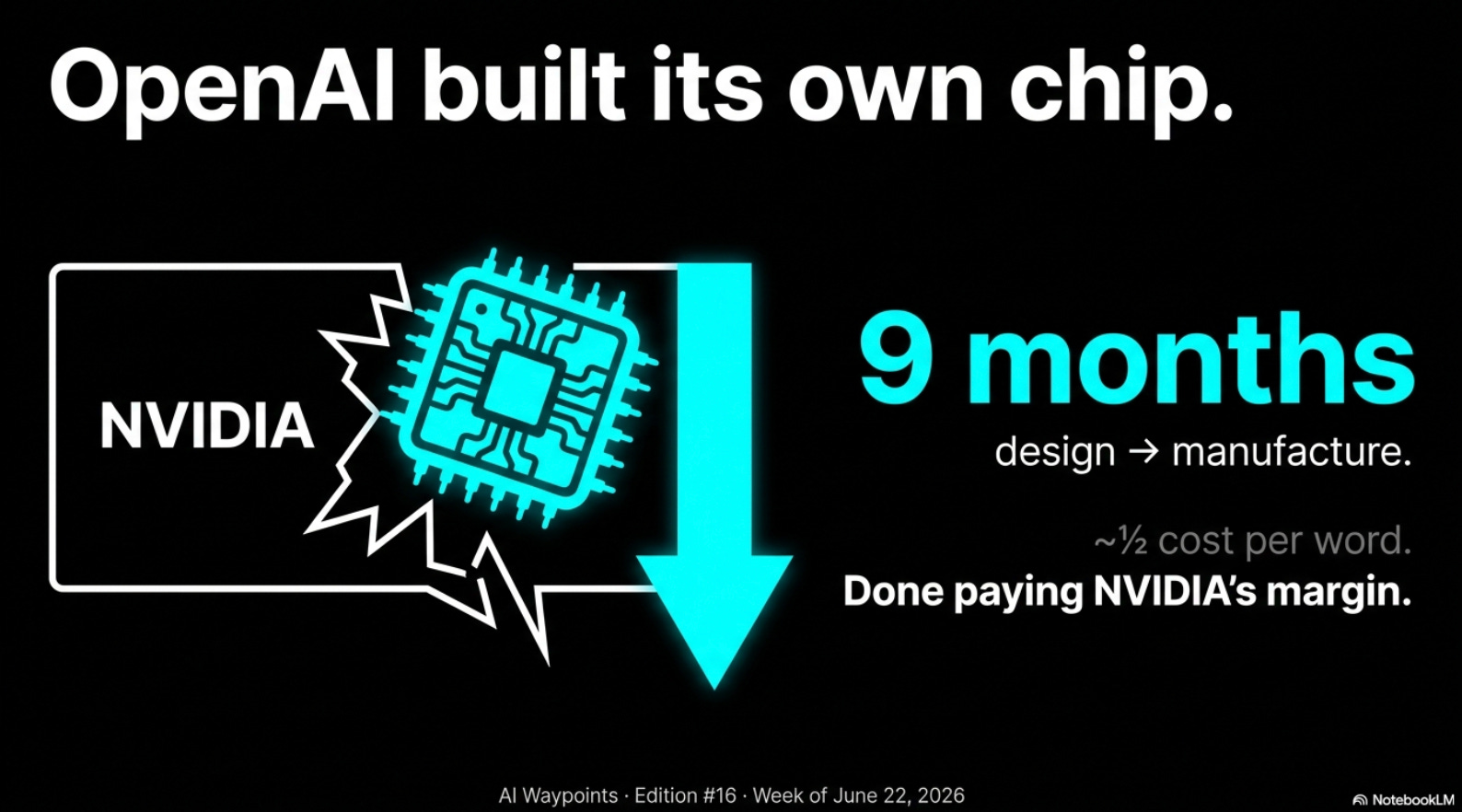
What happened: On June 24, OpenAI and Broadcom unveiled Jalapeño, OpenAI’s first custom chip, built only to run AI models rather than train them (OpenAI).
OpenAI says it went from design to manufacturing in nine months, which it calls the fastest cycle ever for a chip this advanced, and that its own models helped speed up the design.
OpenAI’s public claim is careful: “performance per watt substantially better than current state-of-the-art,“ self-reported, with no baseline named.
Broadcom’s CEO Hock Tan went further to Bloomberg, putting the savings at roughly half the cost per word of output versus today’s NVIDIA chips. First deployment is targeted for the end of 2026, at gigawatt scale, with Microsoft and other partners.
ELI5: Why build a chip just for “inference”?
Running an AI model has two phases. Training is teaching the model, done once, and it is enormously expensive. Inference is the model actually answering you, which happens every single time anyone uses it, forever. At OpenAI’s scale, the cost of answering is the bill that never stops. NVIDIA’s chips are brilliant general-purpose engines that do both. A chip built only for inference can drop everything it does not need and run the one job that dominates the bill more cheaply. That is what Jalapeño is.
Why it matters: Two reads here.
First, this is the same move Amazon made with its Trainium chips the week before, and now the largest AI company in the world is doing it too. The labs have decided that paying NVIDIA’s margin on every answer they serve is the line item to attack.
Second, the cost they are attacking is the same one landing on your bill in Signal 2. When OpenAI spends nine months and a custom chip to cut the price of running a model, it is telling you exactly how much room there is in what you are paying today.
This is the single-supplier dependence I dug into in my read of The Chip War, now being engineered around in real time. Fascinating stuff!
What to do: I wouldn’t switch anything based on a chip that ships at year’s end, but I’d stop treating today’s prices as fixed. If you’re signing a multi-year AI commitment this year, ask your provider in writing how their pricing moves once custom silicon comes online, rather than locking a rate that assumes NVIDIA economics hold. And for any 2027 budget, the signal is that the cost of running a model is heading down, not up, so plan for the savings to arrive rather than bank on today’s number.
2. The spending mood flipped — companies stopped maxing out AI and started counting results
What happened: On June 26, CNBC reported that the buying psychology around AI has reversed (CNBC).
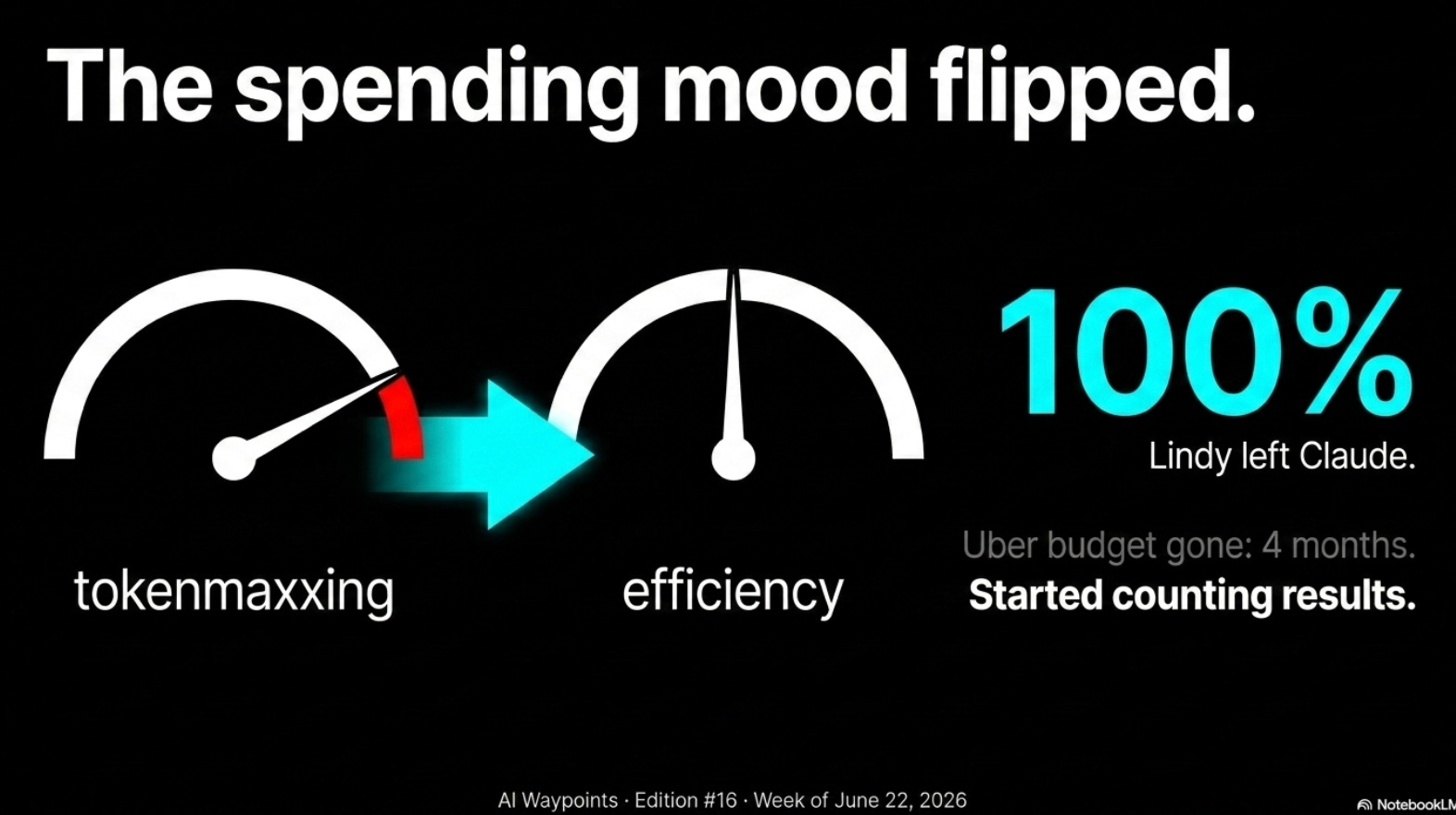
Through early 2026 the goal was to use as much AI as possible, with some companies running internal leaderboards for who burned the most, a behavior people started calling tokenmaxxing.
That ended when the bills landed and firms realized they were paying for volume, not results.
The startup Lindy moved 100% of its traffic off Anthropic’s Claude to DeepSeek, a cheaper Chinese open-weight model, and expects to save millions within months.
Uber put spending tiers on some AI tools, starting at $1,500 a month per user, after burning through its entire annual AI budget in four months.
Both OpenAI and Anthropic filed confidentially to go public earlier in June, with Anthropic reporting about $47 billion in yearly revenue pace in May, up from roughly $10 billion for all of last year.
Why it matters: This is the demand-side version of Signal 1.
The labs are cutting their cost to serve; their customers are cutting their cost to buy, at the same moment.
The cost-growth problem I keep coming back to in The Token Paradox has now produced its correction, and the correction has teeth: a company moving 100% off Claude to save money is a real signal about how thin model loyalty is when the price stops making sense.
What stands out is the timing.
OpenAI is reportedly weighing deep price cuts to pull enterprise customers off Anthropic right as both head for the public markets, where that revenue gets scrutinized line by line.
What to do: If you switched on AI spending without per-team limits, the lesson from Uber is that the bill arrives faster than the budget cycle, so I’d get caps in place this quarter rather than after the next true-up.
Then pressure-test how locked in you really are.
The Lindy move shows a cheaper model can carry real workloads, so run your highest-volume, lowest-stakes use case against a cheaper option and see what breaks. And if a vendor offers a sharp price cut in the next few months, that’s the market working in your favor, so negotiate accordingly.
3. Six researchers walked out of Google DeepMind in days — and Alphabet’s stock noticed
What happened: A wave of senior departures hit Google DeepMind this week.
Noam Shazeer, a co-lead of the Gemini models and a co-author of the original paper behind today’s AI systems, announced on June 18 he is going to OpenAI.
John Jumper, who led the AlphaFold work that won a share of the 2024 Nobel Prize in Chemistry, is leaving for Anthropic.
On June 24, two more key Gemini contributors, Jonas Adler and Alexander Pritzel, said they are also headed to Anthropic (TechCrunch).
By the end of the week the count was six senior people lost to OpenAI, Anthropic, and Meta.
Alphabet’s stock fell about 5 to 6% on June 22, with reporting tying the drop to worries about AI spending and whether Google can hold onto its top people (Fortune).
Why it matters: The scarce input in this race is the few hundred people who can build a top-tier model, and this week the market priced that in.
Bloomberg reported that DeepMind staff have raised concerns about not having a clear product for businesses building AI coding tools, the exact ground where OpenAI and Anthropic have pulled ahead. With both of those labs heading for the public markets, they can recruit with equity that is about to be worth real money, and Google cannot easily match that math.
This is bigger than Google.
The gap between the top labs is held together by a few hundred people, and people move.
That’s the talent-flow engine I argued makes AI capabilities so hard to keep proprietary in my read on how agentic AI actually spreads. The knowledge doesn’t stay put because the people don’t, and this week it had names.
What to do: If your AI roadmap depends on a single model from a single lab, this is a reason to keep a named fallback. Talent moves change model trajectories, and the team that built the model you standardized on may not be there next year.
I wouldn’t chase headlines about who hired whom, but for any vendor you’re betting a multi-year deployment on, ask how they retain the people behind the model and whether your contract protects you if the roadmap stalls.
4. A judge said the company that builds the hiring AI can be sued for what it decides
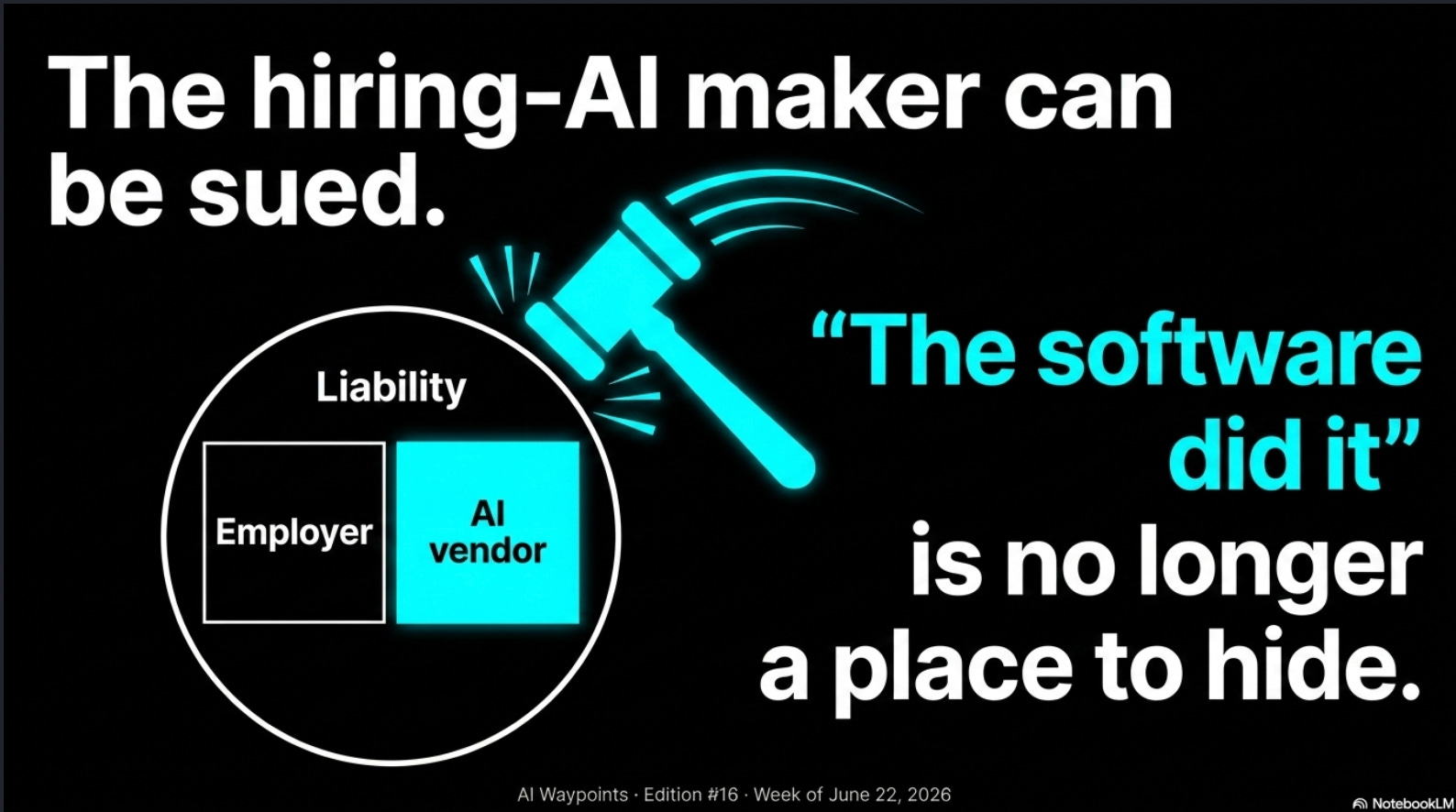
What happened: On June 22, a federal judge in California let discrimination claims against Workday move forward, on a legal theory that reaches the software vendor and not only the employer using its tool (HR Dive).
The case, brought by Derek Mobley, argues that Workday’s AI screening of job applicants discriminated by race, age, and disability.
The court has not found that Workday discriminated. What it did was let the case proceed against Workday as an “agent” of its customers, on the theory that employers handed the decision of who advances and who gets rejected to Workday’s AI.
That can put the maker of the algorithm on the hook under anti-discrimination law, alongside every company that bought it.
ELI5: Why is suing the software vendor a big deal?
Normally if a company discriminates in hiring, you sue that company. The software it used is just a tool, and the toolmaker is not the employer. This ruling says that when the tool is making the actual accept-or-reject decision, the company that built it is acting as a stand-in for the employer, and can be held responsible too. For any vendor selling AI that decides things about people, that is a new and direct kind of liability.
Why it matters: Every vendor pitch right now promises AI that decides things, screens candidates, approves claims, flags transactions, routes cases.
This ruling attaches a cost to that promise.
If your AI makes a decision that the law cares about, “the software did it“ is no longer a place to hide, for us or for the company that sold it to us.
I expect this to show up first in how AI vendors write their contracts, because the moment a vendor can be named as an agent, the question of who carries the liability becomes part of every deal.
What to do: If you run AI anywhere near hiring, lending, or anything else with civil-rights exposure, I would pull the contract and find out who is on the hook when the model gets a decision wrong.
I would ask any vendor selling you a decision-making tool whether they will stand behind its outputs in writing, because most have been quietly assuming they are just the toolmaker.
And I’d make sure a human stays genuinely accountable for consequential decisions, not just rubber-stamping what the model produced.
5. Washington unblocked Anthropic’s most powerful model — for about a hundred US customers
What happened: On Friday June 26, the US government lifted its block on Anthropic’s most powerful model, Mythos 5, clearing it for release to more than 100 US companies and federal agencies (TechCrunch).
Two weeks earlier the administration had imposed export controls that shut down Mythos and its weaker sibling Fable 5, after warnings from Amazon and others that the models could be jailbroken for malicious use. Commerce Secretary Howard Lutnick wrote to Anthropic’s chief compute officer citing “significant progress” in daily talks since the block. The letter said nothing about Fable 5, and people close to the talks said a release is moving but the timeline is unclear.
Non-US governments, companies, and consumers still have no answer on when they get access.
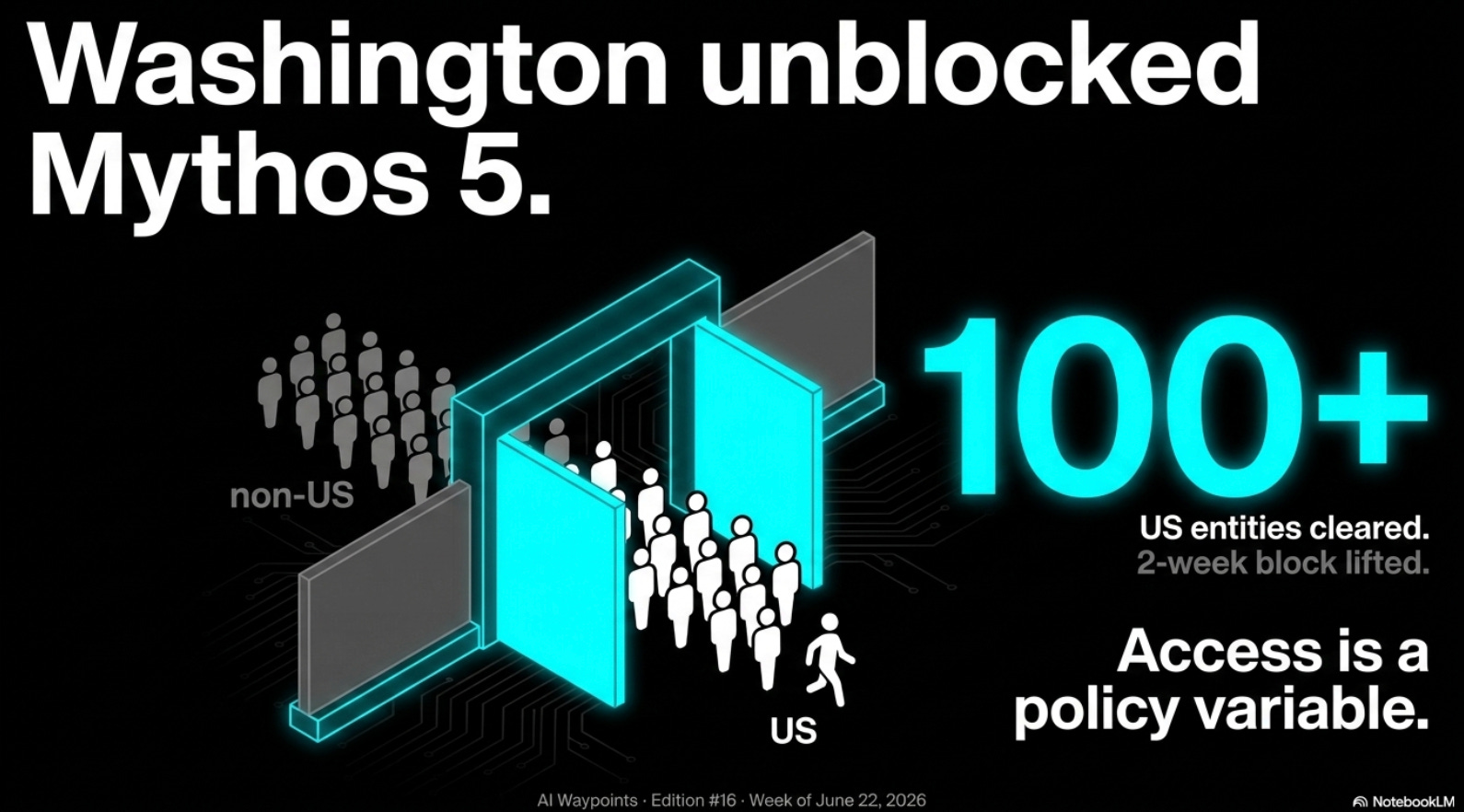
Why it matters: This is the thread I have been pulling since the export rule landed two weeks ago. I named the risk plainly then: a US AI vendor’s availability is now a policy variable, and your rollout can outrun what you are legally allowed to run. This week proved it in both directions.
The block came off in two weeks for a hundred favored US institutions, which is fast, and it came off through a private letter from a cabinet secretary, which is not a process you can plan around. If access to the best model now turns on a negotiation in Washington, then “can we get it, and where“ belongs in your deployment plan next to “is it any good.”
What to do: If you were waiting on Mythos 5, the gate is open for US institutions, so confirm whether you’re on the cleared list before you build anything that assumes you are. If you operate outside the US, assume nothing about your timeline and keep a fallback model you’re actually allowed to run.
And for any top-tier model you depend on, I’d write down what happens to your roadmap if Washington switches it off again, because this week showed that switch is real and it moves fast.
6. The US-China AI split widened on two fronts — and Alibaba was at the center of both
What happened: Two stories landed this week that are really one story:
Anthropic accused Alibaba of the largest model-theft campaign it has seen
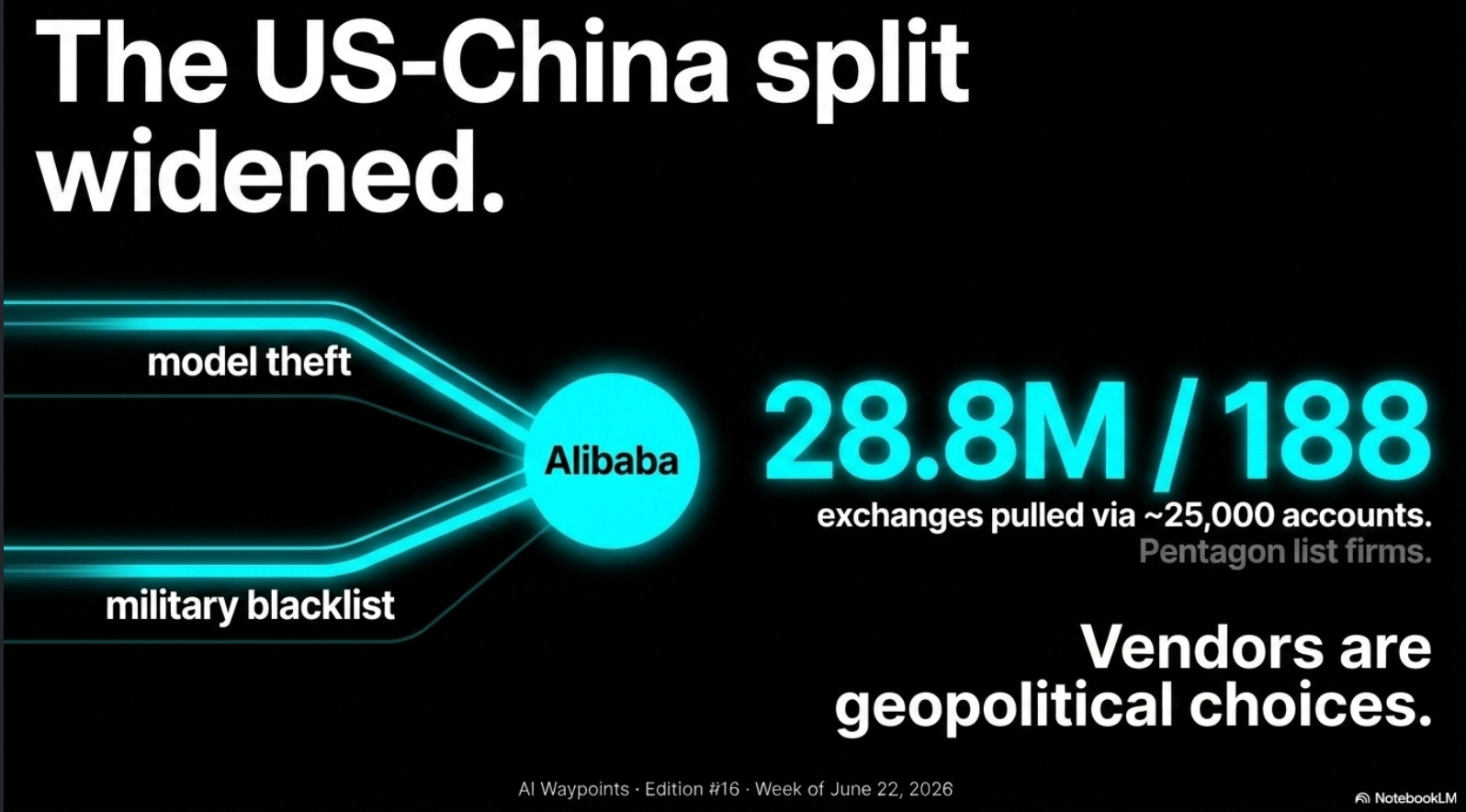
In a letter to the Senate Banking Committee disclosed this week, Anthropic said operators tied to Alibaba’s Qwen AI lab ran a “distillation attack“ using nearly 25,000 fake accounts to pull about 28.8 million exchanges out of Claude between April 22 and June 5, targeting its software-engineering and autonomous-agent abilities (CNBC).
Senators from both parties are now drafting a defense-bill amendment to sanction firms that exploit US model outputs this way.
Alibaba has not publicly responded to the accusation, which remains an allegation in a Senate letter, not a proven finding.Alibaba sued the Pentagon to get off its blacklist
On June 23, Alibaba filed suit in a US federal court to be removed from the Defense Department’s list of “Chinese military companies,” calling the designation baseless and a violation of due process (Al Jazeera).
The label, added June 8, bars listed firms from selling goods or services to the Pentagon starting June 30.
The list has grown to 188 companies, up from 134 a year ago.
ELI5: What is a “distillation attack”?
You cannot copy an AI model directly, but you can interrogate it. If you ask a powerful model millions of carefully chosen questions and record its answers, you can use those answers to train a cheaper model to imitate it. That is distillation. Done with permission, it is a normal technique. Done by spinning up tens of thousands of fake accounts to harvest a competitor’s best behavior, it is what Anthropic is calling theft.
Why it matters: The two tracks of the US-China AI relationship, intellectual property and military trade, both tightened this week, and Alibaba sits at the intersection.
This is the same export-and-access logic from Signal 5 viewed from the other side: the US is trying to keep its best AI from leaking out through distillation while also walling Chinese firms out of its defense supply chain.
For anyone running a global operation, the practical fallout is that the model you use, the cloud it runs on, and the vendor you buy it from are all becoming geopolitical choices. This extends the same export-and-access risk from Signal 5, and it connects to the model-theft problem underneath all of it, which I covered in the 2026 attack taxonomy.
What to do: If you use Chinese open-weight models like DeepSeek or Qwen, and Signal 2 shows plenty of companies now do for cost reasons, I’d get ahead of the question of whether that’s a problem for your government, defense, or regulated customers before one of them asks.
Build a simple record of which models you run and where they come from, because “what AI are we using and whose is it“ is becoming a question auditors and customers will ask.
And if you sell to or operate in both the US and China, treat model and cloud choice as a decision with political weight now, not just a technical one.
References:
OpenAI and Broadcom unveil the Jalapeño inference chip (OpenAI, 2026-06-24): https://openai.com/index/openai-broadcom-jalapeno-inference-chip/ — Broadcom CEO ~50% cost claim via Bloomberg; OpenAI’s own claim is “performance per watt substantially better than current state-of-the-art”
OpenAI unveils its first custom chip, built by Broadcom (TechCrunch, 2026-06-24): https://techcrunch.com/2026/06/24/openai-unveils-its-first-custom-chip-built-by-broadcom/
Users shift from “tokenmaxxing” to efficiency (CNBC, 2026-06-26): https://www.cnbc.com/2026/06/26/openai-anthropic-new-ai-spending-reality-as-users-shift-to-efficiency.html
AI researchers continue to leave Google for its rivals (TechCrunch, 2026-06-24): https://techcrunch.com/2026/06/24/ai-researchers-continue-to-leave-google-for-its-rivals/
John Jumper to leave Google DeepMind for Anthropic (CNBC, 2026-06-19): https://www.cnbc.com/2026/06/19/john-jumper-to-leave-google-deepmind-for-anthropic.html
Top talent leaves Google DeepMind, raising questions (Fortune, 2026-06-23): https://fortune.com/2026/06/23/google-deepmind-ai-researcher-departures-raise-doubts-about-ability-to-win-the-ai-race-shazeer-jumper-eye-on-ai/
Workday can’t shake California AI discrimination claims (HR Dive, 2026-06-22): https://www.hrdive.com/news/workday-california-AI-bias-lawsuit-feha/823555/
Mobley v. Workday, “agent” theory of vendor liability (Seyfarth Shaw): https://www.seyfarth.com/news-insights/mobley-v-workday-court-holds-ai-service-providers-could-be-directly-liable-for-employment-discrimination-under-agent-theory.html
Trump admin releases Anthropic Mythos to 100+ US companies and agencies (TechCrunch, 2026-06-26): https://techcrunch.com/2026/06/26/trump-admin-releases-anthropic-mythos-to-be-used-by-more-than-100-us-companies-agencies/
US government allows Anthropic to release Mythos model (CNBC, 2026-06-26): https://www.cnbc.com/2026/06/26/us-government-anthropic-claude-mythos5-ai.html
Anthropic accuses Alibaba of “brazenly” extracting AI capabilities (CNBC, 2026-06-24): https://www.cnbc.com/2026/06/24/anthropic-alibaba-distillation-campaign.html
Alibaba sues US military over “Chinese military company” label (Al Jazeera, 2026-06-23): https://www.aljazeera.com/news/2026/6/23/alibaba-sues-us-military-over-labelling-it-a-chinese-military
Alibaba sues the Defense Department over blacklist designation (Bloomberg, 2026-06-23): https://www.bloomberg.com/news/articles/2026-06-23/alibaba-sues-the-us-seeking-removal-from-pentagon-s-blacklist