

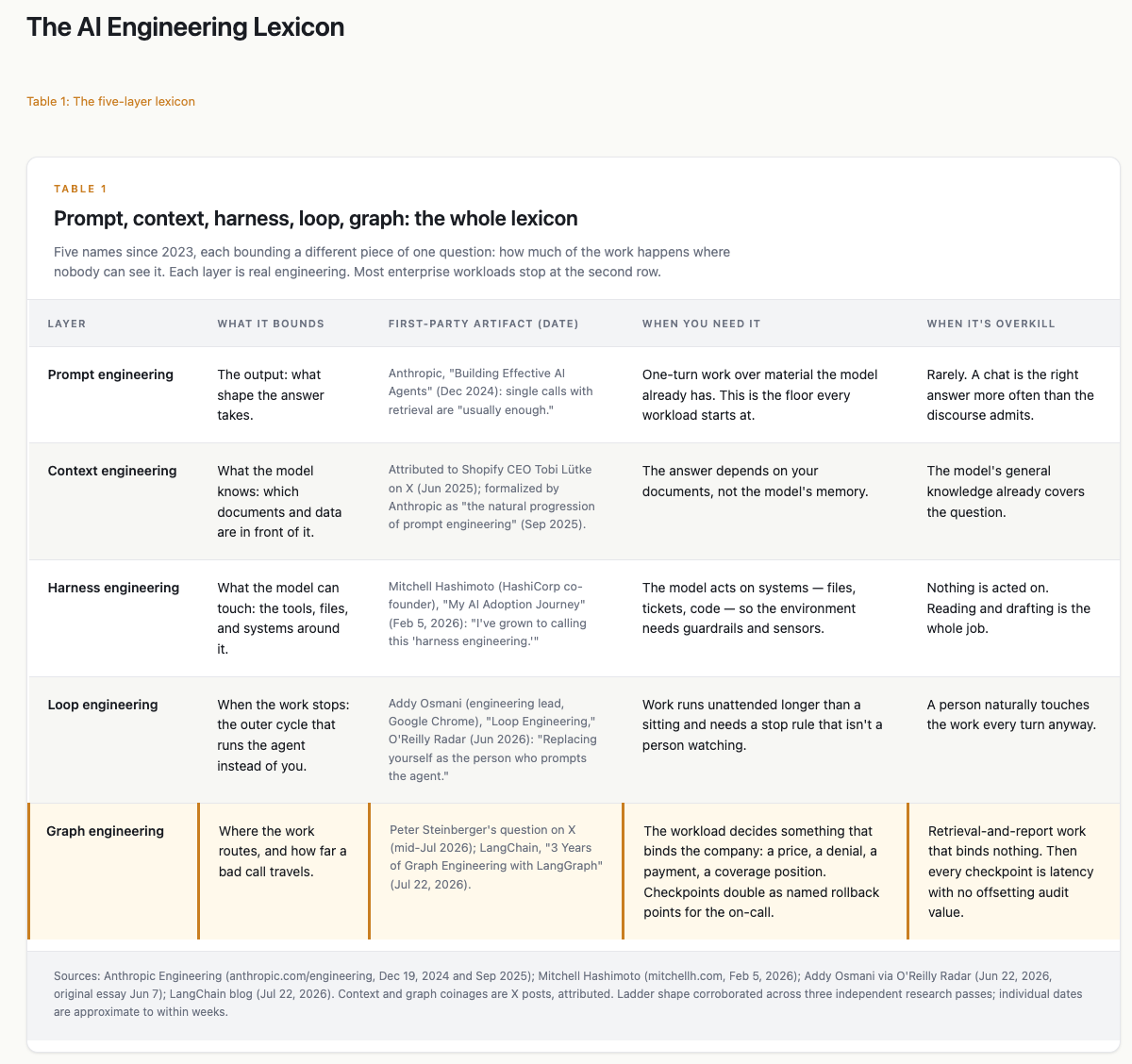
Generative AI has been generating (no pun intended) new techniques that take over the imagination of X, Reddit, and Substack, and the current one is graph engineering, which showed up in mid-July. Before it came loop engineering, and before that harness engineering, context engineering, prompt engineering.
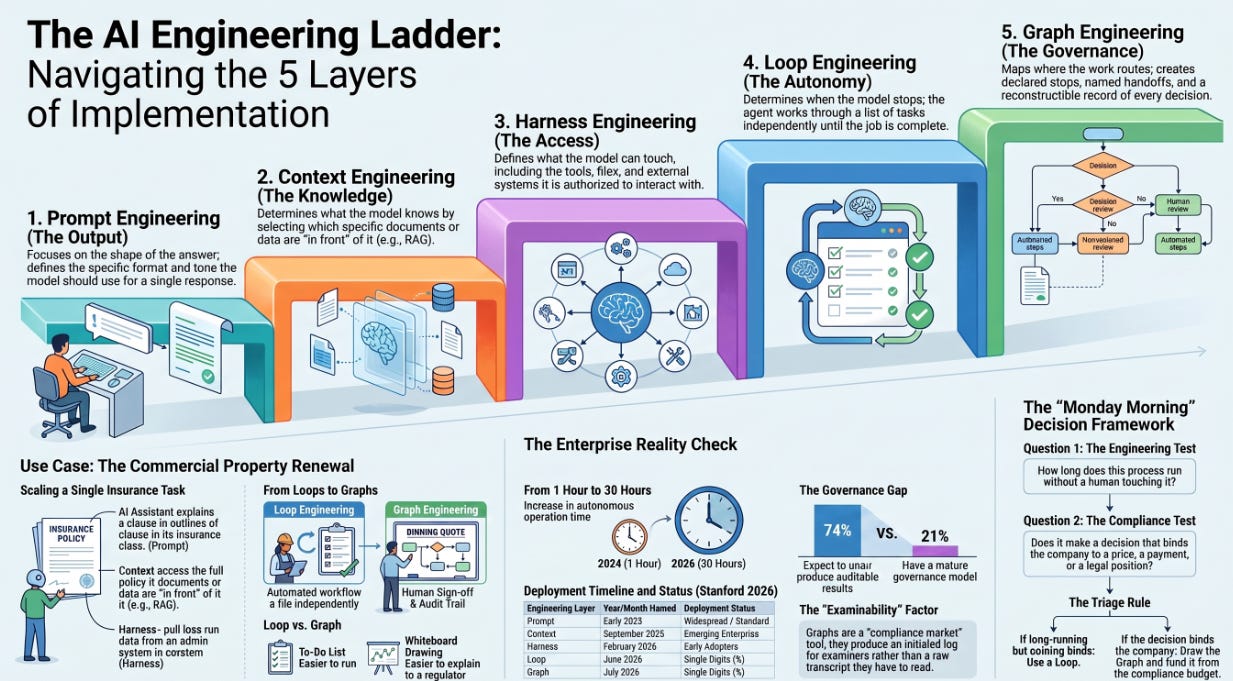
That’s five names since 2023, each holding the floor for less time than the one before it: prompt engineering ran about 2 and a half years before anything displaced it, while graph engineering arrived roughly only 6 weeks after loop engineering.
The technique pile-up is mostly a story of the last 11 months, because that’s when 4 of the 5 got their names:
Context engineering in September 2025,
Harness engineering in February,
Loop engineering in June, graph in July.
If you’ve stopped trying to keep up, I don’t blame you, and I’d argue you shouldn’t have to.
Underneath the churn, though, each name is real engineering, invented because models could gradually with every release do more on their own, and all 5 techniques answer the same question, each bounding a different piece of it:
How much of the work do you let happen where nobody can see it?
The frontier models are good; the whole contest is how we harness them and let long-range agent tasks run without intervention.
What I want us Enterprise Leaders to understand is when each layer earns its place, when it’s overkill, and when you just need a chat.
My answer, up front: most enterprise workloads need the bottom two layers and a chat.
The graph at the top only pays when somebody will later have to reconstruct the decision.
Why the ladder keeps growing
The AI engineering ladder I reference is just those 5 names stacked in the order they arrived, and each rung sets a limit the rung below it doesn’t.
Prompt engineering — the output. What shape the answer takes.
Context engineering — what the model knows. Which documents are in front of it.
Harness engineering — what it can touch. The tools, files, and systems around it.
Loop engineering — when it stops.
Graph engineering — where the work routes, and how far a bad call travels before someone catches it.
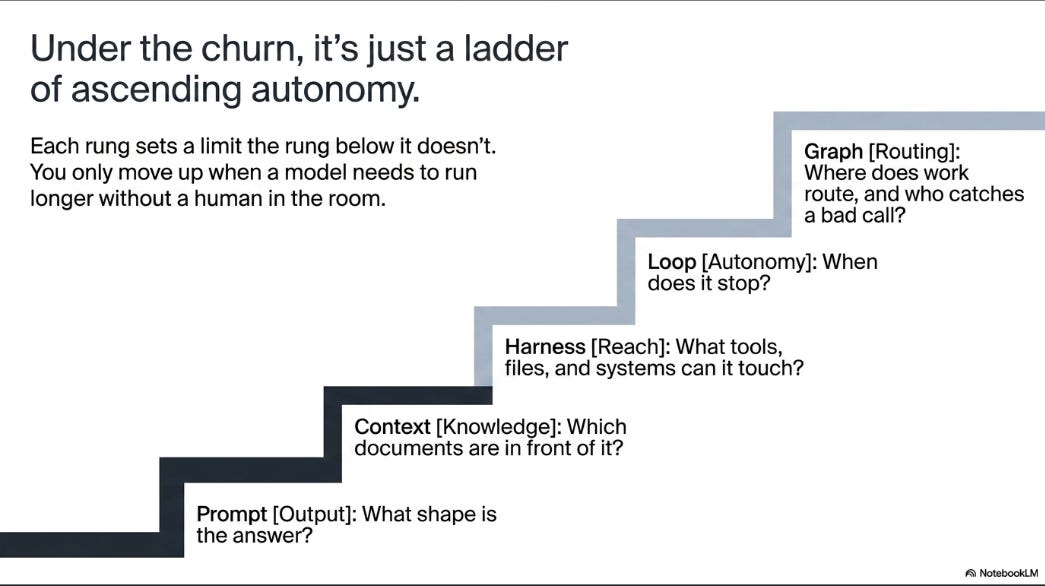
Let’s walk one job up all 5 rungs and see what each name actually means: a commercial property renewal.
Prompt engineering. Ask a model to explain what a coverage clause means. A question and an answer, nothing else but a prompt.
Context engineering. Ask the same question about your policy, and someone has to find the right document and hand it over first. The model can only be as right as the paperwork you give it.
Harness engineering. Let it pull that policy out of the policy admin system itself, along with the loss runs and the submission. It’s touching your systems now, and it can reach things you never handed it.
Loop engineering. Let it work the whole renewal file without you prompting each step: read the submission, pull the history, flag the gaps, draft the summary. Something other than you decides when it’s finished.
Graph engineering. Now the work ends in an output the company has to stand behind, a quote or a reserve. So you build in the places it has to stop, the people it has to hand off to, and a record of who signed off before the number went out the door to your client.
What moves a job up the ladder is that models keep running longer with nobody in the room.
AIG’s CEO Peter Zaffino put dates on that during the company’s Q1 2026 earnings call, using them to mark how fast this has moved: when AIG began its work with Claude 2.0, AI agents could operate autonomously for less than an hour, and today they can run “as long as 30 hours.”
30 hours is a long time for work to happen where nobody is watching.
Each technique arrived when the layer below it hit its limit, which gives us a way to test: you move up a layer when the work outgrows the one you’re on, not when a new word starts trending.
And almost nothing in the enterprise has crossed the top ones.
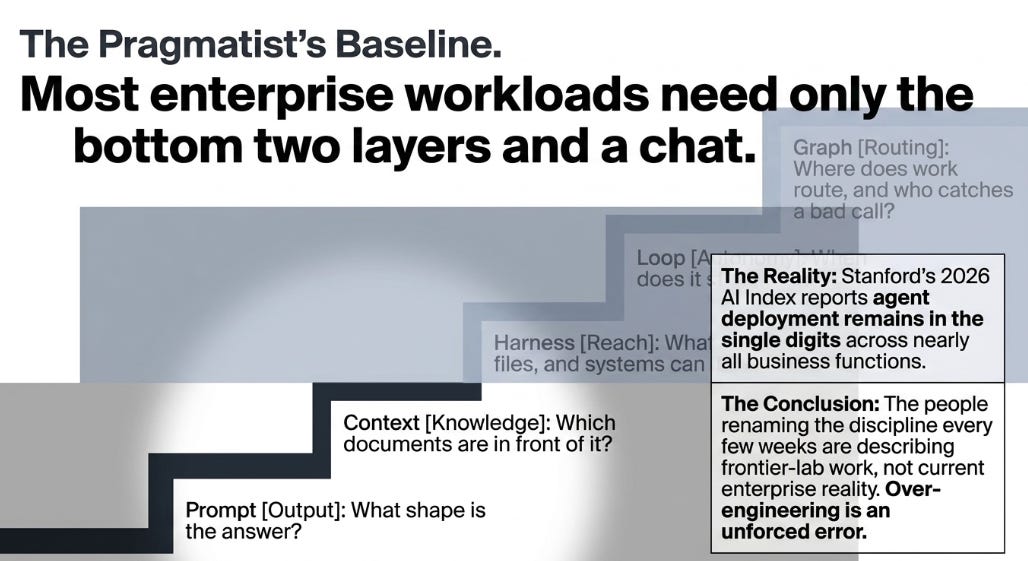
Stanford’s 2026 AI Index found agent deployment “in the single digits across nearly all business functions,” so the people renaming the discipline every few weeks are describing frontier-lab work while the buying decision sits in organizations that mostly haven’t shipped agent one.
Capability already spreads lab to lab in about a week, down from about a year; the vocabulary churns on the same clock, faster than any procurement cycle runs.
ELI5: a loop vs. a graph
A loop is one capable worker with a to-do list: they keep going, picking the next step themselves, until the job is done or someone stops them. A graph is the same work drawn as stations on a whiteboard, handoffs marked, some requiring a person’s sign-off.
The loop is easier to run. The graph is easier to explain afterward.
What the rename crowd gets right, and where it stops
The loudest objection to graph engineering is that it’s rebranded prior art: LangGraph with a marketing budget, or business process management in a new shirt.
On the mechanics, that objection is right. Business Process Model and Notation (BPMN) 2.0, the standards language for drawing executable business processes, specified process graphs, gateways, and typed state in December 2010, and Airflow, Step Functions, and Temporal have run drawn graphs in production for years.
LangChain published “3 Years of Graph Engineering with LangGraph“ days after the term took off, which is a three-year prior-art claim (a patent term as I am learning) on a label that was weeks old.
The skeptics could push that history further than they do. 2 decades of orchestration engines paid off exactly where the work was repetitive, regulated, and measured, and went unused everywhere else. That record looks like an argument against graph engineering, and I read it as a good guide to where the layer pays off, because the line between those two kinds of work hasn’t moved.
The research record is harder still on the version of graph engineering that means “add more agents.”
A June preprint found 5 of 6 multi-agent systems underperformed a matched single agent, and another watched accuracy fall from 54.7% to 50.9% when it expanded orchestration, with timeouts and tool failures rising alongside.
Then in late July, peer-reviewed work in Nature Machine Intelligence made the sharpest observation: stronger models outgrow the collaboration benefit, so past a capability threshold, adding agents stops helping.
The commercial version of that argument is the one a CEO actually would want to hear: buying an orchestration layer in August 2026 is buying a workaround for a limitation the next model release removes.
Two things keep me from closing the case saying Graph Engineering is hype right here.
Regulators set the checkpoints, not the models
If an examiner requires a sign-off at a certain step, that requirement doesn’t go away because the model got smarter. Better models don’t lower the number of stops.
Nobody has tested the actual claim
Every study above changes how many agents run, or how closely they work together. Not one asks whether writing down the steps, the stops, and who hands off to whom beats letting a single agent figure it out as it goes, which I only caught on a second read of the papers. An agent working inside a drawn-out process still counts as “single-agent” in all of them.
What’s actually new here is wrapping 15-year-old process rules around a part that never does the same thing twice. That’s a guess worth testing, not a proven answer, and I’d treat it that way.
When the graph pays
AIG shows what this looks like in production.
On that same Q1 call, Zaffino described underwriting agents “purpose-built for a specific underwriting function,” all feeding “a collaboration agent to synthesize input.“
That’s a drawn graph — named nodes, declared routing — at a large US commercial insurer, described to investors. AIG built it to quote faster, and the examiner-ready record is a byproduct it gets for free, which makes the governance case cheaper rather than weaker.
The byproductof graph engineering is examinability. An explicit graph with named checkpoints is an artifact you hand an examiner, while a thirty-hour agent trace is a transcript you make the examiner read.
Picture a kitchen’s temperature log, initialed at each check, next to security footage of the whole shift: both contain the answer, but only one is easy to check.
Nobody has to read the transcript, though. Point a model at the thirty-hour trace and have it write the log, which is roughly what the observability vendors already sell, and it gets cheaper every quarter.
If that holds up, the graph becomes optional and the reconstruction test goes with it.
Who’s testifying is what gives me a pause.
A summary a model writes about its own run is the defendant’s account of the evening, while a checkpoint that fired at a fixed point, whether or not the machine was confident, is a record somebody else can check. Kitchens keep the temperature log for the same reason they don’t ask the cook to write up how the night went.
What it costs
Examiners are getting equipped faster than the discourse notices, too.
The National Association of Insurance Commissioners (NAIC) adopted its Model Bulletin on insurers’ AI use in December 2023 (the instrument in force today, implemented state by state), and its newer AI Systems Evaluation Tool is in a multistate pilot through September, with insurers’ governance and risk-mitigation practices and their high-risk AI models on its review list.
Deloitte, meanwhile, found 74% of respondents expect to be using AI agents at least moderately by 2027 while only 21% have a mature governance model for them.
Put those numbers side by side and you’re looking at the graph’s real market, and it’s a compliance market rather than a productivity one.
So the money question is which budget this comes out of.
Nothing published so far prices the same workload as a loop and as a graph: the cost side is documented, token bills and tracing and evals (automated scoring of the outputs) and state storage, while the benefit is avoided examination risk, and I couldn’t find a dollar figure on it anywhere. IMHO, anyone handing you a return-on-investment (ROI) number for graph engineering is inventing it. I’d fund the graph from the compliance budget, say so out loud, and start with exactly one workload, the one with an examination requirement already on its calendar.
The same feature carries an operating cost, and I’d say it out loud before compliance teams falls in love with the graph.
Every checkpoint that makes a decision reconstructable is a place where work stops and waits for a person, so if nobody will ever need to reconstruct the decision, every checkpoint you add is latency with no offsetting audit value. A graph also multiplies identity checks, because every node that touches a tool adds one more authorization decision, request by request, at the Model Context Protocol gateway (MCP, the shared doorway agents use to reach outside tools), which just became everyone’s job.
How often the work runs decides how much of that cost you actually pay, and asking whether the company has to stand behind the output doesn’t tell you that.
An examiner looking at a large commercial placement reads the file; an examiner looking at personal-lines quoting pulls a sample, because nobody reads a hundred thousand quotes. You have to stand behind both, but I’d build for them differently.
File review wants a checkpoint a person genuinely clears. Sampling needs less: the path drawn, the decisions logged, enough that someone can reconstruct a handful later.
Make a person sign off on work that runs ten thousand times a day and you haven’t made anything easier to examine, you’ve built a waiting line, and the customer stuck in it notices long before the regulator does.
Anthropic’s July releases are the quiet tell on how far a bad call can travel. Claude Code shipped deeper nesting (subagents spawning subagents three levels down, up from one) and default limits in the same run of releases: 20 subagents running at once, 200 per session.
The same releases that let agents go deeper also capped how many can run, and I’d read those caps as Anthropic’s own view of where the risk starts.
Three insurance workloads, sorted
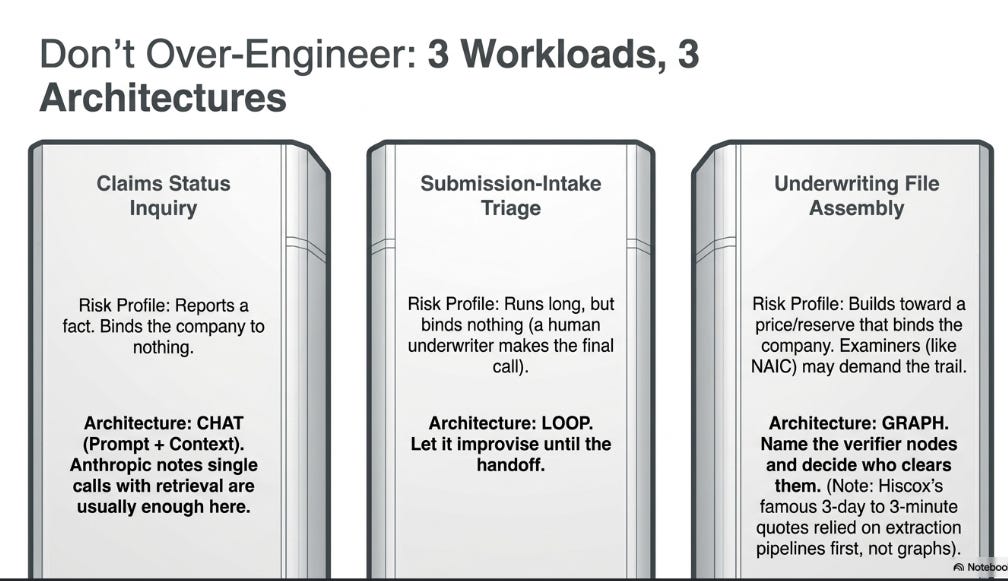
Run 3 ordinary insurance workloads up the ladder and they sort themselves.
Claims-status inquiry, so a chat
It reports a fact and commits the company to nothing. A simple prompt plus the right documents does it, and Anthropic’s own guidance since December 2024 is that single calls with retrieval are usually enough.Submission-intake triage, so a loop
It runs long, but the next stop is a human underwriter, so nothing leaves the building on its own.Underwriting file assembly, so a graph
It builds toward a price the company has to stand behind, one a regulator can later ask to see the trail for. That’s where I’d draw the graph, name the checking steps, and decide who clears them and how fast.
Fix the plumbing before you draw the graph
Hiscox’s headline win, 3-day quotes down to about 3 minutes, is a useful check on what to do first, because it came from a document-extraction pipeline announced in 2023 and live in 2024, not from a graph. That pipeline is rung 2, context engineering: getting the right documents in front of the model, cleanly and automatically.
Rung 2 buys the first big jump. Rung 5 is what I’d add next, once the decision has to run unattended and hold up to an examiner.
The second question to ask
If you read my monotheist-vs-polytheist piece, this is the other half. That one asked whether the work splits cleanly across agents. This one asks whether the company has to stand behind the result, and whether you wrote the split down somewhere an examiner can see it.
Two questions for Monday
The Monday move I’d make is two questions, put to every AI workload on the list, and this one is for the CIO or CFO to run, because the answers decide budgets, not diagrams. The first question belongs to the engineering team; the second belongs to compliance or whoever owns exam readiness, because no engineering standup can answer it.
How long does this run without a human touching it?
Does it make a decision that binds us to somebody — a price, a denial, a payment, a coverage position?
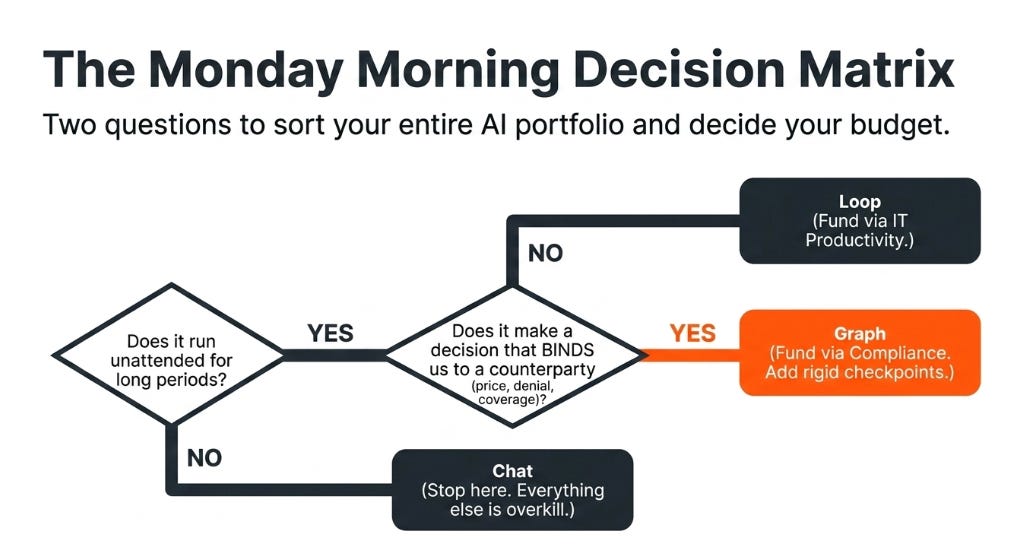
Then two follow-ups I’d suggest.
Which budget this comes out of, because if the answer is “productivity,” those numbers don’t exist yet.
Which engine draws the graph: first the workflow team down the hall, whose Temporal or Step Functions estate is already bought and paid for, then the Guidewire, Duck Creek, and Salesforce reps, on whether graph orchestration is already switched on in something on the renewal list.
I found no published answer to that last question, which is exactly why you want their answer in writing.
I’d log those replies, and log the triage answers with them, because that’s the inventory to have in hand before the sixth name shows up.
Are we taking bets on how long before the 6th?
References:
AIG Q1 2026 earnings call (2026-05-01), webcast via AIG Investor Relations: https://www.aig.com/home/investor-relations/financial-reporting-and-statutory-statements · transcript: https://www.fool.com/earnings/call-transcripts/2026/05/01/aig-aig-q1-2026-earnings-call-transcript/
Stanford HAI, 2026 AI Index Report, Economy chapter: https://hai.stanford.edu/ai-index/2026-ai-index-report/economy
Deloitte, State of AI in the Enterprise 2026 (AI agents findings): https://www.deloitte.com/us/en/insights/topics/emerging-technologies/ai-agents-scaling-faster.html
NAIC CIPR, Artificial Intelligence (Model Bulletin + AI Systems Evaluation Tool pilot): https://content.naic.org/cipr-topics/artificial-intelligence
Anthropic, “Building Effective AI Agents” (2024-12-19): https://www.anthropic.com/engineering/building-effective-agents
Anthropic, “Effective context engineering for AI agents” (2025-09): https://www.anthropic.com/engineering/effective-context-engineering-for-ai-agents
Anthropic, Claude Code CHANGELOG (subagent nesting + caps, July 2026): https://github.com/anthropics/claude-code/blob/main/CHANGELOG.md
Fu et al., “Do More Agents Help?” arXiv:2606.05670: https://arxiv.org/abs/2606.05670 [Note: preprint, not peer-reviewed]
Mittal, “ChromaFlow,” arXiv:2605.14102: https://arxiv.org/abs/2605.14102 [Note: preprint, not peer-reviewed]
Nature Machine Intelligence, s42256-026-01268-y (2026-07-24): https://www.nature.com/articles/s42256-026-01268-y
OMG, BPMN 2.0 specification: https://www.omg.org/spec/BPMN/2.0
LangChain, “3 Years of Graph Engineering with LangGraph” (2026-07-22): https://www.langchain.com/blog/3-years-of-graph-engineering-with-langgraph
Mitchell Hashimoto, “My AI Adoption Journey” (2026-02-05): https://mitchellh.com/writing/my-ai-adoption-journey
Addy Osmani, “Loop Engineering,” O’Reilly Radar (2026-06-22; originally published on addyosmani.com 2026-06-07): https://www.oreilly.com/radar/loop-engineering/
Hiscox press releases (2023-12-12, 2024-08-12): https://www.hiscoxgroup.com/news/press-releases/2023/12-12-23 · https://www.hiscoxgroup.com/news/press-releases/2024/12-08-24