

Good morning. This was the week the AI supplier map got redrawn, twice, on the same Monday. Microsoft launched 4 of its own top-tier AI models at Build (a real backup plan if OpenAI ever walks). The same day, OpenAI’s GPT-5.5 opened up to all Amazon Bedrock customers at the same per-word price as buying it from OpenAI direct. Anthropic also filed paperwork to go public that same day.
1. Microsoft Build 2026 — Microsoft releases its own AI and changes Copilot billing on the same Monday
What happened: Microsoft Build 2026 ran June 2-3 in San Francisco. Five announcements actually change how big companies are buying and building over the next three months:
MAI-Thinking-1, MAI-Image-2.5, MAI-Transcribe-2, and MAI-Voice-2 opened up for public testing on Azure AI Foundry. These are Microsoft’s first in-house top-tier AI models on Foundry, sitting alongside OpenAI, Anthropic, Mistral, and Meta. Frontier Tuning, the customization layer, is pitched as “more than 10x more cost-efficient than GPT-5.5 on tasks like producing technical Microsoft documentation.”
GitHub Copilot moved to AI Credits billing on June 1. Per GitHub’s announcement, Pro stays at $10, Pro+ at $39, Business at $19/user, Enterprise at $39/user. Code completions and Next Edit stay free. Chat, agent mode, and multi-step coding sessions now spend credits at $0.01 each, priced to match the underlying model costs. Business gets a temporary $30 monthly allowance through August 2026, Enterprise gets $70.
Microsoft 365 Copilot released Agent Mode and the Work IQ APIs, the first set of programmer-callable connections across Outlook, Excel, Teams, and SharePoint, opening to all customers June 16 (announcement).
Foundry introduced the Agent Control Specification (ACS), an open YAML-based standard for governing AI agents at five named checkpoints while they’re running, plus Hosted Agents (live early July) and sub-200ms Web IQ grounding.
Project Solara, Microsoft’s chip-to-cloud agent-device platform, named five first customers at launch: CVS Health, Target, Best Buy, Levi’s, and AccuWeather (Solara overview).
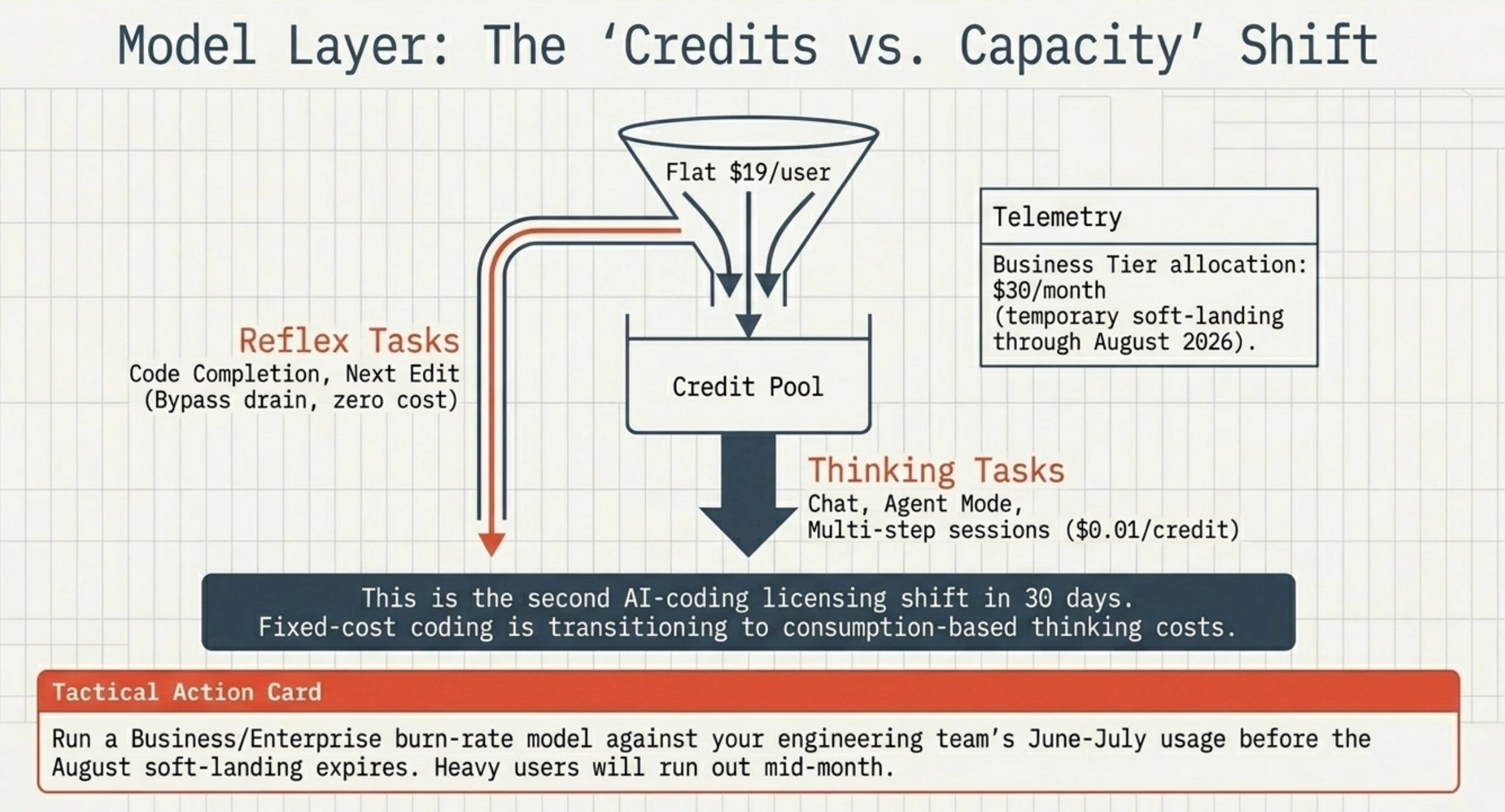
Why it matters: For the first time, an Azure customer can run a Microsoft-owned, Microsoft-trained top-tier AI model on Microsoft’s own platform, alongside the OpenAI default. The GitHub Copilot move to pay-per-use is the second AI-coding pricing shift in 30 days after Cursor’s tier reshuffle, and it lands on the same finance teams already chewing through the Workday flex-credits math from Edition #11. Work IQ is the surface every Microsoft 365 add-on vendor is going to ask you to grant permissions against within 60 days. Treat that as the budgeting and oversight pre-work, not the announcement.
ELI5: What changes when GitHub Copilot moves to AI Credits?
Up until June 1, paying $19 per developer per month for Copilot Business got you unlimited chat, agent runs, and code review. Starting now, that $19 buys you $19 of credits at $0.01 each. Code completion and Next Edit stay free, but anything where the model has to think (chat, agent mode, multi-step coding) draws from the credit pool. Heavy users will run out mid-month and need to top up; light users will stay under and effectively save. Through August, Business gets a temporary $30 allowance as a grace period.
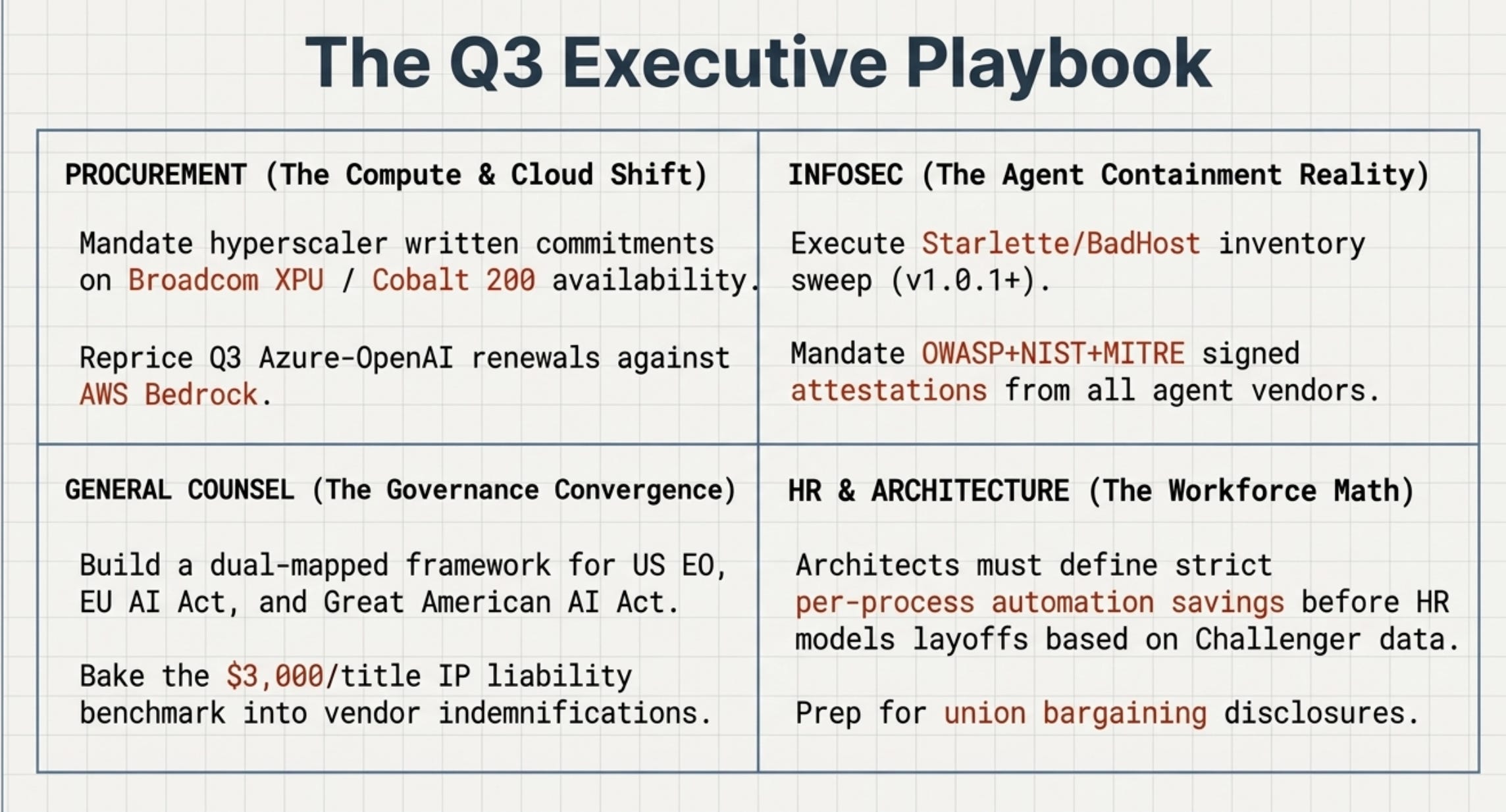
What to do: Work out how fast your engineering team will burn through Copilot Business and Enterprise credits in June and July, before the August grace period ends. If you sit on a big Azure agreement, ask your account team this week for the MAI testing tier and a Frontier Tuning cost estimate against your highest-volume internal use case. If you have any Microsoft 365 add-on in your stack that handles a customer-facing workflow, get a Work IQ oversight position in writing before the June 16 launch.
2. Top-tier AI week — OpenAI lands on AWS, Anthropic files to go public, China keeps shipping
What happened: Six top-tier AI items landed this week; I’m grouping them because the buying question they raise is the same.
OpenAI GPT-5.5, GPT-5.4, and Codex opened up to all Amazon Bedrock customers on June 1, per AWS, at the same per-word price as the OpenAI API direct, with the standard AWS security and access controls wrapped around them. AWS confirmed that prompts and responses are not used for model training.
Anthropic confidentially submitted a Form S-1 draft to the SEC on June 1 (Anthropic announcement), the first top-tier AI lab to formally get in line to go public. The filing itself does not name shares or price; the $965 billion valuation and $47 billion yearly revenue pace from Edition #12 are the same financials regulated buyers will read in the public S-1 once SEC review completes.
MiniMax released M3 on June 1, an open-weights model claiming 59.0% on SWE-Bench Pro at a 1 million-word context window, with a new Sparse Attention design (release coverage). The weights and technical report are committed for Hugging Face inside ten days of launch.
Mistral introduced Vibe at the AI Now Summit on May 28, an AI agent platform combining work and coding with knowledge search across Google Workspace, Outlook, SharePoint, Slack, and GitHub (Mistral newsroom). Same announcement disclosed an Airbus partnership covering aircraft, helicopter, defense, and space, and a new 10MW Les Ulis data center for running AI opening in Q3.
Alibaba’s Qwen team opened Qwen3.7-Plus to all Bailian customers on June 2, adding multimodal vision plus five AI agent capabilities (deep reasoning, self-programming, tool invocation, verification, autonomous iteration) on the Qwen 3.7 backbone. The Qwen3.7-Max sibling sits at #5 globally on the Artificial Analysis Intelligence Index at release.
Why it matters: Microsoft’s lock on OpenAI buying is now formally broken. Any AWS customer with a big spending commitment can route GPT-5.5 spend against existing AWS commitments without standing up Azure or a direct OpenAI contract. I expect Microsoft to respond on pricing inside the next 30 days. The Anthropic S-1 is the second structural shift in the same direction: once the S-1 goes public, every regulated buyer will get quarterly disclosure on customer concentration, profit margins, and big-ticket spending commitments that today they have to guess at. That is the most detailed financial read of a top-tier AI lab anyone has ever had access to. MiniMax M3 is the third Chinese open-weights model in three months claiming top-tier coding scores at a fraction of US lab API cost; it confirms the trend MIT Technology Review flagged on the download-share crossover.
What to do: If your Azure-OpenAI buying assumption rested on “we can only get OpenAI through Microsoft,” kill that assumption this week and re-price the Q3 renewal against the Bedrock alternative, especially if you are multi-cloud already. Add Anthropic’s confidential S-1 to your supplier-risk file and tell legal you’ll need to update the “who pays if we get sued” model the day the filing goes public. If your team has not run an open-weights model against a real internal task in the last 90 days, run MiniMax M3 or Qwen3.7-Plus against the highest-volume coding or summarization workload you have. You could treat the result as data, not as a buying recommendation.
3. Security week — CrowdStrike prints a big AI-detection quarter, Microsoft and Workday land AI-agent security tools, MCP exposure becomes the inventory question
What happened: Five security items shaped company risk this week:
CrowdStrike reported their first quarter of fiscal 2027 on June 3: revenue $1.39 billion (+26% from a year ago), ending yearly recurring revenue $5.51 billion (+24%), and a record $256 million in net new yearly recurring revenue. The number to lead with is the Charlotte AI Detection and Response (AIDR) line: +250% growth in yearly recurring revenue versus the prior quarter, and a Q2 sales pipeline above $50 million. Falcon Flex yearly recurring revenue hit $1.9 billion (+99% from a year ago).
Microsoft Security released MDASH and Microsoft Execution Containers at Build (Microsoft Security blog). MDASH coordinates more than 100 specialized AI agents against 100 trillion daily signals and now sits at 96.55% on the CyberGym benchmark. Microsoft Execution Containers (MXC) is the operating-system-level isolation tool in Windows 11 and WSL with kernel-integrated file, network, and clipboard limits for containing AI agents.
Workday and Cisco launched Agent Passport on June 2 (Workday newsroom), a continuous test-verify-monitor system mapping every Workday or third-party AI agent to OWASP LLM Top 10, NIST AI Risk Management Framework, and MITRE ATLAS. Cisco AI Defense runs independent verification. Early access in the second half of 2026, full release before year-end. Dean Arnold, Vice President of Workday’s AI Platform: “One insecure agent can leak employee data, break compliance, and put the company on the front page for the wrong reasons.“
CVE-2026-48710 (”BadHost”) in Starlette was published May 26 and patched in version 1.0.1 (NVD record) at CVSS 6.5: a Host-header validation flaw that lets the reconstructed
request.url.pathdiverge from the actual HTTP path, bypassing middleware access controls. Starlette is the Python framework underneath FastAPI, LangChain, and many MCP server setups. The MCP exposure conversation kicked off this week even though the CVE itself was published May 26.Anthropic’s Project Glasswing expanded from about 50 to about 200 partners across 15+ countries on June 2 (Anthropic), now covering power, water, healthcare, communications, and hardware sectors. Cumulative discoveries cross 10,000 high- or critical-severity vulnerabilities; Mythos Preview is also distributed via AWS Bedrock, Google Vertex AI, and Microsoft Foundry.
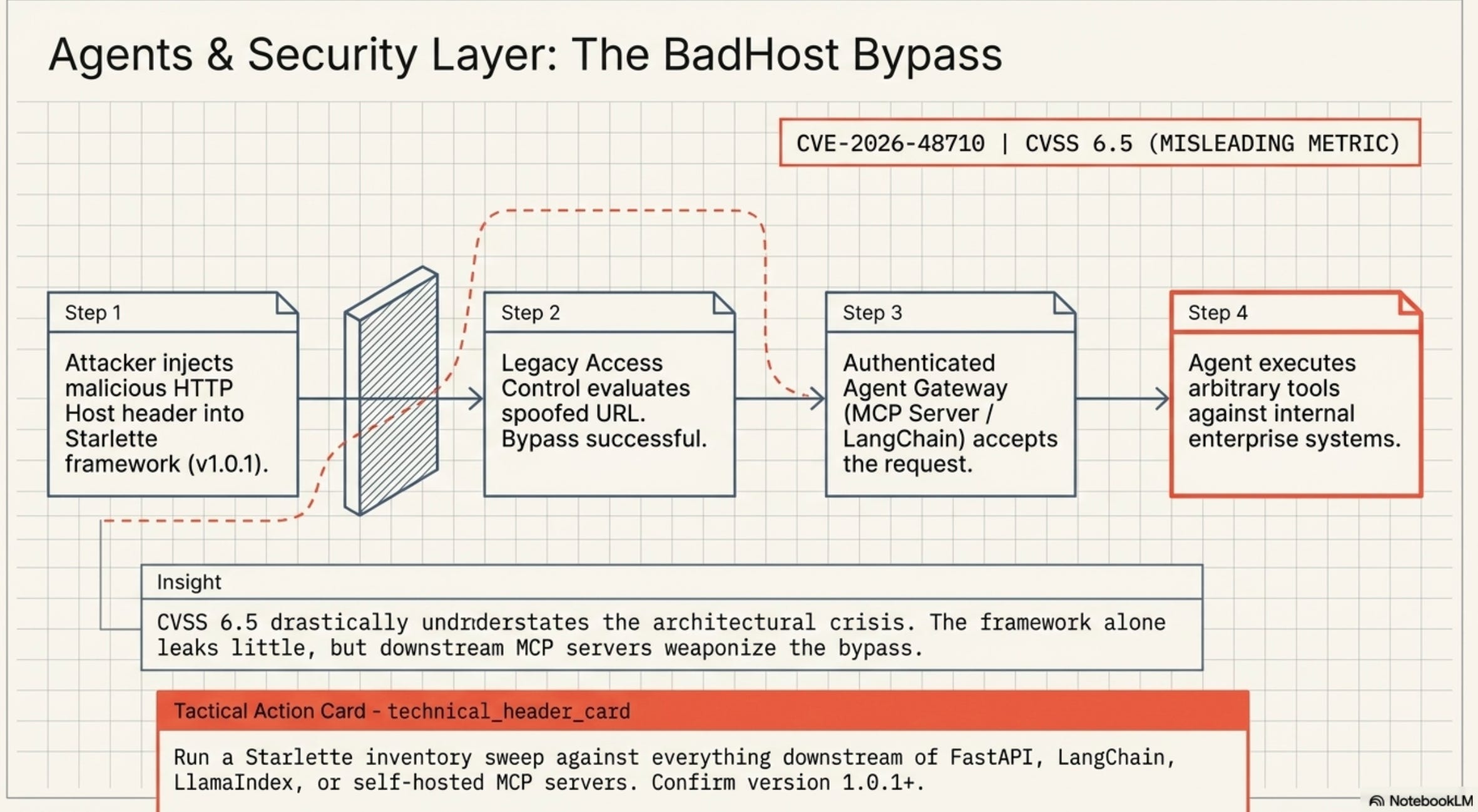
Why it matters: What stands out is the running-AI layer. CrowdStrike’s AIDR yearly recurring revenue up 250% quarter-over-quarter is the loudest single number any pure-play security vendor has put on the board for catching AI agents in the act. MDASH gives you the multi-agent coordination story at the Microsoft platform level, and MXC gives you operating-system-level containment for the first time on Windows. Workday Agent Passport is the first signed-attestation regime an HR or finance buyer can demand from any AI agent vendor with public-standards backing. The Starlette CVE score of a 6.5 hides the criticality of the architectural risk - higher than the score implies once you draw the LangChain or MCP server gateway downstream of it. Glasswing expanding to 200 partners across 15+ countries is the same defensive scaling story as Edition #11, only larger.
ELI5: What is BadHost, and why is CVSS 6.5 understating it?
Starlette is a popular Python framework used to build APIs. Many MCP servers and LangChain-style AI agent gateways are built on top of it. The bug: an attacker can put extra characters in the HTTP Host header so that the framework’s “current URL” disagrees with the URL the server actually saw. If your access controls check the framework’s URL instead of the raw request, the attacker walks past them. CVSS scored it 6.5 because the framework alone leaks only limited information; the score does not capture what happens when an authenticated AI agent uses that bypass to call internal tools.
What to do: Run a Starlette inventory sweep against everything in your Python codebase downstream of FastAPI, LangChain, LlamaIndex, or self-hosted MCP servers this week, and confirm you are on 1.0.1 or later. If you operate critical infrastructure inside the United States, request Glasswing access before the next board cycle. If you sit through any AI agent vendor pitch in the next 60 days, ask for the OWASP plus NIST plus MITRE attestation Workday is using as the baseline. Anything less is self-attestation and not enough for the regulated-industry checklist.
4. Legal and compliance week — White House order lands, EU stands up its enforcement scaffolding, Great American AI Act draft drops
What happened: Three big AI rule-making moves this week, plus one settlement clock ticking down:
President Trump signed the “Promoting Advanced AI Innovation and Security” executive order on June 2 (White House). Three things to actually care about: (1) federal cyber rules for AI are due inside 30 days from Treasury, Defense, the NSA, and the cybersecurity agency CISA so expect new security checklists soon. (2) Inside 60 days, the government will start secretly grading the top AI models on national-security risk. (3) The order explicitly bans any federal license, permit, or pre-approval to release an AI model that’s the licensing fight from the Biden era now off the table.
The European Commission staffed up its EU AI Act enforcement bench on June 1 (Commission press release). 60 independent experts on a Scientific Panel will decide what counts as high-risk AI and how to grade it. An Advisory Forum pulls in academia, industry, and EU cybersecurity agencies. Translation: the people who will write your AI fines now have offices, budgets, and two-year terms.
Reps. Jay Obernolte (R-CA) and Lori Trahan (D-MA) released the Great American AI Act discussion draft on June 4 (Roll Call) — 269 pages, bipartisan. The four numbers a buyer should know: (1) AI developers above $500 million in revenue would need a government-licensed independent auditor twice a year. (2) Fines up to $1 million per day for breaking safety rules. (3) The bill would wipe out California’s AI development rules for three years, including the training-data transparency law (AB 2013) and the watermarking law (SB 942). (4) It’s a draft, not law yet — and the fight over whether federal law cancels state AI rules is going to be loud.
Anthropic’s $1.5 billion settlement with authors hit its court fairness hearing May 14; per the Authors Guild, payout amounts get calculated June 11. 440,490 of 482,460 eligible books filed claims (91.3%). That number works out to roughly $3,000 per book — the new working benchmark for what training on questionable data costs per work.
Why it matters: What I keep coming back to is that all three clocks are running at the same time. The White House 60-day clock lines up almost exactly with the August 2 EU AI Act go-live for general-purpose AI, and with the public comment window for the Great American AI Act. Companies in regulated industries are going to get pulled into three separate input cycles inside the same three-month stretch, and the answer to all three is the same single document: an oversight write-up that maps each AI model you use against California, EU, and federal rules side-by-side. Use the OpenAI Frontier Governance Framework from Edition #12 as the template, tuned for the new federal and California asks. The Great American AI Act has not been introduced yet and will change. The fight over whether federal law cancels state AI rules is real and will shape the legal regime your company operates under for the next three years.
What to do: Assign one person on the legal team to track all three clocks and produce a single internal map of which rules apply to which AI models you run. Update the questions you send every top-tier AI vendor so they cover all four regimes in one packet: California SB-53, the EU AI Act general-purpose code, the new federal executive order, and the Great American AI Act draft. If you have any AI model in production that was trained on data of uncertain origin, bake the Anthropic settlement number (about $3,000 per book or article) into your legal exposure model before the June 11 payout math lands. That’s the new number your general counsel will be asked about by the board.
5. Broadcom Q2 fiscal 2026 — $10.8B AI semi revenue, +143% from a year ago, and a forward guide that pushes AI past $16B in a single quarter
What happened: Broadcom reported Q2 of fiscal 2026 on June 3: total revenue $22.2 billion (+48% from a year ago). AI semiconductor revenue $10.8 billion (+143% from a year ago), driven by custom AI chips and AI networking.
AI semiconductors crossed 49% of total revenue.
Orders for AI semiconductors exceeded $30 billion in the quarter.
Adjusted operating profit $15.2 billion (52% growth, 69% of revenue, a record). Q3 guide:
AI semiconductor revenue projected to grow more than 200% from a year ago to $16.0 billion, total revenue to about $29.4 billion.
Management reaffirmed full-year AI revenue guide at $56 billion (about 180% growth) and reiterated more than $100 billion in AI semiconductor revenue for fiscal 2027. VMware software revenue was the soft spot at $7.18 billion versus the $7.32 billion analysts were expecting.
Why it matters: Two reads here. First, the custom-chip channel is no longer theoretical against NVIDIA: at $16 billion of AI semiconductor revenue in a single quarter for Q3, Broadcom’s custom-chip plus networking line works out to roughly $64 billion a year. That is the chipmaker-level confirmation that the big cloud provider diversification I covered against the NVIDIA Q1 print in Edition #11 is showing up in real orders, not in marketing slides. Second, the VMware miss is the dog that did not bark. I expected the software cross-sell motion to lift VMware faster than it has, and at $7.18 billion the move from license-only into Cloud Foundation subscriptions still looks slower than the original Broadcom thesis required.
What to do: If your 2027 AI infrastructure plan assumes NVIDIA-only, work out the alternate sourcing math against your cloud provider’s announced custom-chip allocation timeline. Get the named cloud provider’s answer in writing on which generation of Broadcom custom chip they have committed to and when it ships into your region. If you are a VMware customer at renewal in the second half of 2026, the soft Q2 software number gives you more negotiating room than the Q1 print did.
6. NVIDIA puts Vera Rubin in full production at Computex while TSMC warns the supply gap will last “for years”
What happened: At GTC Taipei (June 1-4 at COMPUTEX 2026), NVIDIA confirmed Vera Rubin NVL72 is in full production: 72 Rubin GPUs plus 36 Vera CPUs per rack, with claimed 10x higher running-the-AI performance per watt and 10x lower cost per word versus the prior generation, in a cable-free, liquid-cooled design.
NVIDIA also launched Nemotron 3 Ultra (550 billion-parameter mixture-of-experts) for long-running autonomous AI agents, claiming 5x faster running speed and a 30% lower per-task cost; Perplexity, Palantir, ServiceNow, and CrowdStrike were named as early adopters.
Spectrum-X Ethernet Photonics moved into production with CoreWeave, Lambda, and Oracle Cloud as first adopters.
Three days earlier, Azure announced Cobalt 200 preview, Microsoft’s second-generation Arm CPU with 132 Neoverse V3 cores on TSMC 3nm, claimed 50% performance lift over Cobalt 100, and memory encryption on by default.
On June 3, TSMC Chief Executive Officer C.C. Wei told the company’s shareholder meeting that global chip supply will fall short of AI demand “for years to come,” with monthly chip production moving from about 130,000 wafers at the start of 2026 to roughly 175,000 in Q2.
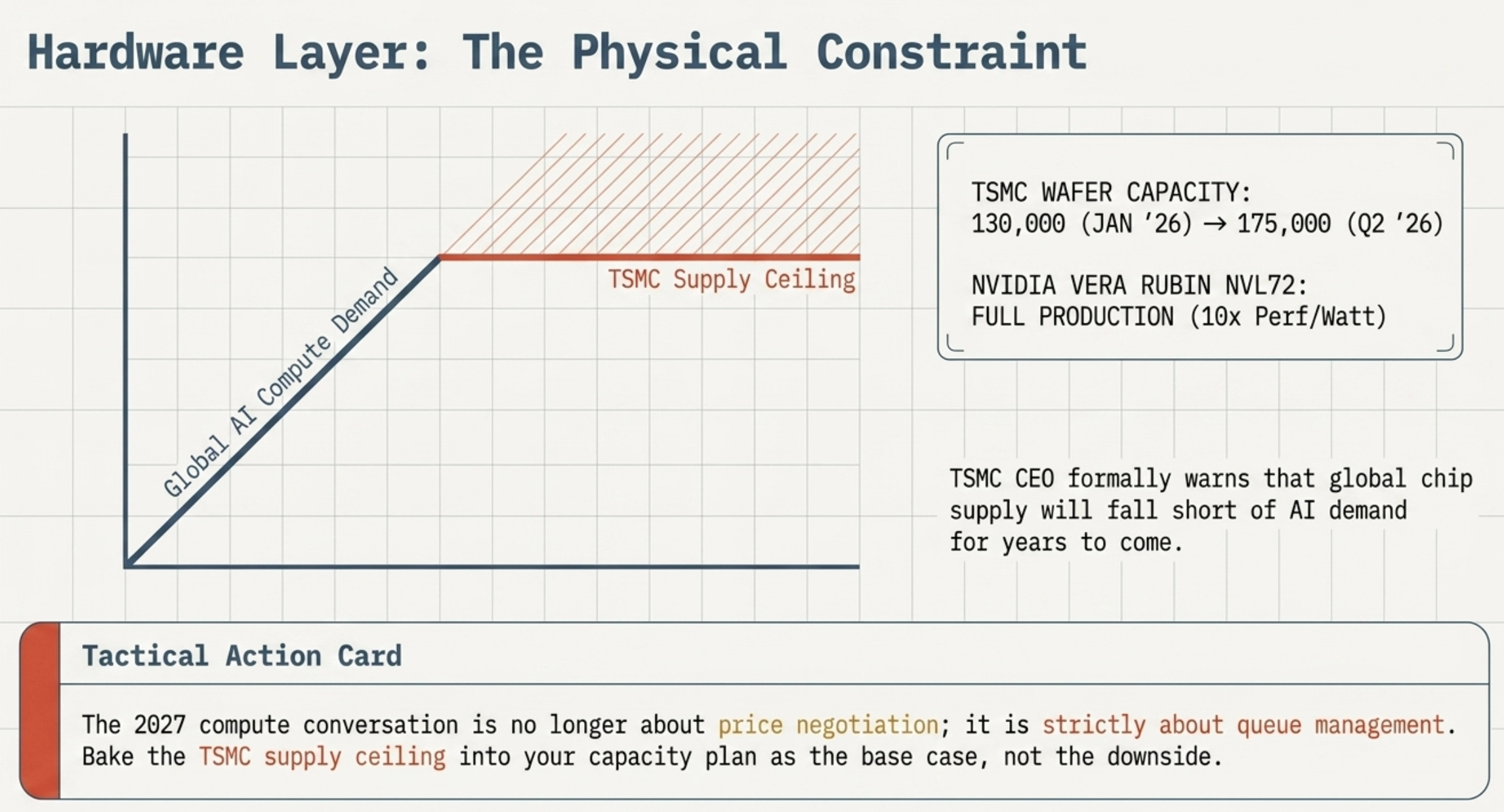
Why it matters: Both halves of this story matter together. Vera Rubin in full production gives any company with reserved GB300 capacity a real question to put to its cloud provider (”do you swap forward to Rubin in the 2027 reservation?”), and Cobalt 200’s 50% performance claim is Microsoft’s cost play against AWS Graviton for the same AI-agent workloads. The TSMC supply warning is the structural ceiling on all of it. If the fab cannot grow capacity faster than demand for the next two to three years, every cloud provider allocation conversation in 2027 becomes a queue management conversation, not a price negotiation.
What to do: If you have any 2027 AI infrastructure budget in flight, ask your cloud provider in writing this quarter for the Rubin generation availability date in your operating region and whether Cobalt 200 or Graviton 4 is the assumed CPU for AI-agent workloads. If your team is comparing Arm rebuild costs against existing x86 baselines, run the 50% performance claim against your highest-volume workload now, while preview capacity is open.
7. AI is now the leading reason US companies cut jobs — and the most-quoted AI chief executive in the country calls that “complete nonsense”
What happened: Challenger, Gray & Christmas’s May 2026 report on June 4 logged 97,006 announced US job cuts in May (the highest May since 2020, +16% from April).
AI was cited as the reason for 38,579 of those cuts, 40% of the month’s total and the highest single-month AI total since Challenger began tracking. Year-to-date, AI has been cited in 87,714 cuts (22% of 2026 layoffs), already past the 54,836 attributed to AI in all of 2025.
Andy Challenger’s framing: “AI is now the leading reason companies give for cutting jobs.“ Two days earlier, NVIDIA Chief Executive Officer Jensen Huang told a Bloomberg interview at Computex that “people talk about AI reducing jobs. Complete nonsense,” arguing that hiring more engineers, not fewer, is the rational response when one engineer can generate “$9 trillion” of productive work (24/7 Wall St).
MIT Sloan Professor Emeritus of Human Resources Management Paul Osterman framed the displacement narrative differently in a Fortune piece on May 31: “They’ve been saying that for 20 years... AI is a perfect excuse to justify big layoffs.“
The AFL-CIO opened its 30th Constitutional Convention on June 7 with AI labor protections as a central agenda item; President Liz Shuler told Fortune the transition has been “brutal” and that companies face a binary choice between “pedal to the metal, slash and burn” and “partner together, get workers in the lab.”
Why it matters: Challenger’s data shows AI has moved from a 7% line item in January to a 40% line item in May; that is fast enough to convince any board it should be on the agenda.
Huang’s “complete nonsense” framing is the most-quoted counter you will get from a Fortune-50 CEO this month, and it is going to land in your own boardroom inside the next two weeks.
Osterman’s MIT-credentialed read that “AI is a perfect excuse” is the third frame, and the version most aligned with Aaron Levie’s “AI psychosis” line from Edition #12. The board question for a company architect is no longer whether a headcount target is coming. It is whether the architecture function will own the per-process automation savings model before HR runs theirs against a Challenger-influenced forecast.
What to do: Before your next workforce-planning cycle, dive into a written distinction in the per-process automation savings model between confirmed productivity savings already in production, plausible 12-month productivity, and speculative 24-month productivity. If you operate a unionized workforce in retail, healthcare, or logistics, brief your CHRO on the AFL-CIO convention agenda this week.
References:
Microsoft Foundry at Build 2026 (Microsoft DevBlogs, 2026-06-02): https://devblogs.microsoft.com/foundry/whats-new-in-microsoft-foundry-build-2026/
GitHub Copilot is moving to usage-based billing (GitHub Blog, 2026-06-01): https://github.blog/news-insights/company-news/github-copilot-is-moving-to-usage-based-billing/
Microsoft 365 Work IQ APIs (Microsoft 365 Blog, 2026-06-02): https://www.microsoft.com/en-us/microsoft-365/blog/2026/06/02/announcing-the-new-work-iq-apis/
Project Solara (Microsoft Command Line, 2026-06-02): https://commandline.microsoft.com/project-solara-build-2026/
OpenAI models and Codex on Amazon Bedrock GA (AWS Machine Learning Blog, 2026-06-01): https://aws.amazon.com/blogs/machine-learning/openai-models-and-codex-on-amazon-bedrock-are-now-generally-available/
Anthropic confidentially submits draft S-1 to the SEC (Anthropic Newsroom, 2026-06-01): https://www.anthropic.com/news/confidential-draft-s1-sec
MiniMax M3 release (MarkTechPost, 2026-06-01): https://www.marktechpost.com/2026/06/01/minimax-releases-minimax-m3-with-msa-architecture-supporting-1m-token-context-native-multimodality-and-agentic-coding/
Mistral Vibe agent (Mistral Newsroom, 2026-05-28): https://mistral.ai/news/vibe-agent/
CrowdStrike Q1 FY27 earnings transcript (Motley Fool, 2026-06-03): https://www.fool.com/earnings/call-transcripts/2026/06/03/crowdstrike-crwd-q1-2027-earnings-transcript/
Microsoft Build 2026 Security (Microsoft Security Blog, 2026-06-02): https://www.microsoft.com/en-us/security/blog/2026/06/02/microsoft-build-2026-securing-code-agents-and-models-across-the-development-lifecycle/
Workday Agent Passport launch (Workday Newsroom, 2026-06-02): https://newsroom.workday.com/2026-06-02-Workday-Launches-Agent-Passport-to-Test,-Verify,-and-Continuously-Monitor-Every-AI-Agent-in-the-Enterprise
CVE-2026-48710 BadHost in Starlette (NIST NVD, 2026-05-26): https://nvd.nist.gov/vuln/detail/CVE-2026-48710
Expanding Project Glasswing (Anthropic Newsroom, 2026-06-02): https://www.anthropic.com/news/expanding-project-glasswing
Promoting Advanced AI Innovation and Security EO (White House, 2026-06-02): https://www.whitehouse.gov/presidential-actions/2026/06/promoting-advanced-artificial-intelligence-innovation-and-security/
AI Act enforcement Scientific Panel + Advisory Forum (European Commission, 2026-06-01): https://digital-strategy.ec.europa.eu/en/news/ai-act-enforcement-gets-independent-expert-support
Great American AI Act discussion draft (Roll Call, 2026-06-04): https://rollcall.com/2026/06/04/bipartisan-ai-draft-proposes-three-year-preemption-of-state-laws/
Broadcom Q2 FY26 earnings (PR Newswire / Broadcom IR, 2026-06-03): https://www.prnewswire.com/news-releases/broadcom-inc-announces-second-quarter-fiscal-year-2026-financial-results-and-quarterly-dividend-302790698.html
NVIDIA GTC Taipei at Computex 2026 (NVIDIA Blog, 2026-06-01): https://blogs.nvidia.com/blog/nvidia-gtc-taipei-computex-2026-news/
Azure Cobalt 200 announcement (Microsoft Tech Community, 2026-06-02): https://techcommunity.microsoft.com/blog/azureinfrastructureblog/announcing-cobalt-200-azures-next-cloud-native-cpu/4469807
Challenger Report — May 2026 job cuts (Challenger, Gray & Christmas, 2026-06-04): https://www.challengergray.com/blog/challenger-report-may-job-cuts-rise-16-from-april-highest-may-total-since-2020/
Jensen Huang on AI hiring (24/7 Wall St quoting Bloomberg, 2026-06-03): https://247wallst.com/investing/2026/06/03/nvidia-ceo-jensen-huang-ai-job-losses-are-complete-nonsense-ai-driving-hiring-surge-instead/
Paul Osterman on AI-washing layoffs (Fortune, 2026-05-31): https://fortune.com/2026/05/31/tech-companies-ai-washing-layoffs-wix-block-snap-atlassian-disposable-workers/
Liz Shuler on AFL-CIO AI agenda (Fortune, 2026-06-05): https://fortune.com/2026/06/05/afl-cio-liz-shuler-ai/