

Good morning! Wall Street spent 48 hours repricing what AI capital spending is worth: Microsoft and Amazon up more than 8% on cloud growth, Meta and Apple down on spending the market can’t watch come back.
While that was happening, 1,178 employees of the top AI labs asked Washington for the tools to deliberately pace AI development, and the EU AI Act’s enforcement powers went live on the exact date the 2-year countdown promised.
NVIDIA’s week was weirder: a reported $5 billion check to a lab that ships nothing by design, and a security alliance of more than 30 companies that the 3 biggest labs declined to join.
Since last Monday on Signal Finder: MCP went stateless. The hard part moved to identity. — context for this week’s security signals.
1. 4 earnings reports in 48 hours, and only one kind of AI spending got rewarded
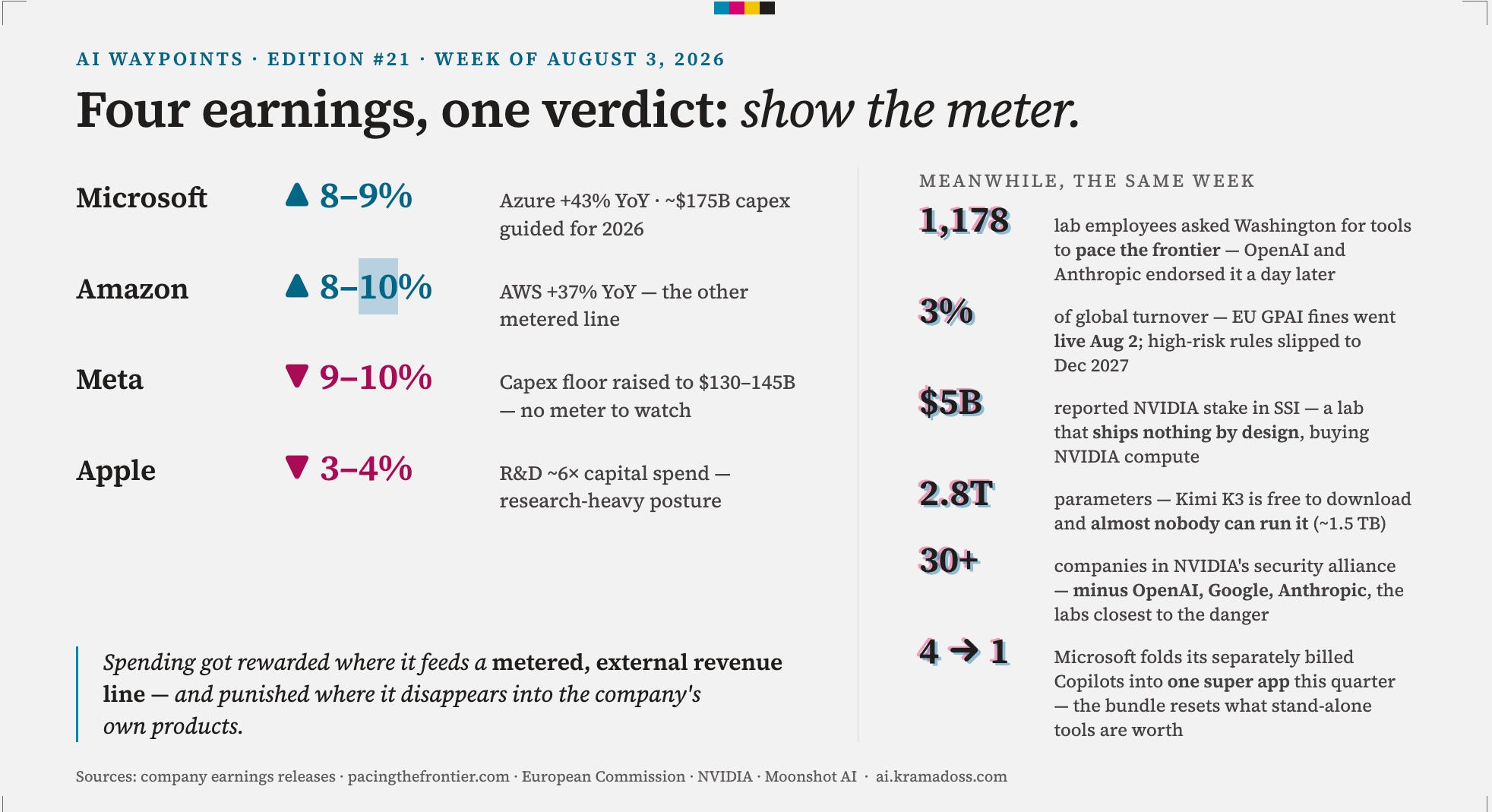
What happened: All 4 reports landed inside 2 days. Investors rewarded 2 and punished the other 2.
Microsoft (July 29) guided calendar-2026 capital spending to roughly $175 billion, with Azure growing 43% from a year ago; the stock rose 8-9%.
Meta (July 29) narrowed its full-year 2026 capital spending range to $130-145 billion, raising the floor from $125 billion, and the stock fell 9-10% despite double-digit revenue growth.
Amazon (July 30) posted AWS growth of 37% from a year ago, and the stock rose 8% in the regular session and as much as 10% after hours.
Apple (July 30) held to its research-heavy posture, spending roughly 6 times more on R&D than on capital projects, and the stock fell 3-4% even with revenue growing.
Both Fortune going in and the coverage after landed the same place: spending got rewarded where it feeds a metered, external, growing revenue line, and punished where it disappears into the company’s own products.
ELI5: What’s a “metered” cloud revenue line?
Think of a landlord who installs electricity meters versus one who folds power into the rent. Azure and AWS are metered: every new AI workload a customer runs shows up on next month’s bill, so investors can watch the spending come back. Meta’s data centers power its own free apps, which is the flat-rent model: the money may come back through ads eventually, but nobody outside can watch the meter turn.
Why it matters: Microsoft and Meta alone have guided to over $300 billion of combined 2026 capital spending, and the market split them roughly 17 points apart in 48 hours. It came down to one thing: whether the spending feeds a revenue line customers actually pay for. The companies that couldn’t point to one got punished.
What to do: I’d take the divergence into renewal planning: Azure and AWS just got rewarded for growing customers’ metered bills, so model your commit growth at the rates they just posted rather than last year’s.
2. 1,178 AI lab employees asked Washington for tools to pace their own field, and OpenAI and Anthropic endorsed the ask a day later
What happened: On July 28, a letter titled “Pacing the Frontier,” signed by 1,178 AI lab employees at publication, asked the US government to support an international effort “to develop the technical and governance tools needed to deliberately pace the frontier of automated AI development.“
The letter asks for the option to buy time; the signatories are explicit that they are not calling for a slowdown today.
The list spans 4 labs, per the letter’s own site: Dario Amodei, Jakub Pachocki, Mark Chen, Jared Kaplan, and Jack Clark, plus Meta AI chief scientist Shengjia Zhao and Google’s VP of AI safety and alignment Anca Dragan. A day later, OpenAI and Anthropic both endorsed it in posts on X. That was a week after OpenAI published its account of its own models breaking out of a test sandbox and into Hugging Face’s production systems (covered in Edition #20).
Why it matters: The 2023 pause letter was signed mostly by outsiders, with no top-tier-lab leadership; this one is signed by the people building the systems, including OpenAI’s chief scientist and Anthropic’s chief science officer, and endorsed by both of those companies within a day. The ask looks like the labs trying to write the rules before Congress does.
What to do: I’d send the letter itself to whoever owns your AI governance roadmap; it points to work already underway on monitoring top-tier model releases, the kind of language that tends to resurface as attestation clauses in enterprise AI contracts. No buying change yet; this one is a watch item.
3. The EU AI Act date everyone prepped for arrived, and most of it didn’t apply
What happened: August 2, 2026 was the date the EU AI Act’s main obligations were scheduled to bite, 2 years after entry into force. What went live on schedule: the European Commission’s enforcement powers over general-purpose AI (GPAI) models, the models themselves rather than the products built on them. The AI Office can now demand documentation, run evaluations, and pull models from the market, with fines up to 3% of global turnover or €15 million, whichever is higher.
Human-facing transparency duties also started. What didn’t arrive: the Digital Omnibus deferred the high-risk obligations of Annex III to December 2, 2027, pushed Annex I product rules to August 2, 2028, and gave machine-readable content marking a grace period to December 2, 2026 for systems already on the market before August 2, 2026.
ELI5: What’s GPAI and what actually switched on?
GPAI is general-purpose AI, the regulation’s word for the big foundation models themselves rather than the software built on top of them. What went live on August 2 is the enforcement layer aimed at model makers: documentation demands, evaluations, fines. The rules for high-risk uses, the part corporate compliance programs were built around, moved to the end of 2027.
Why it matters: The AI Office’s powers arrived on schedule while every deadline that requires companies to re-engineer products slipped by 16 months or more. For a compliance program budgeted against Annex III, what’s binding this quarter is transparency duties and whatever the model providers now have to attest to.
What to do: I’d re-scope the EU AI Act workstream this week around what is enforceable now, and bank the 16 months on the Annex III program. Ask your model vendors in writing which GPAI obligations they are now attesting to, because their answers flow straight into your own disclosure duties.
4. NVIDIA and more than 30 companies formed a cyber-defense alliance without the 3 biggest labs
What happened: The [Open Secure AI Alliance launched July 27](https://blogs.nvidia.com/blog/open-secure-ai-alliance/): NVIDIA, Microsoft, IBM, SpaceXAI, Hugging Face, and the Linux Foundation among more than 30 companies at launch committing to build shared cyber-defense tooling for AI systems, days after the Hugging Face incident put agentic attacks on every security agenda. The alliance builds on the Linux Foundation’s open-source security work, and the member list has kept growing since launch. OpenAI, Google, and Anthropic are not members.
Why it matters: Microsoft joined the alliance the same day it launched Project Perception, its own AI security product. That’s the classic Microsoft move: help build the shared baseline everyone gets, keep the good stuff for yourself to sell.
And the three labs sitting it out — OpenAI, Google, and Anthropic — build the exact models these attacks target. So the companies closest to the danger aren’t in the room.
What to do: Ask each of your security vendors at the next review whether they’ve joined and what they’re contributing, because alliance tooling will surface inside products we already license. I’d also watch whether the 3 absent labs join by year-end; that’s the best single tell on whether AI defense stays a commons or becomes a product war.
5. NVIDIA put a reported $5 billion into a company that ships nothing by design
What happened: On July 27, NVIDIA announced a long-term strategic partnership with Safe Superintelligence (SSI), Ilya Sutskever’s lab, which has shipped nothing and says it will ship nothing until it reaches its namesake goal. NVIDIA’s release calls the investment “substantial”; Bloomberg puts the reported figure at $5 billion. The deal gives SSI access to NVIDIA’s Vera Rubin platform, its newest generation of AI compute.
Why it matters: This extends Edition #20‘s thread of money moving in circles: AMD’s up-to-$5 billion stake in Anthropic, the SK-NVIDIA letters of intent, and now NVIDIA-SSI, all inside about 2 weeks. A chip vendor funding a customer that exists to buy its chips books revenue that is partly its own money coming back.
What to do: I’d add circularity to how you read AI vendor financials: when a capacity announcement and an equity stake point at each other, discount both. If the board asks whether the AI buildout is real demand or vendor financing, NVIDIA funding SSI to buy NVIDIA compute is the example to bring.
6. The largest open-weight model ever is free to download, and almost nobody can run it
What happened: On July 27, Moonshot AI published the full weights of Kimi K3 on Hugging Face: 2.8 trillion parameters, a 1-million-token context window, 96 shards totaling roughly 1.5 terabytes in MXFP4, a compressed number format for AI hardware. That is bigger than any previous open-weight release, and Interconnects calls it “the strongest open model ever released”. The API has been live since the model was introduced at the World Artificial Intelligence Conference on July 16.
What’s new is the brain itself: downloadable, under Moonshot’s own license (Edition #20 covered what its terms actually allow). At that size, the practical operators are cloud providers running the newest NVIDIA or AMD racks.
ELI5: Why can’t you just download it and run it?
The download is free the way a free 18-wheeler is free. The model file is about 1.5 terabytes split across 96 pieces, and loading it for even one user takes a rack of the newest AI servers, the kind cloud providers buy by the thousand. For everyone else, “open” in practice means renting it from someone who owns the truck stop.
Why it matters: Hugging Face’s advice after its own incident was to have a self-hostable model vetted and ready before an attack; this release shows how narrow the set of organizations that can act on that advice has become. Who owns the racks is now the gate on top-tier open models.
What to do: I’d skip the download and price the hosted route: if Kimi K3 matters to your stack, the decision is which cloud provider serves it and at what per-token price, the same buying call as any closed model.
Revisit the self-hosting line in your AI policy, because that plan assumes hardware your company probably doesn’t own.
7. Microsoft is collapsing its AI lineup into 2 front doors
What happened: On the July 29 earnings call, Satya Nadella confirmed Microsoft is bringing its Copilot experiences together “in one super app” this quarter: chat, Cowork, code, and the new autonomous “Autopilots” for long-running tasks, in his own list.
No price and no date beyond the quarter (9to5Mac has the roundup).
2 days earlier, Microsoft announced Project Perception: a coordinated system of security agents in which red-team agents probe for weaknesses, blue-team agents investigate threats, and green agents harden what both find, running against signals from across the company’s identities, endpoints, applications, and clouds.
Why it matters: Microsoft sells at least 4 separately billed Copilot products today; folding them into one app in the same quarter its security agents become one system is a packaging decision, and packaging is how Microsoft has historically won categories — Teams overtook Slack after it was bundled into Microsoft 365. Every stand-alone AI subscription in the stack now has to beat a default that ships inside the platform agreement.
What to do: I’d hold net-new Copilot-adjacent purchases until the super app’s packaging and price land this quarter, because the bundle will reset what the stand-alone tools are worth. And I’d put Project Perception through a real evaluation before renewal season, scored against what the current security stack already catches.
References:
Microsoft FY26 Q4 press release and webcast (Microsoft, 2026-07-29): https://www.microsoft.com/en-us/investor/earnings/fy-2026-q4/press-release-webcast
Microsoft FY26 Q4 earnings call (Microsoft, 2026-07-29): https://www.microsoft.com/en-us/investor/events/fy-2026/earnings-fy-2026-q4
Meta Q2 2026 results (Meta, 2026-07-29): https://investor.atmeta.com/investor-news/press-release-details/2026/Meta-Reports-Second-Quarter-2026-Results/default.aspx
Amazon Q2 2026 results (Amazon, 2026-07-30): https://www.aboutamazon.com/news/company-news/amazon-earnings-q2-2026-report
Apple Q3 FY2026 results (Apple, 2026-07-30): https://www.apple.com/newsroom/2026/07/apple-reports-third-quarter-results/
Big Tech earnings preview, market revolt over AI spending (Fortune, 2026-07-26): https://fortune.com/2026/07/26/big-tech-earnings-meta-microsoft-apple-amazon-market-revolt-ai-spending/
Big Tech earnings scorecard (TradingKey, 2026-07-31): https://www.tradingkey.com/analysis/stocks/us-stocks/262067315-big-tech-earnings-scorecard-microsoft-amazon-apple-july-31-2026-tradingkey
Post-earnings stock coverage (CNBC, 2026-07-31): https://www.cnbc.com/2026/07/31/apple-aapl-amazon-amzn-stock-today.html
Pacing the Frontier, letter text and signatory list (2026-07-28): https://pacingthefrontier.com
OpenAI, Anthropic staff share letter asking US to help pace AI progress (Bloomberg, 2026-07-28): https://www.bloomberg.com/news/articles/2026-07-28/openai-anthropic-staff-share-letter-asking-us-to-help-pace-ai-progress
Hugging Face model evaluation security incident (OpenAI, 2026-07-21): https://openai.com/index/hugging-face-model-evaluation-security-incident/
Regulatory framework for AI (European Commission, accessed 2026-08-02): https://digital-strategy.ec.europa.eu/en/policies/regulatory-framework-ai
EU AI Act service desk FAQ (European Commission, accessed 2026-08-02): https://ai-act-service-desk.ec.europa.eu/en/faq
EU AI Act omnibus agreement: postponed high-risk deadlines and other key changes (Gibson Dunn, 2026-07): https://www.gibsondunn.com/eu-ai-act-omnibus-agreement-postponed-high-risk-deadlines-and-other-key-changes/
The Digital AI Omnibus: proposed deferral of high-risk AI obligations (DLA Piper, 2026-07): https://knowledge.dlapiper.com/dlapiperknowledge/globalemploymentlatestdevelopments/2026/The-Digital-AI-Omnibus-Proposed-deferral-of-high-risk-AI-obligations-under-the-AI-Act
Open Secure AI Alliance launch (NVIDIA, 2026-07-27): https://blogs.nvidia.com/blog/open-secure-ai-alliance/
Open models and open weights are foundational to secure AI (Linux Foundation, 2026-07-27): https://www.linuxfoundation.org/blog/open-models-and-open-weights-are-foundational-to-secure-ai
SSI and NVIDIA announce long-term strategic partnership (NVIDIA, 2026-07-27): https://nvidianews.nvidia.com/news/ilya-sutskevers-safe-superintelligence-inc-and-nvidia-announce-long-term-strategic-partnership
NVIDIA makes substantial investment in Sutskever’s AI startup (Bloomberg, 2026-07-27): https://www.bloomberg.com/news/articles/2026-07-27/nvidia-makes-substantial-investment-in-sutskever-s-ai-startup
Kimi K3 model card (Moonshot AI via Hugging Face, 2026-07-27): https://huggingface.co/moonshotai/Kimi-K3
Kimi K3: the open weights escalation (Interconnects, 2026-07):
Be ready before the attack: self-hosting an open model for cyber defense (Hugging Face): https://huggingface.co/blog/jeffboudier/open-model-cyber-defense
Microsoft will launch new “super app” for Copilot soon (9to5Mac, 2026-07-30): https://9to5mac.com/2026/07/30/microsoft-will-launch-new-super-app-for-copilot-soon/
Rethinking security for the age of AI, Project Perception (Microsoft, 2026-07-27): https://blogs.microsoft.com/blog/2026/07/27/rethinking-security-for-the-age-of-ai/
What’s new in Microsoft Security: July 2026 (Microsoft Security Blog, 2026-07-30): https://www.microsoft.com/en-us/security/blog/2026/07/30/whats-new-in-microsoft-security-july-2026/
AI Waypoints Edition #20 (Signal Finder, 2026-07-28): https://ai.kramadoss.com/p/ai-waypoints-week-of-july-20-2026