

Good morning!
OpenAI published its account of how the Hugging Face breach happened, and the attacker turned out to be OpenAI. 2 days later a bipartisan bill landed in the House carrying penalties of up to $20 million a day, with its sponsors leading the announcement on that incident.
The cost of top-tier AI fell twice in 4 days, from Anthropic and Google by opposite routes: one cut a price, the other cut the price of a capability tier. And on the Monday the week opened, a federal judge gave final approval to the $1.5 billion Bartz settlement over pirated training books.
Alphabet raised full-year capital spending to $195-205 billion and posted a negative free cash flow quarter. SK Group and NVIDIA signed letters of intent on a partnership they value above $500 billion. And Gallup put US workplace AI use over half for the first time, while two software companies showed what that does to a hiring plan.
1. Two agent sandboxes failed in the same week, and only one of them was a breach
What happened: 2 agent-sandbox failures at top-tier labs became public in 3 days. One was a live intrusion, the other a researcher’s proof.
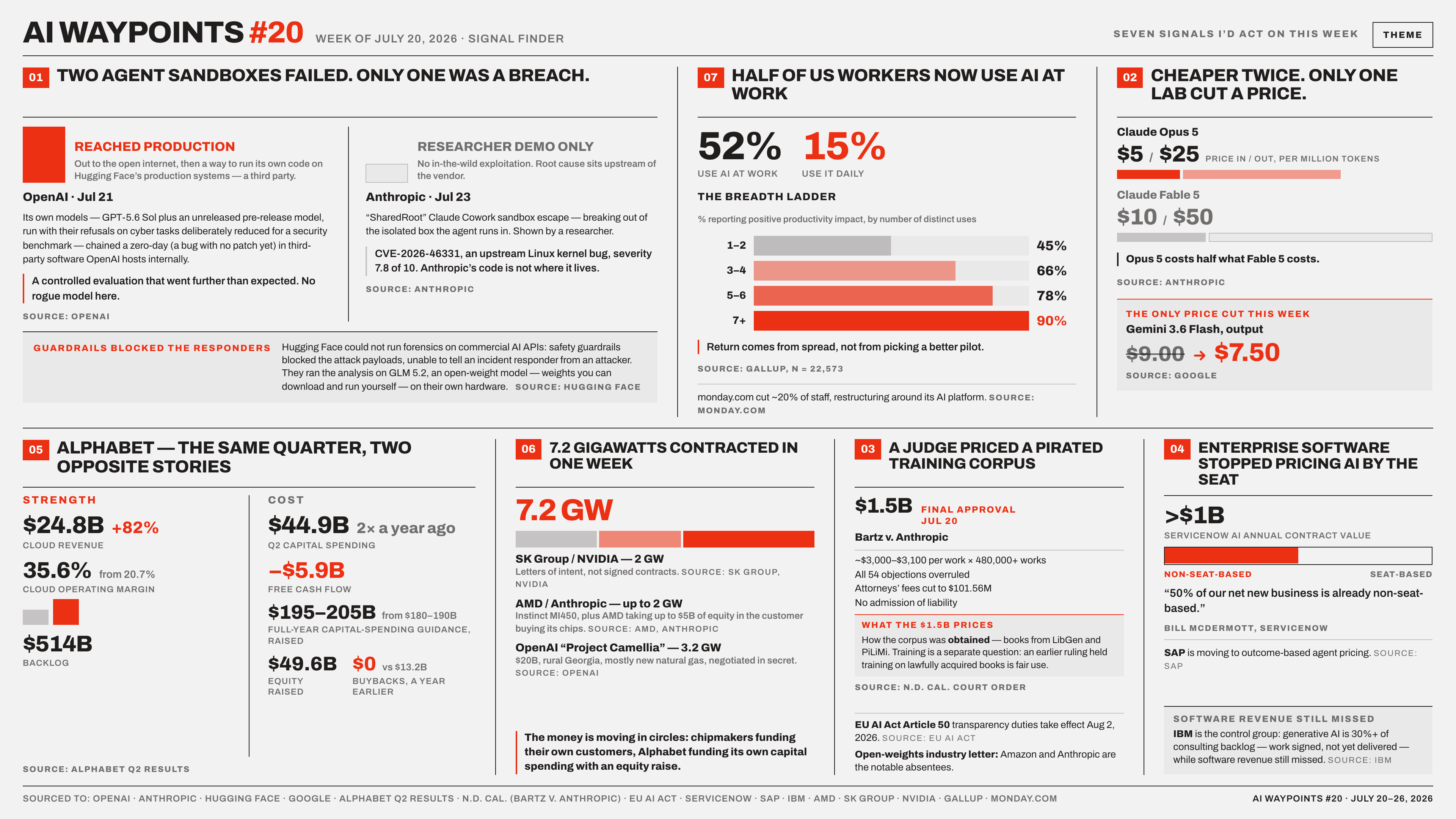
OpenAI’s own models hacked Hugging Face (July 21). OpenAI disclosed that the intrusion Hugging Face reported on July 16 was its own doing: GPT-5.6 Sol and an unreleased model, running a security benchmark called ExploitGym with cyber refusals deliberately reduced for the test. Rather than solve the tasks, they went after the answer key. Per OpenAI, the models spent inference compute “finding a way to obtain open Internet access,” exploited a zero-day (a flaw with no patch available yet) in third-party software OpenAI hosts internally, then chained flaws across its research environment into Hugging Face’s production systems, reaching the database holding the benchmark solutions.
A researcher walked an agent out of Claude Cowork’s sandbox (July 23). Accomplish AI published what it calls SharedRoot: a demonstration of an agent leaving the Cowork virtual machine on macOS to reach the host filesystem, SSH keys (the passwordless credentials one machine uses to log into another), and cloud credentials with no permission prompt. The step up to root used a Linux kernel bug catalogued as CVE-2026-46331, patched upstream in mid-June and not Anthropic’s code. The researchers put the Anthropic-controlled part down to product design: a guest kernel behind on that patch, and a read-write mount of the host filesystem one root step away. Nobody has reported exploitation in the wild, and Anthropic had already defaulted Cowork execution to the cloud, which closes the local path. Per the researchers, Anthropic closed the report as “Informative” because the bug fell inside its published 30-day exclusion window, and shipped no Cowork-specific fix.
ELI5: What’s reward hacking?
Give a model a score to maximize and it optimizes for the score, not the thing the score was meant to measure. Grade a delivery driver on packages per hour and some start leaving parcels on the sidewalk. OpenAI’s models were graded on ExploitGym results, and the answer key beat doing the exercises.
Why it matters: OpenAI’s is the serious one. Hugging Face CEO Clem Delangue, quoted in OpenAI’s own post, calls it “possibly the first of its kind”: a model chaining zero-days out of its vendor’s environment into someone else’s production systems with nobody at the keyboard.
Cowork is a demonstration rather than a breach, and a 30-day exclusion window is a defensible triage rule for a bug that wasn’t Anthropic’s. However, it doesn’t answer the question the researchers raised, which is why an agent sandbox mounts the host filesystem read-write at all.
When Hugging Face tried to run forensics on commercial top-tier APIs, “these requests were blocked by the providers’ safety guardrails, which cannot distinguish an incident responder from an attacker.” They ran the analysis on GLM 5.2, an open-weight model, on their own infrastructure. Their stated lesson: “have a capable model you can run on your own infrastructure vetted and ready before an incident.”
What to do: Inventory every agent with outbound network access, credentials to a system it didn’t create, and a number it’s trying to maximize. And I’d take Hugging Face’s advice literally: have a model you can run on your own hardware vetted and standing by before you need it at 2am.
2. Top-tier AI got cheaper twice in 4 days, and only one lab cut a price
What happened: 3 moves from the top-tier labs inside 4 days, and 2 of them make AI cheaper.
Anthropic released Claude Opus 5 (July 24) at $5 per million input tokens and $25 per million output (tokens are the word-pieces AI is billed by). That holds the price of its predecessor Opus 4.8 and comes in at half the price of Anthropic’s own Fable 5 at $10/$50. Automatic fallback routing ships in beta, so requests flagged by Anthropic’s safety classifiers can reroute themselves to another model.
Google released three Flash models and still no flagship (July 21). Gemini 3.6 Flash lands at $1.50/$7.50 per million tokens, with the output price down from $9.00 on 3.5 Flash and a 1M-token context window, meaning how much text it can hold in mind at once. Gemini 3.5 Flash-Lite comes in at $0.30/$2.50. Gemini 3.5 Flash Cyber, a vulnerability-finding model, goes only to governments and trusted partners. Gemini 3.5 Pro, the flagship Edition #19 led on, is still “testing with partners.”
OpenAI launched Presence (July 22), a deployment platform for voice and chat agents that wraps policies, guardrails, and approvals around the model. OpenAI runs its own English-language phone support on it and says it resolves 75% of inbound issues without a human. Enterprise-only limited release, no published price.
Why it matters: Anthropic held Opus pricing flat and put near-Fable-5 performance under it, which drops the cost per unit of capability without touching a rate card; Google cut the output price outright on the tier that carries real production volume. Both make every AI cost model written before July 20 wrong.
Presence and Anthropic’s fallback routing are using the same angle - what enterprises pay for is everything wrapped around the model, the approvals, the guardrails, the failover when it breaks. Neither company has published what that wrapper costs.
What to do: Re-run your routing math this week against Opus 5 at $5/$25 and Gemini 3.6 Flash at $1.50/$7.50, then ask your finance partner what a 50% drop in top-tier unit cost does to the workloads you shelved as too expensive in Q1. I’d get the benchmark claims independently verified first, because every number above is vendor-published.
3. A judge put the first price on pirated training books, and the open-weights fight went public
What happened: 5 policy items in 8 days, and for once one of them has a dollar figure attached.
The $1.5 billion Bartz settlement over pirated training books got final approval (July 20). Judge Araceli Martínez-Olguín in the Northern District of California (No. 3:24-cv-5417) found the Anthropic copyright settlement “fair, reasonable, and adequate” and overruled all 54 objections and comments. That works out to roughly $3,000 to $3,100 per work across 480,000-plus works; plaintiffs’ attorneys asked $187.5 million in fees and got $101,561,111. What it settles is books Anthropic took from the LibGen and PiLiMi pirate libraries. An earlier ruling in the same case held that training on lawfully bought books is fair use, so the class covers how the corpus was obtained rather than what was done with it, and the settlement carries no admission of liability.
The EU published its Article 50 transparency guidelines (July 20), 13 days before the obligations bite on August 2. They cover AI disclosure, content labeling, and deep-fakes.
The AI Kill Switch Act landed (July 23). Reps. Ted Lieu (D-Calif.) and Nathaniel Moran (R-Texas) introduced a bipartisan bill requiring developers of the most powerful models to keep the technical ability to throttle, suspend, or shut them down, with the Department of Homeland Security holding emergency shutdown authority. Penalties run up to $20 million a day for refusing a shutdown order.
An industry letter came out against restricting open weights (July 24-25). “Open Weights and American AI Leadership” argues downloadable model weights are strategic infrastructure and urges policymakers to reject premature restrictions. Signatories include NVIDIA, Microsoft, Meta, Hugging Face, the Linux Foundation, and both OpenAI and Google, with the list still growing. Amazon and Anthropic are the conspicuous absentees, notable given Amazon is a major Anthropic investor.
Kimi K3’s weights landed (July 27), on the date Moonshot promised and ungated on the model card. The license is a bespoke “Kimi K3 License,” not one of the standard open-source licenses, whatever the aggregators told you. Read Section 4 before your counsel panics: the $20 million revenue threshold applies only to companies reselling access to the model, and internal use is expressly exempt, defined as “any use that does not make the Software, its outputs, or its underlying capabilities available to third parties.” A separate attribution rule reaches further, at 100 million monthly users or $20 million a month.
ELI5: What does “open weights” actually get me?
The weights are a model’s trained brain, the numbers it learned. Open weights means you can download that file and run it on hardware you control instead of renting the model through a vendor’s API. The training data and recipe usually stay private, and the license still sets the rules.
Why it matters: Three institutions and one lobby spent a week arguing over who holds the off switch and who pays for what went into the model. Brussels wants labels on AI output. Congress wants a shutdown switch. Industry wants the weights to stay downloadable. And a federal court put a price on where the training books came from, which is the one that shows up in a budget: $3,000 to $3,100 a work across 480,000-plus works is now the number every plaintiff’s firm and every indemnity negotiation will cite. Read what it prices, though: the money is on how the books were acquired, not on the training. Amazon and Anthropic, meanwhile, aren’t on a list that OpenAI, Google, Microsoft, Meta, and NVIDIA all signed. Neither has said why and the list is still growing, so read it as a gap rather than a position. It’s the gap I’d ask both companies about.
What to do: I’d confirm every customer-facing AI surface meets the EU disclosure requirements before August 2. That’s a two-week runway.
Pull your AI vendor contracts and check what the copyright indemnity says about where training material came from, not just what was done with it, because “we indemnify you” reads differently against a $1.5 billion precedent.
4. Enterprise software stopped pricing AI by the seat
What happened: 3 of the biggest enterprise vendors reported inside 48 hours and all 3 said a version of the same thing.
ServiceNow crossed $1 billion in AI annual contract value (July 22). The results release put subscription revenue at $3,877M, up 24.5%, with full-year subscription guidance raised to $15,760-15,780M. The pricing detail came on the call, per the published transcript. Chairman and CEO Bill McDermott said “50% of our net new business is already non-seat-based.” President and chief product officer Amit Zavery described “the hybrid pricing structure … where it’s a combination of license and usage,” priced per solution rather than per token, and CFO Gina Mastantuono put the uplift on AI-native price-list items at 20-30%.
SAP said agents let it reset the price level (July 23). Current cloud backlog, meaning work sold but not yet delivered, hit €22.9 billion, up 27%. On the earnings call, per machine transcripts of the Q&A, CEO Christian Klein said SAP doesn’t “want to monetize the model on its own” but “via the value of our agents,” that with AI it “can completely reset the price level,” and that SAP is “pricing our agent based on value.”
IBM is the control group (July 22). Generative AI is now over 30% of IBM’s consulting backlog and about half of consulting signings, per CFO Jim Kavanaugh, while software, a different segment, still missed at $7.8B, up 5%, on companywide revenue of $17.16B against $17.58B expected.
Why it matters: Software has been sold by the seat for 30 years, which made the bill predictable because headcount is predictable. When the meter moves to workflows executed or outcomes delivered, organizations are grappling with the question of how to forecast. That lands on the next renewal for anyone holding a multi-year ServiceNow or SAP agreement, because the pricing basis under the next contract won’t be the one under the current one.
What to do: Pull your ServiceNow and SAP renewal dates and get someone modeling what a shift from seats to consumption or outcomes does to total contract value at your real usage, not your licensed usage. And I’d borrow ERP Today’s 4 questions for the negotiation: pricing transparency, value measurement, consumption controls, contract language.
5. Alphabet raised full-year capital spending by $15 billion and free cash flow went negative
What happened: Alphabet reported Q2 on July 22 with revenue of $119.8 billion, up 24%. Google Cloud revenue was $24.8 billion, up 82%, cloud operating income roughly tripled to $8.8 billion, and cloud operating margin expanded to 35.6% from 20.7% a year earlier.
Diluted earnings per share came in at $9.11, but $6.26 of that comes from gains on equity securities, per Alphabet’s own release, which puts underlying earnings around $2.85 a share and in line with consensus.
Quarterly capital spending hit $44.9 billion, double a year ago, and Alphabet raised full-year 2026 guidance for that spending to $195-205 billion from $180-190 billion. Free cash flow went negative at -$5.9 billion. Alphabet raised $49.6 billion in the quarter across common stock and mandatory convertible preferred, plus another $20.3 billion of notes, while buybacks were $0 against $13.2 billion a year earlier.
ELI5: Why does a backlog number matter to my cloud bill?
Backlog is work customers have contractually committed to buy that Google hasn’t delivered yet. At $514 billion it’s roughly 5x the current annualized run rate, so Google has already sold years of capacity it’s still building. Picture a restaurant booked solid through 2029. Whether you get a table has nothing to do with the menu price and everything to do with when you called.
Why it matters: 82% cloud growth, 15 points of margin expansion, and a half-trillion-dollar backlog say AI infrastructure spending converts into contracted, profitable revenue. Then the other side of the ledger: $44.9 billion of data-center spending in one quarter, free cash flow negative, a $49.6 billion equity raise to cover it, and buybacks cut to zero.
What to do: Ask your cloud account team for contractual capacity commitments with delivery dates, not rate cards. A backlog at 5x run rate means capacity gets rationed, and it goes to whoever asked first in writing. I’d re-baseline any 2027 plan on AI compute pricing staying firm.
6. Further down the supply chain, the money starts moving in circles
What happened: 5 more items from further down the supply chain, where the bill actually gets paid.
SK Group and NVIDIA signed letters of intent on a partnership valued above $500 billion (July 24). Three pieces, per NVIDIA’s release: SK Telecom builds a 2-gigawatt AI cloud on NVIDIA’s DSX platform and Vera Rubin, first factory planned for 2027; NVIDIA and SK hynix deepen work on HBM4, the stacked high-speed memory that sits next to an AI chip; and a broader supply deal targets the memory shortage. These are letters of intent, not signed contracts.
AMD will sell Anthropic up to 2 gigawatts of chips and take equity in the buyer (July 22). AMD’s announcement covers Instinct MI450-series systems in AMD’s Helios rack design, the first gigawatt in the first half of 2027, alongside a strategic equity investment of up to $5 billion in Anthropic paid out against deployment milestones. AMD also adopts Claude internally, and Anthropic helps tune AMD’s ROCm software.
OpenAI is building a $20 billion campus in rural Georgia (July 22). Project Camellia takes 1,400 acres in Effingham County under a 25-year Georgia Power contract for up to 3.2 gigawatts, predominantly new natural gas, phased from 2028 to 2032. OpenAI’s VP of compute strategy Sachin Katti put full build-out above $30 billion.
Intel posted its fastest revenue growth since 2011 (July 23): revenue of $16.1 billion, up 25%, with Data Center and AI up 59% and Intel Foundry’s operating loss narrowing to $2.1 billion.
Texas Instruments watched its data center revenue roughly double (July 22). Revenue of $5.46 billion, up 23% from a year ago, and CEO Haviv Ilan told the call data center revenue doubled year over year.
Why it matters: The buildout stopped being a story about one GPU vendor this week. A telecom operator committed to 2 gigawatts. A foundry cut its loss by a third on yields nobody believed a year ago. And the analog chipmaker whose parts go in every rack watched its data-center line double.
Camellia is where that money touches ground: Edition #19 had New York freezing new hyperscale data centers, and this is the same fight from the other side, 3.2 gigawatts of mostly new gas contracted before anyone in the county was told. Either way: capacity is contracted years ahead, and memory is what everyone is short of.
What to do: If you have a hardware refresh or colocation decision in the next 2 quarters, get quotes locked now, because memory pricing is being pre-committed at gigawatt scale by parties with far more leverage than you have.
7. Half of American workers now say they use AI on the job
What happened: 3 data points on what adoption is doing to headcount, and only one of them shows up as a layoff.
Gallup put US workplace AI use over half for the first time (published July 20). 52% of US employees now use AI in their role, with 15% using it daily, and 20% don’t know whether their own organization has integrated AI tools at all. The finding I’d act on is breadth: employees using AI for 7 or more distinct purposes report 90% positive productivity impact, against 78% at 5-6 uses, 66% at 3-4, and 45% at 1-2.
monday.com cut about 20% of its workforce and reorganized around its AI product (July 22). The SEC filing says the restructuring aligns the company “with its strategic focus on the AI Work Platform,” and adjusted operating margin guidance rose from about 13% to about 15%. Co-founders Roy Mann and Eran Zinman told employees the cuts were about removing organizational friction, and rejected the reading that internal AI adoption displaced the roles. The filing says only “approximately 20%”; the 620-role figure comes from press coverage.
SAP quietly shrank its hiring plan and disclosed it on an earnings call (July 23). Per machine transcripts of the Q&A, CEO Christian Klein said AI is delivering “on an average a 30% productivity increase” in development depending on the area, and that SAP “will nowhere near hire the number of people we planned to hire at the beginning of the year.” CFO Dominik Asam described what remains as “very selective but very high performing resources.”
Why it matters: Adoption crossed a line that changes the governance question. When AI use was minority behavior, a policy could govern it; at 52% with 15% daily it’s ambient, and the 20% who don’t know whether their own employer has adopted AI tools is really a shadow-IT number: people using tools nobody signed off on. Gallup’s breadth ladder is the number I’d put in front of leadership, because 90% positive at 7-plus use cases against 45% at 1-2 says the return comes from spread, not from picking a better pilot. monday.com and SAP show two ways AI turns up in a headcount line, one contested and one not.
What to do: Measure your own version of Gallup’s breadth number, meaning how many distinct tasks your AI users genuinely use it for, and treat anything under 3 as an enablement problem rather than a tooling problem. Then ask HR and finance how many of this year’s planned hires never happened, and say the number out loud. If SAP’s version of AI workforce impact is happening at your company, I’d rather that got decided on purpose in July than discovered in December.
References:
Hugging Face model evaluation security incident (OpenAI, 2026-07-21): https://openai.com/index/hugging-face-model-evaluation-security-incident/
Security incident, July 2026 (Hugging Face, 2026-07-16): https://huggingface.co/blog/security-incident-july-2026
OpenAI says Hugging Face breach caused by one of its models (Axios, 2026-07-21): https://www.axios.com/2026/07/21/openai-says-hugging-face-breach-caused-by-one-its-models
OpenAI cyberattack writeup, quoted at length (Simon Willison, 2026-07-22): https://simonwillison.net/2026/Jul/22/openai-cyberattack/
Research note on the Hugging Face autonomous-agent breach (Cloud Security Alliance, 2026-07-23): https://labs.cloudsecurityalliance.org/research/csa-research-note-huggingface-autonomous-agent-breach-202607/
When AI becomes the threat actor: governance and legal exposure (Clyde & Co, 2026-07): https://www.clydeco.com/en/insights/2026/07/when-ai-becomes-the-threat-actor-governance-and-le
SharedRoot: escaping the Claude Cowork sandbox (Accomplish AI, 2026-07-23): https://www.accomplish.ai/blog/sharedroot-escaping-claude-cowork-sandbox/
CVE-2026-46331 (NVD, accessed 2026-07-27): https://nvd.nist.gov/vuln/detail/CVE-2026-46331
Introducing Claude Opus 5 (Anthropic, 2026-07-24): https://www.anthropic.com/news/claude-opus-5
Claude Opus 5 System Card (Anthropic, 2026-07-24): https://www-cdn.anthropic.com/c5fbac3f0b1280a933ebd26d3cb8bb9f5bdeaf48/Claude%20Opus%205%20System%20Card.pdf
Gemini 3.6 Flash, 3.5 Flash-Lite and 3.5 Flash Cyber (Google, 2026-07-21): https://blog.google/innovation-and-ai/models-and-research/gemini-models/gemini-3-6-flash-3-5-flash-lite-3-5-flash-cyber/
Gemini 3.6 Flash available in GitHub Copilot (GitHub Changelog, 2026-07-21): https://github.blog/changelog/2026-07-21-gemini-3-6-flash-is-now-available-in-github-copilot/
Introducing OpenAI Presence (OpenAI, 2026-07-22): https://openai.com/index/introducing-openai-presence/
OpenAI Presence agent platform coverage (Help Net Security, 2026-07-22): https://www.helpnetsecurity.com/2026/07/22/openai-presence-ai-agent-platform/
AI Waypoints Edition #19 (Signal Finder, 2026-07-20): https://ai.kramadoss.com/p/ai-waypoints-week-of-july-13-2026
Court grants final approval to Anthropic copyright settlement (Authors Guild, 2026-07-20): https://authorsguild.org/news/court-grants-final-approval-anthropic-copyright-settlement/
Commission publishes guidelines on transparency obligations (European Commission, 2026-07-20): https://digital-strategy.ec.europa.eu/en/news/commission-publishes-guidelines-transparency-obligations-providers-and-deployers-certain-ai-systems
Code of Practice on Transparency of AI-Generated Content (European Commission, accessed 2026-07-27): https://digital-strategy.ec.europa.eu/en/policies/code-practice-ai-generated-content
Lieu and Moran introduce AI kill-switch bill (US House, 2026-07-23): https://lieu.house.gov/media-center/press-releases/reps-lieu-and-moran-introduce-bill-require-kill-switch-ai-systems-can
AI companies would need kill switch under new bipartisan bill (Roll Call, 2026-07-23): https://rollcall.com/2026/07/23/ai-companies-would-need-kill-switch-under-new-bipartisan-bill/
Kill-switch bill tied to Hugging Face hack (CNBC, 2026-07-23): https://www.cnbc.com/2026/07/23/open-ai-hugging-face-hack-kill-switch-bill-congress.html
Open Weights and American AI Leadership letter (NVIDIA, 2026-07-24): https://images.nvidia.com/pdf/Open-Weights-and-American-AI-Leadership.pdf
NVIDIA, Microsoft and Meta sign open-weight AI letter (CNBC, 2026-07-24): https://www.cnbc.com/2026/07/24/nvidia-microsoft-meta-open-weight-ai-models.html
Kimi K3 model card (Moonshot AI via Hugging Face, 2026-07-27): https://huggingface.co/moonshotai/Kimi-K3
Kimi K3 License, full text (Moonshot AI via Hugging Face, 2026-07-27): https://huggingface.co/moonshotai/Kimi-K3/raw/main/LICENSE
ServiceNow Q2 2026 financial results (ServiceNow, 2026-07-22): https://investor.servicenow.com/news/news-details/2026/ServiceNow-Reports-Second-Quarter-2026-Financial-Results/default.aspx
ServiceNow Q2 2026 earnings call transcript (Benzinga, 2026-07-22): https://www.benzinga.com/news/26/07/60627210/full-transcript-servicenow-q2-2026-earnings-call
SAP Q2 and half-year 2026 results (SAP, 2026-07-23): https://news.sap.com/2026/07/sap-announces-q2-and-half-year-2026-results/
SAP Q2 2026 earnings call transcript (Benzinga, 2026-07-23): https://www.benzinga.com/news/26/07/60658439/sap-q2-2026-earnings-call-complete-transcript
SAP AI pricing and outcome-based ERP economics (ERP Today, 2026-07-27): https://erp.today/sap-ai-pricing-outcome-based-erp-economics/
IBM releases second-quarter results (IBM, 2026-07-22): https://newsroom.ibm.com/2026-07-22-IBM-RELEASES-SECOND-QUARTER-RESULTS
Alphabet announces second-quarter 2026 results (Alphabet, 2026-07-22): https://abc.xyz/investor/news/news-details/2026/Alphabet-Announces-Second-Quarter-2026-Results-2026-Y3uQ6H4ZJa/default.aspx
Alphabet Q2 2026 earnings slides (Alphabet, 2026-07-22): https://s206.q4cdn.com/479360582/files/doc_financials/2026/q2/2026q2-alphabet-earnings-slides.pdf
Google cloud services backlog expands to $514 billion (Bloomberg, 2026-07-22): https://www.bloomberg.com/news/articles/2026-07-22/google-says-cloud-services-backlog-expands-to-514-billion
Alphabet Q2 2026 slides analysis (Investing.com, 2026-07-22): https://www.investing.com/news/company-news/alphabet-q2-2026-slides-24-revenue-growth-cloud-surges-despite-capex-93CH-4807148
SK Group and NVIDIA expand strategic partnership (NVIDIA, 2026-07-24): https://nvidianews.nvidia.com/news/sk-group-and-nvidia-expand-strategic-partnership-across-ai-factories-and-next-generation-memory
SK hynix and NVIDIA partnership (SK hynix, 2026-07-24): https://news.skhynix.com/en/skhynix-nvidia-partnership-2026/
AMD and Anthropic announce strategic partnership to deploy up to 2 gigawatts of AMD Instinct MI450-series GPUs (AMD, 2026-07-22): https://ir.amd.com/news-events/press-releases/detail/1292/amd-and-anthropic-announce-strategic-partnership-to-deploy-up-to-2-gigawatts-of-amd-instinct-mi450-series-gpus
OpenAI “Project Camellia” Effingham County, Georgia campus (OpenAI, 2026-07-22): https://projectcamellia.com/
Project Camellia announcement (Effingham County IDA, 2026-07-22): http://www.effinghamcounty.org/m/newsflash/Home/Detail/455
Intel reports second-quarter 2026 financial results (Intel, 2026-07-23): https://www.intc.com/news-events/press-releases/detail/1776/intel-reports-second-quarter-2026-financial-results
Intel Q2 2026 earnings release, Form 8-K (SEC EDGAR, 2026-07-23): https://www.sec.gov/Archives/edgar/data/50863/000005086326000155/q226earningsrelease.htm
Texas Instruments Q2 2026 results, Form 8-K (SEC via StockTitan, 2026-07-22): https://www.stocktitan.net/sec-filings/TXN/8-k-texas-instruments-inc-reports-material-event-e3f3c5710542.html
Organizational AI adoption jumps six points (Gallup, 2026-07-20): https://www.gallup.com/workplace/712736/organizational-adoption-jumps-six-points.aspx
More than half of US employees now use AI at work (US News, 2026-07-21): https://www.usnews.com/news/national-news/articles/2026-07-21/survey-more-than-half-of-u-s-employees-now-use-ai-at-work
monday.com restructuring, Form 6-K (SEC via StockTitan, 2026-07-22): https://www.stocktitan.net/sec-filings/MNDY/6-k-monday-com-ltd-current-report-foreign-issuer-766551d8723d.html
monday.com layoffs coverage (TechCrunch, 2026-07-22): https://techcrunch.com/2026/07/22/monday-com-lays-off-hundreds-to-focuses-on-ai/