

Someone in your organization is pasting sensitive client data into ChatGPT to meet a deadline right now. They know it’s against policy. They’re doing it anyway. Their manager, who does the same thing, won’t stop them.
This is how most enterprises actually operate in 2026.
I’ve spent twenty six years watching gaps between what organizations claim and what they do. This one is the widest I’ve ever seen.
The official story is governance frameworks and approved tool lists. The real story is tens of thousands of employees building a parallel AI economy in the shadows because the official one doesn’t work fast enough.

The numbers don’t add up
Start with the headline: 88% of organizations now use AI in at least one business function, according to McKinsey’s November 2025 State of AI report.
Sounds like progress.
Then look at the next number: nearly two-thirds haven’t moved AI beyond experimentation, and 39% report zero impact on EBIT.
88% adoption. 39% seeing no financial impact.
That’s not a growing pain. That’s a system-level failure.
The people actually getting value from AI? They’re hiding it.
80% of American office workers use AI, but only 22% stick exclusively to employer-provided tools.
Six in ten say they’d use unauthorized AI if it helped them meet a deadline.
Your best people are quietly solving problems your approved stack can’t touch.
This isn’t a security problem. It’s a management problem.
The instinct is to treat shadow AI as a compliance threat. The security numbers back that up:
60% of organizations have had at least one data exposure incident from employee AI use.
Shadow AI incidents now account for 20% of all data breaches, costing $4.63 million on average versus $3.96 million for standard breaches.
Real risks. No question.
But locking down AI access is like banning smartphones in 2012. You’re fighting the tide while your competitors learn to swim in it.
Employees are telling you — through their behavior — that your official AI strategy doesn’t solve their actual problems.
74% of workers say their employer’s AI training is “average to poor.”
Only 13% have received any AI training at all, even though 55% want more.
We told people to use AI. Didn’t train them. Didn’t give them safe tools. Didn’t even define what “safe” looks like. Then we acted surprised when they improvised.
The leadership problem
Shadow AI isn’t a frontline issue. It starts at the top.
CIO Magazine reports that executives are “major culprits” in shadow AI use. BCG found that 78% of managers use AI regularly, compared to just 51% of frontline employees. The people writing AI policy are the ones ignoring it.
Leadership pushes AI adoption targets while quietly using whatever tools they want. Middle management follows suit. Frontline employees get the message: results matter more than rules.
The governance infrastructure? It barely exists.
Only 15% of organizations have updated their acceptable use policies to include AI.
94% are using or piloting AI, but only 44% have the security architecture to support it.
Do the math. If 72% say they’ve scaled AI but only 33% have governance, roughly 40% of enterprises are running AI at scale with no guardrails.
That’s not adoption. That’s organized chaos.
What this means for leaders
The secret cyborg economy isn’t going away.
Global AI spending hits $2.5 trillion in 2026, up from $1.7 trillion in 2025. Enterprise LLM spending jumped 180%, from $2.5 million to $7 million on average.
Shadow AI will get worse before it gets better.
You have two choices. Fight it with more policies nobody follows. Or build a system that makes the official path faster and safer than the shadow one.
Start here!
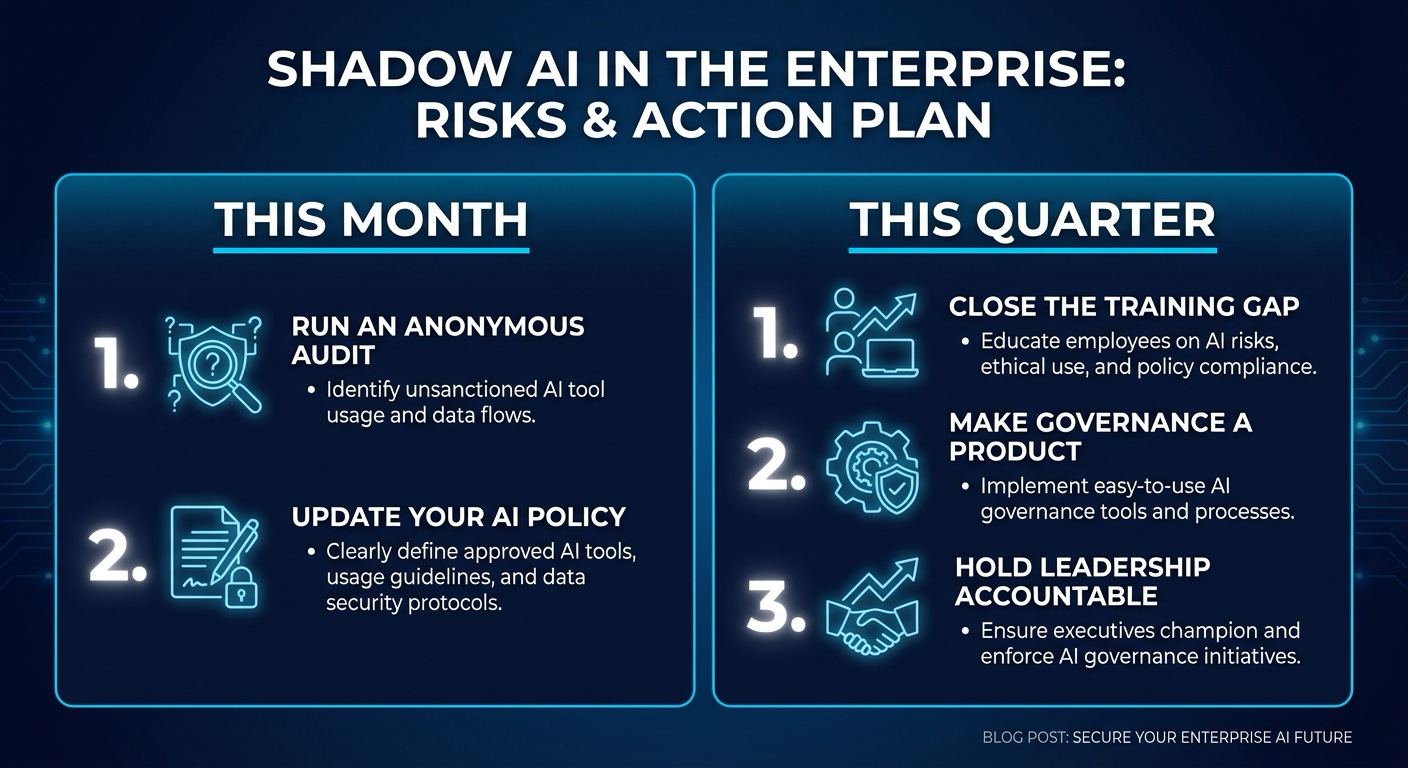
This month:
Run an anonymous audit. Find out what tools people are actually using. Not to punish — to learn. The gap between your approved list and reality is your strategy’s report card.
Update your acceptable use policy. If you’re in the 85% that hasn’t, you’re governing AI with rules written for a pre-AI world.
This quarter:
Close the training gap. Deloitte’s 2026 report calls the AI skills gap — not technology — the biggest barrier to integration. Yet only 28% of tech organizations plan upskilling investments, even though 80% say it’s the most effective intervention.
Train people on judgment and AI intuition, not just prompting.
Make governance a product, not a policy. Build an internal AI platform that’s genuinely easier to use than ChatGPT with a personal login. If your secure option requires three approvals and a ticket, you’ve already lost.
Hold leadership accountable first. If executives won’t use the approved tools, nobody else will either. Model the behavior before mandating it.
The organizations that figure this out won’t just reduce risk. They’ll capture the productivity gains currently leaking through shadow channels — gains that Deloitte says only a third of enterprises are positioned to realize.
The ones that don’t will keep writing policies nobody reads, for tools nobody uses, while the real AI economy hums along in browser tabs that close before the boss walks by.
Is shadow AI a problem in your organization — or a signal?
References: