

The short version
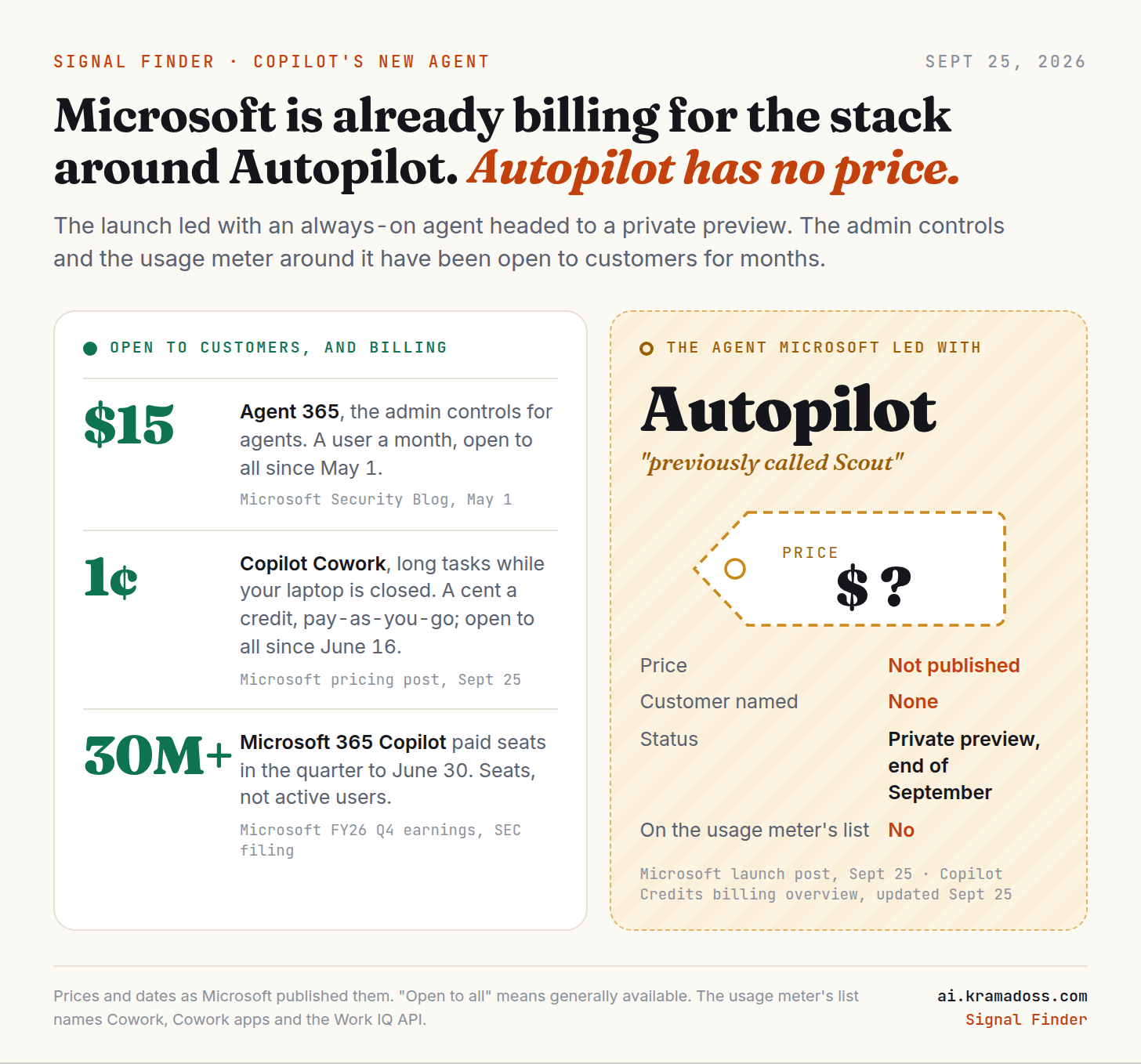
Autopilot, the agent at the top of Microsoft’s launch, is Scout, renamed and moved to the cloud: private preview, no customer named, no price published.
Most of the rest repackages earlier releases, many still in preview; Code’s hosting layer is the one new layer of infrastructure.
Google and AWS publish comparable agent controls. What Microsoft has over them, for a Microsoft 365 shop, is your documents, identity and data already inside it.
Spend limits exist from day one but can be overrun, so I’d pilot Cowork with limits. Nothing published predicts Autopilot’s monthly cost.
Fix billing defaults and agent governance now, don’t reorganize for 90 days, and revisit if Ignite ships Autopilot broadly with a documented identity of its own.
Wait or buy
Other technology leaders keep asking me the same question about Copilot: commit to the agents now, or wait. I have not had a good answer, because it’s hard to determine what an always-on agent will cost per month.
On September 25 Microsoft announced what it calls the new Copilot, and the launch arrived with more agents and still no clear answer to that question.
The launch post, from lists 6 things:
Home,
Code and
Autopilot as the headline 3,
with Office in Copilot,
a proactive view called Today, and
an @Copilot you can call in Teams.
Autopilot, “previously called Scout,” is the one Microsoft leads with: a cloud-hosted agent you give a name, a role and a goal, and it keeps working without waiting for a prompt. It expands to private preview at the end of the month. This is openclaw for Enterprises - not to be confused with OpenClaw for Enterprises just announced as well.
But Agent 365, the set of admin controls Microsoft sells for agents, has been generally available since May 1 at $15 a user a month. Copilot Cowork, the agent that runs long tasks while your laptop is closed, opened to every Microsoft 365 Copilot customer on June 16 and bills by the credit.
Microsoft’s own filing says Microsoft 365 Copilot passed 30 million paid seats in the quarter to June 30; seats, not active users. The headline agent has no price and no line on the billing list, and the stack around it is in production and being billed.
Six features, one verdict each
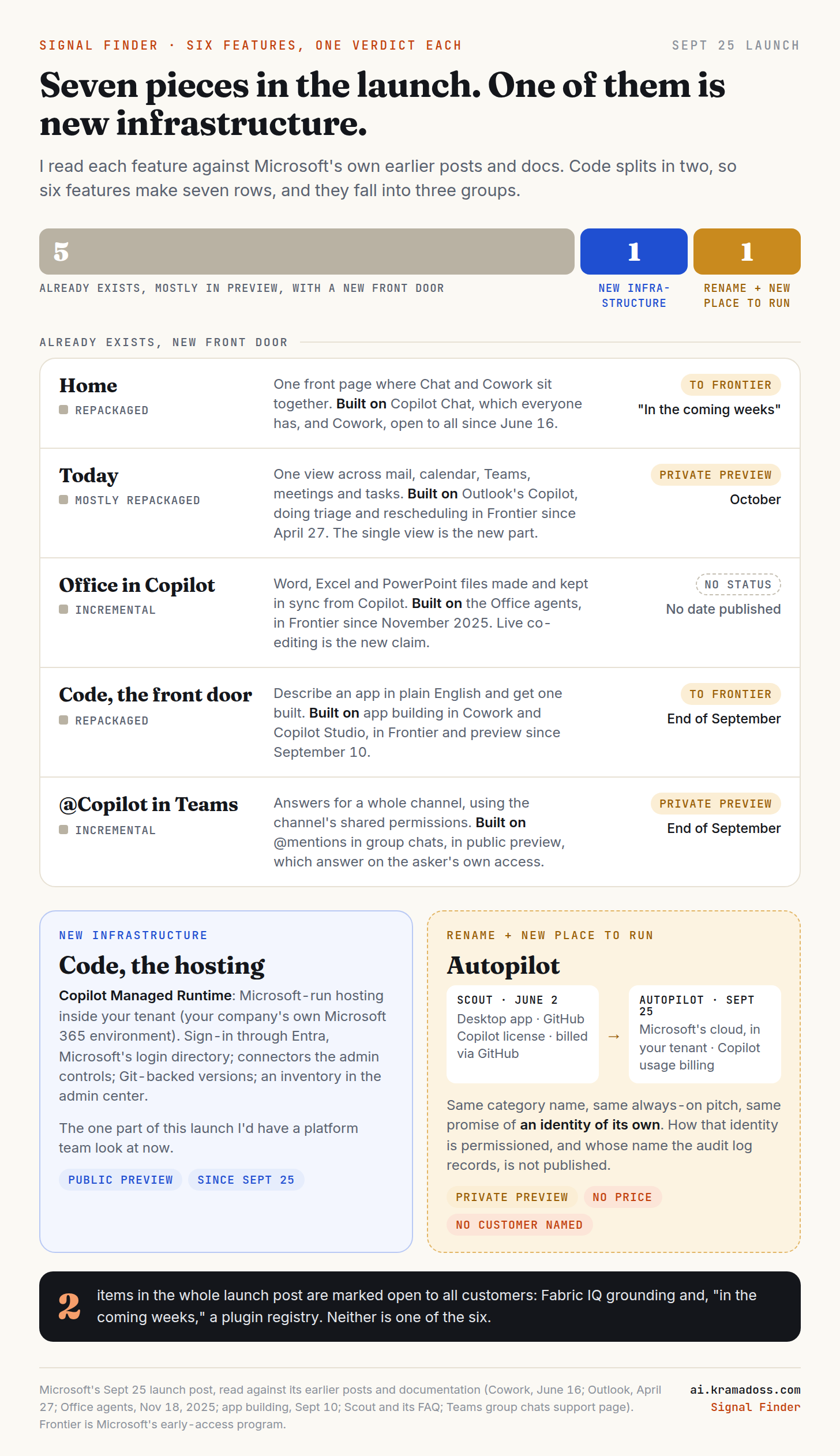
Microsoft’s blog gives every feature the same glow. Read against Microsoft’s own earlier posts and documentation, they fall into 3 groups: things that already exist, mostly in preview, and got a new front door; one thing that is new infrastructure; and one agent that is a rename plus a new place to run.
Home
Home is the new front page, where Chat and Cowork come together in one place. Interestingly, Anthropic made the same choice recently and merged chat and cowork. Cowork has been generally available since June 16, and Chat is the Copilot Chat everyone already has. The only new thing is that you no longer choose between them before you start.
Verdict: repackaged, and not live yet; it goes to Microsoft’s early-access program, which it calls Frontier, “in the coming weeks.”
Today
Today is a view across mail, calendar, Teams threads, meetings and tasks that drafts the reply and proposes the schedule change before you ask. Outlook’s Copilot has done that triage-and-reschedule work in Frontier since April 27, by Microsoft’s own description. What Today adds is the single view across all of them, and that part is private preview in October. I do this myself but have to cobble ti to together and I welcome this.
Verdict: mostly repackaged, with the new bit unshipped.
Office in Copilot
Word, Excel and PowerPoint move into Copilot, so it creates or updates a real document, workbook or deck that stays in sync with the Office apps, live for the whole team. Creating Office files from Copilot chat reached Frontier as Word, Excel and PowerPoint agents in November 2025. The new claim is live co-editing with colleagues inside Copilot, and the launch post gives it no date of its own.
Verdict: incremental, and undated.
Code
Code lets you describe an app or workflow in plain English and get one built on the same technology as GitHub Copilot, running in a sandbox that can be “hosted securely within your tenant.”
The front end is not new: building apps from a Cowork chat or from Copilot Studio reached Frontier and preview September 10, on usage billing.
The hosting is new. Copilot Managed Runtime, in public preview since the September 25 launch, is Microsoft-run infrastructure that, per the launch post, lets code “run safely right inside your company’s Microsoft 365 environment,“ with sign-in through Entra (Microsoft’s login directory), connectors the admin controls, Git-backed versions and an inventory in the admin center.
Its SDK (a developer toolkit) and command-line tool are on npm, with a public repo holding a plugin for Claude Code and GitHub Copilot.
Verdict: the front door is repackaged; the hosting layer is new infrastructure, and it is the one part of this launch for a platform team to look at now. Code itself reaches early access at the end of the month.
Autopilot
ELI5: What does it mean for an agent to have “its own identity”?
Think of the badge you swipe at the office door. Scout’s own documentation describes users signing in with their organization’s Microsoft 365 credentials, which reads as the agent carrying your badge. An agent with an identity of its own gets its own badge: its own doors, its own line in the access log. Microsoft has promised Autopilot the second kind. Which doors, and whose name the log records, is not in anything Microsoft has published yet.
Autopilot is the digital teammate: a cloud-hosted agent that, per the launch post, lives in your tenant (your company’s own Microsoft 365 environment) with its own identity, memory, computer and workspace, and “permissions, audit and governance behind it.“ It is also Scout, which Microsoft launched June 2 with the same category name, the same always-on pitch and the same promise of an identity of its own. What changed on September 25 is where it runs and who bills it. Scout was “a desktop AI application” that needed a GitHub Copilot Business or Enterprise license and “uses your GitHub account for token billing.”
Autopilot runs in Microsoft’s cloud, inside your tenant, on Copilot usage-based billing.
Moving it to the cloud is a real change, and it is why the governance and cost questions get more pertinent. But it is not a new product, and the identity part is less settled than the post makes it sound. The June blog promised Scout “its own governed Entra identity.”
Scout’s documentation, last updated August 21, only describes users signing in with “your organization’s Microsoft 365 credentials on Windows.” The launch post promises Autopilot its own identity; nothing Microsoft has published yet says how that identity is permissioned or whose name the audit log records.
Verdict: a rename plus a new place to run, private preview at month end, no customer named, no price. Always on agent is popping up everywhere in the consumer space. It’s good to get an early understanding in an Enterprise
@Copilot in Teams
Type @Copilot in a Teams channel and the whole team gets answers with the shared context and permissions of that channel. You can already @mention Copilot in group chats, in public preview, but answers draw on the asker’s own access, with an approve step before sharing anything the others can’t access. What is new is answers using the shared permissions of the channel, chat or meeting, in private preview at month end.
Verdict: incremental.
The launch post’s only items marked generally available are Fabric IQ grounding and, in the coming weeks, a plugin registry.
Every vendor publishes the controls
One read, which Deirdre Bosa put well in the post announcing her Nadella interview, is that the race is moving from models to products and Microsoft’s edge is the boring stuff: permissions, identity, auditability and control. That is half right.
Google Cloud documents an Agent Identity service, with a unique identity per agent, credentials bound to certificates, allow and deny rules, and audit that attributes actions to both the agent and the person behind it; the page was updated September 24.
AWS documents AgentCore Identity, an identity and credential service built for agents, with audit trails, plus permissions set per identity, action and resource. An agent with its own identity, limited permissions and an audit trail is now something every serious cloud writes a page about.
If your documents, your people’s identities and your data already live in Microsoft 365, that is the moat: an agent starts with context instead of connectors. And the admin controls still apply when the agent comes from elsewhere:
Agent 365’s service description covers third-party agents, and Managed Runtime hosts apps built with Claude Code as well as with Microsoft’s own tools, which also poses a hosting lock-in risk, and is why the inventory below is vendor-neutral.
What you can cap and what you can’t predict
Nicole Herskowitz’s pricing post opens with “You need to know what AI is going to cost“ and answers, “That’s a fair ask.”
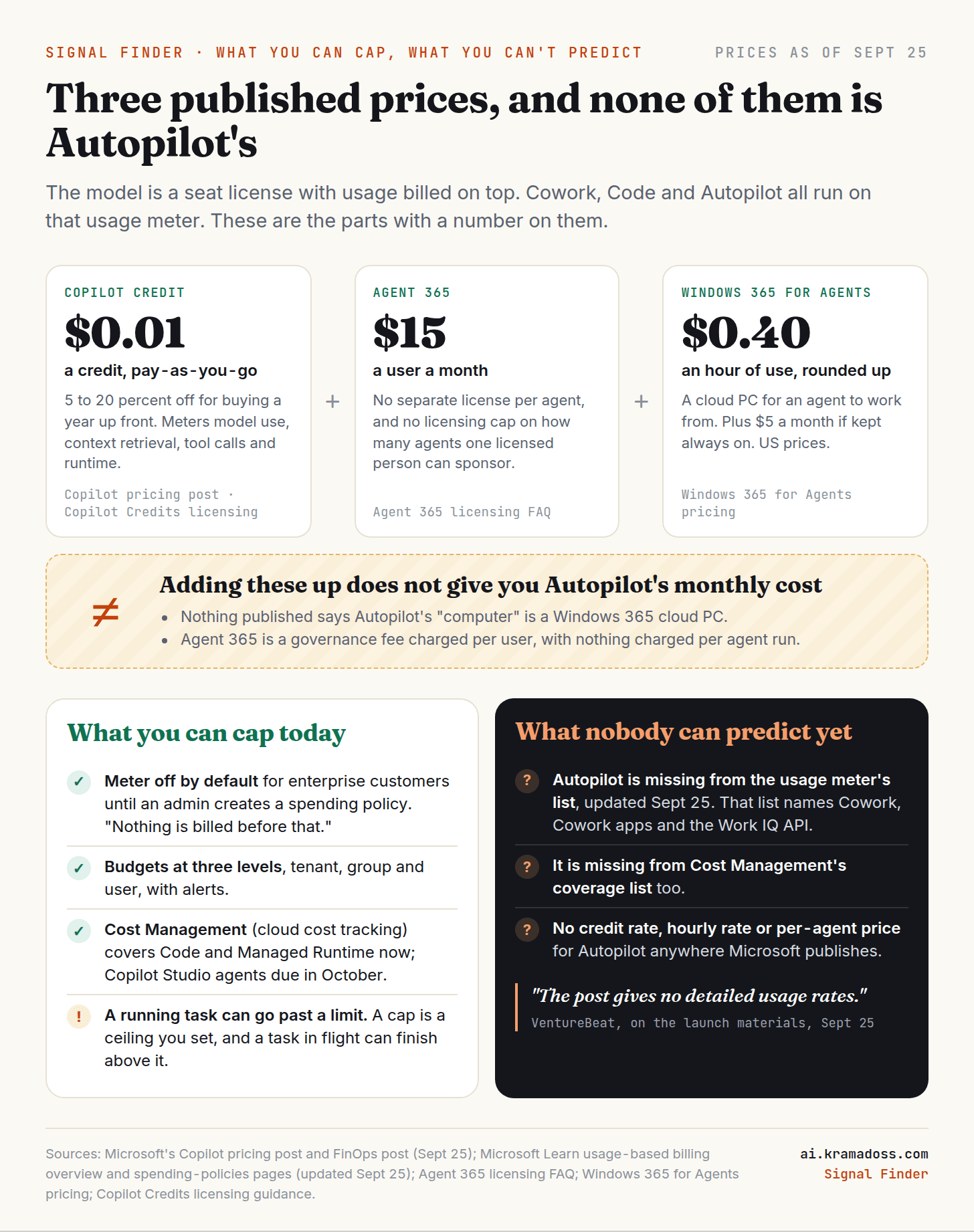
The pricing is a seat license with usage billed on top; the seat is required, and usage billing for enterprise customers stays off until an admin creates a spending policy, so “nothing is billed before that.”
Cowork, Code and Autopilot all run on that usage meter.
A Copilot credit costs a cent on pay-as-you-go, with 5 to 20 percent off for pre-buying a year, and a Cowork credit meters model use, context retrieval, tool calls and runtime.
Agent 365 is $15 a user a month with no separate license per agent and no licensing cap on how many agents one licensed person can sponsor.
Windows 365 for Agents, a cloud PC for an agent to work from, is 40 cents an hour of use, rounded up, plus $5 a month if kept always on (US prices).
Budgets sit at tenant, group and user level with alerts, and a FinOps (cloud cost management) post the same day says Cost Management now covers Code and Managed Runtime, with Copilot Studio agents due in October.
So you can set limits, though a running task can go past them. What you cannot do is predict it.
The list of services the usage meter covers, updated September 25, names Cowork, Cowork apps and the Work IQ API; Autopilot is not on it. The Cost Management coverage list does not name it either.
No credit rate, per-hour rate or per-agent price for Autopilot exists anywhere Microsoft publishes, and VentureBeat’s read of the launch materials was the same: “The post gives no detailed usage rates.” Adding the component prices above together does not get you Autopilot’s price. Nothing says Autopilot’s “computer” is a Windows 365 cloud PC, and Agent 365 is a per-user governance fee, not a per-agent run fee.
To be fair, Microsoft’s own FinOps post puts the order the other way: control spend, then measure value, with a new dashboard tying Cowork’s credit use to the value it produced.
On that reading a limited pilot is how you get the per-outcome number, and a 90-day wait produces none.
What I’d do on Monday
Now: the billing settings and the agent inventory
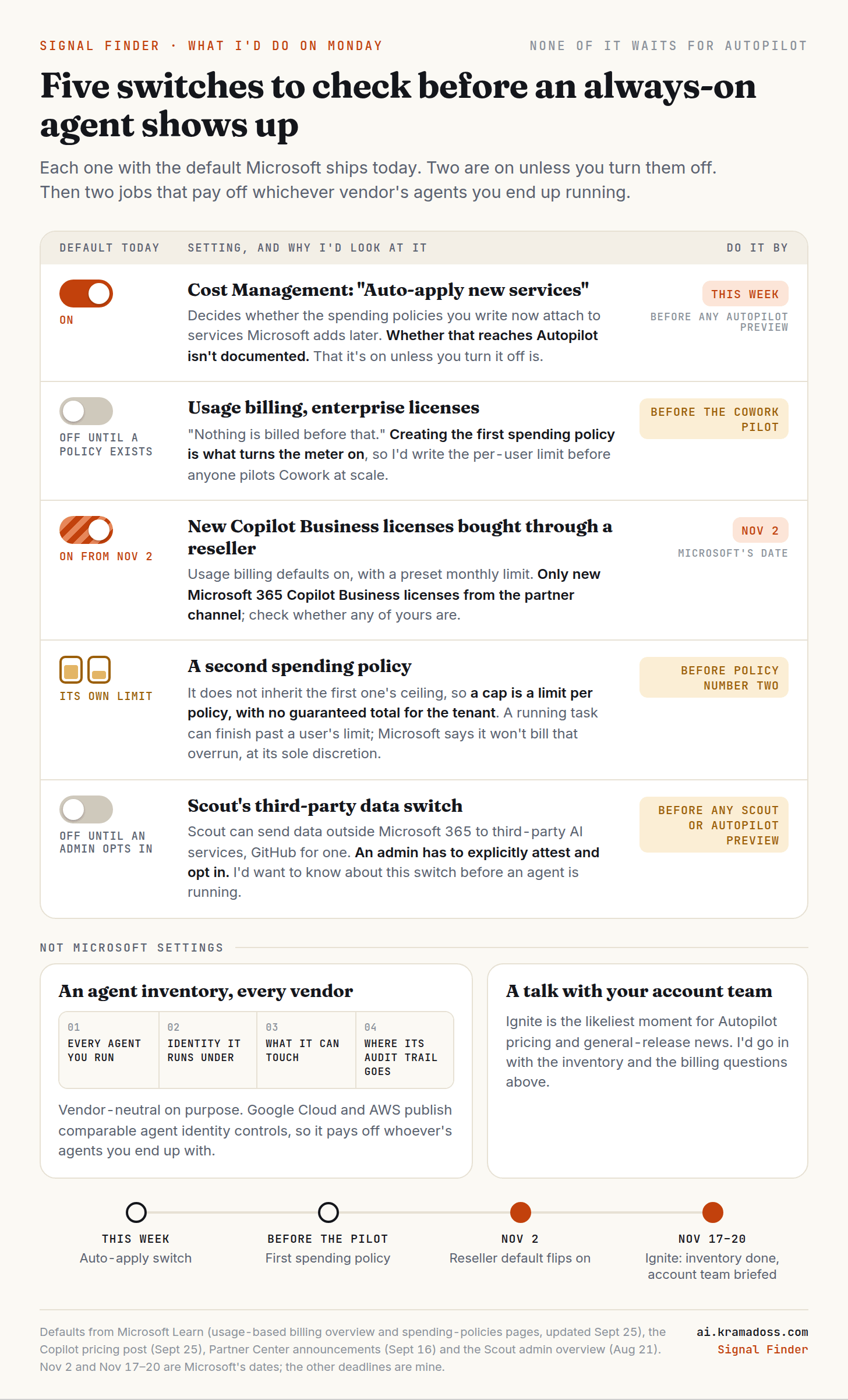
3 settings matter now and none of them wait for Autopilot.
First, in Cost Management the “Auto-apply new services” switch is on by default. That is the setting that decides whether the policies you write now attach to services Microsoft adds later; whether it reaches Autopilot when Autopilot arrives is not documented, and what is documented is that the switch is on unless you turn it off.
Second, from November 2 new Microsoft 365 Copilot Business purchases through resellers default to usage billing switched on, with a preset monthly limit. That is limited to new Business licenses bought through the partner channel, so check whether any of yours are.
Third, read what happens when you have more than one spending policy, because a second one does not inherit the first one’s ceiling and a running task can finish past a user’s limit.
Then the inventory, and it is vendor-neutral on purpose: every agent the company runs, what identity it runs under, what it can touch, and where its audit trail goes.
Scout’s admin docs show why. Because Scout can send data outside Microsoft 365 to third-party AI services, GitHub for one, admins must explicitly attest and opt in before it can. That is the kind of switch you want to know about before an agent is running. This work pays off whichever vendor’s agents you end up with, since Google and AWS publish comparable controls.
Not yet: reorganizing around Autopilot
I wouldn’t build a team, a budget line or a job description around Autopilot for 90 days: wait to reorganize, not to talk to your account team before any Ignite announcement.
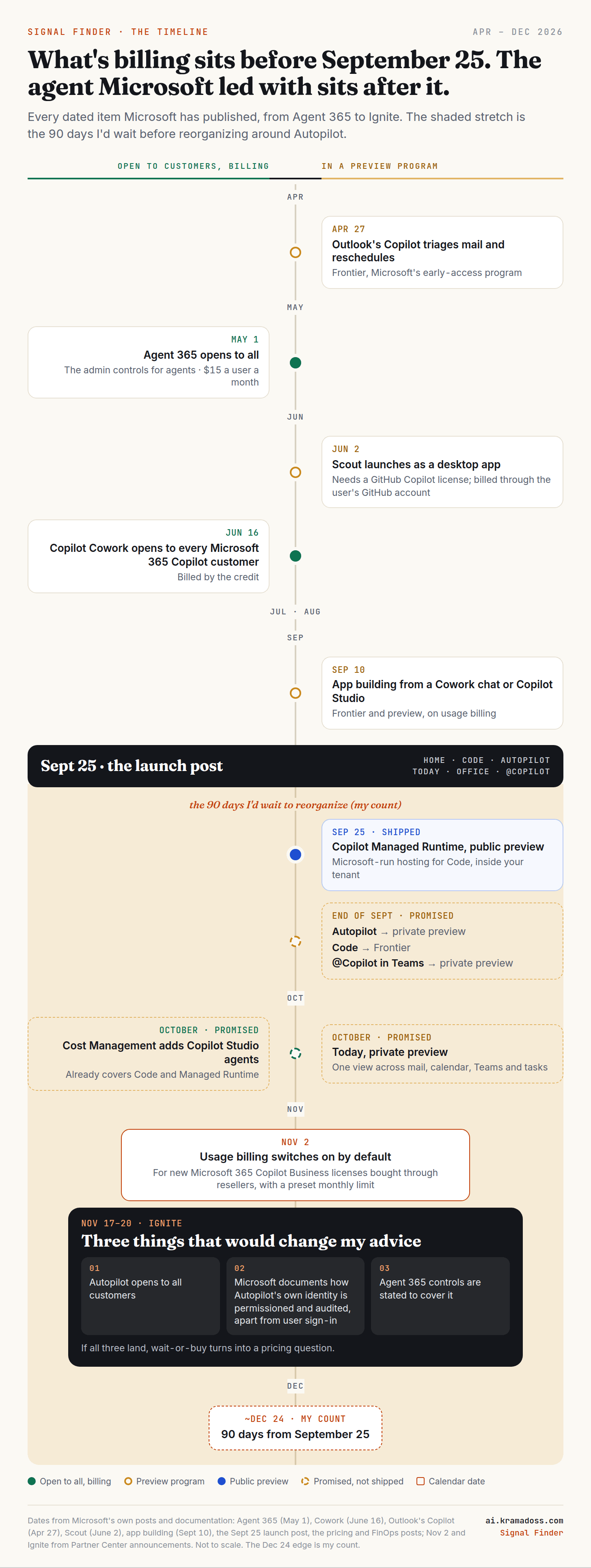
The window from September 25 ends around Christmas Eve and contains 2 dates: the November 2 billing default and Ignite, November 17 to 20, which is the likeliest moment for Autopilot pricing and general-release news.
3 things would change my advice. Autopilot generally available; Microsoft documenting how Autopilot’s own identity is permissioned and audited, separate from user sign-in; and Agent 365 controls stated to cover it.
If Ignite delivers all 3, the wait-or-buy question turns into a pricing question.
References:
Introducing the new Copilot with Home, Code and Autopilot — Official Microsoft Blog, Sep 25, 2026
Evolution of the Copilot pricing model — Microsoft Tech Community, Sep 25, 2026
Build where you want, run with confidence: Copilot Managed Runtime — Microsoft, Sep 25, 2026
Copilot Cowork is now generally available — Microsoft, Jun 16, 2026
Introducing Microsoft Scout, your always-on personal agent — Microsoft, Jun 2, 2026
Usage-based billing overview: Copilot Credits — Microsoft Learn
Partner Center announcements, September 2026 — Microsoft Learn
Microsoft Agent 365 now generally available — Microsoft Security Blog, May 1, 2026
Copilot Studio message and credit management — Microsoft Learn
Microsoft FY26 Q4 earnings release, Exhibit 99.1 — SEC EDGAR, Jul 29, 2026
Build apps in Copilot Cowork and Copilot Studio — Microsoft, Sep 10, 2026
How to use Microsoft 365 Copilot in Teams group chats — Microsoft Support
Announcing Copilot leadership update — Official Microsoft Blog, Mar 17, 2026
Identity and access management for Amazon Bedrock AgentCore — AWS documentation
CEO Satya Nadella on Microsoft’s AI bet — Yahoo Finance Video, Sep 25, 2026
Microsoft unveils all-in-one Copilot app — GeekWire, Sep 25, 2026