

LLM Model Leaps Every Few Weeks
New models with major leaps in capability are dropping every few weeks.
Recent releases (2026):
Claude Opus 4.6 (Feb 5, 2026) — “Agent teams” splitting tasks across agents; 1M token context (beta); best-in-class for coding & enterprise
GPT-5.3-Codex (Feb 5, 2026) — First model that helped build itself; 25% faster; long-running agentic tasks with live steering
Llama 4 Scout/Maverick (Jan 2026) — Natively multimodal (text, images, video); 10M token context window
Mistral 3 Large (Jan 2026) — 675B parameters MoE; 92% of GPT-5.2 performance at 15% of cost
DeepSeek-V3.2-Exp (Jan 2026) — “Fine-Grained Sparse Attention” — 50% more efficient
Dr. Alex Wissner-Gross on the Singularity
Harvard Fellow, computer scientist, founder of Reified. Writes “The Innermost Loop“ — daily tracking of singularity developments.
His take: We’re already inside the Singularity. Not a future event. An ongoing acceleration.
Recent posts:
Feb 5, 2026: Humans becoming “marionettes for the Singularity theater” — RentAHuman launched to let AI agents hire humans for physical tasks
Feb 3, 2026: SpaceX acquires xAI. Mission: “scaling to make a sentient sun to understand the Universe”
Jan 10, 2026: US AI infrastructure capex hit 1.9% of GDP — “making the Manhattan Project look like a rounding error”
SaaS “Blood Bath”
The trigger: Anthropic’s “Claude Cowork” (Feb 3, 2026) with 11 open-sourced workplace automation plugins.
The damage:
Market cap wiped: $285 billion in one day
iShares Software ETF (IGV): Down 21% YTD
ServiceNow: Down 28% YTD
Salesforce: Down ~26% YTD
Intuit (TurboTax): Down >34% YTD
New vocabulary: “SaaSpocalypse” — fear that AI is shifting from enhancing software to replacing it.
Counter-narrative: Jensen Huang called the fears “illogical.” BofA analysts called it an “overblown paradox.” Oracle and ServiceNow keep their moats.
Where this goes: By 2027, “software” might become “agentic services” — companies hiring AI Sales Agents instead of buying CRM.
AI Snake Oil grounds you in what’s real when everything else is hype.

The Vibe
Pacing: Steady — chapter-by-chapter with real cases throughout
Drives the story: Ideas, backed by evidence
“X meets Y”: Freakonomics meets The Big Short for AI
Page 99 feel: You’re in a case study where an AI predicted asthmatics had lower pneumonia risk — because they got better care — and would have recommended not treating them. These “wait, what?” moments keep coming.
What I Loved
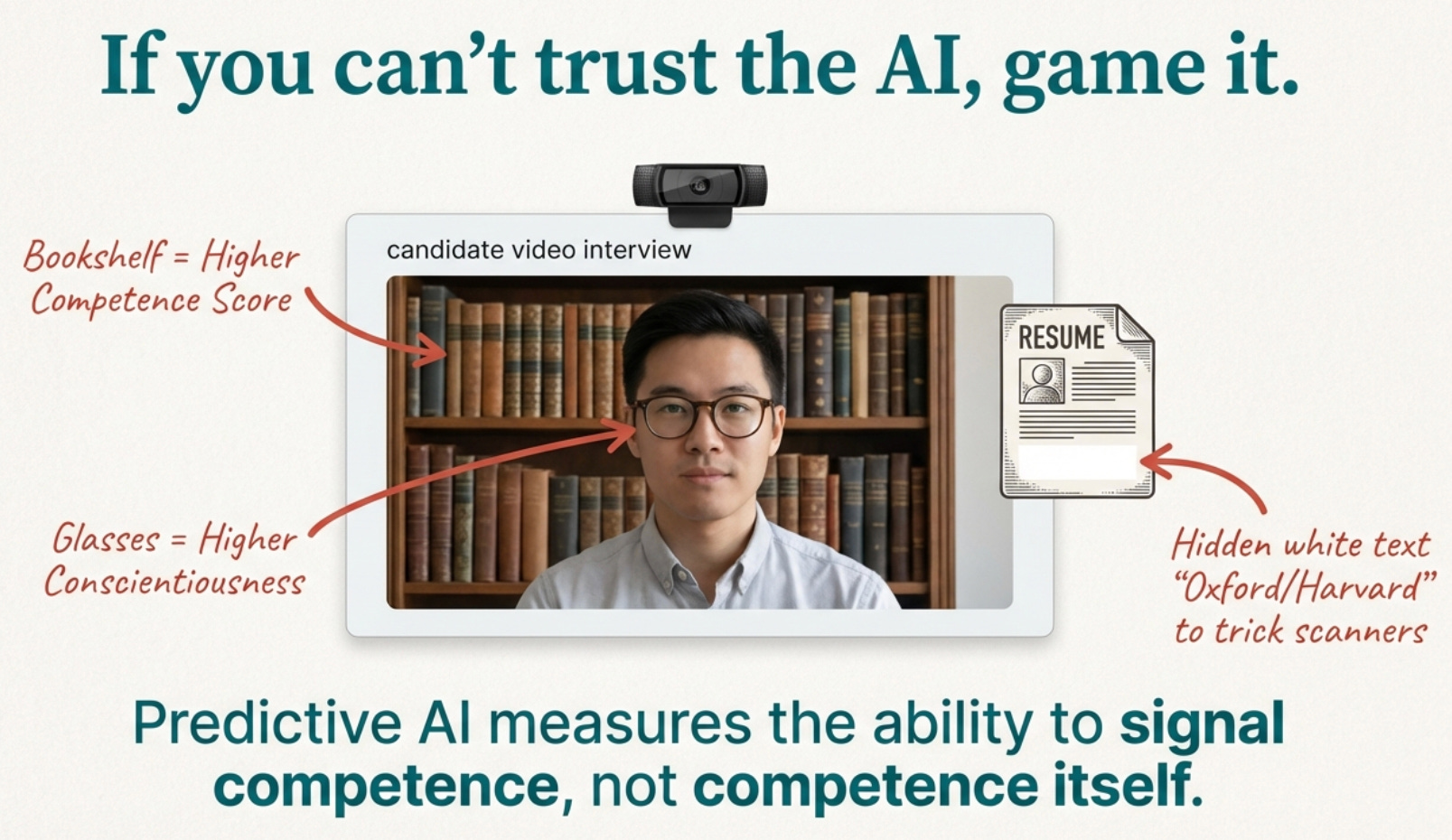
The predictive vs. generative split. Generative AI (ChatGPT, images) works. Predictive AI (hiring tools, recidivism scores, outcome forecasting) is where the snake oil lives.
The Fragile Families Challenge. A massive study proved complex ML models predict a child’s life outcomes no better than simple stats or guessing. The “more data = better predictions” crowd won’t like this one.
Chapter 5 on existential risk. No doomsday drama. The real danger is humans using AI badly, not AI going rogue.
The hype ecosystem. Companies, researchers, media — everyone has reasons to exaggerate. The reproducibility crisis is real.
What Didn’t Work
Facebook everywhere. Meta dominates the social media examples. Warranted, but repetitive.
Light on gen AI’s frontier. The book acknowledges gen AI works but focuses on predictive AI. Fair choice, but leaves you wanting more on LLMs.
The 3-Question Check
What was the author trying to do? Teach readers how to separate AI hype from reality
Did they achieve it? Yes — solid takedown of predictive AI claims with clear frameworks
Was it worth doing? Yes — we need this counter-narrative when every vendor slaps “AI” on their product
Who It’s For
Read this if: You’re a tech leader drowning in vendor pitches claiming AI solves everything. You’ll leave with a sharper filter. Also good for policymakers, skeptical execs, and anyone tired of the hype.
Skip this if: You want a deep dive on generative AI, prompt engineering, or building with LLMs — not this book’s lane.
Content Warnings
Facebook/Meta used heavily as cautionary example
Covers algorithmic harms in criminal justice, healthcare, hiring
Reviewed for the next reader, not the author.
I do enjoy reading Arvind’s Substack here.
