

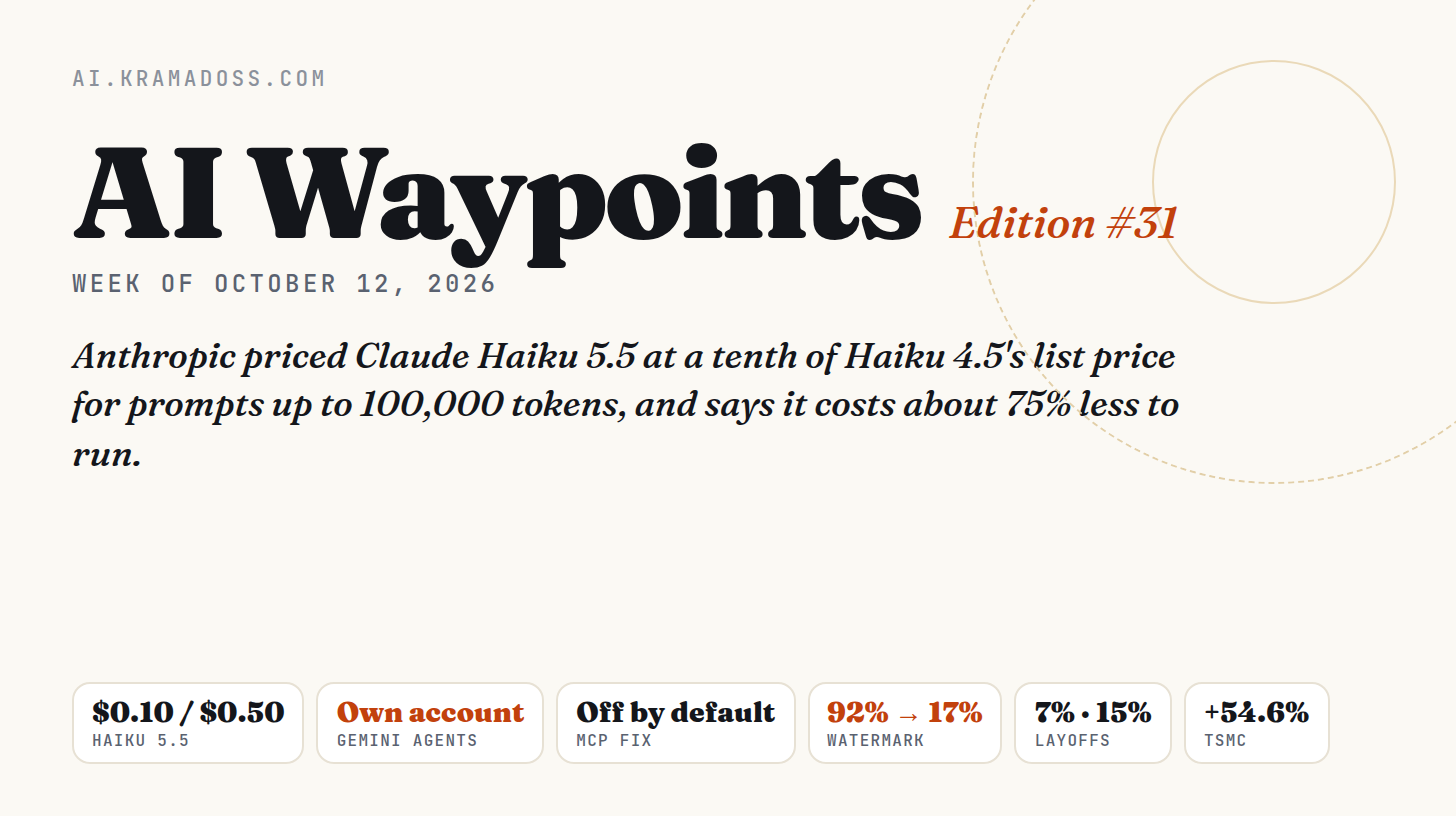
Good morning. Matching flaws in the official Python and TypeScript kits for MCP let servers accept sign-in tokens meant for other services, and the fix stays off until someone switches it on. And FICO and HubSpot disclosed layoffs on the same day: FICO lists AI among its changes, while HubSpot’s CEO says AI efficiency is not the reason.
1. Anthropic cuts small-model prices with Haiku 5.5
Anthropic released Haiku 5.5 on October 7 at $0.10 per million tokens in and $0.50 out for prompts up to 100,000 tokens, against Haiku 4.5’s $1 and $5. Anthropic says the new model breaks text into slightly more tokens per task, and on average it costs about 75% less to run. It also halved Sonnet 5.5’s price for reusing stored prompt text, to $0.10.
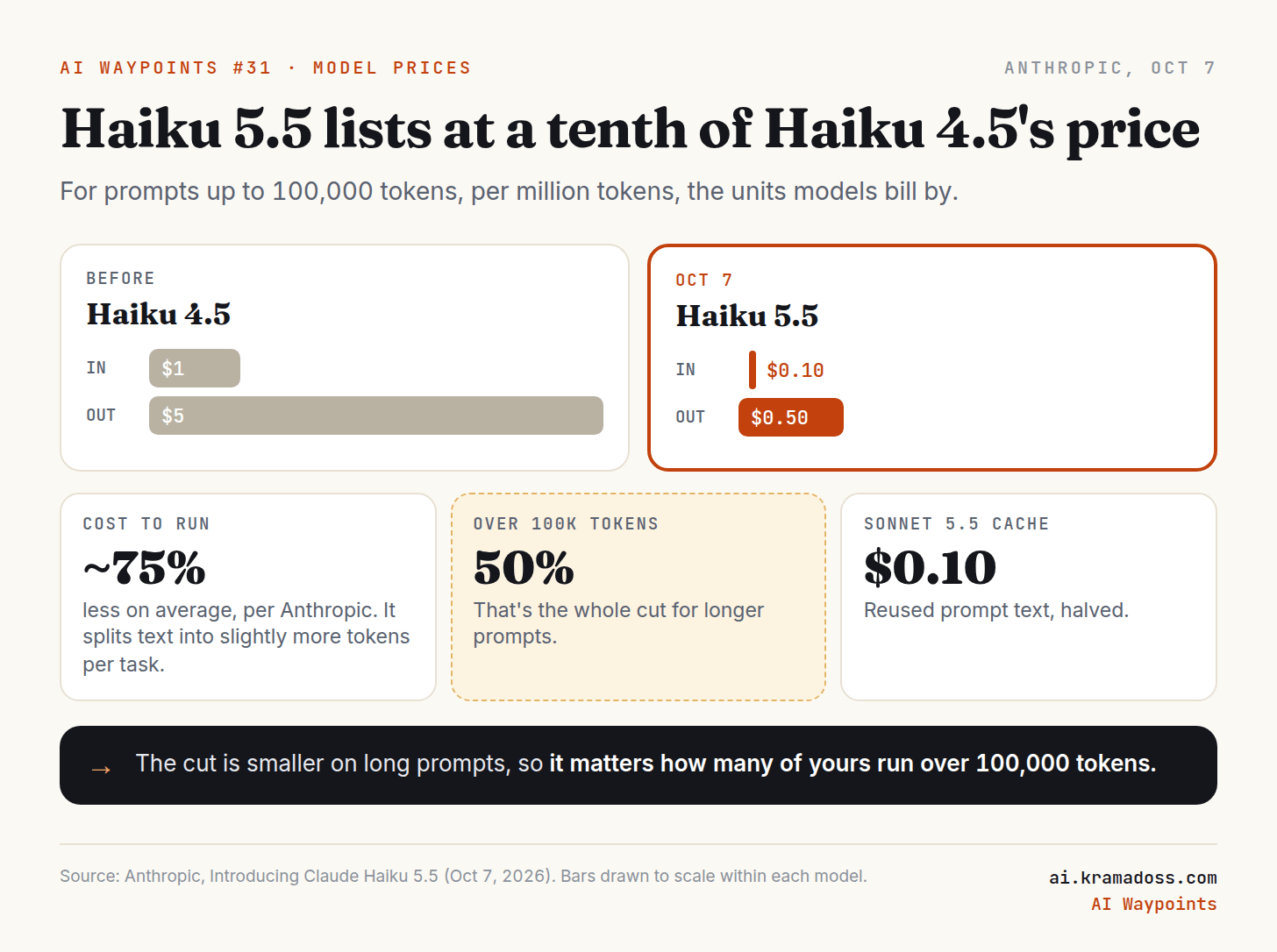
→ Prompts over 100,000 tokens get only a 50% cut, so it matters how many prompts are that long.
2. Google announces Workspace accounts for Gemini coworker agents (28 min read)
Google announced the Gemini agent on October 8. Each “coworker agent” gets its own Workspace account, with an email address, calendar, Drive and a directory entry, acts under its own identity and sees only what it is given. Admins can set a hard cap on a project’s AI spend, and when it trips that project’s agent pauses until someone resumes it.
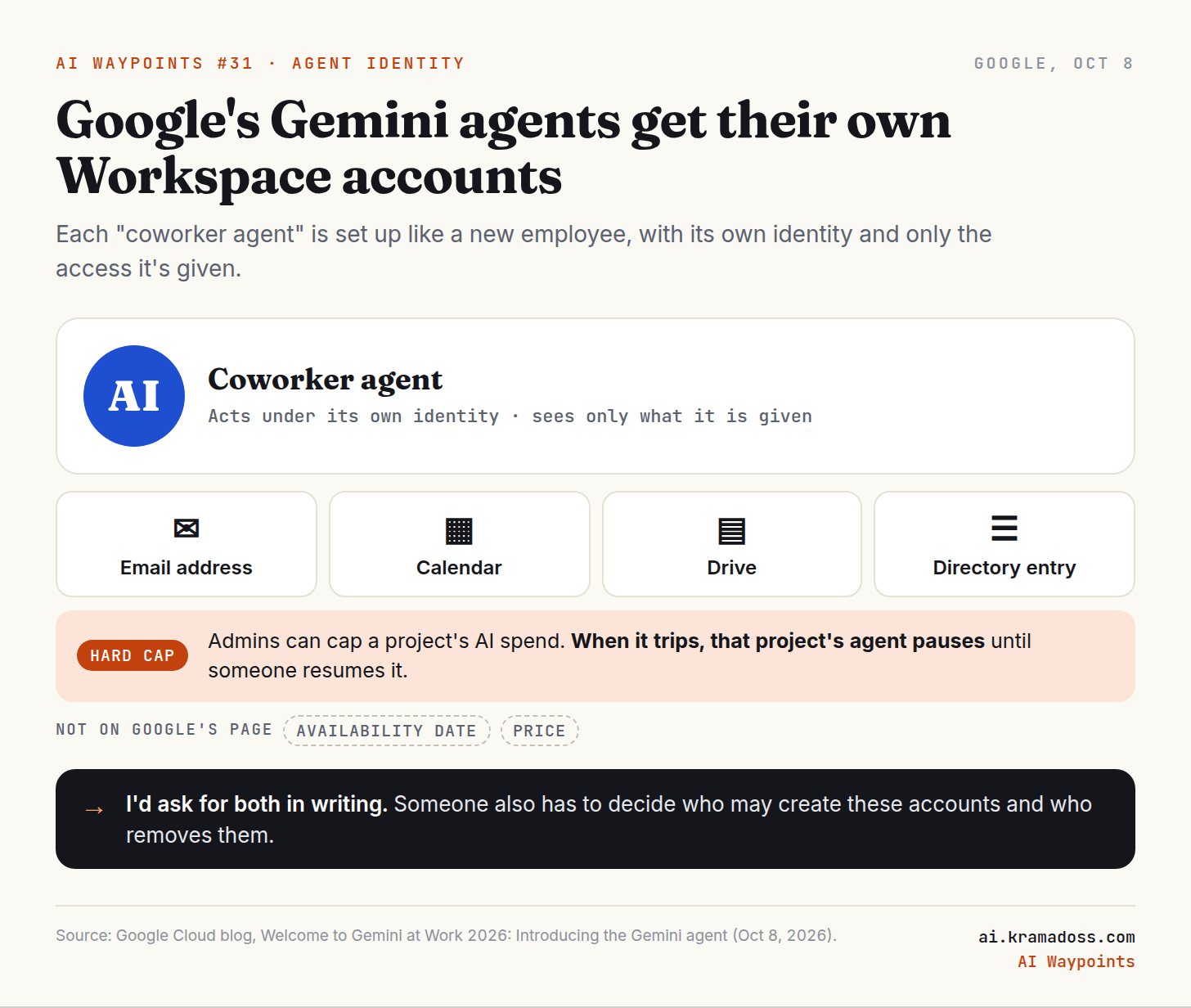
→ Google’s page doesn’t say when it’s available or what it costs, so I’d ask for both in writing. Someone also has to decide who may create these accounts and who removes them.
3. MCP servers accepted sign-in tokens meant for other services (2 min read)
On October 5 the maintainers of the official kits for MCP, the standard agents use to connect to tools and data, published matching Python and TypeScript advisories. Where one sign-in system issues tokens for several services, an MCP server using either kit’s sign-in check accepted a token meant for another service, unless its own code checked who the token was for. Upgrading alone fixes nothing: the new check is off until a developer turns it on.
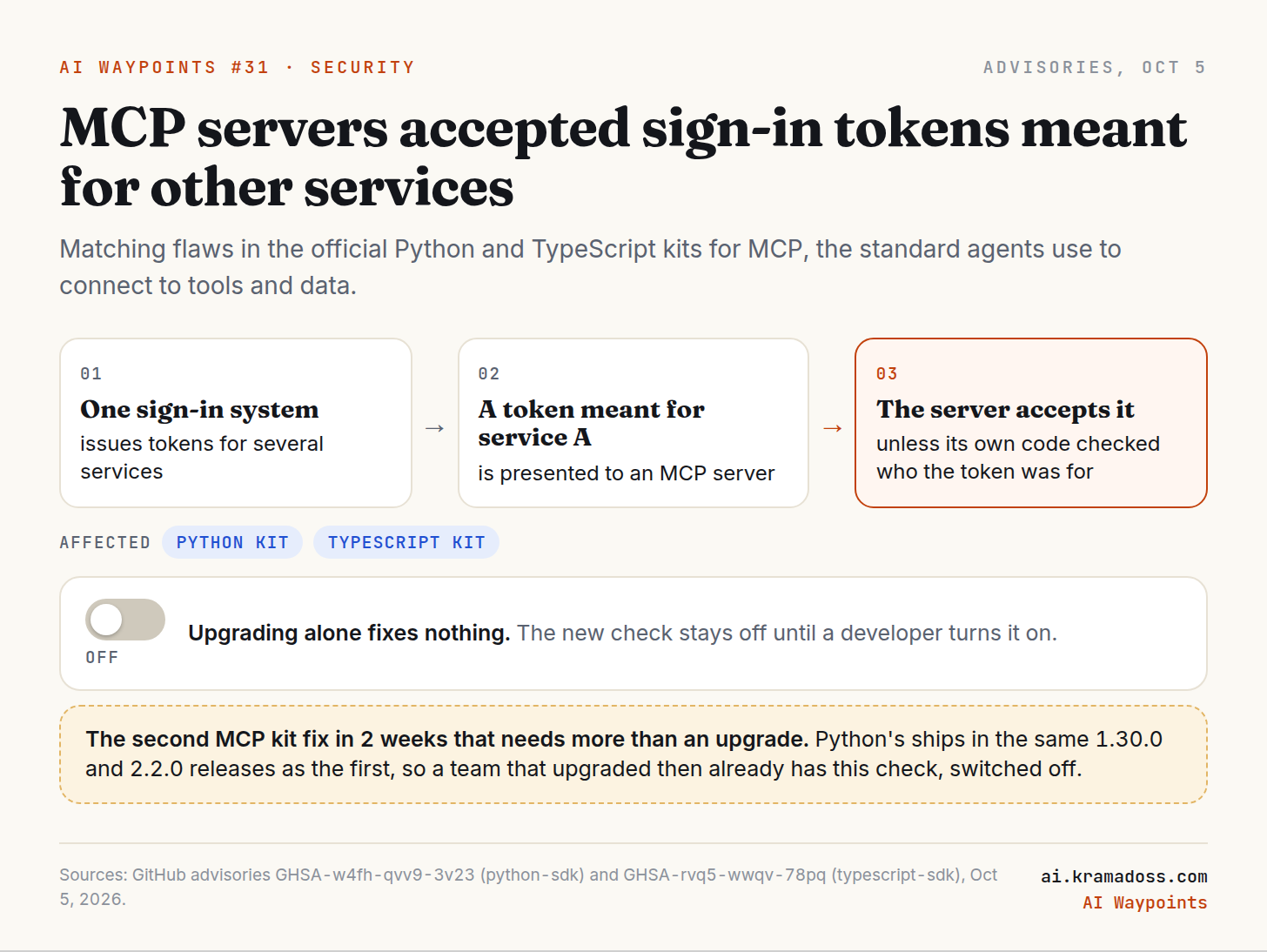
→ This is the second MCP kit fix in 2 weeks that needs more than an upgrade, and Python’s ships in the same 1.30.0 and 2.2.0 releases as the first. A team that upgraded then already has the check, switched off.
4. OpenAI will watermark ChatGPT text in the EU
OpenAI said on October 5 that “over the coming weeks” it will add a watermark, a mark software can detect, to eligible ChatGPT and Codex text in the EU only, citing the EU AI Act. API customers anywhere can opt in for select models. OpenAI’s own tests show swapping 10% of words for synonyms cut detection from about 92% to 66%, and swapping 25% cut it to 17%.
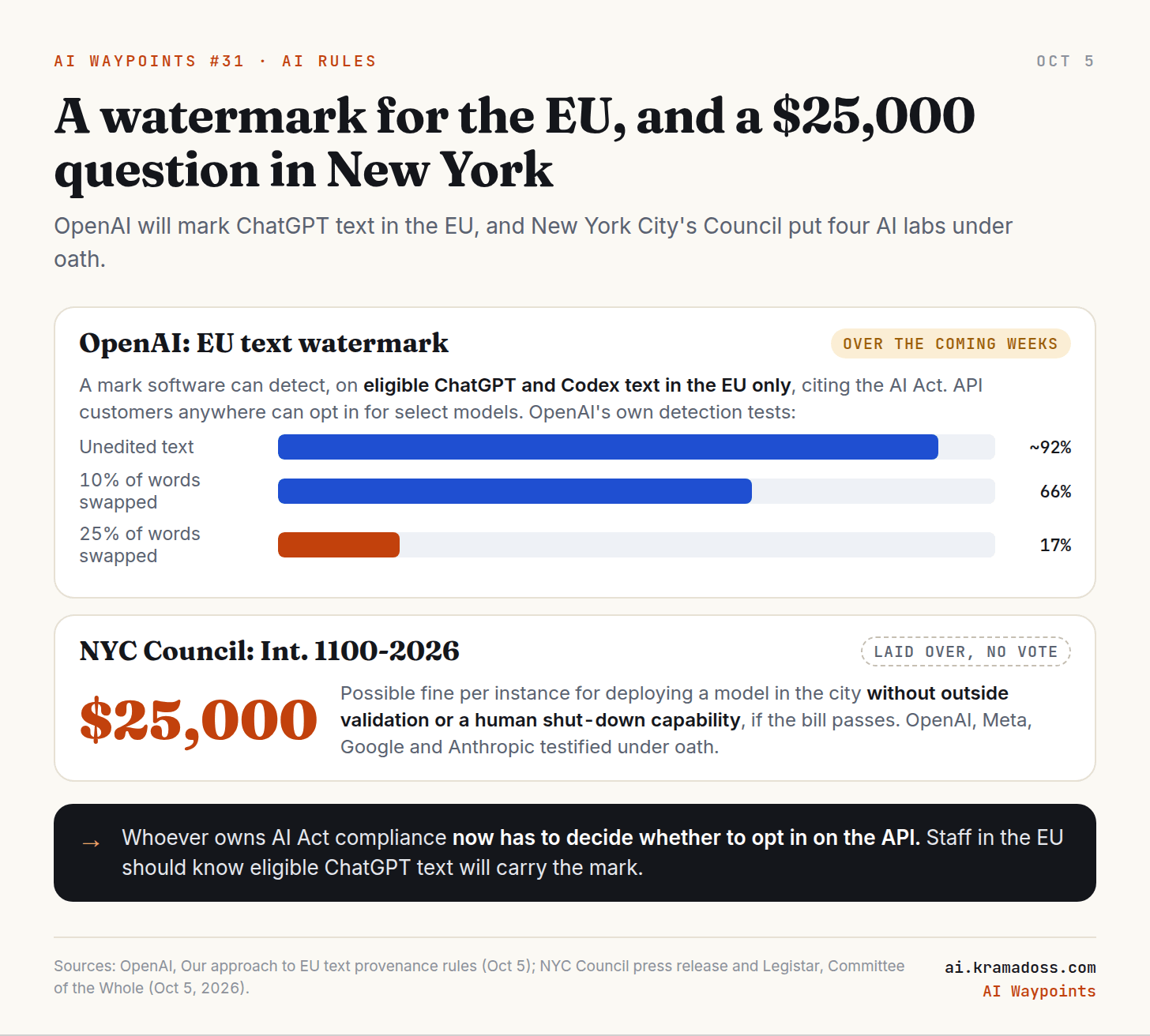
→ Whoever owns AI Act compliance now has to decide whether the company opts in on the API. Staff in the EU should know eligible ChatGPT text will carry the mark.
5. NYC Council questions four AI labs under oath (5 min read)
On October 5 the full New York City Council questioned executives from OpenAI, Meta, Google and Anthropic under oath, and Speaker Julie Menin asked each to “quantify the risk posed by AI in the worst-case catastrophic scenario.” Speaker Menin’s bill requiring outside validation and a human shut-down capability (Int. 1100-2026) was heard and laid over, meaning held for later with no vote.
→ If it passes, any company deploying an AI model in the city that lacks either safeguard could face a $25,000 fine per instance. No vote is scheduled.
6. Two layoff filings, two different answers on AI (5 min read)
HubSpot told regulators on October 6 it would cut about 7% of staff, and its CEO’s memo says “This is not driven by AI-related efficiencies” and describes an AI shift “transforming product, pricing and how we serve our customers.” FICO filed the same day to eliminate about 15% of positions, listing “integrating AI-driven product development” among four changes.
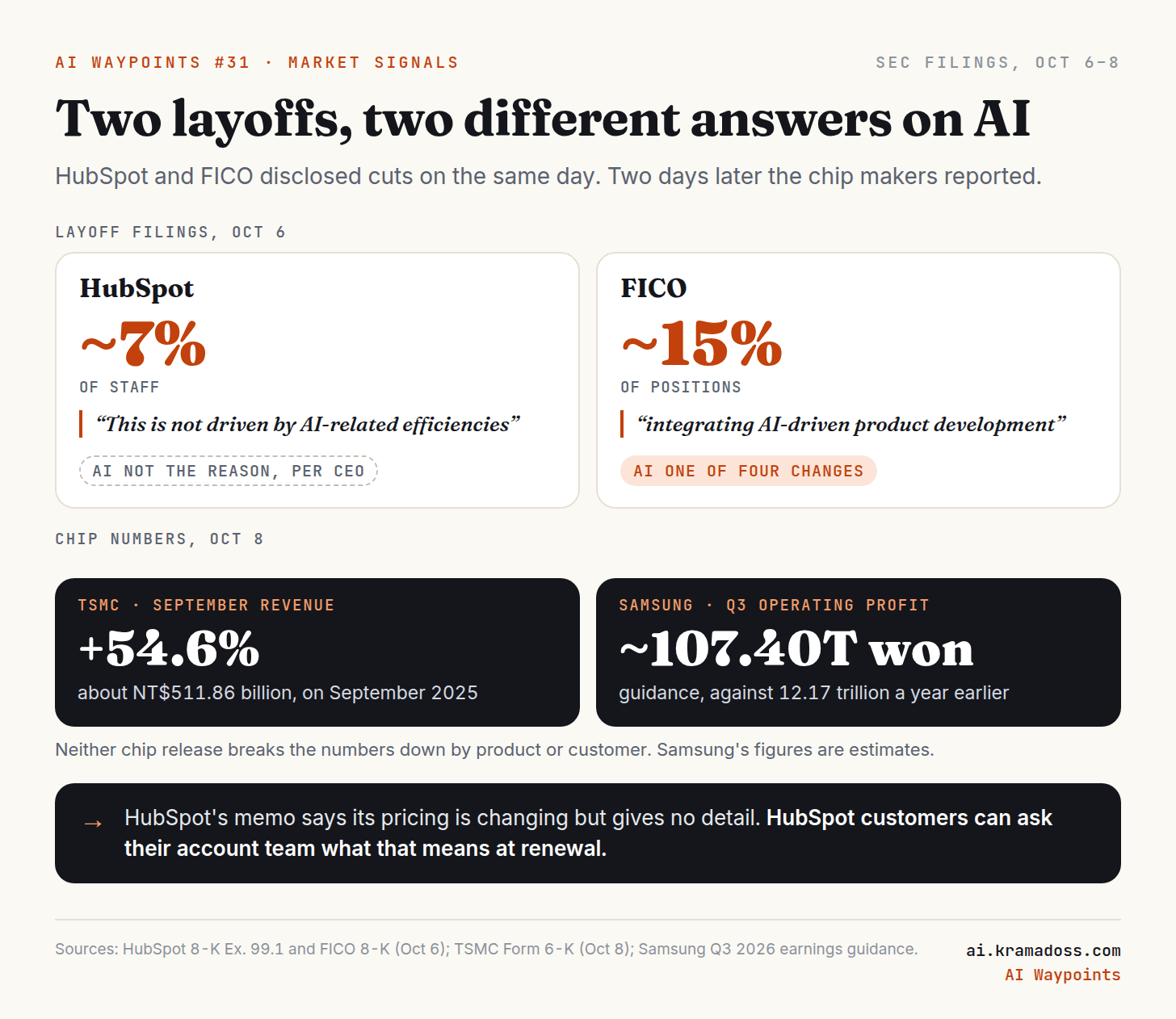
→ The memo says HubSpot’s pricing is changing but gives no detail. HubSpot customers can ask their account team what that means at renewal.
7. TSMC’s September sales rose 54.6% from a year ago (4 min read)
TSMC said in an October 8 filing that September revenue was about NT$511.86 billion, up 54.6% on September 2025. Samsung expects third-quarter operating profit, what is left of sales after running costs, of about 107.40 trillion won, against 12.17 trillion a year earlier. Samsung’s figures are estimates, and full results come later.
→ Neither release breaks the numbers down by product or customer.
References:
Welcome to Gemini at Work 2026: Introducing the Gemini agent
Server bearer authentication accepted tokens issued for another service (GHSA-rvq5-wwqv-78pq)
Meeting of Committee of the Whole on 10/5/2026 at 11:00 AM (NYC Council Legistar)
Samsung Electronics Announces Earnings Guidance for Third Quarter 2026