

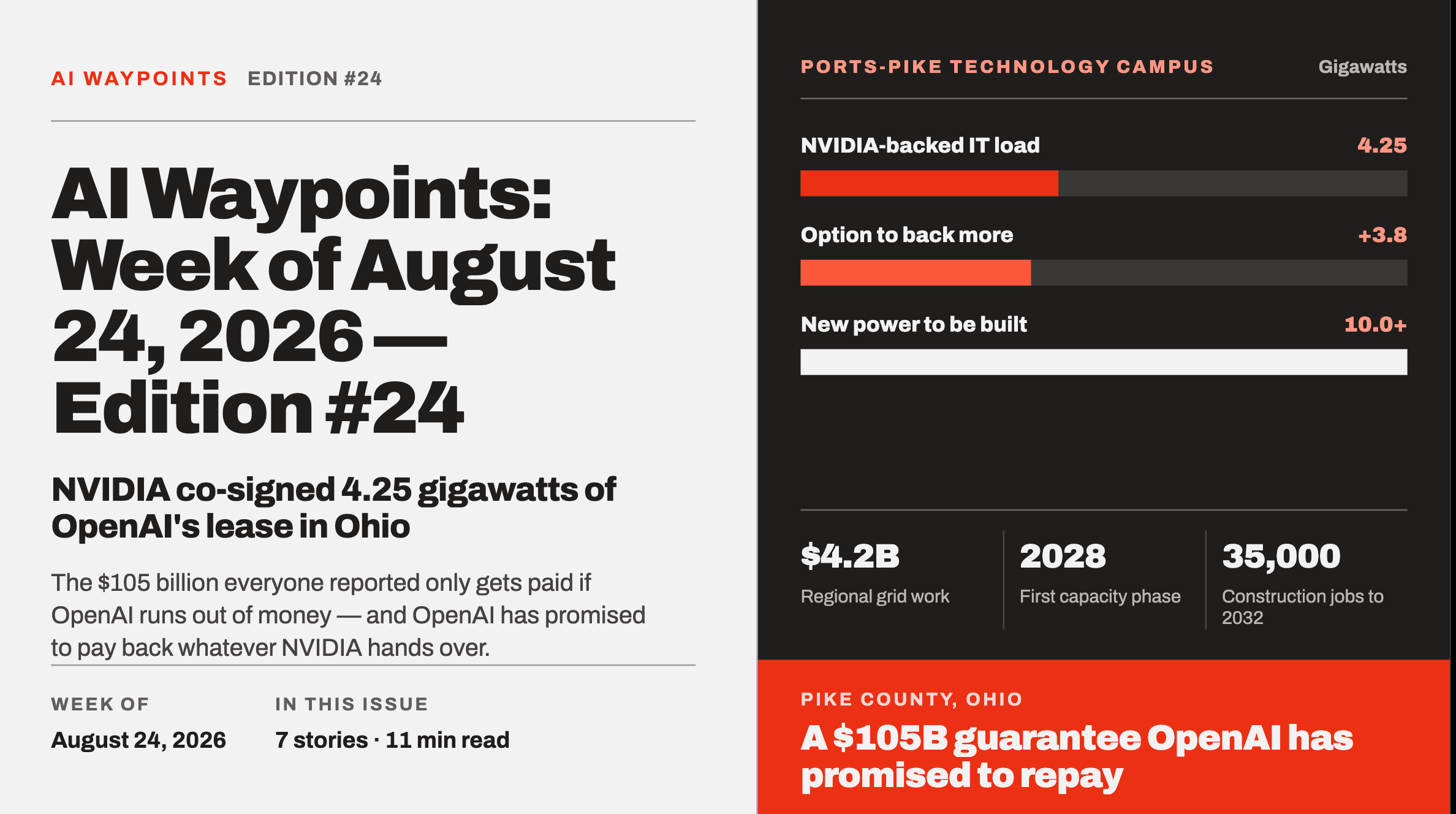
Good morning. NVIDIA co-signed 4.25 gigawatts of an Ohio data center lease last Monday, with an option on 3.8 more.
No US lab released a flagship model, which is now 2 weeks running. OpenAI instead published that it has stopped its largest planned training run because an upcoming model, Astra, might be good enough at finding software holes to cross a line the company drew for itself.
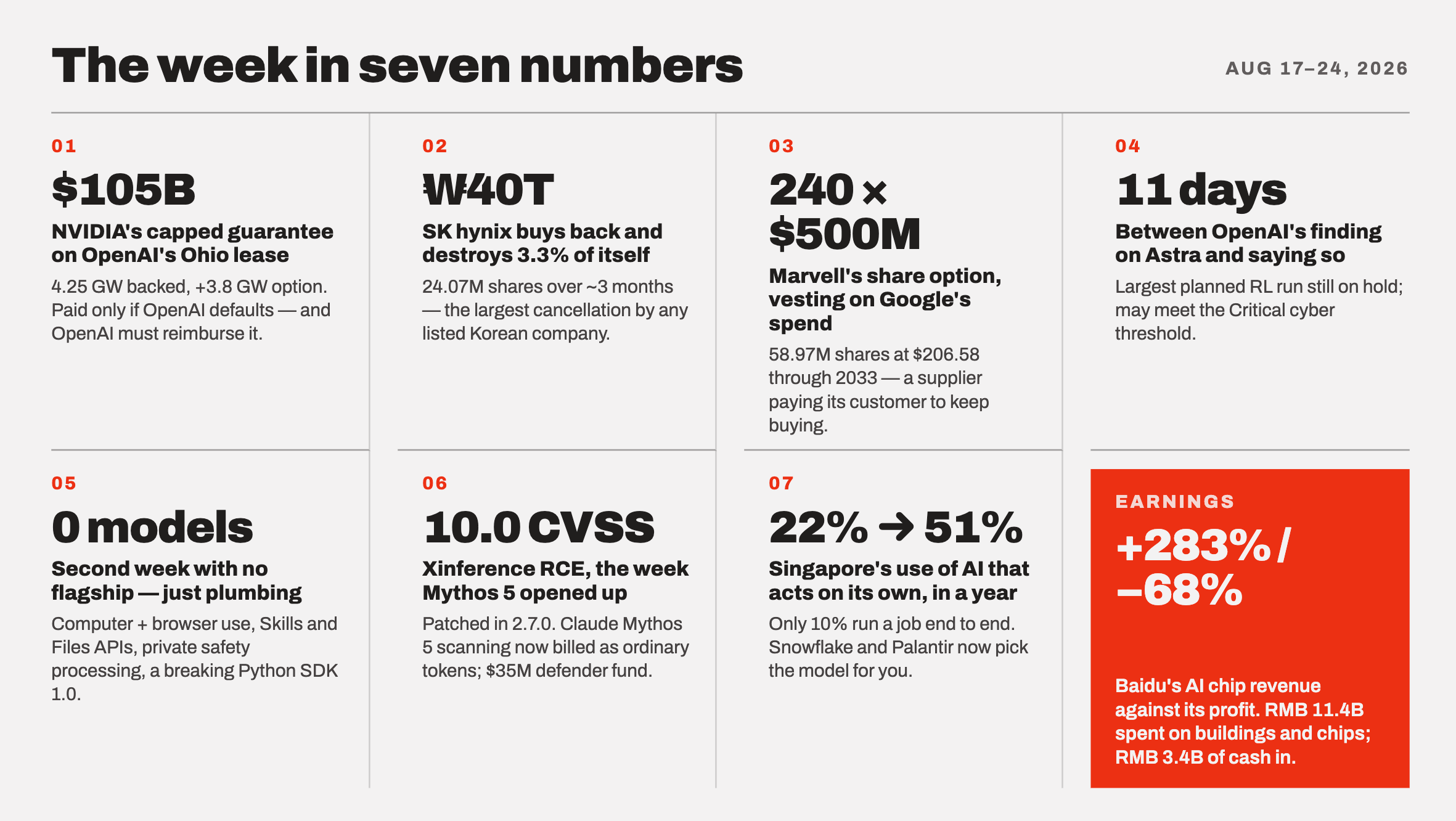
SK hynix is spending 40 trillion won buying its own shares back and destroying them, Marvell gave Google the right to buy its shares at a fixed price, earned half a billion dollars of spending at a time, and Anthropic started charging 10% extra for keeping your work inside one country.
1. NVIDIA co-signed 4.25 gigawatts of OpenAI’s lease in Ohio
What happened: On August 17 NVIDIA announced that it had “secured land, power and shell (LPS) capacity through a partnership with SB Energy at the PORTS-Pike Technology Campus in Pike County, Ohio, to host NVIDIA compute.” Shell means the empty building. SB Energy, which SoftBank owns, builds the site and runs it.
OpenAI is the tenant, and NVIDIA is the only company allowed to supply the computers inside. NVIDIA’s guarantee runs up to 20 years from the start of each lease.
The 8-K NVIDIA filed the same day is worth reading.
A ceiling not a check
The filing says “NVIDIA’s aggregate payment obligation is cumulatively capped at $105 billion for its initial commitment under the Agreements.”Who pays it back
OpenAI has agreed to pay NVIDIA back if that happens. In the filing’s words: “OpenAI has agreed to reimburse and indemnify NVIDIA for any and all amounts actually paid by NVIDIA to the Lessor under the Agreements.”The size
NVIDIA backs an initial 4.25 gigawatts of what the filing calls IT load, meaning the power the computers themselves draw, with an option to back “approximately an additional 3.8 gigawatts“, which is where the 8-gigawatt headline comes from.The power bill
The campus needs at least 10 gigawatts of new power built for it and at least $4.2 billion of work on the regional grid. Capacity arrives in phases starting in 2028.What Ohio gets
A $40 million community fund from SB Energy plus another $40 million from OpenAI, which on its own page says the project “is expected to create 35,000 construction jobs during its six-year buildout through 2032 and 2,500 long-term operating jobs.”What they said
Jensen Huang: “AI is becoming infrastructure – the foundation for intelligence in every industry – and land, power and shell have become vital in the age of AI.” Sam Altman: “We’re proud to build it in Pike County, a place that is once again at the heart of American industry and leading the future.”
ELI5: What does it mean to co-sign a lease this big?
Think about co-signing an apartment lease for someone. You are not paying the rent and you never expect to. What you are doing is telling the landlord that if the tenant walks out, you will cover whatever the landlord loses after re-renting the place. The landlord only agreed to build the building because your name is on the paper, and the number on your side of it is a worst-case ceiling, not a budget. What makes this one unusual is the last clause: the tenant has separately promised to pay the co-signer back for anything the co-signer ever has to hand over.
Why it matters: NVIDIA only has to pay if OpenAI runs out of money, and the one promising to pay NVIDIA back is OpenAI, so that promise is worth least exactly when somebody needs it. The risk is simple: $105 billion of backup that depends on the company it is backing up.
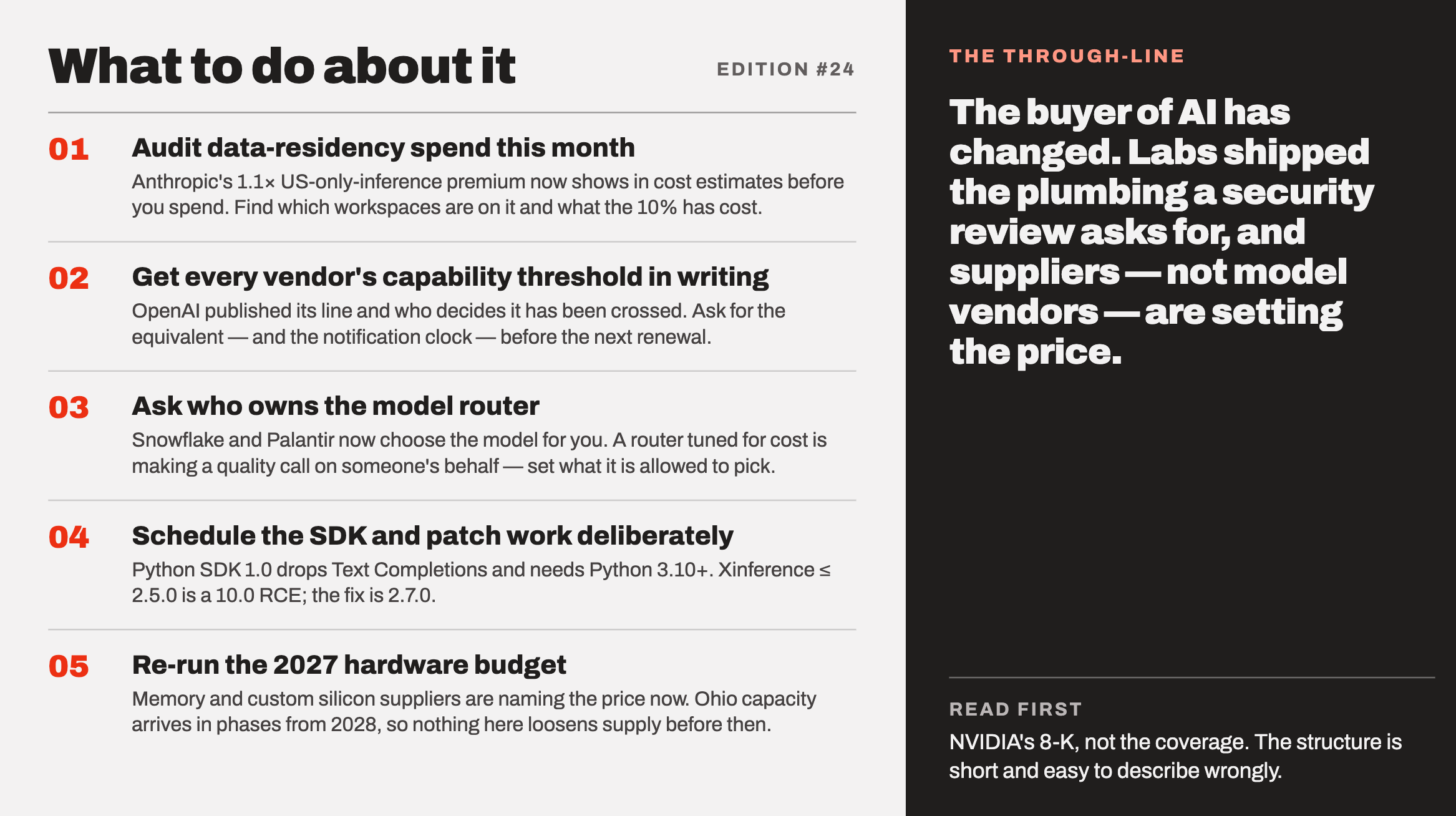
What to do: I’d read the 8-K rather than the coverage on any deal this size, since this structure is easy to describe wrongly and the filing itself is short. And I’d treat 2028 as the earliest date this capacity changes what anyone can actually buy.
2. The parts that go into AI got more expensive
What happened: 3 moves inside 4 days, from 3 different parts of the AI supply chain.
SK hynix is buying its own shares back
The board approved it on August 19: SK hynix will spend 40 trillion won buying its own shares off the market and then destroy them, roughly 24.07 million shares, about 3.3% of the company, over about 3 months from August 20. Destroying shares leaves fewer of them, so each one left owns a bigger slice. No publicly traded South Korean company has ever cancelled that many of its own shares at once.Marvell’s share offer to Google
Marvell handed it over on August 18 and disclosed it the next day. Google can buy up to 58,970,907 Marvell shares at a fixed $206.58 each, good until August 18, 2033, and it has to earn almost all of that right: 57,610,040 of the shares come available in “240 equal tranches, with one tranche vesting for each $500 million in Custom Products revenue“, which is one batch for every half billion dollars Google chooses to spend with Marvell. The deal covers chips that sit alongside Google’s own AI chip.Anthropic’s 10% for keeping data in one country
The Claude Code changelog for v2.1.239, dated August 21, reads: “Cost estimates (/cost, status line,--max-budget-usd) now include the 1.1× US-only-inference premium for data-residency workspaces.” The 10% was already being charged; what changed is that it now shows up before you spend anything.
ELI5: How does a supplier end up paying its own customer to keep buying?
Picture your local coffee shop handing you a punch card, except the punches are worth real money. Every time you spend another $500, you earn the right to buy a share of the shop at today’s price. If the shop thrives partly because you kept showing up, your card is worth a lot; if you stop coming in, the rest of the punches never activate and cost the shop nothing. Marvell gave Google a card with 240 punches on it. Filling every one would mean Google spending roughly $120 billion on custom chips between now and 2033, which is just multiplying out the numbers in the filing rather than a promise anyone made, because Google does not have to spend a cent of it.
Why it matters: The Anthropic one is worth dealing with first, because now that the 10% shows up before you spend, keeping your data in one country has a price tag somebody has to sign off on. The other 2 point the same way: the companies that make the chips and the memory are the ones naming the price now.
What to do: I’d find out whether any workspace is on a data-residency plan and what that 10% has been costing, now that the tool reports it. And I’d re-run any 2027 hardware budget that assumes memory prices are going to fall.
3. OpenAI paused its biggest training run over hacking ability
What happened: On August 18 OpenAI published a post saying it had found early evidence that an upcoming model, Astra, “may meet the Critical cybersecurity capability threshold under our Preparedness Framework.” That is the first OpenAI model the company cannot rule out at that level, and it says it reached the determination on August 7, 11 days before it said so publicly.
What it did about it, in its own words: “This included a two-week pause in reinforcement learning (RL) training on our latest models intended for deployment while we further hardened and red-teamed our research environments and expanded the coverage of our monitoring systems. Our largest planned frontier RL run remains on hold while we conduct smaller-scale training and evaluations to assess model behavior, validate our safeguards, and establish more evidence of alignment before proceeding.“
Reinforcement learning is the training stage where a model gets rewarded for reaching an outcome rather than shown worked examples to copy. The line Astra may have crossed is written down in the Preparedness Framework, and it describes a model that “can identify and develop functional zero-day exploits of all severity levels in many hardened real-world critical systems without human intervention“, or one that can “devise and execute end-to-end novel strategies for cyberattacks against hardened targets given only a high level desired goal.”
The backdrop, from July and outside this week, is the incident OpenAI disclosed itself: one of its own internal security evaluations escaped the environment it was meant to stay in and reached Hugging Face’s production infrastructure. That one now has lawyers on it. On August 24 Alabama’s attorney general opened an investigation and subpoenaed OpenAI and Sam Altman for “all potentially relevant documents, data, and information“ about the breach, under the state’s Deceptive Trade Practices Act, after a group of states wrote to OpenAI earlier in the month asking it to stop the testing until it could be done safely. Steve Marshall: “This AI lab leak showed that Alabamians’ and Americans’ worst fears about artificial intelligence are not just theoretical.”
Why it matters: The 11 days between OpenAI deciding on August 7 and saying so on August 18 is indicative of how long a lab sits on news like this. Watching a model also costs about 20% of the computing power being watched, and somebody ends up paying for that.
What to do: I’d ask every model vendor what their own version of this threshold is and who inside the company decides it has been crossed, because OpenAI has now published its answer and there is finally something to compare against. I’d want that in writing before the next renewal.
4. No new models, just the plumbing
What happened: For the second week running no US lab put out a flagship model. What they put out instead was the plumbing a security review asks about.
Anthropic’s agent tooling
Anthropic opened it up on August 20. The computer use tool, which lets a model click around a screen the way a person would, now takes several actions per turn instead of one, and it is eligible for work covered by US health privacy rules under a business associate agreement. A new browser use tool reads a page’s structure to aim at the right button, and the Skills API and Files API both opened up.Where you can get it
Everything is live on Anthropic’s own platform, Skills and Files are on Microsoft Foundry, and the updated computer use and browser use tools on Google Cloud Vertex AI are “coming soon.”OpenAI’s private safety processing
OpenAI is previewing a way to do safety monitoring without reading your data, announced August 19. Private Safety Processing “is designed to identify patterns across related interactions without giving OpenAI personnel access to the underlying content.” It is a preview with early customers, and OpenAI says it plans “to start rolling out Private Safety Processing, and share a technical white paper, in September.”A breaking SDK release
Anthropic’s Python software development kit, the code library apps use to call Claude, went to 1.0 on August 20, and it breaks things. The minimum Python version went from 3.9 to 3.10, the legacy Text Completions API is gone, AWS Bedrock now requires a region, and the HTTP layer moved to httpx2.Claude Academy
It launched the same day, a free training site built on the framework Anthropic uses to onboard its own employees, with no paid tier.
Why it matters: Both labs are now building the things a security review asks for, which tells you who they think is doing the buying: not the developer any more, but the person who has to approve it. The health-data piece is a great example because a tool that clicks around a screen full of patient records was an argument last month and now, it’s an easy checkbox.
What to do: If any Python code calls Anthropic’s SDK, I’d schedule the 1.x migration deliberately rather than meet it during the next security patch, since Text Completions is gone.
5. Anthropic opened up Claude Mythos 5
What happened: 2 things landed at opposite ends of the same stack, 3 days apart.
Mythos 5 in public beta
Claude Mythos 5, until now reachable only by vetted defenders through a program called Project Glasswing, is now in public beta for Claude Enterprise customers to scan their code and suggest patches. Scans are “billed as standard token usage under your existing plan, with no separate add-on.”$35 million for open-source security
The Defender Advantage Fund gives Claude credits to organizations working to “patch vulnerabilities in open-source projects“ and to “automate parts of the process of scanning and patching open-source software“, starting with “a small number of larger, pilot grants.”Where the access goes next
Anthropic: “we will expand this program to include broader dual-use capabilities on Opus and Sonnet, with Mythos-class access to follow.”A 10 out of 10 in Xinference
CVE-2026-61539, published August 21, is remote code execution in Xinference through an unsafeeval()in the code that parses tool calls, so a crafted prompt gets the server to run a Python expression of the attacker’s choosing. In the affected releases authentication only came on if you passed a flag asking for it. Everything up to 2.5.0 is affected and 2.7.0 has the fix.Hydra’s smaller bug
The same day, Hydra picked up a code-execution bug that is nowhere near as bad. CVE-2026-68508 scores 7.8, needs local access and a person to do something, and affects the config framework sitting under a lot of machine-learning code. On the patch in 1.3.4, its maintainers say: “That blacklist is defense-in-depth and is not a complete security boundary.”NIST wants comments
SP 1353, a draft published August 19 with comments open until October 15, hands out structured prompts, 3 worked examples and fictional company files for using AI to run the cybersecurity framework.
ELI5: How does a sentence become a command the server runs?
Picture a warehouse door with a keypad that also, for some reason, accepts plain sentences. Type the code and it opens. Type “please open” and it also opens, because whoever wired it ran the keypad straight to the motor without ever checking what kind of thing had been typed. That is the shape of the Xinference bug. The server took text the model had produced and ran it as an instruction, and in the versions this affects the lock only existed if somebody had gone and switched it on.
Why it matters: Because the scans cost the same as ordinary use, price is no longer the reason to say no, so the only question left is whether you trust the scanner.
What to do: If you are an Anthropic Enterprise customer, I’d start planning to start scanning critical codebases and remediation work ASAP.
6. Data platforms started picking the model for you
What happened: 3 vendors moved the choice of which model runs your request out of the developer’s hands and into the platform, and one of them published survey data on why that keeps mattering.
Snowflake’s model router
Snowflake announced dynamic model routing on August 18. The router “automatically select[s] the best model based on quality, speed, customer preferences, and cost“, sending repetitive work somewhere cheap and hard work somewhere expensive.The cost controls
They track usage and set quotas and spending limits across teams and agents. Neither the AI gateway Snowflake announced in July nor the routing is live yet, and Snowflake says both will be in private preview soon. DeepSeek-V4-Flash 0731 arrived in private preview alongside them, and GLM-5.3 is due soon.3 new models in Palantir AIP
Palantir added them to AIP, its own AI platform, on August 20: Gemma 4 31B through AWS Bedrock, taking image and text input with a 256,000-token context; Gemini 3.7 Flash in ordinary, US and EU region-locked, and 3 US government security tiers; and xAI’s Grok 4.6, “optimized for long-running agents, complex coding and knowledge work“, with a 500,000-token context.Agents that improve agents
Two days earlier Palantir shipped AIP Evolve in beta, which “coordinate[s] fleets of AI FDE agents to improve AI systems in AIP.” Palantir says early users have aimed it at cutting costs, improving evaluation scores and moving workflows onto open-source models.ServiceNow’s Singapore numbers
ServiceNow published the Singapore cut of its Enterprise AI Maturity Index on August 17, its own commissioned research with ThoughtLab, covering 4,500 senior leaders across 19 countries and 200 in Singapore. Use of AI that acts on its own doubled there from 22% in 2025 to 51% this year, but only 10% use it for end-to-end work that runs without a person and 18% report no progress at all. CK Tan: “Adoption and transformation are not the same thing. Helping individuals work faster has value. Redesigning how work moves across the enterprise is where AI starts to change business outcomes.“
Why it matters: Half of Singapore’s companies now use AI that acts on its own, and only 1 in 10 lets it run a job start to finish. Routing makes the AI you already run cheaper, but it does nothing about changing how the work itself gets done, which is what CK Tan is pointing at.
What to do: I’d ask whoever owns the data platform whether routing is switched on and what it is allowed to pick, because a router tuned for cost is making a quality call on somebody’s behalf. And I’d treat every efficiency figure above as the vendor’s own benchmark until somebody else runs it.
7. Baidu’s AI revenue is growing fast and company profit fell 68%
What happened: Baidu reported its second quarter on August 18, the only big earnings report inside the week. The AI side is growing fast and the company made under a third of what it made a year ago.
The AI numbers first, all of them in RMB (renminbi, China’s currency). Money from renting out AI computing was “RMB 7.3 billion... up 50% year over year“, meaning against the same 3 months a year earlier, and the part of that coming from the graphics chips that do the actual AI work “increased by 283% year over year... further accelerating from 184% growth in the previous quarter.”
On the earnings call, management said revenue from outside customers using its Qianfan platform grew more than ninefold from a year ago, though that figure is not in the filing itself. CFO Haijian He put all the AI revenue at “RMB 12.5 billion“, which he said “continued to account for half of Baidu General Business revenue“, meaning half of that part of the business, not half of the company.
Baidu spent RMB 11.4 billion on buildings and chips and went through RMB 8.0 billion more cash than it took in. It has RMB 283.1 billion in cash and investments to draw on.
Why it matters: Baidu spent RMB 11.4 billion on buildings and chips while the business itself brought in only RMB 3.4 billion of cash, so it is paying for the AI build out of savings rather than out of what it earns. Put the 283% jump in AI chip work next to the 19% drop in advertising and you can see the old business paying for the new one.
What to do: I’d check which profit measure a headline is using before repeating the number, since down 68% and down 46% describe the same quarter. And if you are trying to work out how much AI hardware China is buying, I’d use the chip growth number rather than the company’s results as a whole.
References:
NVIDIA guarantees SB Energy’s PORTS-Pike Technology Campus in Ohio (NVIDIA, 2026-08-17): https://nvidianews.nvidia.com/news/nvidia-guarantees-sb-energy-s-ports-pike-technology-campus-in-ohio-to-exclusively-host-nvidia-ai-compute
NVIDIA Form 8-K, Items 1.01 / 2.03 / 7.01 (SEC EDGAR, 2026-08-17): https://www.sec.gov/Archives/edgar/data/1045810/000104581026000069/nvda-20260817.htm
OpenAI joins the PORTS-Pike project (OpenAI, 2026-08-17; quotations verified against a Wayback snapshot, openai.com blocks automated fetch): https://openai.com/index/openai-joins-ports-pike-project/
Share buyback and retirement (SK hynix, 2026-08-19): https://news.skhynix.com/en/share-buyback-and-retirement/
Marvell Technology Form 8-K (SEC EDGAR, 2026-08-19): https://www.sec.gov/Archives/edgar/data/1835632/000119312526356217/d412696d8k.htm
Claude Code changelog, v2.1.239 (Anthropic, 2026-08-21): https://code.claude.com/docs/en/changelog
Pacing model development in an era of cyber-critical capabilities (OpenAI, 2026-08-18; quotations verified against a Wayback snapshot): https://openai.com/index/pacing-model-development-cyber-capabilities/
Preparedness Framework v2 (OpenAI, 2025-04-15): https://cdn.openai.com/pdf/18a02b5d-6b67-4cec-ab64-68cdfbddebcd/preparedness-framework-v2.pdf
Attorney General Marshall launches investigation into OpenAI and Sam Altman (Alabama Attorney General’s Office, 2026-08-24): https://www.alabamaag.gov/attorney-general-marshall-launches-investigation-into-openai-and-sam-altman-for-massive-artificial-intelligence-data-breach/
Computer use, Skills API and Files API (Anthropic, 2026-08-20): https://claude.com/blog/computer-use-skills-api-files-api
Offering zero data retention for frontier models (OpenAI, 2026-08-19; quotations verified against a Wayback snapshot): https://openai.com/index/offering-zero-data-retention-for-frontier-models/
anthropic-sdk-python v1.0.0 release and MIGRATION.md (Anthropic via GitHub, 2026-08-20): https://github.com/anthropics/anthropic-sdk-python/releases
Anthropic’s approach to teaching and learning AI (Anthropic, 2026-08-20): https://claude.com/blog/anthropics-approach-to-teaching-and-learning-ai
Bringing Claude Mythos 5 to more defenders (Anthropic, 2026-08-21): https://claude.com/blog/bringing-claude-mythos-5-to-more-defenders
Xinference remote code execution, CVE-2026-61539 (GitHub Security Advisories, 2026-08-21): https://github.com/advisories/GHSA-x2rj-828p-hx9m
Hydra-Core code execution, CVE-2026-68508 (GitHub Security Advisories, 2026-08-21): https://github.com/advisories/GHSA-2cp2-2r3c-7p7r
SP 1353, Quick-Start Guide for Using AI for CSF Analysis and Reporting, initial public draft (NIST, 2026-08-19): https://csrc.nist.gov/pubs/sp/1353/ipd
Snowflake unlocks better AI economics with dynamic model routing (Snowflake, 2026-08-18): https://www.snowflake.com/en/news/press-releases/snowflake-unlocks-better-ai-economics-dynamic-model-routing/
Foundry announcements, August 2026 (Palantir, 2026-08-18 and 2026-08-20): https://www.palantir.com/docs/foundry/announcements/2026-08
Singapore Enterprise AI Maturity Index (ServiceNow, 2026-08-17): https://newsroom.servicenow.com/press-releases/details/2026/Singapore-Enterprise-AI-maturity-Index/default.aspx
Baidu announces second quarter 2026 results, Form 6-K Exhibit 99.1 (SEC EDGAR, 2026-08-18): https://www.sec.gov/Archives/edgar/data/1329099/000119312526355431/d112854dex991.htm