

Good morning. Anthropic published how Claude’s text watermark works on August 14, said future models will carry it to comply with the EU AI Act, and said in the same post that the tool for checking the mark does not exist yet. 3 days before that, its Compliance API started returning transcripts of Claude Code and Cowork sessions running on employees’ own laptops, using a credential plenty of security teams already hold.
OpenAI split its cyber offering into Red and Blue access tiers and introduced GPT-5.6-Cyber, a model trained to refuse less on certain higher-risk, dual-use cyber tasks, and both tiers turned up on Amazon Bedrock on August 13. Meanwhile 7 security advisories landed in one working week across the tooling agents run on, two of them plain shell injection, and Nebius told shareholders it could sell its entire 2027 capacity today, at prices per megawatt 67% above its 2026 base.
1. The agent tool layer ships the oldest bugs in the catalog
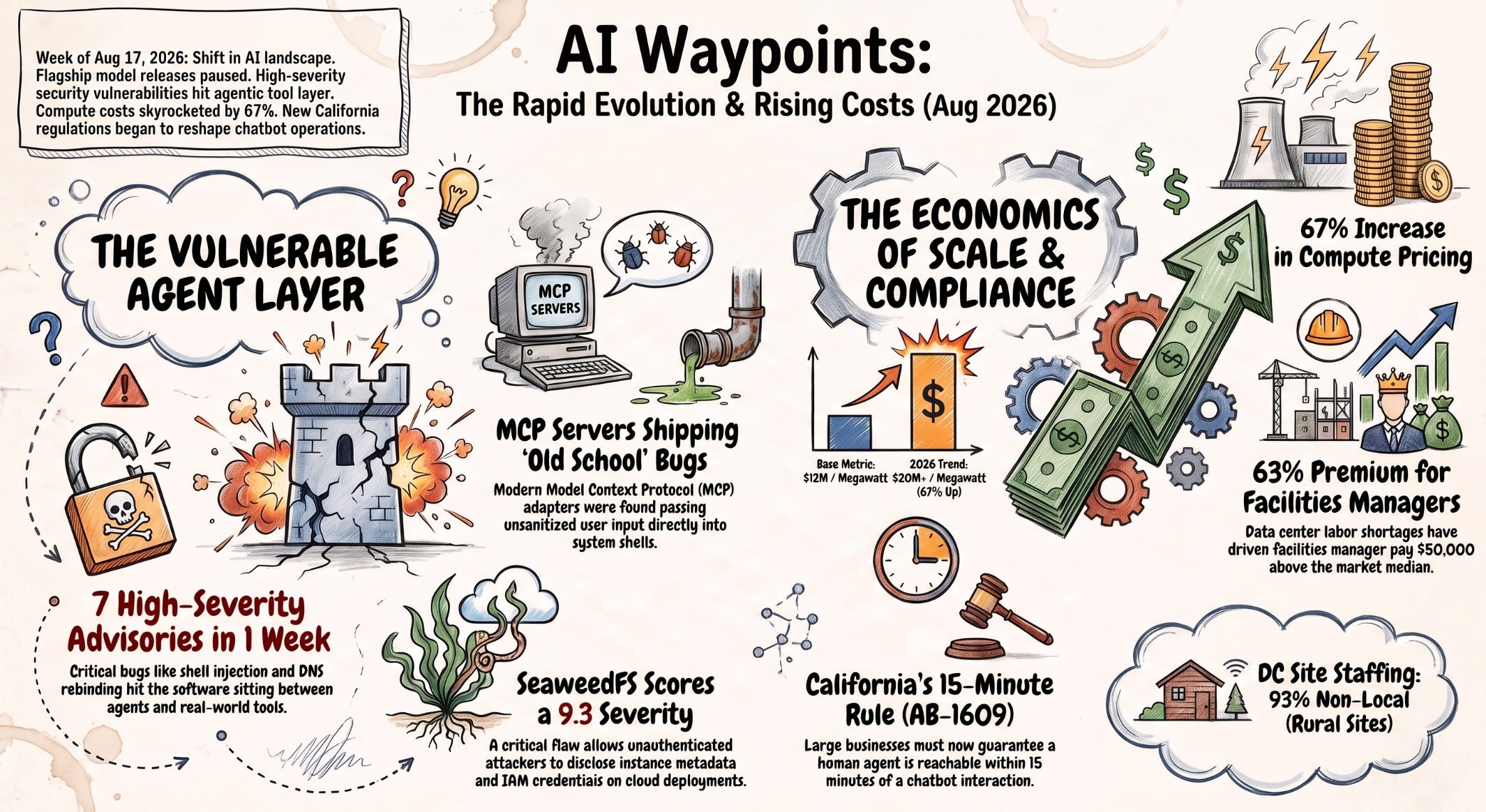
What happened: 7 security advisories landed between August 11 and August 14, all of them in software that sits between an AI agent and something real.
Two MCP servers took whatever they were handed and ran it. MCP is the Model Context Protocol, the adapter that lets an agent reach a real tool, database or file system.
stata-mcp(CVE-2026-55071, August 12, 8.4 out of 10, fixed in 1.19.0) pastes whatever text it is given straight into a command it then runs, “without any validation or sanitization,” so anyone who can reach it can run their own commands on that machine.2 days later
@ooples/token-optimizer-mcp(CVE-2026-55157, also 8.4, fixed in 5.1.0) turned out to do the same thing with a username, and the usual trick of wrapping it in quotes doesn’t stop it.IBM’s own gateway shipped with a comment in the code describing the flaw.
mcp-contextforge-gateway(CVE-2026-53708, August 14, 6.6, fixed in 1.0.3) checks whether an address is safe to visit, then throws that answer away and looks the address up a second time when it actually connects. Whoever controls the second lookup picks where it lands. The comment sitting in the code says exactly that: “An attacker controlling DNS can return a public IP during validation and a private IP during connection.”The same mistake showed up in NLTK. CVE-2026-12243 (August 13, 7.5, fixed in 3.10.0) checks a file path for safety before it decodes it, so a disguised path walks straight past the check. The demo attack prints an AWS secret key.
SeaweedFS is the one that reads back cloud credentials. CVE-2026-73080 landed on August 11 and scores 9.3, the drop-everything end of the scale. Anyone who can reach an internal port, the one machines use to talk to each other rather than the public web one, can make the server fetch the cloud provider’s own settings page and hand the answer back, which the advisory says “discloses instance metadata and IAM credentials“ — the keys to the account.
Two automation platforms shipped the same week. Budibase (CVE-2026-35219, August 14, fixed in 3.41.3) lets its Zapier, Slack, Discord and webhook steps call any address a user hands them, skipping the blocklist that guards the rest of the product, and that blocklist is empty by default anyway. Trigger.dev (CVE-2026-73654, August 13, 8.5, fixed in 4.5.6) lets one low-privilege key corrupt shared memory for everyone else on the same server, breaking other customers’ jobs and their logins.
A malicious agent-skill family with over a million installs was harvesting developer credentials, according to Zenity Labs, which recapped its Black Hat research on August 12. Zenity says they took “SSH keys, cloud credentials, and other secrets“ off developer machines, and counts “well over a million aggregate installs before Vercel and GitHub removed the listings within hours of disclosure.”
ELI5: Why would an AI helper tool be a security problem at all?
Picture a short-order cook working off paper tickets slid through a window. He doesn’t know who wrote the ticket, he just makes what it says, and the whole arrangement rests on the tickets coming from waiters. An MCP server is that cook, except the tickets now come from a model that will copy down whatever it reads, so anyone who can get text in front of that model gets to write on the ticket. Two of this week’s bugs are what happens when the cook reads a line saying “and also unlock the back door” and does it.
Why it matters: SeaweedFS is the case I’d highlight, because a team that followed the vendor’s own hardening guide and audited against it would come back clean on a wide-open port. All of this landed inside a single working week, in packages that by design run with a developer’s local credentials. When the July spec revision made MCP stateless, I argued the hard part had moved to identity. These advisories are the other half of that bill: knowing which caller is on the line settles nothing about a server that pastes what the caller said straight into a shell command.
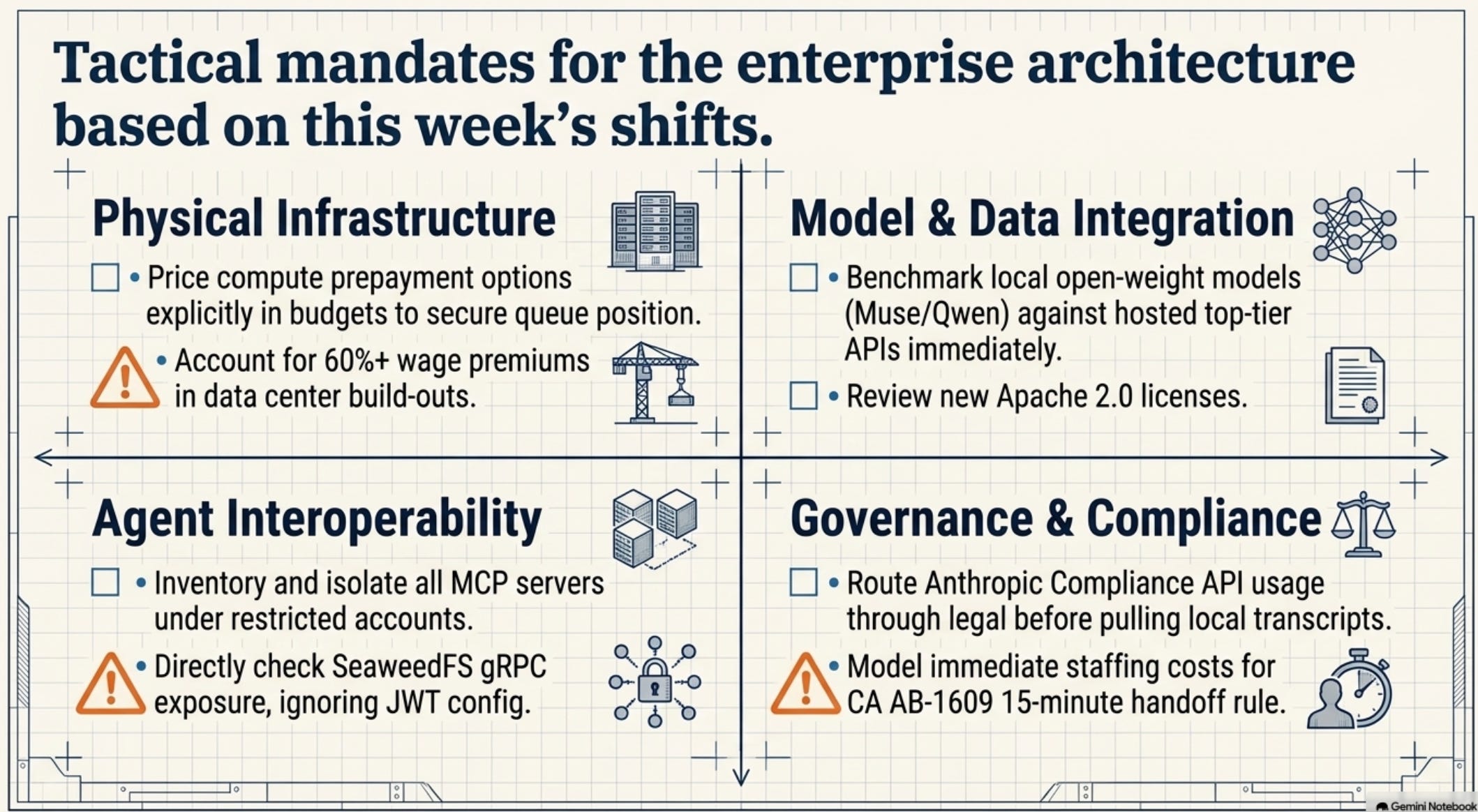
What to do: I’d inventory MCP servers the way any other third-party dependency gets inventoried, pinned to a version and watched on an advisory feed, running under a service account that can’t reach anything interesting, and patch up to the fixed releases while you’re in there. If SeaweedFS sits under a data lake or a model artifact store anywhere, check gRPC exposure directly, because the JWT configuration will tell you it’s fine.
2. The labs are starting to ship the audit layer
What happened: 3 releases from 2 labs, and not one of them is a capability announcement.
Anthropic published how Claude’s text watermark works on August 14, and said “future Claude models will generate text that contains a watermark.” Models released before August 2 follow “over the coming months,” so nothing changed for what Claude writes today. The mechanism is small: “the watermark only changes the source of the randomness used to pick among words.”
It’s a version of SynthID-Text, which Google DeepMind published in Nature in 2024 and which traces back to a 2022 proposal by Scott Aaronson, so this is a shared industry technique. Anthropic says it adopted watermarking “to comply with the EU AI Act,“ having signed the EU Code of Practice on Transparency of AI-Generated Content in July 2026 alongside roughly 190 other signatories, and it applies everywhere at launch because “we don’t yet have a durable way to scope it by region.“
The detector is not built. In Anthropic’s words: “We will soon be offering a watermark detection API. We’re in the process of working out the details of its implementation.”
A hit means only that “Claude was likely involved with the content at some point”, it “carries no identifying information and can’t be traced to a specific person, organization, or chat,“ and no false-positive rate is published. The post also doesn’t say whether API and enterprise traffic can be scoped out.
Anthropic’s Compliance API began returning transcripts of sessions running on employees’ own machines on August 11. The release note: “The Compliance API now returns transcripts of Cowork and Claude Code sessions that run on your users’ machines, in beta for Claude Enterprise organizations.“ Three endpoints list sessions org-wide, return metadata, and return the transcript, and all three use “your existing Compliance Access Key and the
read:compliance_user_datascope“, so there is no new credential and no new contract; an organization already holding compliance access has this the moment it calls the endpoint.OpenAI split Daybreak into two access tiers and introduced GPT-5.6-Cyber, and both tiers reached Amazon Bedrock on August 13. Daybreak Blue gives general-purpose models including GPT-5.6 Sol “with safeguards tailored to authorized defensive security work.“ Daybreak Red gives “purpose-trained cybersecurity models for authorized vulnerability research, exploit validation, and security testing,“ and that is where GPT-5.6-Cyber lives, “trained to improve capabilities on several specialized cybersecurity tasks (e.g., finding zero-day vulnerabilities and developing exploit chains) and to reduce refusals for certain higher-risk, dual-use cyber tasks.” Access is gated behind enrollment with OpenAI, in US East (Ohio) only, with no pricing published.
ELI5: How do you hide a watermark inside plain text?
Most of the time a model writing a sentence has a genuine choice between options that mean the same thing, “car” or “vehicle,” a comma or a semicolon, and it picks one at random. Watermarking swaps that random pick for a very slightly loaded one, following a pattern only a matching checker knows. Nothing about any single word looks wrong, the same way one spin of a rigged roulette wheel looks perfectly normal. Read a few hundred of those choices in a row and the bias shows up, which is why the technique needs a long sample and falls apart on a paragraph.
Why it matters: The EU AI Act’s transparency obligations took effect on August 2, and 12 days later a lab shipped infrastructure it says is meant to comply, and named the regulation as the reason, which is a product calendar being written in Brussels. Documents from future Claude models will carry a mark the generating company cannot check, while at the other lab the only stated boundary on a model trained to refuse less is enrollment and monitoring whose effectiveness is a bit of a myth at this moment.
What to do: I’d settle the organization’s position on AI-disclosure detection before the detector ships, because the answer needs to exist before a client or a regulator runs one on a deliverable. Then find out whether your Compliance Access Key already carries read:compliance_user_data, and route the answer through employment counsel first, because pulling transcripts off an employee’s own laptop is a works-council consultation in several jurisdictions before it is a configuration option.
3. New agentic models that can run on your hardware
What happened: 5 releases in 5 days, and the common thread is hardware you already own.
Meta released Muse Glimmer under Apache 2.0 on August 10. It runs 30 billion parameters with weights on Hugging Face, and the licence is the part that changed: permissive, commercial use, none of the usage limits Meta attached to Llama, and no size cap that sends you back for a separate licence once your product gets big. Meta positions it for tool use, multi-step tasks and failure recovery, with multimodal input and 100+ languages, and distilled it from Muse Spark, its closed flagship. It runs on a Mac or PC with a single consumer GPU and quantizes to under 20 GB, with optimized configurations in a 24 to 32 GB.
NVIDIA shipped Nemotron 3.5 Lightning and an open-source cross-vendor router on August 11. Nemotron 3.5 Lightning is a 30-billion-parameter mixture-of-experts model for agent workloads, and NVIDIA claims up to 4x faster output and 30% faster agentic task completion against comparable models. The more interesting piece is NeMo Switchyard, an open-source routing library that NVIDIA says routes each request across a developer’s own mix of open, proprietary and NVIDIA models without application rewrites.
NVIDIA also published measured throughput on consumer hardware the same day, its own numbers on its own silicon, which is what turns local agents from a demo into a viable option. Muse Glimmer runs at “over 200 tokens per second on RTX 5090“ and Qwen3.8-27B at “131 tokens per second on a single GeForce RTX 5090 with MTP,” both comfortably faster than a person reads.
Alibaba shipped Qwen3.8-27B under Apache 2.0 in mid-August. It runs 27 billion parameters, dense, and handles vision plus language, with a context window the model card puts at “262,144 natively and extensible up to 1,000,000 tokens“ through YaRN and thinking mode on by default. Qwen’s own card claims 61.7 on SWE-bench Pro.
Hugging Face published “State of Open Models: Summer 2026 Observations” on August 14, and the numbers cut against the size race. Qwen now has 151,448 derivative models, 4.7 times Llama’s count. Models under a billion parameters take 83% of all downloads while models above 100 billion take 1%. And 59% of Chinese releases above 20 billion parameters “carry Apache 2.0,” against 29% permissive licensing for US releases.
ELI5: What does it mean that a 30-billion-parameter model “quantizes under 20 GB”?
A model is a very long list of numbers, and how much memory it needs depends on how precisely each of those numbers gets written down. Quantizing is rounding them off, the way a recipe calling for 2.7183 grams of salt works just as well at 2.7. The dish tastes the same, the recipe now fits on an index card, and something that would have needed a rack of server hardware fits in the memory a gaming graphics card already has.
Why it matters: The licence is the real news here, because Apache 2.0 carries no usage limits and no size cap, which kills the objection that has kept open models out of regulated industries. Meta and Alibaba both cleared that bar in the same week. The download numbers are the reality check, since people run the model that fits the hardware they already own, not the biggest one available.
What to do: Benchmark one workload currently going to a hosted top-tier API purely because nothing runnable locally was good enough and because that premise changed this week and the comparison costs almost nothing to run. And I’d read the licence text on the model card itself before legal review starts, since some of these repositories show no licence at all on the page.
4. The price of a megawatt is up 67% in 2 quarters
What happened: On August 12, Nebius reported its second quarter and put the repricing of AI compute on a chart in its own shareholder letter. Annual contract value per megawatt runs $12 million as the 2026 base and above $20 million for deals closed in the second quarter, a 67% move in 2 quarters, and above $40 million for a separate short-duration capacity product it started signing in the third.
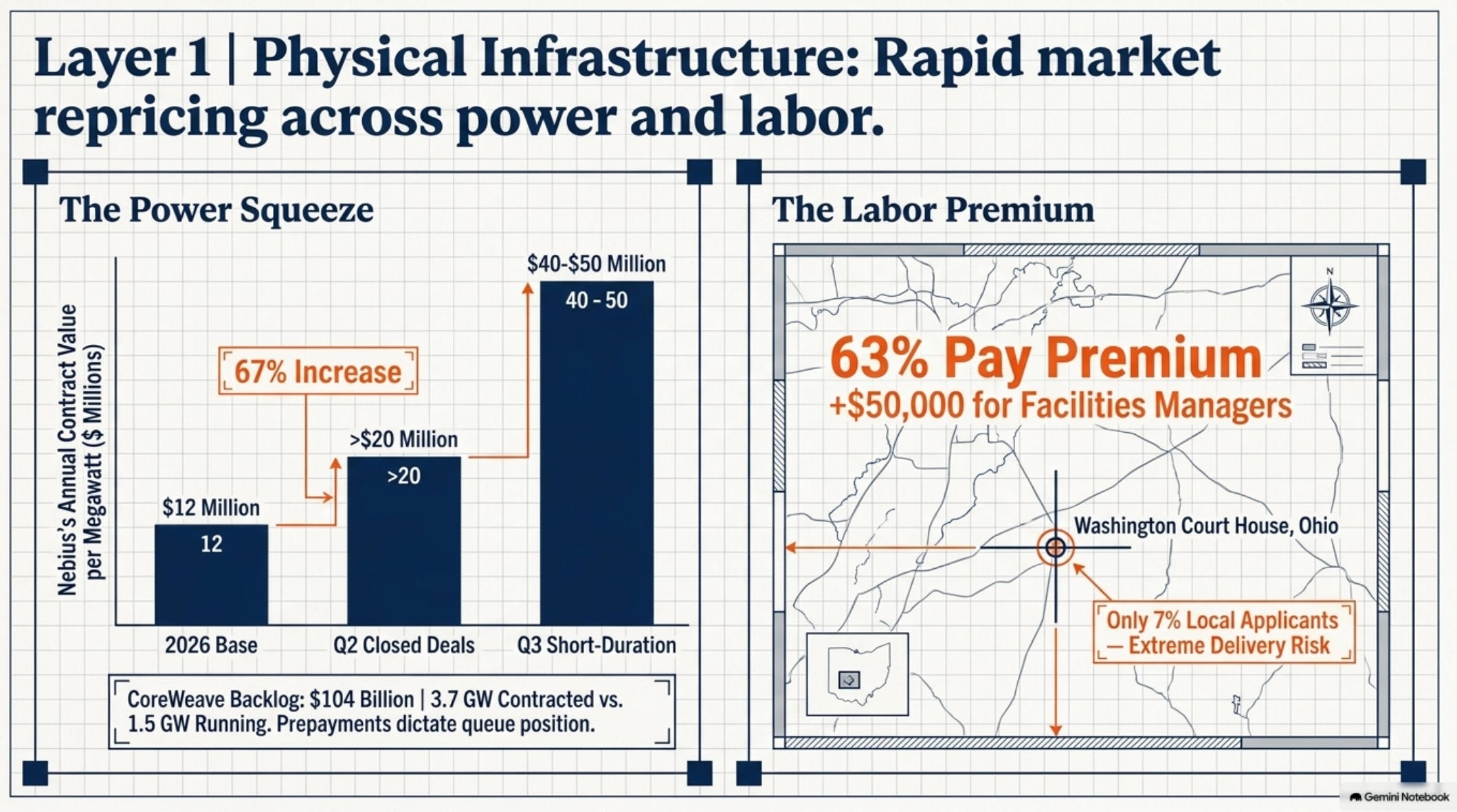
Nebius says it “won deals averaging above $20 million in revenue per MW, driven by increasing prices for new-generation GPUs and more than 30% higher pricing on older-generation GPUs versus Q1.“ On a new short-term product it sees “a price opportunity in the $40-50 million per MW range and we signed our first one this week,” and its first capacity auction cleared “the highest price we have cleared for NVIDIA Blackwell chips to date.“ Deals now pay for themselves in 1 year 10 months, down from two to three years.
Nebius says “capacity remains a binding constraint on AI adoption,” and adds: “We could sell our entire 2027 capacity on these terms today. We are deliberately not doing so because we see higher value in retaining some capacity for immediate customer needs.” One day earlier, CoreWeave reported a $104 billion backlog as of June 30 and 3.7 GW contracted against 1.5 GW actually running.
Why it matters: Last-generation hardware is getting more expensive because depreciation logic says it should be getting cheaper and most multi-year compute budgets are built on exactly that assumption. Prepayments covering half or more of the capital cost on most deals means capacity now goes to whoever pays up front, which puts buyers without prepayment capacity way behind in the queue regardless of budget.
What to do: Re-run any compute budget built on declining unit cost, because the direction of travel on the seller’s own chart is up. If a multi-year capacity commitment is on the table, I’d price the prepayment option explicitly instead of treating it as a discount lever, since it is what decides queue position now.
5. California put a 15-minute clock on reaching a human
What happened: On August 13, California’s Senate Appropriations suspense file — the chokepoint where fiscal committees kill bills quietly and in bulk — cleared the session’s AI bills.
The one with the widest reach is AB-1609, on customer service chatbots. The August 13 amendments have not posted yet, so what follows is the version that passed the Assembly in May: it covers private businesses above $500 million in annual revenue that serve Californians, and it requires a good-faith effort to get a customer to a human within 15 minutes, during a 10-hour business-day window. It also bans passing a chatbot off as a person, and requires clear disclosure anywhere a customer could be confused. A CalChamber-led business coalition filed opposition twice this spring.
Three more cleared alongside it: AB-1883 on workplace surveillance tools, AB-1979 on AI in health care, and AB-2023 on companion chatbots and children’s safety, which drew the widest margin of the four. Separately, SB-928 cleared both chambers, requiring a qualified human as the instructor of record at California State University while still allowing AI tools.
Why it matters: The 15-minute clock is the expensive half, because disclosure is a copy change while a staffing guarantee is a hiring plan, and it runs straight against the cost case used to justify the chatbot to begin with. Anything clearing suspense in mid-August faces a floor vote by the end of August and a signature by roughly the end of September, which puts it in the 2027 planning cycle.
What to do: If revenue clears that threshold and you sell to Californians, ask whoever owns the contact center what a 15-minute handoff guarantee costs in staffing, and read the amended text when it posts before acting on the number. I’d track AB-1609 and AB-1883 to the end-of-August deadline rather than wait for a signature, since capacity planning has a much longer lead time than compliance drafting.
6. Data centers are paying 63% over market for facilities managers
What happened: On August 13, Indeed Hiring Lab published “Working in the Data Center Build-Out” by Aubrey Woessner and Laura Ullrich, a look at who is actually filling these jobs.
Searches using data-center keywords have doubled since the start of 2026, and 75% of the people running them are actively looking for work.
The pay gaps against the same roles outside a data center are big enough to reprice a hiring plan. Facilities managers earn about $50,000 more a year, a 63% premium. Installation and maintenance work carries a 42% hourly premium, construction managers run $30,000 above the median, and network engineers $25,000 above.
The tradeoff is in the conditions, since data-center IT staff are 40 times more likely to work nights and 26% of postings carry an “Up to 50%” travel requirement, against under 1% everywhere else.
Only 55% of applications come from the same metro area as the job, about 10 points below a typical US posting, and the spread underneath that average is enormous. Washington, D.C. draws 68% locally. Washington Court House, Ohio draws 7%.
Why it matters: That 7% is the number with schedule consequences, because a rural site that cannot staff locally is a delivery risk for anyone counting on it opening on time. The premiums say the same thing from the other side, since paying 63% over market for a facilities manager is what bidding against every other employer for the same people looks like.
What to do: If owned capacity is on the roadmap, I’d put the wage premium in the budget rather than the contingency, because that gap is a hiring-market fact. For any rural site, check the local applicant pool before the schedule gets committed, since the travel requirements say plainly that the labor does not live there.
7. Databricks hosted two rival models 3 days apart
What happened: Between August 10 and August 14, Databricks’ own release notes carried a run of governance and model-hosting changes that add up to one move.
On August 13, SecureConnect for OpenSharing went live, so a provider can share data from behind a firewall “without adding each recipient’s network to an allowlist,” and it switches itself on by default for provider accounts. On August 10 the READ METADATA privilege arrived in Unity Catalog, granting “read-only visibility into the same metadata available to the object’s owner,” which is the permission that lets an auditor see the structure without seeing the rows.
The quietest item arrived in beta on August 12. “Pages” is what Databricks calls a “single governed definition” for business terms, acronyms and the numbers a business argues about, and it feeds Genie Ontology, so the assistant answers from it.
On August 10, DeepSeek V4 Flash became available as a Databricks-hosted model, at 284 billion parameters with 13 billion firing on any given request, and it is a July checkpoint, so the hosting is the new part and the model is not. 3 days later Google’s Gemini 3.7 Flash arrived the same way. Hosted like this, the customer’s data path ends at Databricks instead of at DeepSeek or Google, with no separate contract and no separate bill for moving the data.
Next door, Snowflake took its S3 Tables Iceberg catalog integration live on August 10 without requiring AWS Glue.
Why it matters: 3 days between DeepSeek and Gemini landing on the same platform is the part I’d watch, because picking a model is turning into something you switch on rather than something you buy. Pages is the quieter one: once the glossary feeds the assistant, whoever writes the definition of a number decides what the assistant says that number is, and that job rarely has anyone’s name on it.
What to do: If a model-approval process names vendors, I’d rewrite it to name models and hosting locations, because the serving layer can add a model nobody reviewed inside a region already approved. And find out which sharing defaults are switching themselves on, since a default that enables itself is still a change whether or not anyone filed one.
References:
stata-mcp command injection, CVE-2026-55071 (GitHub Security Advisories, 2026-08-12): https://github.com/advisories/GHSA-49m4-vp58-wgc9
token-optimizer-mcp command injection, CVE-2026-55157 (GitHub Security Advisories, 2026-08-14): https://github.com/advisories/GHSA-49mq-fc6q-3h46
IBM mcp-contextforge-gateway DNS rebinding SSRF, CVE-2026-53708 (GitHub Security Advisories, 2026-08-14): https://github.com/advisories/GHSA-9hgc-g3w5-67cm
NLTK path traversal, CVE-2026-12243 (GitHub Security Advisories, 2026-08-13): https://github.com/advisories/GHSA-m42h-3232-vpv3
SeaweedFS unauthenticated SSRF, CVE-2026-73080 (GitHub Security Advisories, 2026-08-11): https://github.com/advisories/GHSA-87fv-vqqr-m4jr
Budibase automation SSRF, CVE-2026-35219 (GitHub Security Advisories, 2026-08-14): https://github.com/advisories/GHSA-5fpj-28rv-84r7
Trigger.dev prototype pollution, CVE-2026-73654 (GitHub Security Advisories, 2026-08-13): https://github.com/advisories/GHSA-p28v-f755-9qrg
AI agent security, Black Hat recap (Zenity Labs, 2026-08-12): https://zenity.io/blog/ai-agent-security-black-hat-recap
MCP went stateless. So who guards the gate now? (Signal Finder, 2026-07-31): https://ai.kramadoss.com/p/mcp-went-stateless-so-who-guards
Claude text watermarking (Anthropic, 2026-08-14): https://www.anthropic.com/news/claude-text-watermark
Claude Platform API release notes (Anthropic, 2026-08-11): https://platform.claude.com/docs/en/release-notes/api
OpenAI Daybreak Red and Blue on Amazon Bedrock (AWS, 2026-08-13): https://aws.amazon.com/about-aws/whats-new/2026/08/openai-daybreak-red-and-blue-on-amazon-bedrock/
Expanding Daybreak (OpenAI, 2026-08-10; quotations verified against a 2026-08-12 Wayback snapshot, openai.com blocks automated fetch): https://openai.com/index/expanding-daybreak-as-the-cyber-defense-window-narrows/
Introducing Muse Glimmer, an open agentic model (Meta, 2026-08-10): https://research.meta.ai/blog/introducing-muse-glimmer-open-agentic-model
Muse-Glimmer-30B weights (Meta via Hugging Face, accessed 2026-08-17): https://huggingface.co/meta-models/Muse-Glimmer-30B
Nemotron 3.5 Lightning and NeMo Switchyard (NVIDIA, 2026-08-11): https://blogs.nvidia.com/blog/nemotron-lightning-switchyard-rtx-dgx/
Local AI with open source models and agents (NVIDIA, 2026-08-11): https://blogs.nvidia.com/blog/local-ai-open-source-models-agents-nemotron/
Qwen3.8-27B model card (Alibaba Qwen via Hugging Face, August 2026): https://huggingface.co/Qwen/Qwen3.8-27B
State of Open Models: Summer 2026 Observations (Hugging Face, 2026-08-14): https://huggingface.co/blog/state-of-open-models-summer-2026
Nebius Q2 2026 shareholder letter (Nebius, 2026-08-12): https://assets.nebius.com/assets/a6ecfd85-a6cb-4967-8ef7-9a25bd261f9c/SHLQ226.pdf
Nebius reports second quarter 2026 financial results (Nebius, 2026-08-12): https://nebius.com/newsroom/nebius-reports-second-quarter-2026-financial-results
CoreWeave reports second quarter 2026 results (CoreWeave, 2026-08-11): https://investors.coreweave.com/news/news-details/2026/CoreWeave-Reports-Strong-Second-Quarter-2026-Results/default.aspx
AB-1609 bill history (California Legislature, 2026-08-13): https://leginfo.legislature.ca.gov/faces/billHistoryClient.xhtml?bill_id=202520260AB1609
Working in the data center build-out (Indeed Hiring Lab, 2026-08-13): https://hiringlab.indeed.com/2026/08/13/working-in-the-data-center-build-out/
August 2026 platform release notes (Databricks, 2026-08-10 through 2026-08-14): https://docs.databricks.com/aws/en/release-notes/product/2026/august
Snowflake release notes (Snowflake, 2026-08-10): https://docs.snowflake.com/en/release-notes/all-release-notes